The SFFaudio Podcast #036

Podcast

The SFFaudio PodcastThe SFFaudio Podcast #036 – Jesse and Scott are joined by Julie of Forgotten Classics to talk with Allan Kaster, the editor of Infinivox’s new audiobook anthology: The Year’s Top Ten Tales Of Science Fiction! We discuss this terrific audiobook, in depth, as well as a few other new releases and recent arrivals.

Talked about on today’s show:
Infinivox (an imprint of Audiotext), biology, study guides, chemistry, Great Science Fiction Stories, Bioware (from medical software to video games), Mass Effect, The Year’s Top Ten Tales Of Science Fiction, A Walk In The Sun by Geoffrey A. Landis |READ OUR REVIEW|, Guest Of Honor by Robert Reed, The Shobies’ Story by Ursula K. Le Guin, Hollywood Kremlin by Bruce Sterling, immortality, Hard SF, Robert Reed, vampires are rather liberal (for being immortal), Five Thrillers by Robert Reed, sociopathy, Ted Chiang, StarShipSofa’s (#88) interview with Ted Chiang, Exhalation by Ted Chiang, consciousness, souls, religion, transcendence, Ray Gun: A Love Story by James Alan Gardner, meta-science fictional stories, “ray guns and spaceships”, Adrift by Scott D. Danielson, World Of The Ptavvs by Larry Niven, Star Trek Animated Series (The Slaver Weapon), “The Soft Weapon” by Larry Niven, romance, Galileo’s Children: Tales of Science vs. Superstition edited by Gardner Dozois, The Dream Of Reason by Jeffrey Ford, The Empire Of Ice Cream by Jeffrey Ford, The Dreaming Wind by Jeffrey Ford (on StarShipSofa AD #75), sense of wonder, 26 Monkeys, Also The Abyss by Kij Johnson, Fantasy vs. Science Fiction, Mini-Masterpieces Of Science Fiction, The Gambler by Paolo Bacigalupi, Fast Forward 2, Fencon 2009 (Dallas, TX), Aliens Rule edited by Alan Kaster, How Music Begins by James Van Pelt, Carolyn Ives Gilman, Laws Of Survival by Nancy Kress, City Of The Dead by Paul McAuley, Shoggoths In Bloom by Elizabeth Bear, H.P. Lovecraft, lovecraftian homage, we need an audio collection of stories inspired by H.P. Lovecraft, frontier, space western, archaeology, aliens, Ray Bradbury, Mrs. Carstairs And The Merman by Delia Sherman, Dercum Audio, 1930s, 19th century, sea creatures, squids, Greg Egan, Peter Watts, The Art of Alchemy by Ted Kosmatka, industrial espionage, The N Word by Ted Kosmatka, Seeds Of Change edited by John Joseph Adams, future releases from Infinivox, Infinivox on Audible.com, Mike Resnick’s Kirinyaga cycle, Guest Law by John C. Wright, Beggars In Spain by Nancy Kress, physics, pirates, Pirates Of The Caribbean: On Stranger Tides, On Stranger Tides by Tim Powers, Charles Stross, Antibodies, Lobsters, A Colder War, The Chief Designer by Andy Duncan |READ OUR REVIEW|, Michael Swanwick, The Edge Of The World by Michael Swanwick, The Griffin’s Egg by Michael Swanwick, the state of the magazine industry, Fast Forward 2, Sidewise In Time, Eclipse 2, Extraordinary Engines, Penguin Audio, Level 26: Dark Origins by Anthony E. Zuiker and Duane Swierczynski, Brilliance Audio, The Beastmaster by Andre Norton, Richard J. Brewer, Audible Frontiers, The Short Victorious War by David Weber, The Rise Of Endymion by Dan Simmons, caterbury tales in space, Luke Burrage’s SFBRP on the Hyperion series, Kick-Ass Mystic Ninjas on Simmons’ Hyperion series, Ilium by Dan Simmons, The Terror by Dan Simmons, novella length stories, Escape Route by Peter F. Hamilton, a recent interview with Audible’s founder, The Law Of Nines by Terry Goodkind, Mark Deakins, Rammer by Larry Niven, narrator Pat Bottino, the MP3-CD format vs the CD format, The Martian Chronicles by Ray Bradbury, Gateway by Frederik Pohl, Robert J. Sawyer, Man Plus by Frederik Pohl

Posted by Jesse Willis

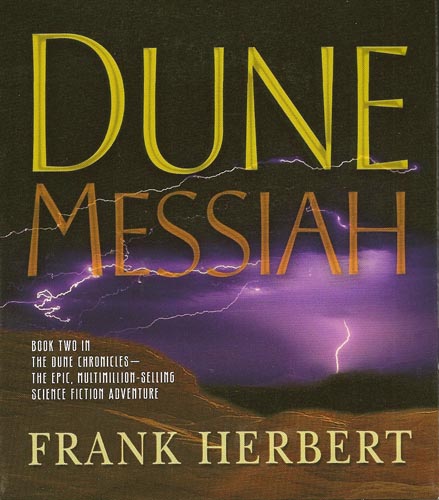
Review of Dune, Messiah by Frank Herbert

SFFaudio Review

Dune Messiah by Frank HerbertDune, Messiah
By Frank Herbert, Read by Scott Brick, Katherine Kellgren, Euan Morton, and Simon Vance
9 hours – [UNABRIDGED]
Publisher: Macmillan Audio
Published: 2007
Themes: / Science Fiction / ESP / Religion / War / Charismatic Leader /

Its 12 years after the triumph of Paul Atriedes on Arrakis, as presented in Dune. But “happily ever after” wasn’t the kind of book that Frank Herbert was interested in writing. Nor was a “Dune Part II” in which Paul would be presented with another challenge, maybe greater than the first, which he would conquer – with much rejoicing. (Yayyyyy!) Instead, Frank Herbert gave us something (here it comes) completely different.

Dune, Messiah opens with a discussion between members of the Spacing Guild, the Bene Gesserit, the Bene Tleiaxu, and the Princess Irulan about how to bring about the fall of the Emperor Paul, making it immediately apparent that things are not going well for Paul. The known universe has not fared well under his rule. The religious fervor around Paul has increased over time, with people, acting in Paul’s name, performing atrocities on various planets. The Fremen way of life has been completely devastated by the changes brought about by Paul’s government. Paul’s ability to see the future has become something of a burden. He’s often acting in ways to fulfill his role rather than of his own volition. He acts to fulfill fate rather than to fight against it.

It’s not hardly the stuff of heroic literature, like Dune was. Instead, it’s decidedly anti-heroic, which is precisely what Frank Herbert was aiming for. He was writing a book in which his hero makes mistakes in order to illustrate the danger presented by a charismatic leader. From Dreamer of Dune, a biography of Frank Herbert written by his son, Brian:

Among the dangerous leaders of human history, my father sometimes mentioned General George S. Patton, because of his charismatic qualities — but more often his example was President John F. Kennedy. Around Kennedy a myth of kingship formed, and of Camelot. His followers did not question him, and would have gone with him virtually anywhere.

To Frank Herbert, this kind of thing was extremely dangerous. This is an especially interesting counter-viewpoint here in 2009, where the United States has another very charismatic leader. One can’t help but to wonder what Herbert would have to say today.

So Dune can be considered to be the rise of Paul Atreides, and Dune, Messiah could be considered the fall. There’s no question that Dune, Messiah is not the masterpiece that Dune is, but it’s still very interesting. Besides the continued exploration of science fiction ideas like the ghola (Duncan Idaho returns as a ghola in this book – a reanimated man that is Duncan Idaho, but is he really?), the overall exploration of an anti-hero is something that is rare enough in science fiction to make it an refreshing read. Children of Dune, the next book, was definitely on Herbert’s mind as he wrote this one, so it’s difficult to present any kind of final judgment until I read that one. Perhaps the fact that I’m interested enough to continue is judgment enough.

Macmillan Audio’s presentation of the book was excellent. There are multiple narrators, each reading sections of the book. All the narrators are top-notch, so I was very pleased with it.

I found some of the history of Dune, Messiah‘s publication to be interesting as well. John W. Campbell couldn’t wait to serialize Dune in Analog magazine, and did so. But when Dune, Messiah came around, he was disappointed enough in the direction of the story that he wouldn’t buy it for his magazine, despite the popularity of Dune. Galaxy Magazine ended up serializing it.

In Road to Dune, Brian Herbert and Kevin J. Anderson quote a letter from John W. Campbell about Dune, Messiah:

The reactions of science-fictioneers, however, over the last few decades have persistently and quite explicitly been that they want heroes – not anti-heroes. They want stories of strong men who exert themselves, inspire others, and make a monkeys uncle out of malign fates!

Perhaps that’s so, but I enjoyed the book very much, partly because it was different.

Posted by Scott D. Danielson
Review of By Heresies Distressed by David Weber

SFFaudio Review

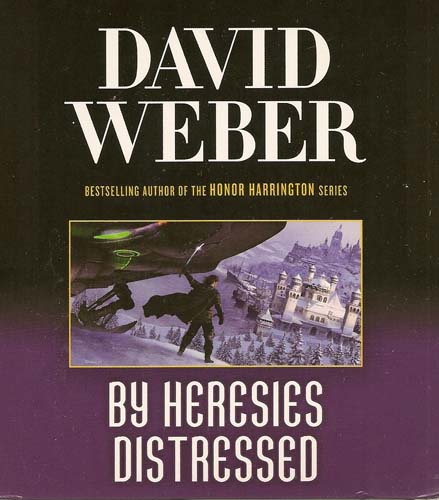
Science Fiction Audiobooks - By Heresies Distressed by David WeberBy Heresies Distressed
By David Weber; Read by Jason Culp
Approx. 25 Hours [UNABRIDGED]
Publisher: Macmillan Audio
Published: 2009
ISBN: 9781427206794 (CD)
Themes: / Science Fiction / Empires / Religion / War /

The Empire of Charis has been founded out of the marriage between King Cayleb of Charis and Queen Sharleyan of Chisholm, and further expanded by the annexation of Charis’ enemy Emerald. Now Cayleb and Merlin go on the offensive. Sharleyan stays behind to construct the new government out of the former Kingdoms, while Cayleb leads their Navy and tens of thousands of Charisian Marines against the League of Corisande and Prince Hektor. Hektor was the willing puppet of the Church of God Awaiting when he led an armada from several of Safehold’s nations against Charis. That armada was defeated with the aid of the technologies introduced by Merlin, but not before Cayleb’s father, King Haarahld, was killed.

Retribution is also dealt against the Kingdom of Delferahk, greatly offending the Church in the process when the priests responsible for the massacre are called to account. Merlin’s SNARCs, autonomous flying, invisible spy cameras, continue to provide a massive tactical advantage and help to solidify Cayleb’s reputation as a master tactician especially as the battle moves onto land. Some of the advances hinted at in the previous books are seen in action and their effects, amounting to almost two centuries of advancement in our history, are somewhat predictable. Unfortunately, the SNARCs can’t be everywhere, and Merlin and his A.I., Owl, can’t review everything that they record. The Church loyalists manage to slip past Merlin’s security, and target Empress Sharleyan in an attempt to break the new Empire.

Being the third book in the series, Weber brings the anticipated final conflict with Mother Church several steps closer. There is less focus on the new technologies being introduced in this book than in those that proceed it. The tactics and politics assume much more the focus. The land battles are clearly drawn, and the narrator, Jason Culp, keeps the back and forth between the combatants clear.

There are a noticeable number of lengthy monologues, in some cases in the middle of what was a normal conversation. They could have been more concise, however Jason delivers them well. He brings all of the many characters to life with ease, from the lowest soldier in the middle of a battle to the nobility and the priesthood.

Merlin is a magical character to the inhabitants of Safehold, but of Arthur C. Clarke’s variety: sufficiently advanced technology. Although that technology plays an important part in the events, it doesn’t really intrude. Merlin’s visions are provided by his SNARCs and the explanation of, what amounts to a mobile phone, in one scene is as intrusive as it gets. Weber’s Safehold series should appeal to fans of alternate history as well as fantasy and Science Fiction.

Posted by Paul [W] Campbell

Review of The Three Stigmata Of Palmer Eldritch by Philip K. Dick

SFFaudio Review

The Three Stigmata of Palmer Eldritch by Philip K. DickThe Three Stigmata of Palmer Eldritch
By Philip K. Dick; Read by Tom Weiner
6 CDs – 6.8 Hours [UNABRIDGED]
Publisher: Blackstone Audio
Published: 2008
ISBN: 9781433248221
Themes: / Science Fiction / Religion / Drugs / Mars / Aliens /

Not too long from now, when exiles from a blistering Earth huddle miserably in Martian colonies, the only things that make life bearable are the drugs. Can-D “translates” those who take it into the bodies of Barbie-like dolls. Now there’s competition: a substance called Chew-Z, marketed under the slogan “God promises eternal life. We can deliver it.” The question is: What kind of eternity? And who—or what—is the deliverer?

Reading Philip K. Dick is the literary equivalent of taking deliriants in church. Dick’s world is fully realized, his characters being windows into Dick’s own sympathies, his own passions. Dick seems to have observed the writing advice that goes: “Write what you know.” What Dick knows about is drugs, suburban druggie life, revealed religion, the conflict between an individual and the group, between women and men. If you look at the basic plot The Three Stigmata Of Palmer Eldritch scans as most similar to Alfred Bester’s The Demolished Man, in that a corporate war between the solar system’s two biggest multi-planetaries drives the action. But it doesn’t feel that way, it feels like a scaled-up version of Dick’s short story Wargame. Sure, the novel is supposed to be about life on Mars and big corporate business, but Dick’s Mars is mostly confined to a few intemperate draftees who couldn’t fake their way out of the draft. Upset with their new colonial life they spend all their time playing with Barbie style playhouses and taking mind altering drugs. I can almost picture Dick sitting in his living room watching his young daughters playing with their Barbie dolls. They sit on the floor, coveting their Barbie corvettes, their Barbie clothes and decorating their Barbie dream houses while Dick, sitting in an armchair above, looks down compassionately and philosophicaly as he reaches for the typewriter. Strangely, the novel also feels extremely prescient. At multiple times throughout I paused and thought about the PC game called The Sims – a game where your avatar must eat, sleep, and furnish her virtual home with virtual goods as you plan her idealized life. We seem to have gotten what Dick was driving at. For what is World Of Warcraft if not a Dickian reality minus the drugs? William Gibson would describe it as “a consensual hallucination” – Dick called it The Three Stigmata Of Palmer Eldritch.

Originally published in 1965, this is the first commercial audiobook release of The Three Stigmata Of Palmer Eldritch. Narrator Tom Weiner seems to be Blackstone Audio’s go-to guy when it comes to narrating the heavy hitters of Science Fiction. This is a good thing as Weiner brings a vast gravitas to his reading. Fans of George Guidall’s narrations will find Weiner similarly impactful. The cover art for The Three Stigmata Of Palmer Eldritch is all original for this production. This is more and more the case at Blackstone, which makes me happy, for I am covetous.

Posted by Jesse Willis

Lecture – Necronomicons: The Scariest Book in the World

SFFaudio Online Audio

Yog RadioNecronomicons: The Scariest Book in the World
By Dan Harms
1 |MP3| – Approx. 79 Minutes [LECTURE]
Provider: Yog-Sothoth.com
Recorded: May 28th, 2009
The Necronomicon was once the most famous book that never existed – until a few decades ago, when the first copies appeared on the market. From Lovecraft to Grant to… well, you name it! This is the story of their non-existence, their existence, and their secret stories. Dan Harms reveals the history of these books, their relevance in the broader current of the grimoire tradition, and their impact upon magical practice. Recorded at Treadwell’s bookshop, London.

Posted by Jesse Willis

Review of Elantris, Part 1 by Brandon Sanderson

SFFaudio Review

We are so pleased to post this review by Susan Dunman, aka AudiobookDJ. You can find her at her wonderful AudiobookDJ blog, or over at SF Site talking audio. Thanks Susan!

Fantasy Audiobook - Elantris Part 1 by Brandon SandersonElantris, Part 1
By Brandon Sanderson; Performed by a Full Cast
Adaptation by Johann Dettweiler
6 CDs – 7 hours – [AUDIO DRAMA]
Publisher: Graphic Audio
Published: 2009
ISBN: 9781599505558
Themes: / Fantasy / Audio Drama / Religion / Romance / Leadership / Magic /

Elantris was once the city where all men dreamed of living. Full of magic and marvels, its citizens were godlike in their appearance and had superhuman abilities. But now, Elantris is a place for the damned, offering only misery and despair for those unfortunate enough to be locked inside the walled city.

For something is terribly wrong with the Dor, a mysterious force that randomly and instantaneously changes individuals from mortals to immortals. Now that change, called the shaod, transforms people, not into gods, but into grey-skinned, hairless creatures whose bodies cannot heal from wounds or illness. However, those same pain-racked bodies cannot die and are banished to the crumbling city of Elantris, away from the “normal” population of Arelon.

The Crown Prince of Arelon awakens one morning to find his skin covered in the black splotches that are the first signs of the shaod’s transforming power. That same day his father orders the priests to perform a funeral service and send Prince Raoden to Elantris – a fate that befalls all who are considered “dead” after their transformation because they cease to have a heart-beat and do not need food or water to survive.

This turn-of-events is not only disastrous for Prince Raoden, but also for his fiancee, Princess Sarene. She has just arrived from a neighboring country to meet her soon-to-be husband for the first time. Serene is only told that the prince is dead – not that he has been condemned to Elantris. But the suspicious Serene decides to remain in Arelon despite her betrothed’s death, vowing to uncover the truth about Prince Raoden’s untimely demise.

This sets the stage for listeners to experience a remarkable story – made even more enticing by this audio adaptation. With a full compliment of narrators (28 to be exact), sound effects and background music, listeners can hear a three-dimensional production of Sanderson’s work – it’s like wearing 3-D glasses for your ears. To do justice to the book, this adaptation is produced in three parts, each approximately seven hours long.

I know some audiobook fans prefer single voice narration, but if you do enjoy audio drama, or have never tried it, then you should listen to a Graphic Audio production. The sound effects can be powerful,
but only rarely do they invade the narrator’s sound space. In addition, the background music really sets the tone for the various scenes. And if you listen closely, you might find surprises. For example, in one ballroom scene, the music playing softly in the background is The Blue Danube Waltz, making me wonder if Johann Strauss, Jr. had done some kind of universe/time shift maneuver to get his music played in Arelon.

Elantris was Sanderson’s first published work, coming out in April of 2005. He explores themes of love, politics, religion, and eternity in intriguing and imaginative ways. This audio production compliments his work in a very satisfying way and I’m looking forward to hearing part two!

Note: For those who do prefer single-voice narration, Recorded Books offers an unabridged narration by Jack Garrett.

Posted by Susan Dunman