SFPRP: Smoke by Donald E. Westlake and more invisible men

SFFaudio Online Audio

Luke Burrage, in the second of two consecutive shows with me as a guest on Science Fiction Book Review Podcast, is talking about Smoke by Donald E. Westlake and other stories about invisibility. We thoughrouly examine the invsiblity meme, discuss its strengths and weaknesses and chat about possible upcoming topics of conversation!

The Science Fiction Book Review Podcast SFBRP #079 – Smoke and more invisible men
1 |MP3| – Approx. 58 Minutes [UNABRIDGED]
Podcaster: SFBRP.com
Podcast: Monday, January 18, 2010

Here’s what we talked about:
Luke’s The Invisible Man podcast (SFBRP#78), The Invisible Man by H.G. Wells, Donald E. Westlake’s Smoke, invisibility, Freddie Urban Noon, crime, Smoke is an invisible man story done right, Memoirs Of An Invisible Man by H.F. Saint, Memoirs Of An Invisible Man (the 1992 film), invisibility in Fantasy (J.R.R. Tolkien’s The Lord Of The Rings), invisibility in Science Fiction (The Invisible Man by H.G. Wells), invisibility in a comic crime story, what are the problems with being an invisible thief?, humor, New York, Richard Stark, hard boiled crime, 5 Writing Lessons Learned from Donald Westlake, “When the phone rang Parker was in the garage killing a man.”, The Writing Excuses Podcast, Luke’s review of Makers by Cory Doctorow (SFBRP #74), big tobacco, Westlake’s way of telling a story “he went into the unspeakable kitchen.”, Westlake is a masterful writer of sentences, Peg Briscoe (Freddie’s girlfriend) is a competent confederate, how do you steal things when you’re invisible? (people will see the stolen goods floating down the street!), how do you sell stolen goods when you’re invisible? (you’ll need a confederate), invisibility is a small but well known meme, comparing the memes of invisibility and time travel, nailing small coffins and flogging tiny horses, The Man With The Getaway Face by Richard Stark, the Stark novels are faced paced and utterly absorbing, the differences between Stark novels and Westlake novels, The Hunter by Richard Stark, Payback (the 1999 film), more invisible men, Hollow Man (the 2000 film), Sony used a fake reviewer to shill its movies, unlikeable characters in novels vs. film, the concept of invisibility is a human concept and not a worldly phenomenon (and what that does to our perception of possibility), negating a phenomenon doesn’t create a new phenomenon, invisibility in The Hitch-Hiker’s Guide To The Galaxy series, Jack Ward, The Sonic Society, Superman, why Superman is impossible, invisible men cannot smoke or drink or eat if they want to remain wholly invisible, Neil Morrisey, The Vanishing Man (1998), future memes and themes for podcasts: THE YELLOW PERIL, when will China take over the world? (soon), David Wingrove’s Chung Kuo series, The Insidious Dr. Fu-Manchu by Sax Rohmer, the Judge Dee mysteries, Starship: Flagship by Mike Resnick, Kirinyaga by Mike Resnick |READ OUR REVIEW|, ***watch out for the false ending*** Alan Moore‘s The League Of Extraordinary Gentlemen, Captain Nemo, Mina Harker, Allan Quatermain, the National Treasure series, Indiana Jones,
6 Insane Fan Theories That Actually Make Great Movies Better, the best television show ever made: The Adventures Of Young Indiana Jones, doing something with a television show that no-one has ever done on TV before or since, automating your podcast with Audacity, python.

http://www.sfbrp.com/?feed=podcast

iTunes 1-Click |SUBSCRIBE|

Posted by Jesse Willis

LibriVox: The People of the Crater by Andre Norton

SFFaudio Online Audio

Looking for a quick entry into the worlds of Andre Norton? Looking for an excellent reading of a FREE audiobook? Look no farther than this…

LIBRIVOX - People Of The Crater by Andre NortonThe People of the Crater
By Andre Norton; Read by Gregg Margarite
2 Zipped MP3 Files or Podcast – Approx. 1 Hour 35 Minutes [UNABRIDGED]
Publisher: LibriVox.org
Published: January 16, 2010
An air force pilot adrift in peacetime is recruited to join an Antarctic expedition. When a strange mist downs his plane he discovers an ancient alien civilization which has prophesized his arrival. Now he and his faithful pet Ana must descend to the depths of the crater and face the Black Ones in order to rescue the fair Thrala, daughter of the Ancient Ones. First published in volume 1 number 1 of Fantasy Book in 1947.

Podcast feed: http://librivox.org/rss/3936

iTunes 1-Click |SUBSCRIBE|

[special thanks also to Betty M. and Laurie Anne Walden]

Posted by Jesse Willis

The SFFaudio Podcast #046

Podcast

The SFFaudio PodcastThe SFFaudio Podcast #046 – Jesse and Scott talk audiobooks, hard SF, current theatrical movies, Kenneth Oppel‘s Skybreaker and the new Gene Wolfe audiobooks at Audible.com! We also debut a new feature (boldly stolen from the late lamented Sofanauts Podcast). RIP.

Talked about on today’s show:
bananas, Smoke by Donald E. Westlake, invisibility, humor, the Richard Stark novels are only funny to psychopaths, crime, Don’t Call Us, We’ll Call You by Donald Westlake (Westlake’s open letter to Science Fiction on why he’s not writing SF anymore), Philip K. Dick’s interview on Hour 25, Those Sexy Vintage Sleaze Books: A Blog About Vintage Soft Core Paperbacks, Robert Silverberg, Lawrence Block, paperbackswap.com, The Ax and The Hook by Donald E. Westlake, The Engines Of God by Jack McDevitt, Rendezvous With Rama by Arthur C. Clarke, aliens, xenoarcheology, terraforming, Tom Weiner, hard SF, 2010: Odyssey Two by Arthur C. Clarke, exoplanets, social science fiction, soft SF, The Windup Girl by Paulo Bacigalupi, androids, first contact, Calculating God by Robert J. Sawyer |READ OUR REVIEW|, how to win any argument about modern SF: bring up Ted Chiang, The Story Of Your Life by Ted Chiang, The Invisible Man by H.G. Wells, Starship: Flagship by Mike Resnick, hero characters doing villainous things, Island Of The Blue Dolphins by Scott O’Dell, Summer Of The Monkeys by Wilson Rawls, Dolphin Island by Arthur C. Clarke, hovercraft, Australia, 2010: The Year We Make Contact, marine biology, District 9, the MacGuffin in District 9 is stupid, Avatar, Sharlto Copley, Star Trek, Skybreaker by Kenneth Oppel, Full Cast Audio, audio drama, Science Fiction, alternate history, Fantasy, airships, pirates, lifting gasses, phrenology, Howard Hughes, Thomas Edison, Graphic Audio, Brandon Sanderson‘s Warbreaker, Elizabeth Moon‘s Serrano Legacy series, audio drama is for truckers!, Jesse’s pick of the week: William Friedkin‘s Sorcerer (1977), laserdiscs, the great thing about laserdiscs!, VHSrips!, The Wages Of Fear (1953), Scott’s Pick of the week: Gene Wolfe’s The Book Of The New Sun (a novel in four parts), narrated by Jonathan Davis, the SFFaudio Yahoo! Group, Audible.com, Blake’s 7 The Early Years – Jenna: The Trial / The Dust Run (Vol. 1.5), Carrie Dobro, Babylon 5: Crusade, the Blake’s 7 television series, Blake’s 7 is the best audio drama space opera series ever!, Brian AldissHelleconia series, Non-Stop by Brian Aldiss, Best SF Stories of Brian W. Aldiss, the fix-up novel, Dreamsongs by George R.R. Martin |READ OUR REVIEW|, Maps In A Mirror by Orson Scott Card, short stories turned into novels, Karen Makes Out (a short story), Out Of Sight (a novel) by Elmore Leonard, Out Of Sight (the film), Karen Sisco, Meatball Fulton‘s Ruby The Galactic Gumshoe, NPR, Recorded Books, The Atrocity Archives by Charles Stross, what Jesse wants for his birthday: the complete fiction of Ted Chiang in audio, The Bishop’s Heir by Katherine Kurtz, the Deryni series, David Weber, series should end!

Posted by Jesse Willis

Review of The Year Of The Flood by Margaret Atwood

SFFaudio Review

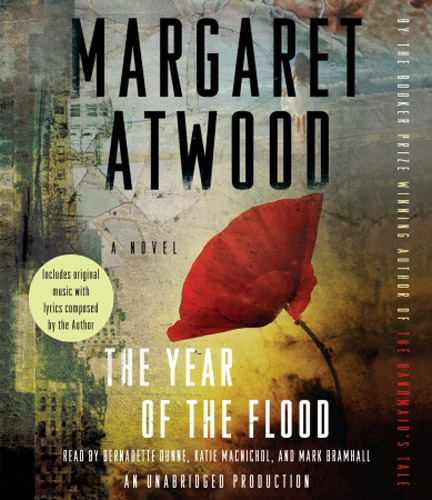
RANDOM HOUSE AUDIO - The Year Of The Flood by Margaret AtwoodThe Year Of The Flood
By Margaret Atwood; Read by Bernadette Dunne, Katie MacNichol and Mark Bramhall
11 CDs – Approx. 14 Hours [UNABRIDGED]
Publisher: Random House Audio
Published: September 22, 2009
ISBN: 9780739383971
Themes: / Science Fiction / Dystopia / Disaster / Environmentalism / Environmental Disaster / Ecology / Planetary Ecology / Religion / Genetic Engineering / Sex / Activism / Genetics /

The long-awaited new novel from Margaret Atwood. The Year of the Flood is a dystopic masterpiece and a testament to her visionary power. The times and species have been changing at a rapid rate, and the social compact is wearing as thin as environmental stability. Adam One, the kindly leader of the God’s Gardeners—a religion devoted to the melding of science and religion, as well as the preservation of all plant and animal life—has long predicted a natural disaster that will alter Earth as we know it. Now it has occurred, obliterating most human life. Two women have survived: Ren, a young trapeze dancer locked inside the high-end sex club Scales and Tails, and Toby, a God’s Gardener barricaded inside a luxurious spa where many of the treatments are edible. Have others survived? Ren’s bioartist friend Amanda? Zeb, her eco-fighter stepfather? Her onetime lover, Jimmy? Or the murderous Painballers, survivors of the mutual-elimination Painball prison? Not to mention the shadowy, corrupt policing force of the ruling powers . . .Meanwhile, gene-spliced life forms are proliferating: the lion/lamb blends, the Mo’hair sheep with human hair, the pigs with human brain tissue. As Adam One and his intrepid hemp-clad band make their way through this strange new world, Ren and Toby will have to decide on their next move. They can’t stay locked away . . .By turns dark, tender, violent, thoughtful, and uneasily hilarious, The Year Of The Flood is Atwood at her most brilliant and inventive.

Margaret Atwood’s book The Year Of The Flood spans several years, before, after and during the waterless flood which is a plague that affects only humans. There are three readers, Bernadette Dunne, Katie MacNichol and Mark Bramhall. Throughout the eleven discs (14 hours), I enjoyed listening to the women, and began to dread the onset of the male reader. He was certainly professional. Was it his character, Adam One, a religious cult leader of God’s Gardeners? Was it the inevitable sermon he would read in a church-appropriate voice? Or was it the hymns, written by Atwood and set to “original” music that would have me engaging in positive procrastination in order to avoid finishing this audiobook.

The loveliest parts of the book take place from the point of view of Ren, a child in God’s Garden. The religion is a logical outcome for a near future on Earth following environmental disasters not too difficult to imagine. Technologies we toy with today lead to some A Clockwork Orange style vocabulary. Words such as “garboil” (a kind of petroleum made from trash) lend a frighteningly vital immersion into this eco-nightmare. Other wonderful vocabulary delights come through the genetic alterations of food and creature such as soydines and bugs with little smiley faces engineered thereon so thoughts of squishing them would be repugnant. The Gardeners have a host of saints to celebrate, showing Atwood’s ability to relate some important environmentalists and peaceniks to her tale including Saint Rachel Carson, Saint David Suzuki and Saint Mahatma Gandhi.

The main female characters, Ren and Toby, both fully developed, are compelling. Throughout the story, one is interested in them as human beings, in their suffering, in their losses, in their desires. Despite the time shifts, the readers manage to keep the characters believable; one is lost in the story (as one should be!) until the final disc. Maybe Atwood can’t write optimistic endings. With all the violence, sadistic sex and death in the world of the Gardeners who are staunch vegetarians who don’t even kill the insects that invade their gardens; with spray guns, layabout body parts and a world of human-pig hybrids conducting funerals, the last disc felt wrong. Ren’s character becomes childish. Toby becomes a murderous cold-blooded killer and then suddenly has another personality shift. The only character to remain true is the one-dimensional ADAM ONE. I was strung along on the brilliant imagination, left flat on story line, and confused in the end by the characters I thought I liked.

Am I waiting for that third expected book in a TRILOGY featuring some of these characters? My interest in Atwood’s “exfernal” world is now lukewarm.

Posted by Elaine Willis

StarShipSofa: iCity by Paul Di Filippo

SFFaudio Online Audio

StarShipSofa’s Aural Delights No. 115 has plenty of goodness to attract all your ferrous materials. Amongst the compellers are a fact article on SF history by the awesome Amy H. Sturgis (she lectures about Anthony Trollope), the Sofanaut Awards results for 2009, and a short story by Paul Di Fillipo.

With regard to that story John DeNardo of SFsignal.com points out his review of the print version of The Solaris Book of New Science Fiction, Volume 2, (which contains ICity) |HERE|, sez John:

“Like all good science fiction should, Paul Di Filippo’s iCity pushes the limits of imagination. To get a feel of the story, picture the next-next generation of SimCity, where ‘competitive urban planning’ takes place. The city is made up of a malleable ‘senstrate’ that obeys the commands planners send it through their phones. The story focus is on one of the top ten planners, Frederick Law Moses, and his up-and-coming rival, Holly Grale (Great name!), who are both vying to take control of a neighborhood recently elected for redesign by its residents.”

Sounds good to me!

StarShipSofa Aural DelightsiCity
By Paul Di Fillipo; Read by Jeff Lane
1 |MP3| – Approx. 77 Minutes [UNABRIDGED]
Podcaster: StarShipSofa’s Aural Delights
Podcast: January 6, 2010

Posted by Jesse Willis

Review of FlashForward by Robert J. Sawyer

SFFaudio Review

Science Fiction Audiobook - Flashforward by Robert J. SawyerFlashForward
By Robert J. Sawyer; Read by Mark Deakins
9 CDs – Approx. 10.5 Hours [UNABRIDGED]
Publisher: Blackstone Audio
Published: 2009
ISBN: 1433252945
Themes: / Science Fiction / Hard SF / Time Travel / Disaster / Physics / Toronto / CERN / Murder / Mystery / Switzerland /
A scientific experiment begins, and as the button is pressed, the unexpected occurs: everyone in the world goes to sleep for a few moments while everyone’s consciousness is catapulted more than twenty years into the future. At the end of those moments, when the world reawakens, all human life is transformed by foreknowledge. Was that shocking revelation a peek at the real, unalterable future, or was it only one of many possible futures? What happens when a man tries to change it, like the doctor who has twenty years to try to prevent his own murder? How will the foreknowledge of a part of “then” affect the experience of the “now”?

This is the sixth Robert J. Sawyer novel that I have enjoyed. But, I didn’t get into it via the usual route. I started watching the TV series without explicitly knowing that it was an audiobook, that it was by Robert J. Sawyer, or that the novel even existed. But after seeing the TV series go into a mid-season hiatus I discovered the novel, and decided this was the perfect chance to read the story upon which it was based. Having seen the first half of the first season, and having read the novel, I recommend that you don’t watch any of the FlashForward TV series until you have read the audiobook. Both are really good and worthy, but different. The TV show is not spoiled by the audiobook, but seeing how it was adapted should add some value. The novel veers towards Hard SF, whilst the TV show is more of a Hollywood drama with SF leanings.

I personally found a couple of blemishes in the novel’s story that may only bother a few others. George Bernard Shaw and I agree that your particular country is not that interesting just because you were born there. I can understand mentioning TRIUMF and the Sudbury Neutrino Observatory, they are useful to the plot and interesting. But the Toronto Transit Commission (TTC)? I ride it every day, and I don’t care. This and a few other Canada Canada Canada details are like being beaten with a Canadian hockey stick. Does the truly “True Great North” need to be bragged about? How un-Canadian. Another quibble, for me, was Sawyer use of John A. Wheeler’s Participatory Anthropic Principle, where things exist only when observed by a consciousness. I cannot fathom anybody believing this anthropocentric twaddle, the idea should be banished like the dark matter, astrology, and celestial spheres. Humans are neither that powerful nor that important.

Despite these quibbles FlashForward has an obliging rationalistic science slant. Consistency reigns. If you like to hear scientists with reasonable amounts of emotions talking, this book is for you. The conversations were what I expect from physicists. The visions of the future, caused by the flashforwards of the title, were very down to earth and believable. The audiobook also mixes in a modicum of mystery, via a future “who done it.” I predicted some of the events and was pleasantly surprised by others in this not-too-long a story. The ending, though plausible, did not unfurl as I had expected.

Narrator Mark Deakins gave a realistic delivery. His only error being when he twice mis-pronunced “Dyson” with the accent incorrectly on the last syllable, as in “Die-sown.” FlashForward is definitely worth a listen.