LibirVox: This Crowded Earth by Robert Bloch

SFFaudio Online Audio

LibriVoxLibriVox is really picking up the pace of audiobook production. Happily, more and more of these free public domain audiobooks being released have a single narrator. This latest audioboo is a title listed in our 3rd Annual SFFaudio Challenge, it’s a cool short novel by the legendary Robert Bloch – that makes it’s narrator, Gregg Margarite, eligible for a prize! Wanna prize Gregg?

Incidentally, I’ve now put up a ROBERT BLOCH author’s page, where you can find more Bloch on audio, and I’ve added a 1-click subscribe version to our LibriVox + SFFaudio = Instant iTunes Audiobook page too.

LibriVox Science Fiction - This Crowded Earth by Robert BlochThis Crowded Earth
By Robert Bloch; Read by Gregg Margarite
12 Zipped MP3 Files or Podcast – Approx. 3 Hours 35 Minutes [UNABRIDGED]
Publisher: LibriVox.org
Published: March 05, 2009
Robert Bloch (1917 – 1994) was a prolific writer in many genres. As a young man he was encouraged by his mentor H. P. Lovecraft, and was a close friend of Stanley G. Weinbaum. He also wrote many screenplays including Hitchcock’s Psycho, and scripts for the original Star Trek. He received the Hugo Award, the World Fantasy Award, the Bram Stoker Award, and he is a past president of the Mystery Writers of America. Published in Amazing Stories in 1958, This Crowded Earth is a thriller set on an overpopulated Earth of the future.

Podcast feed:

http://librivox.org/bookfeeds/this-crowded-earth-by-robert-bloch.xml

Posted by Jesse Willis

Review of Starman Jones by Robert A. Heinlein

SFFaudio Review

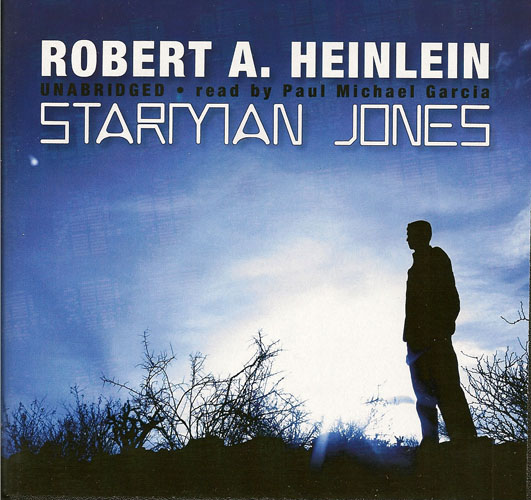
Blackstone Audio - Starman Jones by Robert A. HeinleinStarman Jones
By Robert A. Heinlein; Read by Paul Michael Garcia
7 CDs – 8.5 Hours [UNABRIDGED]
Publisher: Blackstone Audio
Published: 2008
ISBN: 9781433230387
Themes: / Science Fiction / Space Travel / Aliens / Dystopia /

It was a desperate time, when one’s next meal and the comforts of home couldn’t be taken for granted. Max Jones, a practical, hard-working young man, found his escape in his beloved astronomy books. When reality comes crashing in and his troubled home life forces him out on the road, Max finds himself adrift in a downtrodden land. Until an unexpected, ultimate adventure carries him away as a stowaway aboard an intergalactic spaceship—but to where? And when? And how could he ever get back? With the ship’s pilot dead and his charts and tables all destroyed, Max must call upon all of his untested knowledge and skills in order to survive.

There’s nothing like going back to that old-time Science Fiction. Heinlein’s novels are steeped in the inspissate brew of American idealism. Puritanical hard work, honesty and humility are mixed with the libertarian and the liberal, the conservative and the anarchistic. These aren’t just the bywords of Heinleinian characters, they’re the fundamentals of their character – all that, and tempered too with happy portions of both skepticism and hucksterism. A Heinlein character is just as likely to be a gruff middle aged con-man (honest in his own fashion) as a naive wundderkind. The naive wundderkind is often found with a variously doting, tolerant, and even brighter sweetheart. We find all three, the canny conman, the boy genius and his devoted young woman, along with a whole lot more in Starman Jones.

There are three main sections of Starman Jones. Most of the folks who talk about the novel talk about the middle section – where Max works his way up the chain of command in a luxury spaceliner. Indeed, this is what gives the novel its title. The third section, set on board a primitive alien planet has some nicely interesting aliens (a whole novel could have been done there). Personally I liked the first third, set on a vaguely dystopic planet Earth. This is a land of no-opportunity, in order to get a decent job you have to inherit it. Vested interests, taking the form of professional guilds, seem to have staked out every possible avenue for advancement. Sure, there are people there willing to bend the rules to kind-hearted kids like Jones, but the general rule is a complacency towards pervasive corruption. At one point during this first third a kindly truck driver, hopped up on amphetamines, gets Max to help him break the rules of the road (that you have to pull over and sleep once in a while). That scene and another, gives an odd kind of atmosphere of low-level-corruption that Heinlein seems fairly comfortable with. Later still, with the only ticket off the sewed-up planet Earth is via false documents and bribery – Max goes for it, to the detriment of his conscience only after the fact.

In other juvenile novels, like Citizen Of The Galaxy, a Heinleinian protagonist will stay “dirtside” where he’ll grift and finagle his way through life – justifying each action step by step – here and frankly in every single Heinlein story that I’ve ever read, the bad guys are never bad because of the greed or corruption per se, but rather because they are dumb, ignorant and vain.This is a Heinlein failing I think. His cardboard cut-out villians are too dim, too dull-humored and too officious to be any real threat. There are at least two of these lame-brains in this novel. That got me to thinking. If one were to rewrite a Heinlein novel from the strawman’s point of view – it’d be extremely obvious who Heinlein had meant the hero to be [namely Heinlein’s own ideas and values – however ambivalent they are]. But, don’t let this criticism let you think I don’t like Starman Jones because, warts and all, I really did enjoy it.

Paul Michael Garcia is ably suited to reading Heinlein’s well chosen words – giving the dialogue-heavy prose a banter-like give and take. Garcia’s range too is very impressive, voicing Max Jones as youthful and energetic, his older pal Sam as languid and confident, the girl, the mom, the step-dad, the alien spacepet, and everyone else – all in unique voice. It really is the ideal reading. I’ve been a fan of Garcia’s narration since Blackstone picked him for Kirinyaga. Despite a lot of technical jargon, especially while talking astrogation, I only heard one tiny mispronunciation in the whole novel. Concomitant meaning “occurring or existing concurrently.” Garcia read it as “konk-mittant.” The original art that Blackstone has given Starman Jones looks good, if a bit generic, but a closer inspection – past the silhouetted landscape and into the roiling clouds will admit a bit more detail in the night’s overcast sky.

Posted by Jesse Willis

Review of January Dancer by Michael Flynn

SFFaudio Review

The January Dancer by Michael FlynnThe January Dancer
By Michael Flynn; Read by Stefan Rudnicki
1 MP3-CD or 9 CDs – Approx. 10.5 Hours [UNABRIDGED]
Publisher: Blackstone Audio
Published: 2008
ISBN: 9781433250996 (MP3-CD), 9781433250972 (CD)
Themes: / Science Fiction / Space Opera / Aliens / Space Flight /

Captain Amos January, and crew, are forced to look for ship repair materials on an unknown planet. There they discover an alien ship filled with fascinating artifacts, among them a shape-changing sculpture that becomes known as “The Dancer.” We learn of some of The Dancer’s attributes as known in ancient legends and confirmation is received as we watch the story unfold. It is sought by cabals, pirates, governments, and other powers who unleash different characters to acquire The Dancer. Not unexpectedly these characters are scoundrels, idealists, and romantics whose tracks intersect and form their own sort of dance as they maneuver to best one another. This tale is told to us as a story within a story as a Harper hears the tale, a bit at a time, from the Scarred Man. This is an interesting device as not only are we told the story but Flynn uses the framing story to give us his ideas about storytelling as an art.

It is a trend these days, or so it seems to me, for modern science fiction authors to attempt to write “space opera.” As an aficionado of that subgenre who has recently been browsing among the past masters of the art (in large part thanks to Librivox), my view is that the modern take tends to be drawn-out, unfocused, and sprawling by comparison. Sadly, although I also am an aficionado of Michael Flynn’s work, I believe he has fallen prey to the desire to expand the story past the demands of the genre. The original writers wrote snappy, bold, romantic adventures that did not worry overmuch about expostulation and got to the point. Flynn, on the other hand, gives a bewildering combination of too much philosophical conversation and not enough details about the characters’ lives. There is a plethora of characters as well, almost too many to track, and this often leaves the listener bewildered as to just who has suddenly popped up unexpectedly in a scene. As well, in the last couple of chapters the tone shifts unexpectedly, as if Flynn suddenly was told he had to finish up, and thus the novel swung into abrupt action and snapped out a strangely sparse finale. The revelations were not illogical or even unsatisfying. However, after dragging on and on in the middle of the book it was quite disconcerting to suddenly be flung headlong into the finish in the style of “a shot rang out and everyone fell dead.”

Stefan Rudnicki narrates with his usual expertise, adroitly affecting slight voice changes that communicate character when voicing dialogue. One wishes that the editors had added a slight aural indicator when there were scene changes. In a book of many characters who are flung from one exotic location to another at a second’s notice, it is very difficult to tell when there is a scene change immediately with nothing other than a slight pause between sections. I must also note, that my above complains about Flynn’s book overall may have been due to the fact that a complex book is necessarily more difficult to grasp when listening rather than reading as it was written. In this instance, the editors would have done well to help the listener all they could.

If you are a Michael Flynn fan, this book will not be a complete waste. I did enjoy it initially, but I simply wished it had been truly the space opera that it purported to be.

Note: should readers think that there are no modern writers capable of space opera that is worthy of comparison with those of older times, I refer you to the “Agent of Change” series by Sharon Lee and Steve Miller (Agent of Change, Conflict of Honors, Carpe Diem, Plan B, and I Dare) and Space Vulture by Gary K. Wolf and John J. Myers. None of these are in audiobook format that I know of but are well worth seeking out.

Posted by Julie D.

LibriVox: The Edge Of The Knife by H. Beam Piper

SFFaudio Online Audio

Here’s a new FREE LibriVox H. Beam Piper audiobook, it took a little while for the podcast feed to appear but its all ready for listening now…

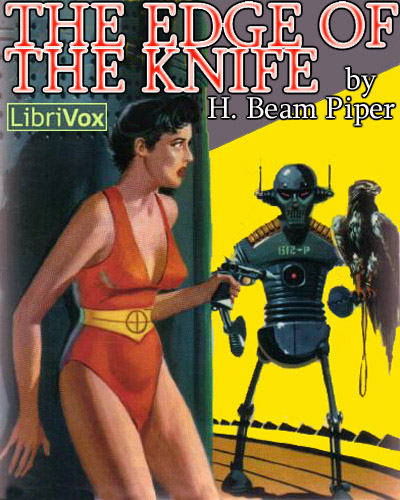
LibriVox Science Fiction - The Edge Of The Knife by H. Beam PiperThe Edge Of The Knife
By H. Beam Piper; Read by Julio Martini
6 Zipped MP3 Files or Podcast – Approx. 1 Hour 48 Minutes [UNABRIDGED]
Publisher: LibriVox.org
Published: February 12, 2009
The Terro-Human Future History is Piper’s detailed account of the next 6000 years of human history. 1942, the year the first fission reactor was constructed, is defined as the year 1 A.E. (Atomic Era). In 1973, a nuclear war devastates the planet, eventually laying the groundwork for the emergence of a Terran Federation, once humanity goes into space and develops antigravity technology. The story “The Edge of the Knife” (collected in Empire) occurs slightly before the war, and involves a man who sees flashes of the future. It links many key elements of Piper’s series.

Podcast feed:

http://librivox.org/bookfeeds/the-edge-of-the-knife-by-h-beam-piper.xml

Posted by Jesse Willis

Review of Star Wars: Millennium Falcon by James Luceno

SFFaudio Review

Star Wars: Millennium Falcon by James LucenoStar Wars: Millennium Falcon
By James Luceno, Read by Marc Thompson
8 CDs – 10 hours [UNABRIDGED]
Publisher: Random House Audio
Published: 2008
ISBN: 9780739377130
Themes: / Star Wars / Science Fiction / Fantasy / Religion / Space Travel / Adventure / Hardware /The Star Wars audiobook has been around for a long time. I use them often to illustrate the evolution of the audiobook: they started with two cassette abridgments, moved to CD, then the abridgments got longer, and now, as we are seeing the rest of the industry move (nearly) completely away from abridged audio, Star Wars novels are now… unabridged.

Marc Thompson does the reading here, after a very long stretch of excellent Star Wars narration by Jonathan Davis. The series is in good hands. Marc Thompson is a bit of a impressionist, able to invoke Harrison Ford’s Han Solo merely by the tone and meter of his voice. Most of the time it works great, but every now and then I got a clear view of David Puddy in my head (Elaine’s boyfriend from Seinfeld, played by Patrick Warburton). Who knew that Ford’s and Warburton’s voices were so near each other? These times are few, though, and Marc Thompson is a narrator I’d listen to any time.

Star Wars: Millenium Falcon spans a lot of history. The famous ship has been around, and James Luceno takes us on a tour of its busy life. Han Solo and Leia are married, for those who haven’t been keeping up, and have grandkids (yes, a LOT has happened), one of which is named Allana. One day she asked Han about the history of the ship, which prodded him into looking more into it.

In the meantime, a previous owner of the ship (before Lando) has been in stasis for quite a few years. He wakes up and immediately goes after something he left on the ship. Eventually, their paths cross.

This is an entertaining adventure that ties together the whole Star Wars saga through the history of the Millenium Falcon. It’s extremely well done, and lots of fun for a fan like me.

Random House Audio Star Wars page

After listening to this audiobook, I was curious – did the Millennium Falcon make an appearance in Episodes I, II, or III? The answer is yes, but only briefly:

Posted by Scott D. Danielson

Review of Starship: Rebel by Mike Resnick

SFFaudio Review

Audible Frontiers - Starship: Rebel, Book 4 by Mike ResickSFFaudio EssentialStarship: Rebel
By Mike Resnick; Read by Jonathan Davis
Audible Download – 8 Hours 45 Minutes [UNABRIDGED]
Publisher: Audible Frontiers
Published: December 16th 2008
Themes: / Science Fiction / Space Opera / Galactic Civilization / Aliens / Rebellion / War / Military SF / Space Station /

The date is 1968 of the Galactic Era, almost three thousand years from now. The Republic, dominated by the human race, is in the midst of an all-out war with the Teroni Federation. Almost a year has passed since the events of Starship: Mercenary. Captain Wilson Cole now commands a fleet of almost fifty ships, and he has become the single greatest military force on the Inner Frontier. With one exception. The Republic still comes and goes as it pleases, taking what it wants, conscripting men, and extorting taxes, even though the Frontier worlds receive nothing in exchange. And, of course, the government still wants Wilson Cole and the starship Theodore Roosevelt. He has no interest in confronting such an overwhelming force, and constantly steers clear of them. Then an incident occurs that changes everything, and Cole declares war on the Republic. Outnumbered and always outgunned, his fleet is no match for the Republic’s millions of military vessels, even after he forges alliances with the warlords he previously hunted down. It’s a hopeless cause…but that’s just what Wilson Cole and the Teddy R. are best at.

A good audiobook can make a regular day enjoyable. A great audiobook can put a delightful spring in your step for a whole week. Starship: Rebel has made for absolutely terrific listening. As I was listening to it over the course of a week or so I’d wake up in the morning, remember that I’d still got a few hours of listening left, and smile as if I’d won the Nobel Prize for luck. I’ve heaped a lot of praise for this terrific series of audiobooks since Audible Frontiers started releasing it back in Spring 2008. The closest I’ve come to criticism has been a little humming and hawing about how the series is ‘short on ideas and originality.’ That, it feels like a better version of Star Wars. And that’s all still true, nothing in the Starship series feels anything like innovative. The weapons technology has no new ideas, the faster than light space travel relies on the same few tropes, the aliens are all Star Wars-ish. Despite this, there is an amazing feeling of being safely ensconced in the hands of a master storyteller when listening to this series. The team of writer Mike Resnick with narrator Jonathan Davis is absolutely stupendous.

With this book, Book 4, Resnick is raising the stakes by forcing Captain Cole and the crew of the Theodore Roosevelt to take on the Republic itself. And that’s good, but it isn’t everything. Resnick also pulls an unexpected maneuver – a very important character is killed about a third of the way into the novel – and that hit, a real hit, shakes up that feeling of familiarity and safety in a way that just freezing Han Solo into a block of carbonite can never do. Barring accidents I expect to be enjoying another terrific week when Starship: Flagship, the 5th and final book in the Starship series, comes out in December 2009.

Posted by Jesse Willis