LibriVox: Victory by Lester del Rey

SFFaudio Online Audio

From LibriVox and the reader of This Crowded Earth (Robert Bloch) and the Deathworld (Harry Harrison) comes…

LibriVox Science Fiction - Victory by Lester del ReyVictory
By Lester del Rey; Read by Gregg Margarite
2 MP3 Files – Approx. 1 Hour 38 Minutes [UNABRIDGED]
Publisher: LibriVox.org
Published: March 30, 2009
“It seemed Earth was a rich, and undefended planet in a warring, hating galaxy. Things can be deceptive though; children playing can be quite rough—but that ain’t war, friend!” – Victory is the story of an undefended Earth in a warring galaxy. First published in Astounding Science Fiction, August, 1955.
Part 1 |MP3| Part 2 |MP3|

Podcast feed:

http://librivox.org/bookfeeds/victory-by-lester-del-rey.xml

Posted by Jesse Willis

Review of Anathem by Neal Stephenson

SFFaudio Review

AnathemAnathem
By Neal Stephenson; Read by Oliver Wyman, Tavia Gilbert, William Dufris, and Neal Stephenson
Audible Download –  32 hours 30 minutes [UNABRIDGED]
Publisher: Macmillan Audio
Published: 2008
Themes: / alien invasion / philosophy / religion / alternate universe

After nearly two weeks of listening to this 2009 Hugo-nominated book during nearly every moment of my free time–getting ready for work in the mornings, sitting on the bus, tossing and turning in bed–I’ve finally finished Neal Stephenson’s latest tale of metaphysical adventure. Does the book measure up to Stephenson’s earlier work? More importantly, is it fun to read?

First, some background: Anathem is set on the planet of Arbre, a world much like, and yet unlike, our own. The tale opens in the year 3690 AR (After the Reconstitution), in the Mathic Consent of Saunt Edhar. Consents are much like the medieval monasteries of our own world, except that instead of contemplating religious matters the Mathic avout research and debate matters of math, science, and philosophy. The tale is told from the perspective of Fraa Erasmas, a young avout who has now lived at the Consent for ten years. A mysterious craft appears in the skies above Arbre, which is the driving force behind the plot, since it excites consequences and conflicts first in the Mathic world and then in the Saecular, or outside, world as well. The craft, it turns out, belongs to an alien race unknown to Arbre, and packs a significant military punch. The inhabitants of Arbre, Mathic and Saecular alike, must decide how to face this threat.

I can’t fully answer the first question, since the only other Stephenson novel I’ve read in full was his cyberpunk effort Snow Crash, which I thoroughly enjoyed. Stylistically speaking, comparing these two novels, though, is like comparing apples and oranges. The prose ofSnow Crash is taut, earthy, and vernacular, while that of Anathem is expansive, meandering, and somewhat more formal. Yet the two books share a tendency to veer into philosophical discourse that usually, but not always, has some relevance to the plot.

As to the second question, I wouldn’t quite characterize Anathem as “fun”. It certainly has many moments of intense action, wry humor, and emotional drama. These moments, however, are interspersed between long stretches of the aforementioned philosophical discourse. So one’s response to the novel largely depends on one’s tolerance for and appreciation of Stephenson’s vast store of scientific and theoretical knowledge. In this respect, as well as in its setting, Anathem resembles Umberto Eco’s equally challenging The Name of the Rose.

Those interested in such things will find here a treasure trove of insights (or “upsights” as they’re called in the world of Arbre) into the nature of reality, consciousness, and the universe. Without giving too much away, I’ll simply hint that the quantum physics principles that play such a large role in Philip Pullman’s His Dark Materials trilogy rear their hydra-heads here as well.

The book isn’t all dialogues and theorums and proofs. Much of Anathem‘s beauty stems from its likable characters. Fraa Erasmas is a young lad possessed of loyalty, imagination, and more heart than seems to be usual in the Mathic community. His best friend Fraa Lio, upon whom he bestows the epithet of “thistlehead”, takes a keen interest in the martial arts techniques, or vlor, of the Consent of the Ringing Veil. The cast of brothers is rounded out by the ambitious yet likable Fraa Jesry and the good-natured portly Fraa Arsibalt. Unlike medieval monastaries, Mathic consents are not segregated, so Erasmas and company are joined in their adventures by the capable but hot-tempered Suur Ala and the mild-mannered Suur Tulia. The real standout characters, though, are the enigmatic Fraa Orolo and Fraa Jad. The former has a fascination with cosmology and also with saecular speelies (read: movies), while the latter is first seen puzzling over a disposable razor from the outside world. Both these old men are reminiscent of Albus Dumbledore from the Harry Potter series in that they combine immense knowledge with eccentricity and childlike curiosity.

For a word nerd like myself, much of the pleasure from reading Anathem is derived from marveling at Stephenson’s ability to construct a linguistically coherent alternate reality that still has resonances in our own world. Take the word saunt, for instance, which denotes a Mathic avout who has made some sort of significant theoretical advance. As the book’s glossary explains, the word is actually a contracted form of the word savant, but also immediately brings to the reader’s mind the real-world word saint. I’m fairly certain that all these subtle layers of meaning were intentionally embedded, and this is just one example of many.

While there are endless avenues of literary, cultural, and philosophical allusions to explore and deep philosophical questions to unravel, I found myself a bit weary as I got to the end of the novel. Though certainly a more-than-capable storyteller, Stephenson seems more interested in advancing his scientific explorations, and overlays the story atop them. This is similar to sme of J.R.R. Tolkien’s writings, in which the story is made subservient to linguistic aims. I’m not quite sure where I fall on this “story-versus-substance” spectrum, but if I had to choose I think I’d lean towards the “story” direction.

Given its complexity of its language, Anathem poses a real challenge to audiobook producers. Fortunately, the narrators are up to the task. William Dufris performs the bulk of the novel, and he shifts easily from the erudite jargon of the book’s dialogues to its memorable emotional climaxes. Read by a less capable narrator, Anathem might be marketed as a surefire cure for insomnia, but Dufris brings every character to life as if they were in a speely, the Arbre equivalent of film.

Even with the few caveats listed earlier, it’s hard to underplay Neal Stephenson’s immense achievement with Anathem.

Posted by Seth Wilson
LibriVox: The Lost Continent by Edgar Rice Burroughs

SFFaudio Online Audio

LibriVoxHere’s another Edgar Rice Burroughs novel that I hadn’t heard of prior to its release on LibriVox. For fans like me who are daunted by the prospect of trundling through one of the many series books by Burroughs this is a good place to start as this is a standalone novel. First published in the February 1916 issue of “All Around Magazine.”
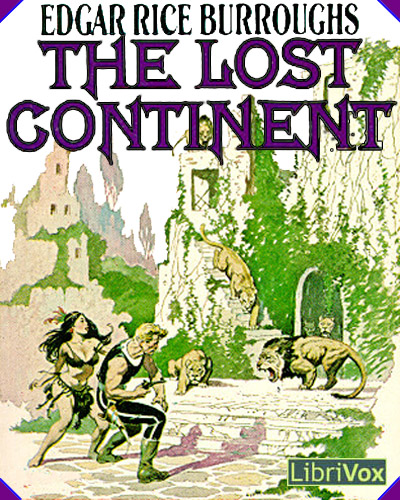

LibriVox Science Fiction - The Lost Continent by Edgar Rice BurroughsThe Lost Continent
By Edgar Rice Burroughs; Read by Lucy Lo Faro
9 Zipped MP3 Files or Podcast – Approx. 4.5 Hours [UNABRIDGED]
Publisher: LibriVox.org
Published: April 2009
Originally published under the title Beyond Thirty. The novel, set in the year 2137, was heavily influenced by the events of World War I. In the future world depicted in the novel, Europe has descended into barbarism while an isolationist Western Hemisphere remains sheltered from the destruction. The title Beyond Thirty refers to the degree of longitude that inhabitants of the Western Hemisphere are forbidden to pass.

Podcast feed:

http://librivox.org/bookfeeds/the-lost-continent-by-edgar-rice-burroughs.xml

iTunes 1-Click |SUBSCRIBE|

Posted by Jesse Willis

LibriVox: Deathworld by Harry Harrison

SFFaudio Online Audio

LibriVoxGregg Margarite is an up and coming narrator over on LibriVox.org. He recorded stories for five of the LibriVox “Short Science Fiction” collections as well as soloing on the Collected Public Domain Works Of Stanley G. Weinbaum! But it is his latest project that I suspect will be his most popular narration. Here’s how he describes it:

Deathworld is the first in a series of novels begun in 1960 and originally serialized in Astounding Science Fiction Magazine. It’s the story of Jason dinAlt a professional gambler with psionic skills who finds himself on Pyrrus the deadliest planet to be colonized by humanity. Violent weather, active tectonics, heavy gravity, abundant predators, and a hostile splinter group of colonists is only the beginning of Jason’s quest to learn the truth about Pyrrus.”

LibriVox Science Fiction - Deathworld by Harry HarrisonDeathworld
By Harry Harrison; Read by Gregg Margarite
28 Zipped MP3 Files or Podcast – Approx. 5 Hours 23 Minutes [UNABRIDGED]
Publisher: LibriVox.org
Published: April 2009
Some planet in the galaxy must—by definition—be the toughest, meanest, nastiest of all. If Pyrrus wasn’t it … it was an awfully good approximation! First published in Astounding Science Fiction magazine’s January, February and March 1960 issues.

Podcast feed:

http://librivox.org/bookfeeds/deathworld-by-harry-harrison.xml

iTunes 1-click |SUBSCRIBE|

Posted by Jesse Willis

BBC7: Understand by Ted Chiang

SFFaudio Online Audio

BBC Radio 7 - BBC7Tuesday will see another broadcast of Understand by Ted Chiang. If you haven’t heard it before, don’t miss it! Understand was originally published in “Isaac Asimov’s Science Fiction Magazine” in 1991. This outstanding novelette is one of the very best stories I’ve ever heard on radio. It was produced by Gemma Jenkins for the BBC and first broadcast in 2004 on BBC 7. Re-broadcasts of this popular tale have been heard in 2006 and 2007.

BBC Radio 7 - Understand by Ted ChiangUnderstand
By Ted Chiang; Read by Rashan Stone
4 half-hour segments – Approx. 2 Hours [UNABRIDGED]
Broadcaster: BBC Radio 7
Broadcast: Tuesday April 7th to Friday April 10th 2009 (6.30pm and 12.30am)
Leon is a former coma victim, who has gone experimental medical treatment to repair the massive trauma his brain received after he was trapped under ice for more than an hour. He’s regained consciousness, found he has all of his faculties back and a whole lot more. In the tradition of Daniel Keyes’ Flowers For Algernon.

If you don’t live in the U.K., or even if you do, I highly recommend you try out Radio Downloader, it takes the streamed broadcasts and converts them to MP3s with nary a trouble once its set up.

Posted by Jesse Willis

Review of Phantoms by Dean Koontz

SFFaudio Review

Brilliance Audio - Phantoms by Dean KoontzPhantoms
By Dean Koontz; Read by Buck Schirner
12 CDs – 15 Hours [UNABRIDGED]
Publisher: Brilliance Audio
Published: January 2008
ISBN: 9781423339267
Themes: / Horror / Suspense / Science Fiction / Mass Disappearance / California /

They found the town silent, apparently abandoned. Then they found the first body strangely swollen and still warm. One hundred fifty were dead, 350 missing. But the terror had only begun in the tiny mountain town of Snowfield, California. At first they thought it was the work of a maniac. Or terrorists. Or toxic contamination. Or a bizarre new disease. But then they found the truth. And they saw it in the flesh. And it was worse than anything any of them had ever imagined…

I went into this novel with low expectations. Our resident Dean Koontz aficionado was telling me that Phantoms wasn’t one of Koontz’s best works. That’s the bright side about low expectations – it makes the mediocre seem better. My biggest complaint isn’t really with the story at all – but rather with its length. 15 hours is a bit too long for a novel with this content and plot – there’s a whole separate subplot about an escaped criminal and his subsequent interactions with a biker gang. These parts of the book get mentioned a couple of times by the main narrative – but are otherwise un-interactive until the end of the novel. That whole subplot might have made an interesting short story, if separate, but it ends up being a side-note that doesn’t come to any real fruition, except in what felt like a tacked on end piece. Still, the main narrative is rather compelling. Dr. Jennifer Page, who lives and works in the small resort town of Snowfield, California, is returning from the big city and in doing so she’s taking with her much younger sister Lisa. Their mom has recently died and Jenny plans to raise her younger sister in the small town. Unfortunately, their arrival in Snowfield yields a much more horrifying and surprising disaster than the mere death of their mom. Everyone in town is missing! Well, almost everybody is missing anyway, with those few who aren’t entirely disappeared being completely dead – having been killed in grisly or bizarre fashions. The only clue to what has happened in Snowfield, while Jenny has been out of town, is a near incomprehensible message scrawled onto a bathroom mirror.

Fans of certain H.P. Lovecraft stories, John Carpenter’s The Thing, and Stephen King‘s The Mist will likely quite enjoy this tale. Thinking back on myself, it feels as if Phantoms would have made an excellent late 1960s or early 1970s Doctor Who serial. What I liked most about it was not the atmosphere of spookiness (that seems a high point to a lot of folks), but rather the care and attention to the back story and the explanations which Koontz put into the lead up to the events in snowfield. I can’t recall a lot of other novels that have dealt with the “mass disappearance” phenomenon. I do recollect one film on the topic, The Quiet Earth (it is terrific) but has a far different execution and feel than does Phantoms. Speaking of film, I recommend you shy away from the film version of Phantoms entirely – it trims down the plot (which you’d think would be good) – but manages to feel rather crappy all-around, despite being adapted to film by Koontz himself.

Phantoms gave Dean Koontz a reputation as a horror writer, Koontz describes the novel as “one of the ten biggest mistakes” of his life because, it earned the label horror writer, which he says he “never wanted, never embraced, and [has] ever since sought to shed.” I can see it. The actual novel is definitely working within the rules of Science Fiction. Sadly, suspense, which Koontz does embrace, is often confused with horror – and hence his problem. The initial publication of Phantoms in 1983 garnered the novel several positive reviews. But only Analog’s review clearly recognized Koontz’s attempt to put technology and science to the fore in Phantoms. Narrator Buck Schirner sounds a whole lot like Mel Blanc. He’s got a good range, and changes his voice for different character genders, ages, and accents. The cover on this audiobook is sadly wholly uninformative, as is the bland title. The novel should have been called “The Ancient Enemy” and the cover should have depicted an open sewer grate, or a sink full of jewelry.

Posted by Jesse Willis