LibriVox: Mary Shelley, William Morris and Horace Walpole

SFFaudio Online Audio

LibriVoxA recent flurry of furious audiobook cataloging over the past week on LibriVox.org has resulted in a massive new library of old SFF listens! Here are three old novels, almost ancient in fact. Now before you get too excited, they will be rather difficult listening for beginners – but, for a select few connoisseurs, these are priceless gems.

First up, from the author of the first Science Fiction novel….

LibriVox Science Fiction Audiobook - The Last Man by Mary ShelleyThe Last Man
By Mary Shelley; Read by various
32 Zipped MP3 Files or Podcast – Approx. 18 Hours [UNABRIDGED]
Publisher: LibriVox.org
Published: October 9th, 2008
The Last Man is an early post-apocalyptic science fiction novel by Mary Shelley, which was first published in 1826. The book tells of a future world that has been ravaged by a plague. The plague gradually kills off all people. Lionel Verney, central character, son of a nobleman who gambled himself into poverty, finds himself immune after being attacked by an infected “negro,” and copes with a civilization that is gradually dying out around him.

Podcast feed:

http://librivox.org/bookfeeds/the-last-man-by-mary-shelley.xml

Next, the first modern Fantasy novel (chosen from our 2nd Annual SFFaudio Challenge and nearly a year in the making) way to go Cori!

LibriVox Fantasy Audiobook - The Wood Beyond The World by William MorrisThe Wood Beyond the World
By William Morris; Read by Cori Samuel
12 Zipped MP3 Files or Podcast – Approx. 5 Hours 20 Minutes [UNABRIDGED]
Publisher: LibriVox.org
Published: October 9th, 2008
The Wood Beyond The World is a fantasy novel by William Morris, perhaps the first modern fantasy writer to unite an imaginary world with the element of the supernatural, and thus the precursor of much of present-day fantasy literature. His use of archaic language has been seen by some modern readers as making his fiction difficult to read, but brings a wonderful atmosphere to the telling. Morris considered his fantasies a revival of the medieval tradition of chivalrous romances. In consequence, they tend to have sprawling plots of strung-together adventures. In this story, Walter leaves his father and his own unfaithful wife and sets sail in search of adventure. This he finds aplenty, encountering love, treachery and magic in the Wood of the title and travelling through the Mountains of the Folk of the Bears. But can he find happiness and peace by means of this Quest?

Podcast feed:

http://librivox.org/bookfeeds/the-wood-beyond-the-world-by-william-morris.xml

And, The forerunner for both, the first gothic novel!

LibriVox Gothic Novel - The Castle Of Otranto by Horace WalpoleThe Castle of Otranto
By Horace Walpole; Read by Great Plains
6 Zipped MP3 Files or Podcast – Approx. 4 Hours [UNABRIDGED]
Publisher: LibriVox.org
Published: October 6th, 2008
The Castle of Otranto is a 1764 novel by Horace Walpole. It is generally held to be the first gothic novel, initiating a literary genre which would become extremely popular in the later 18th century and early 19th century. Thus, Castle, and Walpole by extension is arguably the forerunner to such authors as Ann Radcliffe, Bram Stoker, Daphne du Maurier, and Stephen King.

Podcast feed:

http://librivox.org/bookfeeds/the-castle-of-otranto-by-horace-walpole.xml

Posted by Jesse Willis
LibriVox: A Princess of Mars by Edgar Rice Burroughs

SFFaudio Online Audio

Here’s the second LibriVox edition of this Edgar Rice Burroughs classic, this time with a solo narrator!

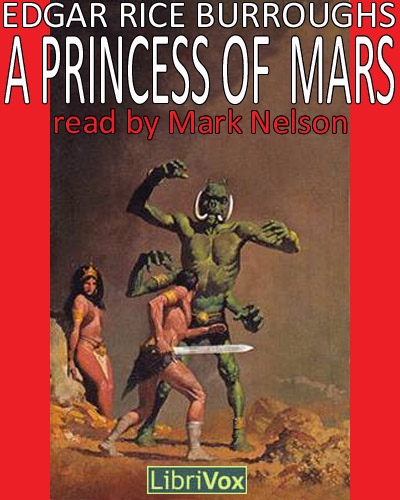
LibriVox Science Fiction Audiobook - A Princess Of Mars by Edgar Rice BurroughsA Princess of Mars (#1 in the John Carter series)
By Edgar Rice Burroughs; Read by Mark Nelson
14 Zipped MP3 Files or Podcast – Approx. 7 Hours 26 Minutes [UNABRIDGED]
Publisher: LibriVox.org
Published: October 10th 2008
John Carter, an American Civil War veteran, goes prospecting in Arizona and, when set upon by Indians, is mysteriously transported to Mars, called “Barsoom” by its inhabitants. Carter finds that he has great strength on this planet, due to its lesser gravity. Carter soon falls in among the Tharks, a nomadic tribe of the planet’s warlike, four-armed, green inhabitants. Thanks to his strength and combat abilities he rises in position in the tribe and earns the respect eventually the friendship of Tars Tarkas one of the Thark chiefs. The Tharks subsequently capture Dejah Thoris, Princess of Helium, a member of the humanoid red Martian race. The red Martians inhabit a loose network of city states and control the desert planet’s canals, along which its agriculture is concentrated. Carter rescues her from the green men to return her to her people.

Subscribe to the podcast feed:

http://librivox.org/bookfeeds/a-princess-of-mars-by-edgar-rice-burroughs-2.xml

Posted by Jesse Willis

BBC7: Last Days of Shandakor by Leigh Brackett

SFFaudio Online Audio

BBC Radio 7 - BBC7 BBC7’s The 7th Dimension program is re-broadcasting an action-packed reading of a Leigh Brackett novelette: The Last Days of Shandakor was originally published in the April 1952 issue of Startling Stories magazine. It was first broadcast on BBC7 back in March 2007.

NOTE: The story will be aired in 2 parts on Wednesday, October 15 and Thursday, October 16 evenings at 6:30pm and 12:30am GMT.

The Last Days Of Shandakor
By Leigh Brackett; Read by Nathan Osgood
Broadcast in 2 parts – Approx. 50 minutes
Broadcaster: BBC 7 / 7th Dimension time slot
Broadcast: Wednesday, October 15 and Thursday, October 16, 2008

An epic science fiction adventure written in Brackett’s classic style in which Mars is portrayed as a dying planet where desperate Earthmen compete with the last Martians races for lost knowledge and hidden power. Follow Jon Ros on his solitary trek as he learns more about Mars’ history and visits a remote Martian city lost in its own memories of the past.

And remember, if you miss it, BBC7 provides a “listen again” feature that keeps programs available for 6 days following the broadcast –like this and this.

Posted by RC of RTSF

Review of The Standards of Creation by James Campanella

SFFaudio Review

The Standards of Creation
By James Campanella; Read by James Campanella
MP3 Download – Approx 16.5 hours – [UNABRIDGED]
Publisher: Uvula Audio
Published: 2008
Themes: / Science Fiction / Mars / cybernetics / aliens / telepathy / genetic manipulation /

J.J. Campanella is perhaps best known in audio circles as a frequent narrator on StarShipSofa, which is where I first encountered him. His website, Uvula Audio, features Campanella’s narration of a wide variety of audiobooks ranging from L. Frank Baum to Doc Savage to P.G. Wodehouse. It does not take long to discover that narration is indeed a skill at which Campanella is expert. He handles foreign accents and different voices with an ease that makes it easy for the listener to visualize each speaker.

What is easy to miss, perhaps, is that Campanella’s own written work, The Standards of Creation, is included among the archived files. This is a shame as Campanella has written a fast-paced, multi-layered book that combines the best of action thrillers and science fiction. It definitely deserves to be noticed by more people.

Just a few of the elements woven into the story include:

• Martian colonies of Chinese and Americans, each hiding their secrets while trying to discover those of the other.

• Yarrow Hayes, a Nobel Prize winning biologist born and raised on Mars, who ironically is dying of an incurable disease.

• Alex Arodyne, a young scientific genius whose cynical outlooks threatens to cripple his promise.

• Belle, an undercover NATO agent whose cybernetic enhancements give her unparalleled skills but carry with them a price that lead her to take surprising steps.

• Who are Gabe and his mysterious boss? Is he really an alien using telepathy to speak to Alex in his dreams?

• What is the mysterious alien ship voyaging through the solar system?

• Just what are the standards of creation? How will they change the lives of each person in the story?

All this is set against a background containing some of the most classic science fiction elements: terraforming on Mars, life in the Martian colony, biological scientific development in the future such as the different versions of the cloned NATO officers, and an alien device that looks like a huge black marble silently making its way toward the sun while scientists struggle to communicate. All of this is laced with characters in impossible situations for which there is seemingly no solution.

Above all this is a book of secrets. Every person and every situation has at least one secret beyond those that we think have been revealed. This leads to an indepth look at free will and personal responsibility that both surprisd and delighted me.

I am not even including some of the subplots involving drug trafficking or an order of priests with a surprising yet practical hidden agenda. It might sound as if there is too much crammed into the story to make a good book. However, Campanella handles the many elements with ease to provide us with a truly original novel that is not only thought provoking but which also hearkens back to the times when science fiction included real science. We hope that his future endeavors branch out again from narration to include more novels such as this one.

Posted by Julie D.

Commentary: Jack London’s The Call Of The Wild is Science Fiction

SFFaudio Commentary

For almost a year now I’ve been making the argument, to anyone who’d listen, that Jack London’s short story To Build A Fire is Science Fiction.

I’m ready to make the same argument for London’s most famous work, The Call Of The Wild.

First off, the story is told from a dog’s POV. Normally that’d make this a Fantasy novel, in the spirit of Redwall or similar. But, we never hear Buck, the hero, speak, or think thoughts out in words (unlike other anthropomorphic fiction) – yet we are clearly seeing the world through Buck’s alien eyes. Moreover, the premise of the novel, the theme that informs the title of each chapter, was a commonly held idea in fantastic literature of that era. Namely, that ‘barbarism is around every corner, that civilization is a thin veneer, one broken easily.’ You see this in the writings of H.P. Lovecraft and Robert E. Howard. London wrote: “…the reign of primitive law … the facts of life took on a fiercer aspect, and while he faced that aspect uncowed, he faced it with all the latent cunning of his nature aroused.” Jack London’s The Call Of The Wild is Science Fiction. The novel was set in the then recent past, and doesn’t have any future tech or extraterrestrial aliens – but that’s not what makes SF. What makes it SF is what makes The Call Of The Wild a classic – the presentation of bold philosophical ideas informed by science.

Below is a free version read by the talented narrator James Campanella. Unfortunately, for me, the reading is spoiled by two serious problems. First, it has a poor recording environment (rectified in later Campanella releases). Second, Jim has added in sound effects. An, imperfect recording environment I can live with, added sound effects I can’t. Check it out for yourself…

Uvula Audio - The Call Of The Wild by Jack LondonThe Call Of The Wild
By Jack London; Read by James Campanella
7 MP3s – Approx. 3 Hours 44 Minutes [UNABRIDGED]
Podcaster: Uvuvla Audio
Podcast: 2007
“The Call of the Wild was written by American author Jack London. The plot concerns, Buck, a previously domesticated and even somewhat pampered dog whose primordial instincts return after a series of events finds him serving as a sled dog in the treacherous, frigid Yukon during the days of the 19th Century Gold Rushes in the Northwest. Published in 1903, The Call of the Wild is one of London’s most read books and it is generally considered one of the classics of western adventure literature. Because the protagonist is a dog, it is usually classified as a juvenile novel, suitable for children.”
Part 1 |MP3| Part 2 |MP3| Part 3 |MP3| Part 4 |MP3|
Part 5 |MP3| Part 6 |MP3| Part 7 |MP3|

There’s a LibriVox version also available.

Posted by Jesse Willis

Review of The Great Secret by L. Ron Hubbard

SFFaudio Review

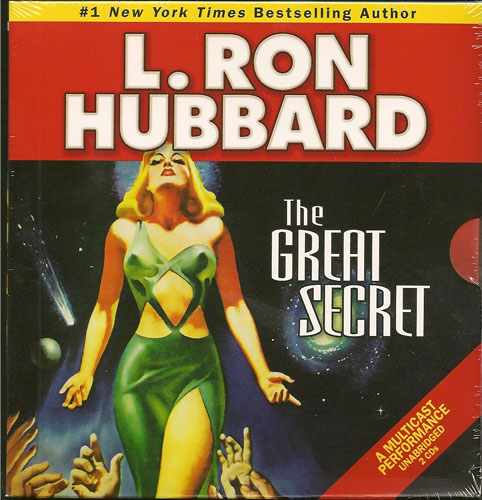
The Great Secret by L. Ron HubbardThe Great Secret
By L. Ron Hubbard; Read by various
2 CDs – Approx. 2 Hours 20 Minutes [UNABRIDGED]
Publisher: Galaxy Press
Published: 2008
ISBN: 1592122493
Themes: / Science Fiction / Pulp / Spaceship / Navy / Venus / Slavery /
Fanner Marston was raised as a slave as a child, became a petty street thief as a teen, and now masters his own craft and crew as a grown man. He’s also gone completely mad. Driven by privation, with a vicious greed and slavering lust for power, Marston alone of forty men has survived the perilous trek through a blistering desert to the magical city of Parva, where legend says a secret awaits which will give him absolute control over the Universe. However, Marston finds the key to all power is not at all what he expected…”

Galaxy Press has given a deluxe treatment to these very pulpy pulp tales. The handsome cover art dates from 1949. Inside the package there is a 37 page, fully illustrated, booklet that includes a 6 page essay by Kevin J. Anderson and a 15 page biography of Hubbard. There are four stories included in this collection:

The Great Secret (Approx. 17 Minutes) – Narrated by Bruce Boxleitner, this is a fairly compelling, and quite strong story. The tale of an utterly driven man, searching for the alien tech rosetta stone that will make him the master of the universe. It could be interpreted as a Buddhist, Confucian or even Nietzschean parable. It also reminded me of the old “The Rip Van Winkle Caper” episode from the original Twilight Zone TV series. Boxleitner does good work.

Space Can (Approx. 35 Minutes) – A tale written in a bombastic puff that is so pulpy as to feel like it’s a pure pastiche. It’s the tale of a space navy ship “Menace” on patrol against superior aliens from Saturn. The action feels like a WWI-era naval battle, or earlier, complete with iron plated battleships, brstling with cannons, all pounding away at each other. There’s a lot in this short story, a breif setup, a few fights, a steely-eyed captain and crew, not to mention the fun sword-wielding ship boarding scenes. Space Can has multiple readers, though they only show up when the sparse dialogue appears.

3. The Beast (Approx. 43 Minutes) – On swampy Venus a mysterious Beast must be killed. Ginger Cranston, a “great white hunter” from Earth. Despite all the action this may be the most thoughtful tale in this collection, I quite liked where it went, though the getting there could have been a lot clearer. It’s almost like the movie Predator, except with an inversion of the alien and the man. Running water, grunts, and punching sounds all make the nifty action the narrator is giving out, hard to hear. It’s like a white noise, interfering with story.

4. The Slaver (Approx. 42 Minutes) – The weakest tale in this set, hardly memorable. Captured by slave traders, our hero, Kree Lorin the young hawk of Falcon’s Nest, outwits his captors, frees Dana, the “peasant girl of Palmerton” girl, and regains his spaceship. It’s got some very hokey dialogue and even hokier descriptions. I ended up not caring about it, and had to go back and listen again to recall any of the details.

Overall, the entire audiobook all feels over-produced. These Hubbard tales don’t really require multiple readers as they are very dialogue sparse. Also, the spartan use of sound effects and atmospheric sound doesn’t add anything substantial – in fact, in poor listening conditions, like while listening on the road, makes the varied voice types harder to hear. I can recommend The Beast and The Great Secret, these are solid pulp stories.

Posted by Jesse Willis