Forgotten Classics: The Wonder Stick by Stanton A. Coblentz

SFFaudio Online Audio

Forgotten ClassicsI was cheering up a young friend of mine by showing her video of Weird Al’s White and Nerdy the other day. It worked. Afterward, in explaining who Weird Al was, I described the character he played in the movie UHF. I said:

“He’s a sort of guy everybody thinks is a loser – incredibly passionate about his interests. In other words, he’s a nerd like me.”

My young friend then sez: “You know you’re a loser?” and then she laughed.

It was funny.

After the convulsions died down, I said: “I know that some people think of me that way.”

I explained that I know I’m a nerd. That I wear the nerd badge with pride. I like, and always have liked Weird Al and the whole ’embrace your inner nerd’ mentality he exemplifies. Which brings me to The Wonder Stick:

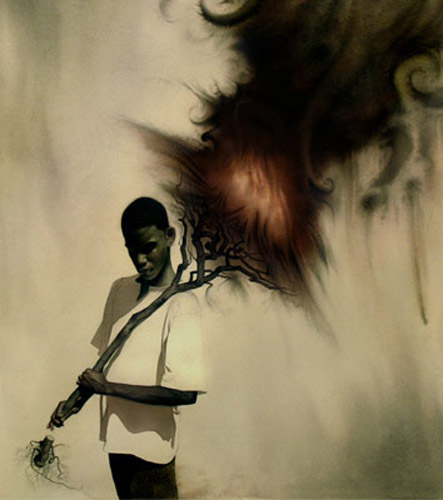
Julie D., of Forgotten Classics podcast (and a contributor to SFFaudio), has just wrapped up the final installment of her wonderful reading of The Wonder Stick by Stanton A. Coblentz. It was Coblentz’s first novel. You can kind of tell it his first novel, much of the dialogue is rather simplistic, especially with crowds of cavemen speaking like a Greek chorus (but then again, cavemen probably weren’t super eloquent). I get the sense that kids will really dig this adventure. Had I read it, when Julie had (in junior high school or high school), I’d have probably have enjoyed it even more than I did.

The Wonder Stick is the story of Ru, a young caveman who’s an outsider. Ru is scorned by his community despite his superior intellect, insight and cunning. In the end Ru triumphs, and gets the respect he so rightly deserves. It’s really the story of the original triumph of the nerds.

What The Wonder Stick doesn’t quite have is the modern ethos of the nerds (it is also absent from the W&N video), namely: We don’t need the respect of the non-nerds. We have our own community. So, to my young friend, and to all you nerds, I highly recommend downloading…
Forgotten Classics presents… Stanton A. Coblentz’s The Wonder StickThe Wonder Stick
By Stanton A. Coblentz; Read by Julie D.
Podcast – [UNABRIDGED]
Podcaster: Forgotten Classics
Podcast: May – September 2008
A prehistorical science fiction novel that does everything but invent the wheel. The “wonder-stick” of the title, is a real invention which provided an unparalleled quantum leap in human technology.

|MP3| Chapters 1 – 2 |MP3| Chapters 3 – 5
|MP3| Chapters 6 – 7 |MP3| Chapters 8 – 10
|MP3| Chapters 11 – 12 |MP3| Chapters 13 -15
|MP3| Chapter 16 |MP3| Chapters 17
|MP3| Chapters 18 – 19 |MP3| Chapters 20 – 21
|MP3| Chapters 22 – 24 |MP3| Chapter 25 – 26 & Conclusion

and then watching…

Posted by Jesse Willis

CANADIA: 2056 coming to CD

SFFaudio News

Canadia: 2056Good news for radio drama fans! Greg DeClute, a producer at CBC Radio One, informs me that:
“…the second season of Canadia will be released on CD in time for Christmas. The CBC will start taking
pre-orders on November 17. People can order it from the Canadia site or
from the CBC shop.”

Greg is referring of course to the second season of CANADIA: 2056, which aired earlier this year on CBC Radio One stations across Canada. Season one, by the way, is already available in a 5 CD set.

Posted by Jesse Willis

Review of Journey to the Center of the Earth by Jules Verne

SFFaudio Review

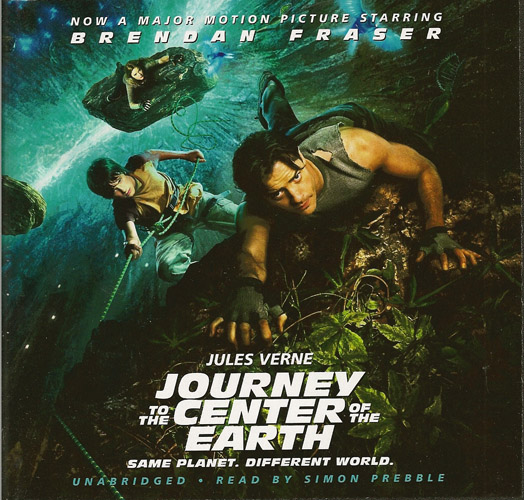
Science Fiction Audiobook - Journey to the Center of the Earth by Jules VerneJourney to the Center of the Earth
By Jules Verne; Read by Simon Prebble
7 CDs – 7.5 hours – [UNABRIDGED]
Publisher: Blackstone Audio
Published: 2008
ISBN: 9781433243806
Themes: / Science Fiction / Classic / Geology / Dinosaurs /

In listening to Jules Verne’s Journey to the Center of the Earth, I was struck by how much modern films like Raiders of the Lost Ark and National Treasure owe to this book. Although it was written way back in 1864, while the War Between the States was in full swing and the earth was a very different place, in many ways its thoroughly modern, at home alongside recent sci-fi novels like John Crichton’s Jurassic Park.

In summary, Journey to the Center of the Earth is a fast-paced and lively pseudo science/exploration story that manages to be mostly interesting and entertaining. Unfortunately, it also crosses over into unbelievable territory about three-quarters of the way through and ends with a classic deux-ex-machina, but I found I can live with it.

Journey to the Center of the Earth takes aim at the theory that the earth grows hotter the nearer that you travel to its center. Verne posits the idea that the earth’s core is inhabitable and houses massive cavities, caverns so huge that you cannot see their roof. At its center is a sea large enough that you can travel across its and lose sight of land all around. Science has of course since proven this idea impossible, but it makes for a fun story if you divorce it from reality.

Journey to the Center of Earth has a compelling opening that reminded me of The DaVinci Code–Professor Liedenbrock and his nephew Axel, the heroes of the story, find a coded note written in runes within the pages of an Icelandic saga. They puzzle through it and discover that it is a note written by Arne Saknussemm describing a passage he has found to the center of the earth. The opening is located in the interior of a dormant volcano in Iceland. Liedenbrock and Axel recruit an Icelandic guide and the three men embark on their journey.

I found Verne’s descriptions of overland and sea travel to Iceland interesting, and the first scenes of the descent fascinating. Verne vividly portrays the vast depths and terrifying downward drops of the volcano draft, and creates excitement and dread in two sequences in which Axel gets lost in the inky blackness and the three men nearly die of thirst.

Unfortunately I thought that the tale started to unravel once the men near the earth’s center, which contains ice age creatures, dinosaurs, and even early men. If the story didn’t literally jump a shark it certainly started to lose me once Liedenbrock and Axel’s small boat passes very nearly over an Ichthyosaurus. I was also puzzled with the abrupt ending–Liedenbrock and Axel gain great fame from their expedition, while others treat their claims with skepticism. But, inexplicably, no one ever bothers to re-trace their footsteps and verify their claims.

Still, you could do worse than pass the time by giving it the book a listen. It’s also skillfully read by English-accented, professorial-sounding narrator Simon Prebble.

Posted by Brian Murphy

Escape Pod Features “Reparations” by Merrie Haskell

SFFaudio Online Audio

A new Escape Pod episode…

“Reparations”
By Merrie Haskell; Read by Mary Robinette Kowal
1 |MP3| – [UNABRIDGED]

Subscribe to the podcast via this feed:

http://escapepod.org/podcast.xml

Posted by Charles Tan

SFFaudio Challenge title: Space Tug by Murray Leinster on LibriVox

SFFaudio Online Audio

SFFaudio’s Make An Audiobook Win An Audiobook Challenge #2Who’s the narrator that’s a reading machine to all the listeners?
MARK!
Ya, damn right!

Who is the man that would complete the challenge for his brother man?
MARK!
Can you dig it?

Who’s the cat that won’t cop out when there’s unrecorded audiobooks all about?
MARK!
Right On!

They say this cat Mark mutters…
SHUT YOUR MOUTH!
I’m talkin’ ’bout Mark!
THEN WE CAN DIG IT!

He’s a complicated man
But everyone understands his letter clear readings
MARK NELSON!

Damn straight! The latest Mark Douglas Nelson read audiobook has just posted to the LibriVox library. Mark’s got the voice that makes all the listener’s say aww-yeah. And, he’s choosing the books that make you say boo-yah. Best of all, he’s making them PD (free for all, for all-time).

Librivox Science Fiction Audiobook - Space Tug by Murray LeinsterSpace Tug
By Murray Leinster; Read by Mark Douglas Nelson
11 Zipped MP3s or Podcast – 6 Hours 18 Minutes [UNABRIDGED]
Publisher: LibriVox.org
Published: September 16th, 2008
Joe Kenmore heard the airlock close with a sickening wheeze and then a clank. In desperation he turned toward Haney. “My God, we’ve been locked out!” Through the transparent domes of their space helmets, Joe could see a look of horror and disbelief pass across Haney’s face. But it was true! Joe and his crew were locked out of the Space Platform. Four thousand miles below circled the Earth. Under Joe’s feet rested the solid steel hull of his home in outer space. But without tools there was no hope of getting back inside. Joe looked at his oxygen meter. It registered thirty minutes to live.

Subscribe to the podcast:

http://librivox.org/bookfeeds/space-tug-by-murray-leinster.xml

Posted by Jesse Willis

Review of Spin by Robert Charles Wilson

SFFaudio Review

Spin by Robert Charles WilsonSpin
By Robert Charles Wilson; Read by Scott Brick
Audible Download – 17 Hours and 33 Minutes – [UNABRIDGED]
Publisher: Macmillan Audio
Published: 2008
Themes: / Science Fiction / Hard SF / Medicine / Time / Space / Physics /

This Hugo Award winning novel (2006) is a novel of two parts in my mind. The first, which involves the covering of the entire Earth with a complex membrane, is some of the most exciting hard science fiction I’ve read in a long time. Picture yourself lying on a lawn, looking up at the stars… and they go out. As awe-inspiring as a Clarke novel, Wilson tells us what the world’s scientists come up with as they try to answer the big questions. What is happening? Why is it happening? Is there a “who” behind it? An outline of this book could be written that would look like a knotted string, each knot being an important and sometimes jaw-dropping idea. “The Spin”, as the phenomenon is called by the characters, grips the Earth tightly and apparently permanently. Initial discoveries find that the membrane has created a time difference between life on Earth and life in the rest of the universe. A minute passes here while years pass out there. A few days of time here, and empires would rise and fall outside, if they existed. Do they?

The second part of this novel is the connecting material, or the rest of the string. I didn’t find this as interesting as the Big Idea stuff while I was listening. In retrospect, I do appreciate what Wilson illustrated with his characters, but the plot won’t be what I remember when I talk about this novel in the future. Frankly, about halfway through the novel, I wanted to skim the sections that focused on the characters, not because they were poorly written, but because I simply couldn’t wait for what was really interesting me about the novel – more info about “The Spin”. Of course, I can’t skim an audiobook, so I dealt with the suspense and just kept listening. (Note to self: Add “lack of ability to skim” to the list of plusses for audiobooks. If I had read this book in print I would have skimmed – this way I got the whole novel.)

The story is about three main characters. Jason and Diane Lawton are the twin children of an entrepreneur. Tyler Dupree, the first person narrator, is a close friend. The three, as children, witness the beginning of “The Spin” together, lying on a lawn at a party attended by their parents. The event alters their lives, and the lives of all humans, but time marches on, the kids grow up, and, though each one lets “The Spin” define their lives, they each deal with the new reality in a completely different way. It is there that my appreciation for this aspect of the novel lies; how different we all are, and how different our reactions to the very same event. Some turn to religion, some turn to science, some to their business, and some to help their fellow man.

I’m not a person who dislikes a good character driven story. If I’m reading a piece of fiction that’s not genre, I’m likely to be reading something from the general fiction section of the bookstore, as opposed to mysteries or military thrillers. But still, I found it difficult to focus on parts of this novel, probably because I was listening to a story largely about people reacting to “The Spin”, rather than a story about the people that were actively trying to figure it out. Though one of the three main characters is indeed a scientist that is deeply involved, I wasn’t hearing a story about those scientists and exactly what they were doing. In other words, a lot of really interesting stuff is happening off stage while the novel was focused elsewhere.

Scott Brick narrates, always a plus from my perspective, and is a great match with this book. He does very well with science “ooo wow” moments, and there are plenty here. A quibble for the accuracy department: a mispronounced word that unfortunately is used often during a portion of the book. “Oort cloud”.

All in all – another fine audiobook from Macmillan Audio – it is available exclusively as a download from Audible and iTunes.

Posted by Scott D. Danielson