Review of The World Set Free by H.G. Wells

H.G. Wells Month

Science Fiction Audiobook - The World Set Free by H.G. WellsThe World Set Free
By H.G. Wells; Read by Shelly Frasier
1 MP3-CD or 6 CDs – Approx. 6.5 Hrs [UNABRIDGED]
Publisher: Tantor Media
Published: 2002
ISBN: 1400150108 (MP3-CD); 1400100100(CDs)
/ Science Fiction / Atomic Power / Atomic Bombs / War / Utopia / Politics / Futurism / Prophecy / World State /

“Never before in the history of warfare had there been a continuing explosive; indeed, up to the middle of the twentieth century the only explosives known were combustibles whose explosiveness was due entirely to their instantaneousness; and these atomic bombs which science burst upon the world that night were strange even to the men who used them.”

The Father of Science Fiction first works are still among our classics. With excellent treatments of alien invasion (The War of the Worlds), space travel (First Men in the Moon), proto-genetic manipulation (The Island of Dr. Moreau), and of course time travel (The Time Machine). In his first decade of a writer he had written these classics as well as The Invisible Man, and The Food of the Gods, as many classic short stories.

Wells continued his writing career for another 40 years. Always remaining a popular author. So what happened to all these books he wrote? What happened to this iconoclast of SF? Why were his later works seldom reprinted and so hard to find? In his day, books like Tono-Bungay and Ann Veronica were huge critical and commercial successes. Thanks to Project Gutenberg and other public domain sites, his more obscure works are now obtainable. Much of his later work does not qualify as SF. But there are a number of his novels that deal with prophecies and future utopias and do qualify as SF.

The World Set Free was one of those future visions. Written and published upon the cusp of World War I, the novel proves that Wells had a gift for prophecy, although many of the details played out in a different way. In the novel the World War would not occur till 1956.

The main impetus of the novel is the advent of atomic power, both as a bomb and as a power source. The atomic bomb has many similarities to the actual bombs, including decaying radiation. Wells’ portrait of a World War would lead to numerous atomic bombs destroying civilization.

Wells had hoped from the ashes of a World War that nationalism would dissolve and a new world state would evolve. He portrays the World War in a horrific way. For one who saw the war as a way to a new world order, he does not handle the horrors of war with kid gloves.

Wells uses a narrative device that this book is written from a far utopian future. And from this far future perspective, it tells of the dark days of the war and then of the end of countries and the beginning of the world state. The tone is scholarly and leaves the listener/reader distanced from the characters.

I believe Wells started to see himself as an educator to the masses. That through his writing, both fiction and non-fiction, he could change the world. Sounds like a maniacal delusion, but he was an extremely popular writer. He was the equivalent to a rock star in terms of cultural popularity, but with the intellectual clout of an author. Unfortunately this didactic charge, he placed on himself, put storytelling subordinate to the message. Despite these flaws, the novel is filled with many thought provoking ideas.

Shelly Frasier narrates the novel. After an introduction, in which she speaks with an American accent, she switches to an English accent for the text of the novel. After getting use to this change, I found her accent and characterization quite good and she turns in a solid performance.
The Time Traveler Show #17 participates in our H.G. Wells Month

H.G. Wells Month

Podcast - The Time Traveler ShowThe Time Traveler Show podcast #17 is all about our author of the month, H.G. Wells! Upfront is the announcement of a new guest-host contest that The Time Traveler is holding. Prizes included, besides the chance to host one of the best podcasts in the podosphere, are SIGNED copies of awesome Charles Stross audiobooks, and an advanced reading copy of Tobias Buckell‘s newest novel! The meat in this chronological sandwich is a reading of H.G. Well’s 1901 short story, The New Accelerator, is read by Bromley native Tim Rowe. Wells too was born and raised in Bromley, a suburb of London, and so that’s why I think this reading is likely to be the most faithfully accented Wells story ever attempted. Even better, Rowe has a melodic professional delivery. Check it out…

The Time Traveler Show #17 The New Accelerator by H.G. WellsThe New Accelerator
By H.G. Wells; Read by Tim Rowe
1 MP3 File – [UNABRIDGED]
Podcaster: Time Traveler Show.com
Podcast: April 2007

Subscribe to the podcast to listen for free:

http://www.timetravelershow.com/shows/feed.xml

Review of The Chief Designer by Andy Duncan

SFFaudio Audiobook Review

Audiobook - The Chief Designer by Andy DuncanThe Chief Designer
By Andy Duncan; Read by Jared Doreck
2 CDs – 132 minutes – [UNABRIDGED]
Publisher: Infinivox
Published: 2006
ISBN: 1884612547
Themes: / Science Fiction / Alternate History / Space Flight / History / Ghosts / Heroic Journey /

“Tsiolkovsky,” he said. “Your memory is excellent, Comrade Korolev.” The man who had held the open book before Korolev’s face reversed it and examined it himself. He wore a full-dress officer’s uniform, and two soldiers flanked him. “Exploration of Cosmic Space with Reactive Devices, by Konstantin Tsiolkovsky. Published 1903.

Though you’d be hard-pressed to spot the fantastic elements this tale is a inspirational and deeply moving for any true Science Fiction fan. I’m not a spiritual person, I think that spirit is bunk and people who believe in spirit are all marks. But in a very deeply emotional sense I can almost understand the need for something like the spiritual when I look up into the deep night. There is nothing more powerful than seeing the immensity of existence and then comparing our thus far pitiful explorations to them. Those persons with the will to embrace the larger goals of space travel, by passing by the little miasma of our insignificant apish little goals, to get a shiny new car, a cell phone or an expensive suit are those worthy of worship. One such man was Sergei Korolev, the “Chief designer” of the secret Soviet space program. This story follows his management of the men who would create the universe’s only known spacefaring species from 1957’s Sputnik forward into what we can only hope would be a bright future. The story spans from World War II, when Korolev was released from a prison camp to design rockets, to 1997 and the Mir space station.

Andy Duncan is not someone I’d read anything of prior, but his work here is remarkable. If this wasn’t supposed to be Alternate History, and it is very subtle if it is even that, I’d have said the story of Koralev’s life history was massaged to provide a more ballistic plot. Though Koralev was sent to the Gulag, as depicted in the opening sentences of this novella, the reason for his departure from it didn’t happen, in real life, for the reasons stated in the story.

Michael Swanwick called The Chief Designer, “A portrayal … of the single most positive enterprise of the twentieth century”, and he is right, but too limiting, Koralev’s genius, along with men like Wernher von Braun was to expand the meaning of humanity from mere animal to demi-god. Before these men, their vision and action, we were just animals with tools and language, afterwards we became creatures capable of refining the metal of the crust of the planet upon which we were born, shaping it into cylinders filled with explosives and sending our representatives to other worlds. The Chief Designer is a portrayal of the single most important enterprise in human history! Koralev is in a very real sense our real life Titan, our very real and historical Prometheus, stealing fire from the gods and giving it to humanity.

The Chief Designer is winner of the 2002 Theodore Sturgeon Memorial Award, the Southeastern Science Fiction Achievement Award, a 2003 Nebula Award finalist and a 2002 Hugo Award finalist. Today we can add SFFaudio Essential to its many achievements.

Posted by Jesse Willis

Review of The Prestige by Christopher Priest

SFFaudio Audiobook Review

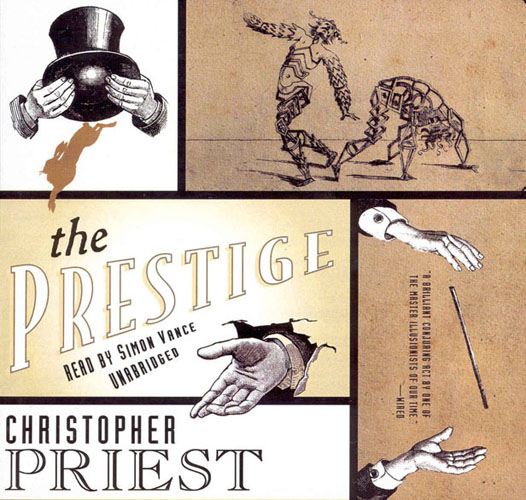
Fantasy Audiobook - The Prestige by Christopher PriestThe Prestige
By Christopher Priest; Read by Simon Vance
10 CDs – 12 Hours [UNABRIDGED]
Publisher: Blackstone Audio
Published: 2006
ISBN: 0786168412
Themes: / Science Fiction / Magic / Magicians / 19th Century / Electricity / World Fantasy Award /

It’s difficult to say how long it’s been since I’ve been so enthralled with an audiobook as I was with this unabridged version of the World Fantasy Award-winning The Prestige. In very few words, the production was excellent. Simon Vance narrated, and since the story is primarily told through journal entries of the two main characters, he was basically called upon to portray these two dark, intricate magicians. He unreservedly succeeded – his performance was stellar. Because of his subtle care, the surprises of the novel were enhanced by his reading. And there are many surprises.

The main characters are late 19th century stage magicians (or “prestidigitators”, as they call themselves) named Alfred Borden and Rupert Angier. They perform in London, but at the height of each magician’s popularity, they tour America and Europe. But not together. No, these two guys are mortal enemies, out to better the other by whatever means necessary. Each one in turn performs a trick on stage that seems impossible to the other, and their personal quests are rooted in finding out how the other does it, and then to perform it better.

The novel is filled with fascinating detail about these magicians and their tricks. But even more interesting are the journals themselves. It becomes quickly apparent that the journal writers are not reliable. Christopher Priest was masterful in the way he made sure that the journal writers were speaking squarely from their own point of view, which was not always technically true; rather, like journal writers everywhere, they would write something about their own motives that justified events to themselves. The result is an intricate web that is slowly unraveled throughout the book. It’s an audiobook that merits a second listen; knowing what I know now, having finished, a second listen would reveal the breadcrumbs I missed along the way. I suspect I left several on the trail.

Also prominent is Priest’s portrayal of life in the 19th century. The values, the language, and the daily life of the characters all feel accurate, though I am no 19th century historian. The world’s reaction to the advent of electricity is a fascinating example. I couldn’t help but to think of modern parallels with the advent of the internet.

At first glance, this novel is fantasy. It even won the World Fantasy Award in 1996. But is this a fantasy novel? It really isn’t. Yes, there are magicians here, but they are stage magicians. As such, their tricks have perfectly reasonable explanations. Each of the main characters do specific remarkable things, but the reasons given for the way these things work are not magical, but scientific. More, I will not say, because this is a novel to be discovered for yourself, not to be read about. After I finished the book, I watched the recent film version. Be assured that there are enough major differences that a listen to this book will be a different (though similar) and very worthwhile experience – worthwhile enough to be the latest addition to SFFaudio’s Essential List.

Audio Sample: LINK

Posted by Scott D. Danielson

CBC Radio One interview with Matt Watts writer of Canadia: 2056

SFFaudio OnlineAudio

Canadia 2056How dedicated am I to interesting you in listening to CBC Radio One’s new audio drama series Canadia: 2056?

VERY! And I’ll prove it…

I’ve got a snippet of the Q interview with Matt Watts (writer/star) of the show.

Download the |MP3|, but after listening to the clip be sure to tune in to hear the entire interview. It’s on TODAY! Check your time zone HERE for when exactly. Canada on CBC Radio 1.

Tune in tomorrow for… the first episode of Canadia: 2056 airs this Friday at 11:30 AM on CBC Radio One.

Another Hugo Nominee, FREE: Inclination by William Shunn

SFFaudio OnlineAudio

SF author William Shunn has spun off a lean and mean fiction version of his regular podcast. The debut tale is his Hugo nominated novella Inclination available in three parts on Shunn’s cleverly titled ScienceFicShunn podcast. Here are the details…

Inclination by William ShunnInclination
By William Shunn; Read by William Shunn
3 MP3s – Approx. 2 Hours 10 Minutes [UNABRIDGED]
Podcaster: Science Fic Shunn Podcast
Podcast: April 2007

Get all three parts:
|Part 1 MP3|Part 2 MP3|Part 3 MP3|

Or subscribe to podcast via this feed:

http://www.shunn.net/shunn.xml