Review of King Kong by Edgar Wallace and Merion C. Cooper

SFFAudio Review Header

Science Fiction Audiobooks - King KongKing Kong
By Edgar Wallace and Merion C. Cooper; Read by Stefan Rudnicki
5 CD’s, 5.5 hours – [UNABRIDGED]
Publisher: Blackstone Audio
Published: 2005
ISBN: 0786175362
Themes: / Science Fiction / Horror / Movie making / Gorillas / Dinosaurs / Commentary /

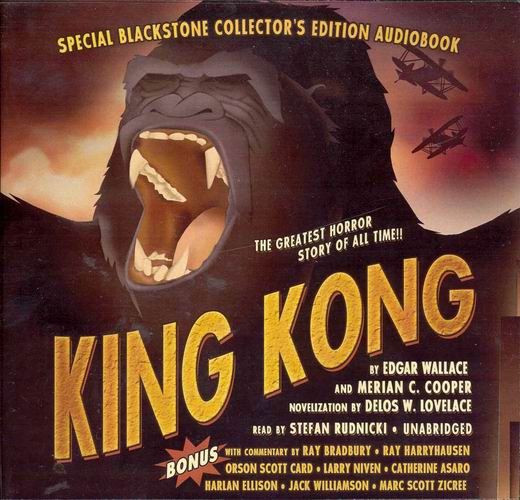
This audiobook has two phrases emblazoned on the cover: “Special Blackstone Collector’s Edition Audiobook” and “The Greatest Horror Story of All Time!!” (both exclamation points are there…) Of the first phrase I can say that this audiobook is certainly special. Not only does it include the unabridged audio version of the novelization of the original King Kong film, but it also includes a bonus disc containing commentary from Ray Bradbury, Ray Harryhausen, Orson Scott Card, Larry Niven, Catherine Asaro, Harlan Ellison, Jack Williamson, and Marc Scott Zicree. Is it the greatest horror story of all time? Not in my eyes, but the words fit nicely on this gorgeously packaged audiobook.

The original King Kong film (1933) holds a special place in a lot of hearts. I don’t share those feelings, possibly because the film predates me by 35 years. I recall more details about the 1976 remake starring Jessica Lange than I do the original. I was 10 in 1976 and, since that version of King Kong was mediocre, it stirred little in me. News of Peter Jackson’s remake didn’t excite me.

But this audiobook has awakened my interest in a big way, for two reasons. First, the story itself. Engagingly read by Stefan Rudnicki, the story of Kong, Denham, Ann Darrow, and Jack Driscoll is really a good story. The filmmaker Denham’s recklessness, actress Ann Darrow’s willingness to go along, and Jack Driscoll’s love keep things very interesting. Kong, of course, is the character around which the story revolves, and his journey from island to New York City and from beast to human-like ape fascinates.

The second thing that sparked my interest is the commentary. I loved the commentary included here. All of the people I mentioned above had a different and interesting take on King Kong, from Harlan Ellison’s declaration of the original film’s perfection to Catherine Asaro’s discussion of power unused. After listening to this, I’m now eager to see the new film, and even more eager to watch the original.

It would be an excellent thing if other books are given similar treatment. Unabridged classic science fiction novels with commentary would add a new and greatly appreciated dimension to the audiobook experience. Kudos to Blackstone for giving us this Special Edition.

Posted by Scott D. Danielson

Tee Morris, Fantasy author and gonzo podcaster h…

News

The Survival Guide To Writing Fantasy PodcastTee Morris, Fantasy author and gonzo podcaster has scooped an interview with Robert J. Sawyer for The Survival Guide To Writing Fantasy podcast. This is a great pairing, both Tee and Rob are success oriented authors with great marketing chops. Check it out HERE or subscribe to Tee’s podcast through iTunes. Especially cool is the talk about the marketing of Rob’s first novel, Golden Fleece, one of the best Science Fiction / Mystery novels not available as an audiobook.

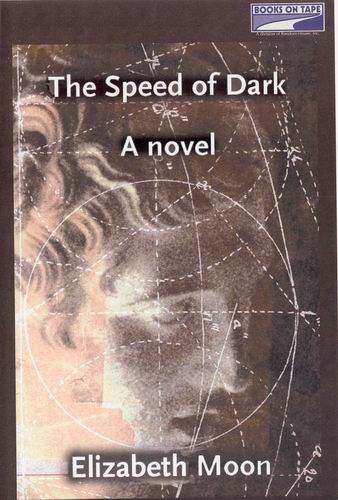
Review of The Speed of Dark by Elizabeth Moon

Science Fiction Audiobook - The Speed of Dark by Elizabeth MoonThe Speed of Dark
By Elizabeth Moon, Read by Grover Gardner
9 cassettes – 13 hours [UNABRIDGED]
Publisher: Books on Tape, Inc.
Published: 2003
Themes: / Science fiction / Gene Therapy / Autism /

In the near future, disease will be a condition of the past, cured genetically at birth or soon afterward. But for the generation born before this development, it is too late, and they must get along as best they can. Lou Arrendale is in this lost generation. He is a high-functioning autistic with a job, friends and a love of fencing. But now, an experimental treatment will cure his autism. The question is, will he be the same person after he receives the treatment?

This is the first time I’ve been really happy that a book was on tape as opposed to CD. Normally I like not having to change cassettes or flip them over, but The Speed of Dark hooked me so deeply that I took it everywhere with me. I dragged my little portable tape player around the house and then would pop the tape out and put it in the car stereo while I was running errands. I couldn’t stop listening.

Most of the novel is told from Lou Arrendale’s first person point of view and Grover Gardner gave a pitch-perfect performance. His clipped and precise delivery captured the precision with which Lou dealt with the world. Coupled with Ms. Moon’s evocative language, the story unfolded with the inevitable beauty of a Bach cantata–events surprised me, but there was no other way for the story to unfold.

One of the most fascinating things was how Ms. Moon dealt with Lou’s perceptions of normal people. He had been taught that it was rude to interrupt other people, but normal people could interrupt and it was not rude. He is fascinated by how normal people can pick up on subtle social cues so that they seem to read each others minds. His wonder at the complex pattern of group conversation is so palpable that I felt it too, and found myself watching a conversation of my friends with some of the same awe. How do we know when it’s time to stop talking and let someone else, or when it is okay to interrupt and when it is not?

Other sections of the book are briefly told from the point of view of other characters, but Ms. Moon stays with third person for them. The writing is as clear, but I never connected with the other characters and sometimes found myself shifting in my seat, anxious to get back to Lou. These sections provide necessary plot information, and are also a fine way to view Lou from the outside. I suspect that in written format, my impatience would be less pronounced, but since Lou’s sections are in first person I came to associate Mr. Gardner’s voice with Lou. When he was reading other characters it seemed like a mask. A good mask, but I wanted Lou back.

And that is the crux of the novel. Ms. Moon made me care about Lou by showing me the inside of his thoughts. I could not fathom how he could possibly be the same person if he were not autistic. The dilemma is fascinating.

I won’t tell you what decision Lou makes in the end. Why? The gift-giving season is upon us; rather than recommending this as an item for your gift-giving list, you should have a copy of The Speed of Dark for yourself.

Posted by Mary Robinette Kowal

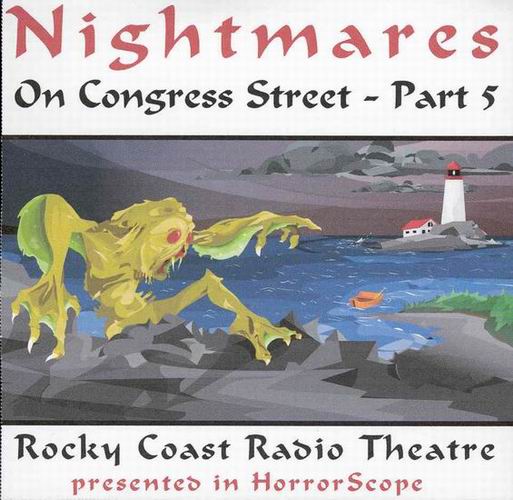
Review of Nightmares on Congress Street, Part 5

SFFaudio Review

Nightmares on Congress Street 5Nightmares on Congress Street – Part 5
By Rocky Coast Radio Theatre; Performed by a Full Cast
2 CD’s – 2 hours [AUDIO DRAMA]
Publisher: Rocky Coast Radio Theatre
Published: 2005
Themes: / Horror / Science Fiction / Murder / Government / Spirits /

Here’s another top-notch title from Rocky Coast Radio Theatre out of Maine. It contains seven dramatized horror tales:

The Demon of the Gibbet by Fitz-James O’Brien
A horror poem, very nicely rendered.

The Tell-Tale Heart by Edgar Allen Poe, adapted by Patrick Bradley
A modern adaptation of Poe’s classic story. Nightmares on Congress Street, Part IV contained Poe’s “A Cask of Amontillado” presented traditionally – this one is also excellent, but the script updates the story to a modern setting.

Retroactive Anti-Terror by Alex Irvine, adapted by William Dufris
This science fiction story portrays a different type of horror – a future where people are prosecuted for what they might do. Alex Irvine’s original story appeared in Salon.com in 2004. The story makes a clear political statement which people from all viewpoints would benefit from hearing.

Much A-Zoo About Nothing written and performed by Michael Duffy
A humorous song in which a guy goes to a zoo and encounters “ten green men with super suits on”.

The Wind by Ray Bradbury, adapted by William Dufris
It starts when Alan calls Herb on the phone obviously very nervous. After a little prodding by Herb, Alan reveals that it’s the wind he’s so worried about, and the tense story takes off from there. Bradbury probably has more stories available as audio drama than any other author, and this wonderful adaptation has me hunting for more.

The Door Below by Hugh B. Cave, adapted by William Dufris
Another good horror story that takes place mostly in a lighthouse… ghosts, anyone?

The Statement of Randolph Carter by H.P. Lovecraft, adapted by William Dufris
This is my favorite of the collection. Dufris and crew perfectly capture the creepy horror of Lovecraft’s original story.

Nightmares on Congress Street V is the second title I’ve heard from Rocky Coast, and I’m convinced that they are one of the top current producers of audio drama. With first-rate acting, the careful placing of sound effects, very good music, and fantastic scripts, these stories capture and hold tight. I can’t recommend this title highly enough for fans of audio drama and horror.

You can get this title from Paperback Digital, Tantor Media, Amazon, and Audible.

Posted by Scott D. Danielson

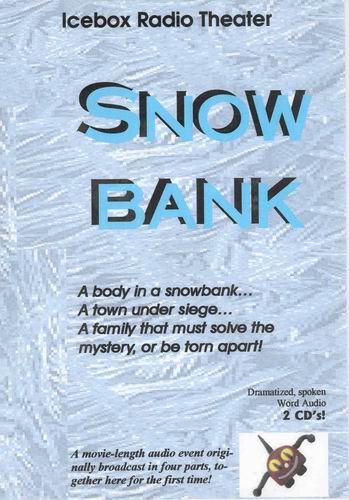
Review of Snow Bank by Jeffrey Adams

Science Fiction Audio Drama - Snow BankSnow Bank
By Jeffrey Adams, performed by Icebox Radio Theater
2 CDs – 115 minutes [UNABRIDGED 4 part serial]
Publisher: Icebox Radio Theater
Published: 2004
Themes: / Science Fiction / Alien / Mystery / Teen Drama

A body in a snowbank…
A town under siege
A family that must solve the mystery, or be torn apart!

If you had to do a high-concept pitch for Snow Bank you’d probably wind up saying “X-files meets the Bobbsey Twins.” Sean (Brock Krahnke) and his twin sister Bobbie (Anna Remus) discover a body under a snowbank next to their school. Despite warnings from their father, the local D.A., the twins set out to investigate the murder themselves. What follows dips into UFOs, alien scientists and twin psychic connections. They even manage to pull off a car chase in radio. That’s pretty impressive.

The story is all over than map and unfortunately wraps up in the final episode with a long expository scene which, maddeningly, says that the car chase was a hallucination–which both twins shared. There are logical inconsistencies in the story and unresolved questions which left me very frustrated. For instance, I can’t give you a spoiler on how the dead body got in the snow bank because they never explain it.

The acting in this is very strong with only one or two exceptions. What is most impressive about the production is that it was originally broadcast live. When I listened to the first episode I was troubled by some over-modulation on the microphones, but when I listened to the outro and realized that I had just heard a live performance, I was stunned. The performances are tight and the Foley is beautifully handled to create an aural picture of what is happening. Both Krahnke and Remus turn in really compelling performances. In particular, when Remus’s character, Bobbie, is sent to a juvenile detention center you can hear her character change posture from a cocky teenage girl, to an insecure and frightened one.

So, although the story almost felt like they were making it up as they went, the execution makes Snow Bank worth listening to.

Posted by Mary Robinette Kowal

Review of House of Bones by Robert Silverberg

Science Fiction Audiobooks - House of Bones by Robert SilverbergHouse Of Bones
By Robert Silverberg; Read by Jared Doreck
1 CD – [UNABRIDGED]
Publisher: Infinivox
Published: 2005
ISBN: 1884612431
Themes: / Science Fiction / Time Travel / Prehistory /

Another stunning audio achievement from Infinivox! House Of Bones is a unique time-travel story that imbues a deep sense of satisfaction on nearly every level. A top shelf reading by a dynamic reader, a dynamite story and an elegant production combine to make pure aural delight! House Of Bones is a modest tale, recounting the unfortunate fate of the world’s first and perhaps last time traveler. After a misguided test run he’s become trapped 20,000 years in our past, unequipped for survival his future is uncertain. What’s worse he’s surrounded by people so primitive they don’t even have a written language. So primitive they take in his unworthy and skilless self and accept him into their society. This glimpse of what life might have been like for Cro-Magnon man in the late Pleistocene epoch shows us precisely why we can’t judge a society by it’s lack of tool based technology. Silverberg skillfully extrapolates a fascinating working culture out of what little modern archaeologists and paleoanthropolgists know of these people, our ancestors and creates in the process something to think about when using words like “primitive”. House Of Bones is kind of a mirror image of Isaac Asimov’s The Ugly Little Boy. And like that tale this one is a keeper.

Posted by Jesse Willis