Review of Ender’s Game: Special 20th Anniversary Edition by Orson Scott Card

Science Fiction Audiobooks - Ender's Game by Orson Scott CardEnder’s Game: Special 20th Anniversary Edition
By Orson Scott Card; Read by Stefan Rudnicki, Harlan Ellison, Gabrielle de Cuir, David Birney and a FULL CAST
9 CDs – 10.5 hours [UNABRIDGED]
Publisher: Audio Renaissance
Published: 2004
ISBN: 1593974744
Themes: / Science Fiction / War / Children / Military / Politics / Spaceships / Space Station / Aliens /

Andrew ‘Ender’ Wiggin isn’t just playing games at Battle School; he and the other children are being tested and trained in Earth’s attempt to find the military genius that the planet needs in its all-out war with an alien enemy. Ender Wiggin is six years old when his training begins. He will grow up fast. Ender’s two older siblings, Peter and Valentine, are every bit as unusual as he is, but in very different ways. Between the three of them lie the abilities to remake a world–if the world survives.

Many male children covet uniforms and the manly art of war – and on the surface that is what Ender’s Game appears to be about, a wish-fulfillment novel for the pre-teen set. But it isn’t only that. Science Fiction is an accumulative literature, perhaps more so than any other kind. Good creations stick in SF and accumulate and grow. Robots once invented, need not be reinvented. Faster than light travel, time travel or Asimov’s “three laws” are tools which once created need not be ignored as outside the scope of another SF novel, quite the contrary in fact. Simply ask yourself; in what other literature could a constructed story device like an “ansible” (invented by Ursula K. Le Guin in 1966 but used in Ender’s Game) be mentioned without renaming it? But it is not just the story props that SF shares, the concepts and themes of science fiction can never be fully appreciated in isolation. Every science fiction story is in dialogue with another.

Ender’s Game is especially engaged with two other superlative science fiction novels that preceded it, namely Robert A. Heinlein’s Starship Troopers and Joe Haldeman’s The Forever War, and like those two masterpieces of science fiction Ender’s Game has something new and unique to say. Whereas Starship Troopers can be viewed as the relationship between a teenager’s individualism and his relationship to society (a neo-Hobbesian social contract concept typical of mid-career Heinlien), and The Forever War as a discussion of that same relationship but with a college aged young man and his more skeptical worldview (the post Vietnam influence) Ender’s Game engages neither an adult’s nor a teen’s relationship to his society its war. Instead Ender’s Game is that relationship from a child’s perspective. It is also, paradoxically, not a grunt’s view of a war, as was the case with both Heinlein’s and Haldeman’s novels, but rather is about how the supreme commander of an interstellar war is created.

Orson Scott Card has not ignored the disconnect between a child’s desire to play at war and the brutal cost of killing, and the burden of ultimate responsibility. We primarily follow Ender and his classmates as they train to command Earth’s military in a genocidal war against a hostile alien threat, but the parallel story of his two siblings back on Earth compels equally. Each character in this novel is in a chess match of emotional and philosophical conflict with one another and their society. There are a few better hard science fiction stories, and a few better soft science fiction stories, but there are fewer science fiction stories as well constructed and emotionally satisfying as this one.

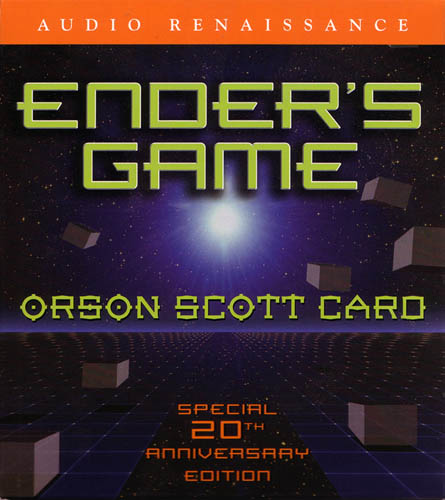
The 20th anniversary of the novel’s re-publication brought about this audiobook. It is regrettable that the cover art of this edition is as generic as it is because the folks at Audio Renaissance have quite literally have brought greatness to the text. They’ve included an introduction and a postscript read by Card himself, both of which place the novel and the audiobook in its context as well as enlightening us to the author’s method of its construction. Multiple readers lead by Stefan Rudnicki work perfectly to vocally illustrate each chapter, character and scene. Stefan Rudnicki, Harlan Ellison, Gabrielle De Cuir, David Birney and the rest of the readers have given us an audiobook perfectly rendered. In what is the pattern for the Enderverse novels adapted for Audio Renaissance readers trade off at the ends of chapters, and when two unplaced voices are unattributed – except by what they actually say – two actors engage in conversation. Multi voiced readings have never been better.

And so it is with great pleasure that we enter this Special 20th Anniversary edition of Ender’s Game as the first into the ranks of the SFFaudio Essential audiobooks.

Posted by Jesse Willis

The ::overclocked:: podcast

SFFaudio News

The ::overclocked:: podcast is waycool. Though it covers tech, science and lots of other things it is the “sci-fi” content that interests us most. Far more intellectual than nearly every other non-fiction podcasts that talks about science fiction ::overclocked:: doesn’t dwell on TV and movies as much as concepts and developments in modern Science Fiction literature. The man behind this cool Seattle based podcast is Bluejack, he’s also a contributing editor to the The Internet Review Of Science Fiction. Three ::overclocked:: podcasts defintely worth listening to are listed below:

The Singularity
Show #024
: The Singularity has been one of the most challenging new ideas in science fiction: challenging for writers to approach in interesting ways, as well as a challenge to everyone’s beliefs about the significance of humanity. This show discusses some of the specifics of Vinge’s idea, and presents some objections. It also takes a quick look at what the concept has meant for science fiction.

Post Humans
Show #017: Science Fiction has long explored ideas about the next step in human evolution: steps that we will consciously choose; science isn’t quite catching up on all fronts, but scientists are undermining the very notion of consciousness.

Genre Purists
Show #006
Reading stuff that might or might not be in the spirit of science fiction (or related genres) brings some new insight to bear on the age-old topic, debated by Genre Purists everywhere, of what is science fiction? Or what should it be?

Review of Technical Error by Arthur C. Clarke

Science Fiction Audiobooks - Technical Error by Arthur C. ClarkeTechnical Error
By Arthur C. Clarke; Read by David Zinn
37 Minutes – [UNABRIDGED]
Publisher: 2005
Themes: / Science Fiction / Hard SF / Parallel Worlds
/ Math Fiction /

Another FREE streaming audio short story by Arthur C.
Clarke from Assistive Media. An ingenious concept for a story, Technical Error shows why Arthur C. Clarke is who he is – excellent ideas executed intelligently. The premise is too good to spoil but I’ll give you a hint – imagine a world in which 90% of people are left handed.

This streaming audio story also includes a little introduction written by Clarke. Unfortunately David Zinn doesn’t pause between the introduction and the story’s start – making it slightly confusing. The reading is adequate; Zinn doesn’t have too much to work with given the dialogue and characters, since both are rather flatish. One more minor quibble, it sounds as if someone forgot to turn off the air conditioning in the recording studio.
Available at AssistiveMedia.org.

REALAUDIO LINK: http://www.assistivemedia.org/amrams/TechnicalError.ram

Posted by Jesse Willis

Review of The Harvest by Alec Sand

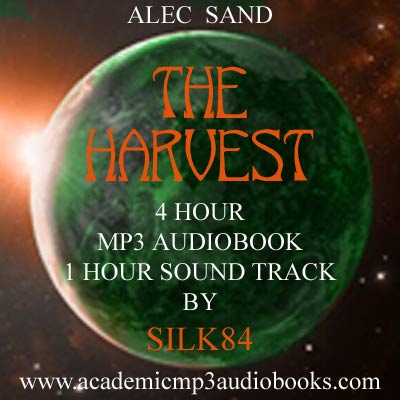
The Harvest by Daniel SandThe Harvest
By Alec Sand; Read by John Pruskin
1 MP3-CD – 4 hours [UNABRIDGED]
Publisher: Academic MP3 Audiobooks
Themes: / Science Fiction / Space Travel / Biology / Alien life / Medicine /

Click here for an Audio Trailer

The Harvest is a short novel of future history. No, it’s a bit more than just that. Alec Sand has created a detailed future in which his characters move. It is a future in which a substance called iridium has changed things significantly – it’s a substance from which power is derived and the finding and mining of iridium occupies much of mankind’s time. The Harvest is hard science fiction in which the ideas and concepts generously flow.

In this future, Gideon and his sister Dara reside. Dara has a disease that Gideon is somehow convinced has a cure somewhere “out there”, so he takes her with him on a mining expedition to a new planet. Dara finds much there.

There was some lecturing during the story, which I felt slowed things down a bit. The author could have found smoother ways to introduce information, but it was all interesting, and I found myself eager to know what happened next. I liked the story as a whole very much.

John Pruskin narrates, and overall was very good at keeping my interest. There were a few errors in the narration, but again – I was always eager to continue, and a listener can’t ask for much more than that. He maintained a good, consistent pace throughout and read with clarity.

A unique aspect of this audiobook is its soundtrack. There are several songs that play at various times throughout the audiobook, usually as bridges between chapters or sections. A band called Silk84 provides this music, and the songs are included in full in a different folder on the MP3-CD. I’m listening to some of this music as I write this… I like it! The music ranges from upbeat dance music to beautiful piano music, and though I didn’t always feel the music matched my mood while listening, what Academic did with music in this audiobook is unique and it worked! Yeah, Silk84… I like the sound of your guitar. (You can find Silk84 on iTunes.)

You can get a copy of The Harvest from Academic MP3’s website by clicking right here.

Posted by Scott D. Danielson

Review of Speaker for the Dead by Orson Scott Card

Science Fiction Audiobooks - Speaker for the Dead by Orson Scott CardSpeaker for the Dead
By Orson Scott Card; Read by David Birney, Stefan Rudnicki, Gabrielle de Cuir, John Rubinstein, Scott Brick, Amanda Karr, Lisa Nemacheck, Don Schlossman
12 CD’s – 14 hours [UNABRIDGED]
Publisher: Audio Renaissance
Published: 2005
ISBN: 1593974760
Themes: / Science Fiction / Relativistic Space Travel / Sentient Life / Families / Communities /

Have you ever wished your computer was an intelligent entity you could interact with? Yeah . . . me either. And why don’t we? Because one day when you sit down at your terminal the computer will ask you, “Shall we play a game?” And you’ll say, “How about some Halo 2?” And it will reply back, “How about Global Thermonuclear War?” And unless you think fast and figure out some child’s game that will teach the computer the pointlessness of nuclear war, you’re in a lot of trouble.

There are many other examples of the basic evilness of intelligent computers, like Hal 9000, the recently released Stealth and the entire world of The Matrix.

But in the world of Ender Wiggin there is Jane, restoring hope to all us social skill-less speculative fiction nerds that one day we can be adored by a digital babe. (And don’t give me that “I’m not a nerd, I’ve got skills” stuff–how many other artificial intelligence characters that I didn’t list have you thought of already? Hmm?)

As a sentient, non-human being that interacts with Ender via an interplanetary network of computers, Jane is the ultimate information resource. Not only is she not threatening humanity, Jane is pleasant, caring, and humorously informative. She is easily one of the most likable non-human characters you’ll read, but that isn’t why you should listen to this book.

You should listen to this book because it is a masterwork on human behavior. Orson Scott Card is often praised as a master developer of characters, but if every other book he has written had flopped, this book itself earns him that recognition.

Andrew (Ender) Wiggin was unable to return to earth after he destroyed the Formics in Ender’s Game. Racked by guilt after learning he destroyed a (relatively) innocent form of life, he wrote a book explaining the whole situation, and by doing so became the first “Speaker for the Dead.”

Fast forward a few thousand years. Andrew is only a couple decades older, thanks to the relativistic effects of space travel, and a mythology has developed about him. He is known historically as “Ender the Xenocide,” whose name evokes the same warm fuzzy feelings we associate with the name “Hitler.” “Andrew Wiggin” is also remembered, but as the writer of the near-canonized The Hive Queen and The Hegemon and initiator of the profession of speaking for the dead.

Those around him don’t know that both the Xenocide and the original Speaker were the same person, or that Andrew is him. Andrew is drawn to the colony planet Lusitania to help preserve another sentient species (the piggies). Speaker for the Dead picks up with events that lead to conflict between the piggies and humans, and Ender’s decision to go to Lusitania to help. There he meets the family of a man whose death he is to speak, and who are in the middle of the piggy problems via their scientific/anthropological roles.

As Ender comes to know the family we come to know and love them too. We learn what understandable need or desire or pain is behind their choices. For example, at no point do you agree with the mother’s behavior as years of angry distance from her children starts to bear bitter fruit. But you also see how love, pain and loss have distorted her reality. You despise her behavior, feel compassion for her suffering and understand her intentions. That is reality in all its rich, painful complexity.

But Speaker for the Dead does something even more amazing. It accurately shows the process of change. Change for an individual is a complicated enough process. Showing how a family changes is much more complicated. I am astonished at how accurate that process is portrayed in the book. I have yet to read another book that comes close to describing family change as well as Speaker for the Dead.

Having David Birney and Stephan Rudnicki both narrate the book is like have Shaq and Michael Jordan both on your team in a pick-up game. Those are the only two listed on the CD case, which is really unfair because there is an entire cast and not one person falls short of absolute excellence in their narration. They are the U.S. Olympic Team of readers. The others include Gabrielle de Cuir, John Rubinstein, Scott Brick, Amanda Karr, Lisa Nemacheck, and Don Schlossman.

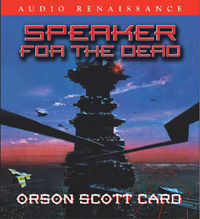
And while I’m complaining about the case, couldn’t they have put a relevant picture on it? That funky tower thing and the planet surface below it looks like Capitol, but that’s a whole other set of Orson Scott Card stories. I guess the publisher wants the association with the original book cover, but Jane or a pequenino, or any other image actually related to the story would have been nice.

And why stop my spiral of increasingly trivial complaints there? I decided I really don’t like cardboard flap-around cases for the CDs. They are harder to handle, which matters if you are listening while driving, and I think it is easier to scratch a CD in that than in the hard plastic cases with soft sleeves.

I find that I especially like listening to books I have read in the past. If you’re already a fan of Speaker for the Dead, the audio version is a must.

Posted by Mike