The Coming Of The Ice by G. Peyton Wertenbaker

SFFaudio Online Audio

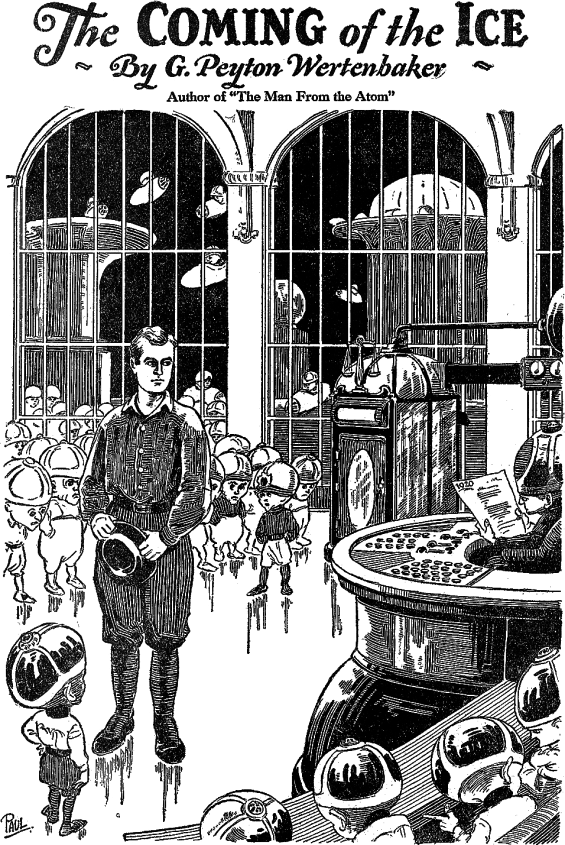
The Coming Of The Ice - illustrated by Frank R. Paul

I posted about this story, as part of a larger LibriVox collection, back in 2009. Then, I described it thusly:

The Coming Of The Ice explains the strange and sad fate of a man who undergoes an operation to make him immortal (and sterile).

I had somehow forgotten about it. But, as I heard someone describe it recently I was reminded of it, tracked it down again, and enjoyed it wholly afresh today.

The Coming Of The Ice deserves to be far better known. Not only is it a really terrific story, but the narration, by Giles Baker, is absolutely outstanding too!

Sam Moskowitz, in his introduction to the 1961 reprint of The Coming Of The Ice wrote the following about it:

One of the gravest editorial problems faced by the editors of AMAZING STORIES when they launched its first issue, dated April, 1926, was the problem of finding or developing authors who could write the type of story they needed. As a stop-gap, the first two issues of AMAZING STORIES were devoted entirely to reprints. But reprints were to constitute a declining portion of the publication’s contents for the following four years. The first new story the magazine bought was Coming Of The Ice, by G. Peyton Wertenbaker, which appeared in its third issue. Wertenbaker was not technically a newcomer to science fiction, since he had sold his first story to Gernsback’s SCIENCE AND INVENTION, The Man From the Atom, in 1923 when he was only 16! Now, at the ripe old age of 19, he was appearing in the world’s first truely complete science fiction magazine. The scope of his imagination was truly impressive and, despite the author’s youth, Coming of
the Ice
builds to a climax of considerable power.

Back in 1926 the editorial introduction, presumably by Hugo Gernsback himself, said this about The Coming Of The Ice:

This powerful and tragic story by the author of “The Man From The Atom” tells of a man who acquired terrestrial immortality – tells of a world many centuries hence – a time when everything is changed. This one man remains as a relic of the 20th century, He is alone with strangely developed human beings, the product of ages of evolution. Climactic changes are taking place. The world begins to grow cold. New York is almost in the Arctic region and Italy is covered with snow all the year around. In spite of their enormous intellectual development, all human beings must perish. Our hero alone can withstand the intense cold. He wanted eternal life – and he got it – eternal life, purely intellectual. What does he do with all his years? And how does he enjoy them?, Read this powerful story.

LibriVoxThe Coming Of The Ice
By G. Peyton Wertenbaker; Read by Giles Baker
1 |MP3| – Approx. 40 Minutes [UNABRIDGED]
Publisher: LibriVox.org
Published: February 4, 2009
“Strange men, these creatures of the hundredth century, men with huge brains and tiny, shriveled bodies, atrophied limbs, and slow, ponderous movements on their little conveyances … it was then that I was forced to produced my tattered old paper, proving my identity and my story.” First published in Amazing Stories, June 1926.

|ETEXT|

Here are two PDF versions:

Amazing Stories, June 1926 |PDF|
Amazing Stories, July 1961 |PDF|

[Thanks also to David T. and Carlo!]

Posted by Jesse Willis
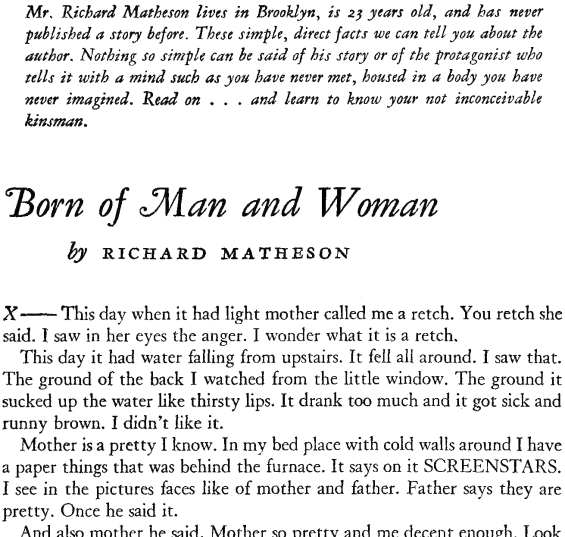
Future Tense: Richard Matheson’s Born Of Man And Woman

SFFaudio Online Audio

Richard Matheson’s first published story, Born Of Man And Woman, is a powerful three page Science Fiction Horror tale written in the form of a diary. An uneducated and abused child, our protagonist, is kept chained in the basement by his or her parents, he or she has never been outdoors or upstairs. It’s a thoughtful tragic masterpiece.

Though I take the title as an allusion to a line in William Shakespeare’s Macbeth it also, I think, adds a layer of depth to the story’s sketch.

Born Of Man And Woman by Richard Matheson from Fantasy & Science Fiction, Summer 1950


Future TenseFuture Tense – Born Of Man And Woman

Adapted from the story by Richard Matheson; Performed by a full cast
1 |MP3| – Approx. 10 Minutes [RADIO DRAMA]
Broadcast: WMUK Special Projects
Broadcaster: May 30, 1974
Provider: SciFi Friday
First published in Fantasy & Science Fiction, Summer 1950.

External |PDF|

Posted by Jesse Willis

The Risk Profession by Donald E. Westlake

SFFaudio Online Audio

One of my favourite writers, Donald E. Westlake, mostly left the SFF field for the greener pastures of crime fiction after the 1960s. He was very successful there.

The Risk Profession, first published in 1961, is a fun SF novelette and one well worthy of our continued attention.

Another guy who appreciated Westlake was my friend, Gregg Margarite, who narrated it for LibriVox back in 2010.

The plot, a murder mystery, concerns an insurance investigator who makes a trip to the asteroid belt to investigate the death of an asteroid miner.

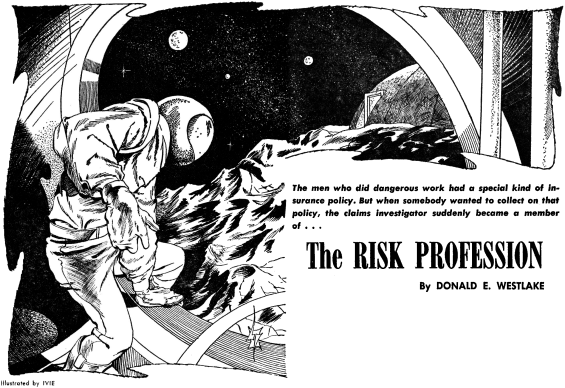
The Risk Profession by Donald E. Westlake - illustrated by Ivie

LibriVoxThe Risk Profession
By Donald E. Westlake; Read by Gregg Margarite
1 |MP3| – Approx. 1 Hour 4 Minutes [UNABRIDGED]
Publisher: LibriVox.org
Published: January 17, 2010
“The men who did dangerous work had a special kind of insurance policy. But when somebody wanted to collect on that policy the claims investigator suddenly became a member of… The Risk Profession.” First published in Amazing Stories, March 1961.

Here’s a |PDF| made from the publication in Amazing.

[Thanks also to Wendel Topper and Lucy Burgoyne]

Posted by Jesse Willis

The SFFaudio Podcast #220 – AUDIOBOOK/READALONG: The Machine Stops by E.M. Forster

Podcast

The SFFaudio PodcastThe SFFaudio Podcast #220 – The Machine Stops by E.M. Forster; read by Elizabeth Klett (for LibriVox). This is a complete and unabridged reading of the story (1 hour 13 minutes) followed by a discussion of it. Participants in the discussion include Jesse, Professor Eric S. Rabkin, and Mr. Jim Moon.

Talked about on today’s show:
Novelette or novella, novellini?, E.M Forster wrote some Science Fiction?, genre boundaries, H.G. Wells, adventure, horror, The Time Machine, a critique of English society, dystopias, diegesis, a didactic approach, The War Of The Worlds, a bogus bifurcation of the body and the spirit (or the mind), ambiguous possibility, the “Machine” of the titles, Morlocks and Eloi, a reversal, a complement, prophetic vs. appropriate, looking through my blue plate, this book is the biggest existential critique of my lifestyle, it was lovely to meet Jim and Eric, a caricature and a critique, blackberry season, a swaddled lump of flesh, a curiously intrusive narrative technique, a fable, author backchat, in C.S. Lewis’ Narnia, J.R.R. Tolkien, lampshading, breaking the fourth wall, an aural phenomena, a fable, a parable, philosophical scenarios, Plato’s Myth Of The Cave, The Republic, Socrates, ontological imaginary equivalents, The Metamorphosis by Franz Kafka, the narrator isn’t exactly human, “back chat”, man is not necessarily the measure of all things, empiricism vs. rationalism, the unanswerable questions of the stars, everyone is a lecturer in the future, “second hand ideas”, the French Revolution not as it was but as it might be in our society, Alexander The Great’s monstrous rampage through Asia, “the juice of the individual human experience”, we have many books, books as experience generators, Ion, J.R.R. Tolkien, “there is a muse”, the rhetor, aiming out of the subterranean, why are we obsessed with essays?, SAT style essays, a quasi-Aristotelian view of happiness, what does a happy horse look like?, fleet fleets make happy shipwrights, happiness verb, man is not an animal like the others, the body doesn’t matter, man is a mind, big fat babies, the wealthy vs. the working, the bloom of Victorian society (men in sheds), a satire of academia, the Logical Positivists, natural deductive logic, Mr. Jim Moon does a lot of research, rehashing, Terry Jones, Christopher Columbus, Nathaniel Hawthorne, an unexpected continent, the North-West Passage, telling powerful and relevant, the use of the word “idea”, “forms”, Rene Descartes, interpenetration, Orion, the hunter giant,” when you give a bad podcast do you ask for euthanasia afterwards?”, you’re not there for the characters, a very erudite story, Vashti (from the Book of Esther), Purim, the worst possible kind of mother, “the book”, unmechanical, religion, what is the machine exactly?, is the machine Capitalism? Google? Wikipedia? The Internet? Communism?, the beds only come in one size, the six sided cell, a hive society, command societies, totalitarianism, “machines are in the saddle and ride mankind”, the trains make us run on time, a network of machines is the Machine, a perfected machine disallows individuality, “In the dawn of the world our weakly must be exposed on Mount Taygetus”, the worship of Helios, Ancient Greece, the homeless don’t die, despite being set in the future this is a danger in human existence, a perfect social system (utopia), an inversion of the ancient Spartan technique, not to go against the Greek, an inversion of the Garden of Eden story, in real life, a very disturbing story, a hopeful ending, a white snout, sexual competition as in Dracula, have we learned our lesson?, a passion for connection, Wall-E, infantilized adults, vomitorium, Logan’s Run, We by Yevgeny Zamyatin, an anti-romantic Eden, “they give me no ideas”, “metal blind”, Brave New World by Aldous Huxley, E.M. Forster invented Skype?, pneumatic tube, Paris, Looking Backward by Edward Bellamy, the business of Science Fiction isn’t technological prediction, a totalizing synergy, the blue slates, an Edwardian future, the machine religion, humans enslaved by their own social attitude, Cory Doctorow, the mending committee doesn’t know how to fix anything, personifying and deifying the machine, Voltaire’s “The better is the enemy of the good.”, Protagoras, the Sophists, a sophist editorial cartoon, give me money and pay attention to me, an incredibly weak story with spectacularly fruitful ideas, what does it mean to say “I read something and liked it?”, The City And The Stars by Sir Arthur C. Clarke, its left to us to ponder some very deep questions, we’re not at The City And The Stars tech yet, the 1970s and the 1990s was the time for Brave New World, complementary drugs, the work and the context we read them in, recycling of knowledge and group consensus, exciting and relevant for our time, where and when we are when we first read something is important, Against The Fall Of Night, The Catcher In The Rye, To Kill A Mockingbird, Have Space-Suit, Will Travel, Little Brother, the civilized society and the outer savage, Dr. Eric & Mr. Moon.

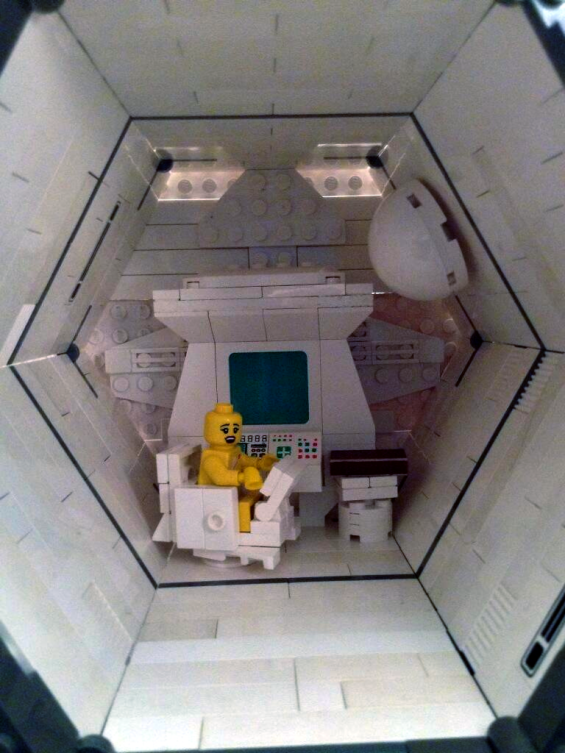
LEGOized - The Machine Stops by E.M. Forster

Which Killer Deserves To Have Been Read His Miranda Rights?

Posted by Jesse Willis

The Destiny Of Special Agent Ace Galaksi

SFFaudio Online Audio

The Destiny Of Special Agent Ace GalaksiMaissa Bessada’s The Destiny Of Special Agent Ace Galaksi is very hard to tell you about. It’d be easy to say the show is just bonkers, but that’d give you the idea that it doesn’t work on a certain level that it really does. The plot is nonsensical, in the way that some of Philip K. Dick’s are. But If I said it was like a Philip K. Dick plot that’d give you absolutely the wrong idea. The Destiny Of Special Agent Ace Galaksi is far more like the Goon Show than PKD.

The Destiny Of Special Agent Ace Galaksi is naive, sharp, amateurish, polished, bizarre, insightful, childish, wise, ridiculous, and hilarious. I’ve been listening to the six half hour episodes over and over for the last three weeks and I still honestly don’t know exactly what to make of it or how even to really describe it – other than to say I like it a whole lot and I want Maissa Bessada to be my friend.

We may have to look at The Destiny Of Special Agent Ace Galaksi as a kind of work of genius, something to marvel at, something to experience. There’s a kind of damn the torpedoes specificity to the details of this show that make it an impossible project to imagine got made. And yet here it is, like a very weird dream come alive, The Destiny Of Special Agent Ace Galaksi seems to have come from an alternative universe.

But I don’t want to scare you off, it a weird experimental audio drama, in fact it’s pretty conventional, and first and foremost it’s a comedy. So let me invite you in.

Think of the great comedic audio dramas: The Hitchhiker’s Guide To The Galaxy, The Scarifyers, Steve, The First or Dick Dynamo: The Fifth Dimensional Man.

You’d say yeah, it’s a comedy like those. But then I’d say to you that, unlike Hitchhiker’s, this one’s really zany! Zany on multiple levels. And that, unlike Scarifyers, this one’s a Science Fiction comedy, that it’s really not very much interested in how things are, as much as how they could be! There’s no periodicity to it. And that, unlike Steve, this one, though totally and utterly Canadian, is full of international flavouring! And unlike Dynamo, the titular character is the straight-man to the off-the-rails flowing crazy funny world.

The Destiny Of Special Agent Ace Galaksi is crazier than a patchwork quilt of all of those shows gliding through puffs of time and space.

And although they are really completely and wholly different in every possible way The Destiny Of Special Agent Ace Galaksi reminded me most of was The Adventures of Sexton Blake. It’s not the word play, nor the lunatic pacing, it’s more the characters. And yet, the comparison still falls completely apart.

Indeed, the ears you need to appreciate The Destiny Of Special Agent Ace Galaksi require you to throw out your basic assumptions. They require a paradigmatic shift within you, an unencumbered embrace of the unfamiliar and hilarious, a removal of expectations, an open mind.

The Destiny Of Special Agent Ace Galaksi is an audio drama that cares most about the weird story that it is weirdly telling. It’s really, really fun.

Here’s the official premise:

After a comet of unknown origin crashes through one of God’s recycling piles, a new planet, Traa Laa Laa, forms in the aftermath. Created from a little bit of this and a little bit of that, the beings on that planet have the ability to change shape. It is CSIS special agent Ace Galaksi’s destiny to discover that those shape-changing extraterrestrials have been visiting Earth since time immemorial – and that some of those visitors left artifacts behind. One of those artifacts is as small as a seventy million year old tennis ball, another as big as the great pyramid of Giza. Certain peculiarities about the artifacts lead Ace to some startling discoveries about the very nature of existence. Unfortunately Ace Galaksi’s destiny is unclear as to whether or not he’ll be able to stay ahead of world government plots to ensure he keeps his findings to himself – permanently.

Sez scripter Maissa Bessada:

“After completing the novel version of Ace Galaksi, I realized the work had great potential as an audio play. I re-wrote it as a series of scripts, hired several talented, highly versatile actors and a Juno award winning, retired CBC producer. The show was complete. Fantastic! For about a split – or as those of us with a sci-fi bent would have it – nano-second. Then I realized that having an entertaining, thought-provoking show online wasn’t the end of my work, it was only the beginning. The next challenge was finding an audience for it.

A few weeks ago I was introduced to your podcast. In one episode Scott said in passing, ‘The best audio drama is better than a movie.’ I stopped in my tracks. (I was listening while walking the dog) and told the dog and whatever squirrels and trees that would pay attention, ‘The best audio drama is better than a movie – I couldn’t agree more!’

I’d love for you guys to listen to my show. People that choose to enjoy sci-fi in an audio format – I feel like a stranger in a strange land who has finally found home.”

Teaser |MP3|

Part 1 |MP3| Part 2 |MP3| Part 3 |MP3| Part 4 |MP3| Part 5 |MP3| Part 6 |MP3|

Podcast feed:

http://acegalaksi.libsyn.com/rss

Leave a comment, tell me what you think of this show.

Posted by Jesse Willis

BBCR4 + RA.cc: Nineteen Eighty-Four

SFFaudio Online Audio

Nineteen Eighty-Four by George Orwell

Earlier this year BBC Radio 4 began a season they called “The Real George Orwell” – here’s the official description:

A Radio 4 journey through the labyrinth that is the life and work of George Orwell.

Of course there is no real George Orwell – it was the pen name of Eric Blair – but he was a writer and political commentator who is very hard to pin down. Ever since his early death in 1950, he has been at one and the same time the darling of some on both the left and the right of British politics – whilst being reviled by others. For all the beautiful simplicity of his writing and storytelling Orwell/Blair is a complex mass of confusions – an anti-establishment, pro-English, ex-Etonian ex-policeman and socialist, who was ardently anti-authoritarian. He was as anti-fascist as he was anti-communist, a former Spanish Civil War soldier who was anti-war but pro the Second World War, and so on and so on.

Through dramatisations of the key books, through four newly commissioned plays that explore the disjuncture between the man who was Eric Blair and the writer who was George Orwell, and through factual programming and readings, Radio 4 will take you on a journey from Burma via Catalonia, Wigan, Jura, Manor Farm along the road that led to Nineteen Eighty-Four, one of the most influential novels of the twentieth century.

I’m listening to Nineteen Eighty Four now, and loving it. Have a read of Tom Goulding’s review for the RadioTimes:

Radio 4 continues its series of Orwell dramatisations with Jonathan Holloway’s long-awaited two-part adaptation of Nineteen Eighty-Four. An eerie dystopian vision in the vein of Yevgeny Zamyatin’s We and Aldous Huxley’s Brave New World, Orwell’s magnum opus is a prescient window into Cold War politics, closed-circuit surveillance and blanket censorship.

Christopher Eccleston is the downtrodden protagonist Winston Smith, while Pippa Nixon shines as forbidden love interest Julia. Elsewhere, V For Vendetta villain Tim Pigott-Smith fills O’Brien’s face-stamping boots with sinister relish.

A masterclass in ferocious condemnation and harrowing satire, this is another gem in this superb season.

Then fire up your torrent client and head on over to RadioArchive.cc – where the drama is getting rave reviews!

BBC Radio 4RadioArchives.ccNineteen Eighty-Four
Adapted from the novel by George Orwell; Dramatised by Jonathan Holloway; Performed by a full cast
2 MP3s via TORRENT – Approx. 1 Hour 54 Minutes [RADIO DRAMA]
Broadcaster: BBC Radio 4
Broadcast: Feb. 10, 2013 and Feb. 16, 2013
Source: RadioArchive.cc
Winston Smith works for the Ministry of Truth. Sick and separated from his wife, he lives alone in a one-room flat in Victory Mansions in London, chief city of Airstrip One. Big Brother stares out from every poster, the Thought Police uncover every act of betrayal. When Winston finds love, he discovers that life does not have to be dull and deadening, and awakens to new possibilities.

Directed by Jeremy Mortimer

Credits:
Winston Smith – Christopher Eccleston
Julia – Pippa Nixon
O’Brien – Tim Pigott-Smith
Parsons – Kim Wall
Syme – Sam Alexander
Prostitute – Susie Riddell
Charrington – Robert Blythe
Actor – Christine Absalom
Actor – Don Gilet
Actor – Joe Sims
Actor – Joshua Swinney
Actor – Sam Alexander

And the |ETEXT|.

And ++good, here’s the BBC TV version from 1954 (starring Peter Cushing!):

Posted by Jesse Willis