
Colin‘s reading of The Nine Billion Names Of God by Arthur C. Clarke is not nearly popular enough.
As of this post it’s only received a mere 17 viewings (or hearings).
Posted by Jesse Willis
News, Reviews, and Commentary on all forms of science fiction, fantasy, and horror audio. Audiobooks, audio drama, podcasts; we discuss all of it here. Mystery, crime, and noir audio are also fair game.

Colin‘s reading of The Nine Billion Names Of God by Arthur C. Clarke is not nearly popular enough.
As of this post it’s only received a mere 17 viewings (or hearings).
Posted by Jesse Willis
This recording of Arthur C. Clarke’s The Nine Billion Names Of God was produced by Dercum Audio – it’s that signature opening, that terrific, haunting music that begins at the ten second mark – that’s the giveaway. Produced in 1991, it is long out of print and a real treasure.
Part 1 of 2:
Part 2 of 2:
Posted by Jesse Willis

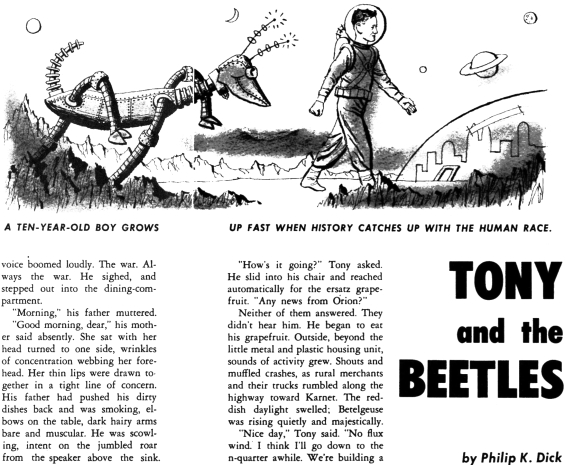
This 4,712 word story may not be among Philip K. Dick’s best, but it is certainly worth looking at, and hearing!
Tony And The Beetles is a bit unusual too, having an almost juvenile or YA feel to it. Maybe that’s because it’s not nearly as horrific as many of Dick’s fantasy tales – there are some frightening elements, but the general tone is that of an ungroundedness. I see Tony And The Beetles as a kind of historical allegory and I’m not the only one. Phil Chevernet, the narrator who recorded it for LibriVox, wrote “I think [Dick] was commenting on imperialism in the 40s and 50s.” I think he’s right, but I think the comment is somewhat ambiguous, rather depressing, and almost wholly unhopeful. Dick grew up during World War II and little PKD was a very sensitive fellow, kind of like Tony.
Here’s the setup:
Young Tony Rossi has grown up on an alien world. As a child he’s known little else than bubble helmets, pressure suits, and robot pets. His playmates and schoolmates have all been the non-human children of the planet, but around him swirl the forces of history and when news of the ongoing war breaks Tony’s parents don’t seem to hold the same opinions of what it all means.
 Tony And The Beetles
By Philip K. Dick; Read by Phil Chevernet
1 |MP3| – Approx. 34 Minutes [UNABRIDGED]
Publisher: LibriVox.org
Published: October 16, 2012
A ten-year-old boy grows up fast when history catches up with the human race. First published in Orbit, volume 1 number 2, 1953.
And here’s a |PDF| made from it’s original publication in Orbit.
Posted by Jesse Willis
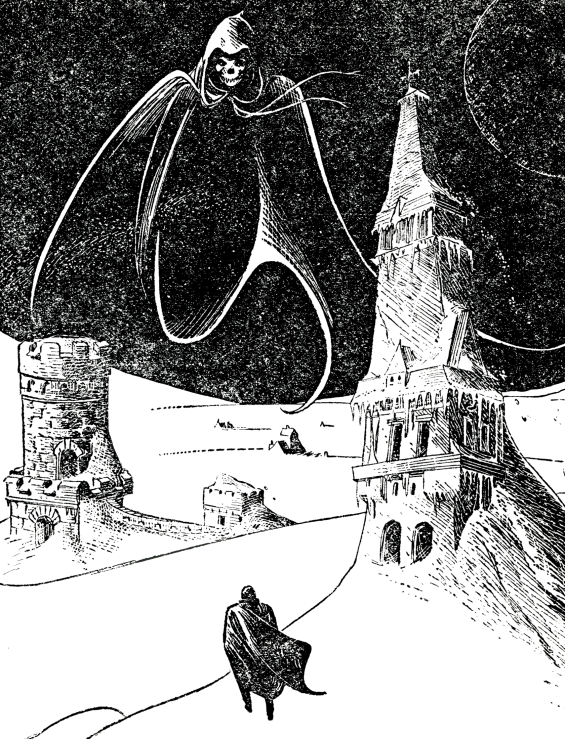
This is the third time I’ve posted about this wonderful podcast episode. The last time was just last year. But I’ve just come across another wonderful illustration, this time from a reprinting in an issue of Avon Science Fiction And Fantasy Reader, so I’ve just had top post about it again. It’s highly recommended listening.
 A Bite of Stars, a Slug of Time, and Thou – The Forgotten Enemy
By Arthur C. Clarke; Read by Elisha Sessions
1 |MP3| – Approx. 1 Hour [UNABRIDGED]
Podcaster: A Bite Of Stars A slug Of Time And Thou
Podcast: 2008
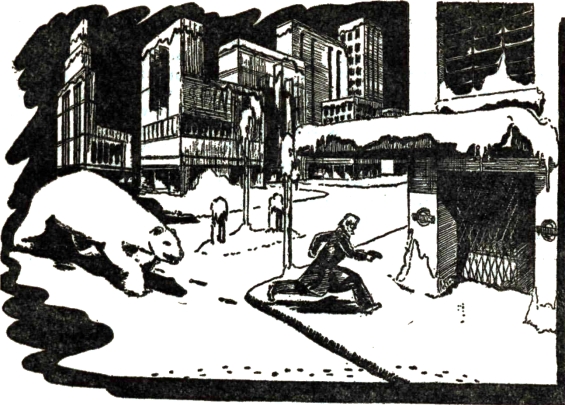
In a bleak snow and ice covered London, a lone survivor faces isolation, polar bears and loneliness. But even his one hope, the idea that a rescue team is crossing the Atlantic ice sheet isn’t enough to stave off The Forgotten Enemy. First published in December 1948, in an issue of King’s College Review.
First broadcast in 2008 on Resonance FM 104.4 FM in London, U.K, The Forgotten Enemy is an excellent Arthur C. Clarke tale. Set in London, it tells of solitary man waiting for rescue. He can almost hear the helicopters. Yes, the helicopters. The slow, loud, helicopters coming inevitably from the north. But what of the terrible white menace that threatens his lonely existence? Can he survive?
One aspect of the tale may remind you of 28 Weeks Later, another may remind you of The Day After Tomorrow. But fear not, this story pays far greater dividends than either of those.
In the discussion that follows the story is described as a “cozy calamity” and it’s compared to Who Goes There? and A Pail Of Air. It is a wonderful podcast – all around!
Here’s the accompanying art, by Clothier, from the New Worlds printing:
Posted by Jesse Willis
“For me, it’s one of those stories that does what SF does so very well, shining a light into those murky places where mundane fiction either will not or can not go: asking difficult questions about the nature of faith, belief and pride (and taking a few well aimed and accurate shots at the nature of colonialism along the way).” – James Lecky
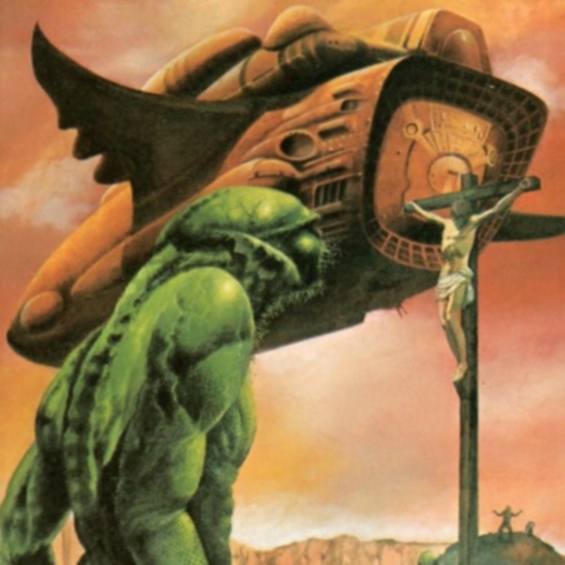
The Streets Of Ashkelon is a terrific tale audiobooked as part of last month’s issue of Lightspeed. Sometimes classified as a horror, often reprinted, it’s a classic SF story that’s in dialogue with James Blish’s A Case Of Conscience. Maria Doria Russell’s The Sparrow could also be considered a part of this long conversation. But unlike either of those novels this fifty year old short story takes the other side, stridently offering a challenge to the authority of faith’s promulgators. It asks an important question:
Ought evangelists and proselytizers have any business promoting their religion to aliens?
This is an SF story in the vein of Star Trek and H.G. Wells, so ought we not to read the innocent aliens as an allegory for something a little closer to home?
Decide for yourself.
 Lightspeed – The Streets Of Ashkelon
By Harry Harrison; Read by Paul Boehmer
1 |MP3| – Approx. 49 Minutes [UNABRIDGED]
Podcaster: Lightspeed
Podcast: September 2012
First published in New Worlds Science Fiction, #122, September 1962.
Posted by Jesse Willis

 14
14
By Peter Clines; Read by Ray Porter
Audible Download – 12 Hours 42 Minutes [UNABRIDGED]
Publisher: Audible Frontiers
Published: 2012
Themes: / Mystery / Science Fiction / Horror
As you might be able to tell from the diverse yet vague range of themes listed above, 14 is a difficult book to classify or review. Much like The Matrix, you can’t really be told what 14 is; you simply have to experience it for yourself. The blurb–or perhaps the term log line would be more appropriate–reads:
There are some odd things about Nate’s new apartment. Of course, he has other things on his mind. He hates his job. He has no money in the bank. No girlfriend. No plans for the future. So while his new home isn’t perfect, it’s livable. The rent is low, the property managers are friendly, and the odd little mysteries don’t nag at him too much. At least, not until he meets Mandy, his neighbor across the hall, and notices something unusual about her apartment. And Xela’s apartment. And Tim’s. And Veek’s. Because every room in this old Los Angeles brownstone has a mystery or two. Mysteries that stretch back over a hundred years. Some of them are in plain sight. Some are behind locked doors. And all together these mysteries could mean the end of Nate and his friends. Or the end of everything….
Aside from giving off a subtle Stephen King vibe, this synopsis doesn’t much help categorize the book either. And yet, in precisely the way book cover pitches are supposed to do, it offers just enough tantalizing hints to draw you in. If I had to pick a single overriding genre for the novel, I would choose mystery. There are indeed some strange goings-on in the Kavach Building, which houses the novel’s motley assortment of tenanets as well as the eponymous apartment number 14. Some of these things are creepy, hence the horror; some are paranormal, hence the science fiction. But ever driving the plot forward is protagonist Nate Tucker’s desire to get to the bottom of it all. The mystery theme is underscored by repeated, almost overdone, references to Scooby Doo. But in terms of literary and historical allusions Scooby and Shaggy are kept good company by the likes of Nikola Tesla and H. P. Lovecraft. Yes, the book is that weird.
What makes it all work and flow so smoothly is Clines’s knack for characterization. The listless protagonist Nate Tucker, the artist Xela with nudist tendencies, the Hindi hacker Veek, the hardcore Christian Andy, and virtually every other character, major or minor, are people whose stories are minor mysteries in their own right. When, pardon my French, shit gets weird, you’re always anchored by this (mostly) likable ensemble. Clines’s writing is also excellent. His background in Hollywood is evident in the novel’s setting and characters, and the third-person narration is likewise cinematic in pacing. It would be easy to see 14 adapted into a movie or, preferably, a miniseries. The novel excels, as a good mystery should, in dropping tantalizing plot hints, only to cut away to more chapters on characterization, spurring the reader to read on and find out what happens next. In the hands of less capable writers this technique can feel like a cheap trick, but fortunately Clines doesn’t overdo it.
The diverse cast of characters poses a potential challenge for narrator Ray Porter, from the feminine cadence of Veek’s Indian accent to the clipped, harried German accent of Oskar the building manager. Fortunately, Porter is mostly up to the task. He handles these characters, as well as a broad range of accents from our own continent, nearly flawlessly. With a few exceptions near the end, his narration manages to feel unobtrusive, almost as if there were no narrator at all and the listener is simply telepathically absorbing the words from the page. I don’t believe I’ve listened to Ray Porter’s work before, but I’ll certainly watch for him from now on.
The book puts a neat little bow on most mysteries, but there are still a few loose tendrils that could serve as springboards for another novel in the same universe. It really was difficult to say goodbye to the characters and the world. In his review for Fantasy Book Critic, Mihir Wanchoo draws several apt comparisons between 14 and the television series Lost. The resemblance is indeed strong. If you enjoy strong characterization and a whirlwind of genre-bending mysteries, you’ll probably love the hell out of 14. And–sorry J.J. Abrams et al.–Peter Clines actually knew where the plot was going.
Posted by Seth