Review of The Long Walk by Stephen King

SFFaudio Review

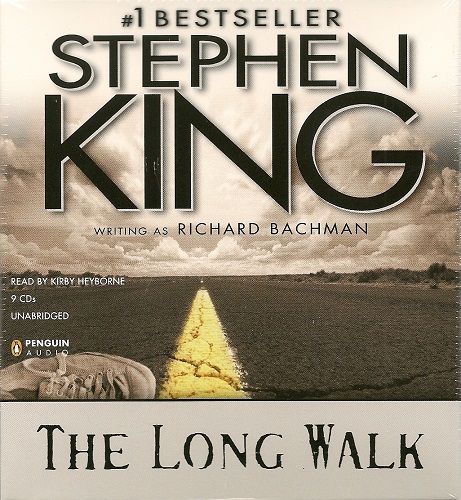
Horror Audiobook - The Long Walk by Stephen KingThe Long Walk
By Stephen King; Read by Kirby Heyborne
9 CDs – Approx. 11 Hours [UNABRIDGED]
Publisher: Penguin Audio
Published: 2010
ISBN: 9780142427835
Themes: / Horror / Walking / Alternate History / Maine /

Every year, on the first day of May, one hundred teenage boys meet for an event known throughout the country as the “Long Walk.” Among this year’s chosen crop is sixteen-year-old Ray Garraty. He knows the rules: Warning are issued if you fall under speed, stumble, sit down. After three warnings, you get your ticket. And what happens then serves as a chilling reminder that there can be only one winner in the Walk: the one who survives.

One of the things that generally makes me not connect with fiction is what’s missing. That is to say, if the story isn’t talking about some idea (the human condition, society, or how the world works) I probably won’t connect with it. I therefore always assume that a novel has some message. A lesson it is trying to impart to me. Perhaps this is a mistake as The Long Walk, by Stephen King, lives on the surface of what it is. It’s 100 boys walking across the United States in a kind of slow motion deathrace. Unlike the the traditional death march, these walkers are all volunteers, and are supplied with food and water. “That’s the premise.” I told myself. But what message had King planted underneath it? What idea was he trying to convey in novel form?

At first I was wondering if King was addressing the Vietnam War. But that didn’t pan out, not exactly. The way the book is structured, the premise is never flatly stated, we only learn how the boys ended up where they are (walking across Maine) when they discuss it amongst themselves. So, we’re learning the premise as we go. I figured that if there was a message in The Long Walk it needed to be decoded. My first suspect for the key to the message was the soldiers who passively enforce the Long Walk’s rules. Their faces were strangely blank, providing no bounce or reaction to their work or the insults the walkers hurl at them. I thought their blankness might be a hint, a symbol, or something. But if so, it didn’t work out for me. In fact, by the end, never having learned the names of any of the nearly faceless soldiers, it was quite the opposite. The only idea I could come up with to explain this was that they were designed to represent the unfeeling laws of nature. Kind of an embodiment physics, unfeeling and inalterable. That got me thinking that perhaps the whole of the The Long Walk was kind of a metaphor for mortality – you know, the idea that no matter your station, no matter your talent, none of us can escape our coming demise. But, the more I read, the less that seemed likely. In fact, no matter which intellectual straw I grasped at I kept coming away with a figurative handful of nothing.

Another angle of attack I took was to look at the world. What kind of a world would allow this horror race? What was the meaning of “the prize” for the winner? The world, what little we get to hear of it, was pretty interesting. We learn that there are 51 states in the Union, that before then end WWII some kind of air raid from Nazi Germany hit the American East Coast, and that the government may be entirely in the hands of a military dictatorship. Nice! These and other small details slip out in the many varied conversations between the boys in the Walk, amongst trash talk, sex talk and the discussion of literature. With nothing much left to go on I tried to think about the literary references, tried to see if there was some key there, to unlocking the meaning of this novel. At one point one of the walkers says that ‘the Walk is like living in a Shirley Jackson story.’ He was right! And later on, when ruminating on the effect of being watched by the public, another of the boys says he’s ‘reminded of a Ray Bradbury story.’ And he was right! In fact, there are maybe a half dozen literary references alluded to in this novel. But none of them, not any one of them, was the key to decoding the meaning for me. So, in the end, I didn’t come away with was any sense of what this novel was about, other than what it would be like to be force marched across the United States.

Apparently The Long Walk was originally written in 1966 and 1967 while King was in his first two semesters of university. I’m assuming it was somewhat updated or re-written before it’s 1979 debut in paperback under King’s Richard Bachman pseudonym. I first heard Kirby Heyborne’s narrative abilities with Little Brother |READ OUR REVIEW|. That novel was told in the first person, and Heyborne’s youthful voice was up for the job there. Here, voicing more than a dozen young men and boys, all in the third person, he renders an acceptable, if not stellar, performance. He adds the occasional regional American accent to each kid and it always sounds appropriate for what we know about his background. Also of note: There is an interesting introductory essay on Disc 1 entitled The Importance Of Being Bachman. It does not, however, provide any particular details about The Long Walk.

Posted by Jesse Willis

The SFFaudio Podcast #074

Podcast

The SFFaudio PodcastThe SFFaudio Podcast #074 – Jesse and Scott talk about the recently arrived audiobooks with assistance and commentary by Luke Burrage

Talked about on today’s show:
New York, “your whole life is a holiday”, The Way Of Kings by Brandon Sanderson, The Wheel Of Time series, “the entire world is imagined from the ground up”, Blackstone Audio, The Shadow Hunter by Pat Murphy, neanderthals, cave bear, “a little cave dude”, The Ugly Little Boy by Isaac Asimov, Robert Silverberg, Robert J. Sawyer’s Neanderthal Parallax trilogy, shamanic or shamanistic, The Science Fiction Book Review Podcast, Urban Fantasy Alert, City Of Ghosts by Stacia Kane, the Chess Putnam series, First Drop Of Crimson by Jeaniene Frost (Book 1 in the The Night Huntress World series), paranormal romance vs. urban fantasy, spade vs. Spade, vampires, by , southern Gothic, Flannery O’Connor with zombies, the full zombie vs. the half zombie vampire, The Reapers Are The Angels by Alden Bell, The Walking Dead by , Being Human (tv show), Dark Shadows, Hawaii 50, V, Half Blood Of Brooklyn by Charlie Huston, Stephen King, noir urban fantasy?, On Stranger Tides by Tim Powers, Subterranean Press, Bronson Pinchot, pirates, magic, voodoo, Brilliance Audio, Bearers Of The Black Staff by Terry Brooks, Caviar by Theodore Sturgeon, Shannara, Audiofile Magazine, Connecting the Robots and Empire (Foundation) series, demon war, war dudes and siege engines, The Speed Of Dark by Elizabeth Moon, autism, Mary Robinette Kowal’s review of the Books On Tape edition of The Speed Of Dark |READ OUR REVIEW|, Luke’s idea for a paranormal romance set in the stone age, “urban cave fantasy”, Quicksilver by Neal Stephanson, audiobooks are being shaped to the length of an Audible credit, The Baroque Cycle, The Lies Of Locke Lamora by Scott Lynch |READ OUR REVIEW|, “it ends in Gibraltar”, Penguin Audio, Zorgamazoo by Robert Paul Weston, Dr. Seuss, Roald Dahl, science fiction, Zero History by William Gibson, Max Headroom, Elmore Leonard, great writing is not enough, Michael May’s Adventure Blog article on back of the book copywriting, taking the risk of writing only the keywords, Starship: Mutiny by Mike Resnick |READ OUR REVIEW|, Kirinyaga by Mike Resnick |READ OUR REVIEW|, Finch by Jeff Vandermeer, StarShipSofa, weird fantasy vs. new weird, the George Zarr talk (The SFFaudio Podcast #071), Stephen King’s Salem’s Lot a BBC radio drama, “if you’re 14 years old and you’re listening to this…”, fantasy women, Ranger’s Apprentice by John Flanagan, Young Adult fiction, the The Ruins of Gorlan series, I Am Number Four, Battlestar Galactica, The Hunger Games by Suzanne Collins, This Immortal by Roger Zelazny, Dune by Frank Herbert, Children Of Dune, Bad Blood by John Sanford, James Lee Burke, Santa Fe Edge by Stuart Woods, by Michael Kramer, the Richard Stark Parker books (Books On Tape), Ed Eagle vs. Eddie The Eagle, New Mexico, puzzling murder, false identity, lush and exclusive resorts, family, vegetarian, car, crash, human, not human, zombie, mystery, maggot infested corpse, brink of death, flesh off her bones, Dust by Joan Frances Turner, should be able to know it, OVERLORDS!, Childhood’s End by Arthur C. Clarke, The Time Machine by H.G. Wells, The Caves Of Steel by Isaac Asimov, Have Spacesuit, Will Travel by Robert A. Heinlein, futuristic gadgetry, Snow Crash, Virtual Light by William Gibson, “the first really good augmented reality book”, The Steel Remains by Richard K. Morgan.

Posted by Jesse Willis

The SFFaudio Podcast #072 – READALONG: Assam And Darjeeling by T.M. Camp

Podcast

The SFFaudio PodcastThe SFFaudio Podcast #072 – Jesse and Scott talk with Julie Davis, of the Forgotten Classics podcast about Assam And Darjeeling by T.M. Camp |READ OUR REVIEW|.

Talked about on today’s show:
Assam & Darjeeling by T.M. Camp, Podiobooks.com, iTunes, serialized fiction, entertaining copyright notices, where do you do your podcast listening?, I’ve got my hands full of car, the volume on Assam And Darjeeling is way too low!, remastering Assam And Darjeeling for audiobook, listening to podcasts at double speed (only on iTouch and iPhone), the premise of Assam And Darjeeling, Hades, the underworld, Inferno by Larry Niven and Jerry Pournelle |READ OUR REVIEW|, Escape From Hell by Larry Niven and Jerry Pournelle , The Divine Comedy: The Inferno by Dante Alighieri, Virgil’s The Aeneid, Ovid, the Brothers Grimm, witches, Greek Mythology, Edgar, no one can be as cruel as a kid, Joss Whedon, in the hands of a skillful author, Matters Of Mortology by T.M. Camp, Kij Johnson‘s The Fox Woman, the Black Gate blog, foxes in mythology, Aesop’s Fable The Fox And The Grapes, Cernunnos, Herne the Hunter, making the switch from comedy to horror and horror to comedy, the Shaggy Man (in the Oz series), Tom Bombadil, he has psychic powers too?, page 18, masterly dialogue put into the mouths of young children, the PDF version of Assam And Darjeeling, What Dreams May Come by Richard Matheson, life after death, Inception, Edgar Alan Poe should go into the underworld to get his wife Virginia, The Memory Palace episode about Edgar Allan Poe’s death (Episode 20 strong>This Ungainly Fowl), This American Life is really bleak, WNYC’s Radiolab isn’t, general fiction is generally bleak, A Good Man Is Hard To Find by Flannery O’Connor, Science Fiction vs. general fiction, Social Science Fiction, Science Fiction has a second layer, it’s not all style, The Cold Equations by Tom Godwin, Staggerford by Jon Hassler, there are ways to tell powerful stories, A Man In Full by Tom Wolfe, Bangsian Fantasy, Fantasy, re-reading The Lord Of The Rings, the more I think about it the more I think I don’t like Fantasy, SFSite.com, derivative Fantasy, romance novels, Jane Austen, John Thorne, The Long Walk by Stephen King (Richard Bachman), The Stand, It, Salem’s Lot, The Shining, Under The Dome, Shirley Jackson, Ray Bradbury, long vs. short, The Cell by Stephen King, 28 Days Later, Desperation by Stephen King, The Rapture, if you were a character in this book who would you be?, the rule that makes any book better: talk about food, Lawrence Block, the economy of the afterworld, lampshading, I’m done with sequels, Mike Resnick’s Starship series, Jim Butcher’s Dresden series, The Fall Of Hyperion by Dan Simmons, Make Room, Make Room by Harry Harrison, Soylent Green, Adventures by Mike Resnick, mammoths vs. mastodons, Brave New World by Aldous Huxley, Nineteen Eighty-Four by George Orwell, The Star Beast by Robert A. Heinlein, The Great Gatsby by F. Scott Fitzgerald, The Scarlet Letter by Nathaniel Hawthorne.

Posted by Jesse Willis

The SFFaudio Podcast #070

Podcast

The SFFaudio PodcastThe SFFaudio Podcast #070 – Jesse and Scott talk about the most recent arrivals and the latest audiobook releases!

Talked about on today’s show:
The Big Time by Fritz Leiber, public domain, Brilliance Audio, Audible Frontiers, Scott Danielson’s Audiobook Fix, Fafhard And The Grey Mouser, Death’s Excellent Vacation, a new Sookie Stackhouse book, Charlaine Harris, True Blood, HBO, George R.R. Martin’s blog, A Game Of Thrones, “fat fantasy”, The Stand by Stephen King, the preface to The Stand: The Complete & Uncut Edition, Stephen King’s version of Hansel And Gretel, “getting lost in the world”, reading for ideas, characters are not ideas, The unexpurgated version of Robert A. Heinlein’s Stranger In A Strange Land, novelists are writing to the width of the supermarket paperback rack, Allan Kaster, as ebooks become more common book lengths will vary more, Outlaw Of Gor by John Norman, the movie version, Palimpsest by Catherynne M. Valente, the meaning of palimpsest, Aasne Vigesaa, Day By Day Armageddon: Beyond Exile by J.L. Bourne, The Stainless Steel Rat by Harry Harrison is coming to audioook!, funny old Science Fiction, comics, Crossed: Volume 1 by Garth Ennis and Jacen Burrows, George Romero’s The Crazies, the 2010 remake of The Crazies, the “trixie virus”, the Reavers from Firefly, The Omega Man, I Am Legend, The Last Man On Earth, Upcoming Readalongs:, Assam And DarjeelingEarth Abides by George R. Stewart, Connie Willis’ introduction to Earth Abides, The Dying Earth by Jack Vance, Strange Case of Dr Jekyll and Mr Hyde by Robert Louis Stevenson, going off the rails, the Michael Caine version of Dr Jekyll and Mr Hyde, Wayne June, Charles McKibben, The Essential Dr Jekyll and Mr Hyde: The Definitive Annotated Edition edited by Leonard Wolf, Scott’s Pick Of The Week: Netflix Streaming, Netflix is coming to Canada, there should be a Netflix-like service for comics, Jesse’s Pick Of The Week: Crossed: Volume 1, (get issue #0 FREE online |HERE|) you have to slowly build up your tolerance for Garth Ennis, “horrifically visceral”, DC Comics Hitman, DC Vertigo’s Preacher, War Story, Battlefields, The D-Day Dodgers, Neil Gaiman, The Sandman.

Posted by Jesse Willis

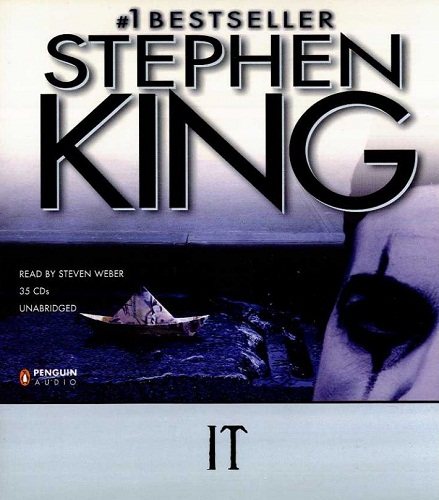
Review of IT by Stephen King

SFFaudio Review

Horror Audiobook - IT by Stephen KingIT
By Stephen King; Read by Steven Weber
45 hours – [UNABRIDGED]
Publisher: Penguin Audio
Published: 2010
Themes: / Horror / Childhood / Adulthood / Monsters /

You don’t have to look back to see those children; part of your mind will see them forever, live with them forever, love with them forever. They are not necessarily the best part of you, but they were once the repository of all you could become.
—Stephen King, IT

What quality separates an adult from a child? Is it responsibility in the former and unbridled freedom in the latter? Do adults possess a higher order of thinking? Or, to take a cynical view, are adults merely physically larger (perhaps they/we never really do grow up)?

I happen to think there is a difference, though it’s hard to say precisely what. You could describe adulthood as a phase through which we all must pass, else we remain stunted and undeveloped, looking backward instead of forward, unable to transform into the mature beings that the hard world requires. Indefinable and amorphous, you may as well call this period of transition it. Stephen King did, and in 1985 he wrote a massive book by the same name about this very subject.

As is King’s forte, IT is also a horror story, and a terrifying one at that. The villain of IT is a creature that lurks in the sewers of Derry, Maine, one that takes the shape of our worst fears. IT’s favorite shape is a painted clown known as Pennywise, friendly at first glance but whose greasepaint smile reveals a double-row of Gillette razor teeth. Pennywise can also take the form of a werewolf, the Creature from the Black Lagoon, Frankenstein, and more. Whatever a particular child finds most terrifying, Pennywise can take its shape.

Pennywise has been preyed on the children of Derry for untold generations, emerging from a deep slumber in the sewers every 27 years to feed. After a year of gruesome killings (written up in the press as mysterious child disappearances, or frequently blamed on other sources), the cycles end with a culminating event, typically an awful orgy of destruction, after which the creature resumes its hibernation.

But Pennywise—aka., IT—always comes back. Derry is perennially under its pall and seems to accept the darkness as “just the way things are” and the horrors continue in cyclical fashion. But then comes the summer of 1958. A group of 10 and 11-year-old children called the Loser’s Club, led by a stuttering, charismatic child known as Bill Denbrough, unite to battle Pennywise. All have had close brushes with the monster. Scarred by their experiences but united in purpose (Bill’s six year old brother Georgie is dragged into the sewer and killed in a gruesome scene at the beginning of the novel, and Bill vows revenge), they travel into Derry’s byzantine sewer systems to put an end to the monster. Following an epic confrontation in the creature’s den the children vow to return to Derry should Pennywise/IT ever return.

One of the club, Mike Hanlon, remains behind in the ensuring decades to watch and wait. When Pennywise does re-emerge 27 years later the children of the Loser’s Club are now adults in their late 30s. Some higher power has mercifully allowed them to forget the terrible events of their childhood and move on with their lives. But now they have to fight the terrible evil once more and growing up has diminished them in some way. This time around they find themselves less equipped to fight.

IT is a great story full of memorable events, places, and characters. King imbues Derry with its own personality, and the town feels like a member of the cast. King skillfully weaves in events from Derry’s awful past, including past murder sprees and the culminating bloodbaths that sent IT back into the sewers, including a horrific nightclub fire (The Black Spot) and the explosion of the Kitchener Ironworks.

But in the end, what I like most about IT, and what separates the book from much of the rest of King’s oeuvre, is its thoughtful exploration of that amorphous crossing of the bar from youth to maturity. To get where you want to go in life you have to grow up, King says, but it’s not a simple process. The transition from childhood to adulthood is a complex and bittersweet, its benefits equivocal. Adulthood brings with it at least some measure of financial, parental, and geographic freedom. We can leave those hometowns that are so frequently a source of shame and failure and hidden darkness. But in so doing we lose a lot, too—our dreams, our innocence, our closest friends, and sometimes even our faith in a higher power. And the only way to defeat Pennywise—that monstrous, childhood IT—is through faith.

King has been accused by his critics of being shallow, all style and no substance (he did himself no favors by once calling himself “the literary equivalent of a Big Mac and Fries”). But I’ve found that his best material has more depth than meets than eye. IT is not just about battling monsters. Or rather it is about that, but the monsters are also the real, adult fears of loneliness, guilt, and dependency, of growing up, of confronting the monsters of one’s past and trying to move on. We are all incomplete until we face our past and determine who we are, what we stand for, and how we want to live our lives. This personal struggle, as much as visceral, horrific battles with Pennywise, is what brings me back to IT again and again.

I will say that IT is not without its problems, including a sequence that remains controversial among King’s readers. Without spoiling the story, it involves a coming of age ritual in the sewers that is a bit off-putting and jarring, even though I do understand its purposes. Some of the characters feel a bit one-trick and allegorical (representative of concepts rather than three-dimensional human beings). Other readers have complained that IT’s big secret—Pennywise’s final reveal—a bit of a let-down after 1,000 pages of build up. King is unfortunately often guilty of unsatisfying endings to otherwise great novels, and IT arguably suffers from the same problem. I don’t necessarily agree, as I find the epilogue incredibly satisfying, but others have made this criticism.

But despite its flaws, IT is one of my favorite books by King. With a memorable monster, a nice cast of characters, and a compelling, decades-spanning storyline with an epic final showdown, IT is a horrific page turner with deeper literary ambitions that it mostly fulfills.

Posted by Brian Murphy

Recent Arrivals: More Stephen King from Penguin!

SFFaudio Recent Arrivals

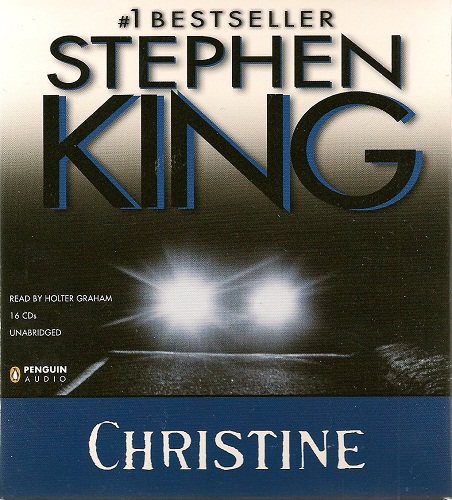
Horror Audiobook - Christine by Stephen KingChristine
By Stephen King; Read by Holter Graham
20 hours – [UNABRIDGED]
Publisher: Penguin Audio
Published: 2010

From the moment seventeen-year-old Arnie Cunningham saw Christine, he knew he would do anything to possess her. But Christine is no lady. She is Stephen King’s ultimate vehicle of terror.
 
 
Horror Audiobook - IT by Stephen KingIT
By Stephen King; Read by Steven Weber
45 hours – [UNABRIDGED]
Publisher: Penguin Audio
Published: 2010

They were just kids when they stumbled upon the horror within their hometown. Now, as adults, none of them can withstand the force that has drawn them all back to Derry, Maine, to face the nightmare without end, and the evil without a name…
 
 
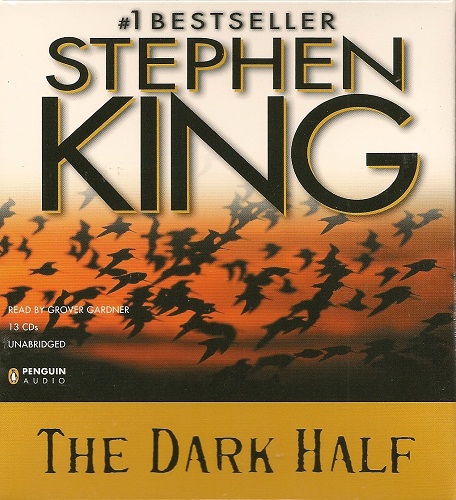
Horror Audiobook - The Dark Half by Stephen KingThe Dark Half
By Stephen King; Read by Grover Gardner
15 hours – [UNABRIDGED]
Publisher: Penguin Audio
Published: 2010

Bestselling author Thad Beaumont would like to say he has nothing to do with the evil that has committed a series of monstrous murders. But he can’t-because he created it.
 
 
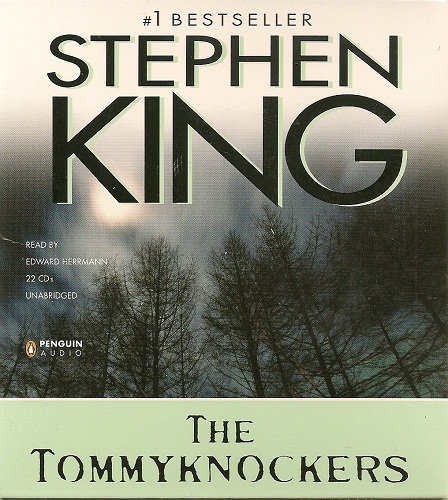
Horror Audiobook - The Tommyknockers by Stephen KingThe Tommyknockers
By Stephen King; Read by Edward Herrmann
28 hours – [UNABRIDGED]
Publisher: Penguin Audio
Published: 2010

Bobbi Anderson and the other good folks of Haven, Maine, have sold their sould to reap the rewards of the most deadly evil this side of hell.

Posted by Scott D. Danielson