The SFFaudio Podcast #056 – READALONG: The Status Civilization by Robert Sheckley

Podcast

The SFFaudio PodcastThe SFFaudio Podcast #056 – Jesse and Scott talk with Rick Jackson, Gregg Margarite, Jerry Stearns and Julie Davis about Robert Sheckley’s The Status Civilization!

Talked about on today’s show:
Wonder Publishing Group (Wonder Audio and Wonder Ebooks), LibriVox.org, Acoustic Pulp, Sound Affects, Great Northern Audio Theatre, Doctor Who, The Prisoner, Riverworld by Philip Jose Farmer, deep Science Fiction, Deathworld by Harry Harrison, The Space Merchants (aka Gravy Planet) by Frederik Pohl and Cyril M. Kornbluth, Preferred Risk by Frederik Pohl and Lester del Rey, Gladiator At Law by Frederik Pohl and Cyril M. Kornbluth, Anarchaos by Donald E. Westlake, a religion based on evil, satire, Friedrich Nietzsche‘s “master-slave morality,” good and evil, David Hume‘, the naturalistic fallacy, cognitive dissonance, original sin (aka atavistic guilt), Skulking Permit by Robert Sheckley, Breaking Point by James Gunn |READ OUR REVIEW|, psychology, society, robots, This Perfect Day by Ira Levin, utopia, dystopia, libertarianism, rebellion, “a benign evil,” narrating audiobooks, Mark Douglas Nelson, This Crowded Earth by Robert Bloch, Deathworld 2 by Harry Harrison, Watchbird by Robert Sheckley, Second Variety by Philip K. Dick, Tunnel Under The World by Frederik Pohl, Bellona Times, X-Minus One, Mark Time , Yuri Rasovsky, Raymond Z. Gallun, Bing, Seeing Ear Theatre, Orson And The Alien, The SFFaudio Challenge, turning modern public domain books into audio drama, Night Of The Cooters by Howard Waldrop, Jack J. Ward, The Sonic Society, Brian Price, Alfred Bester‘s review of The Status Civilization (from The Magazine Of Fantasy And Science Fiction, December 1960), the naming of “Tetrahyde”, a readalong on The Stars My Destination by Alfred Bester, the “amazing” audio drama version from BBC Tiger Tiger, The Count Of Monte Cristo by Alexandre Dumas, Frederik Pohl’s review of The Status Civilization (from January 1961 issue of Worlds Of If), the competition between the LibriVox and the commercial versions of audiobooks, Plato’s Cave, precognition, John W. Campbell, skrenning, scrying, Icelandic cook books!

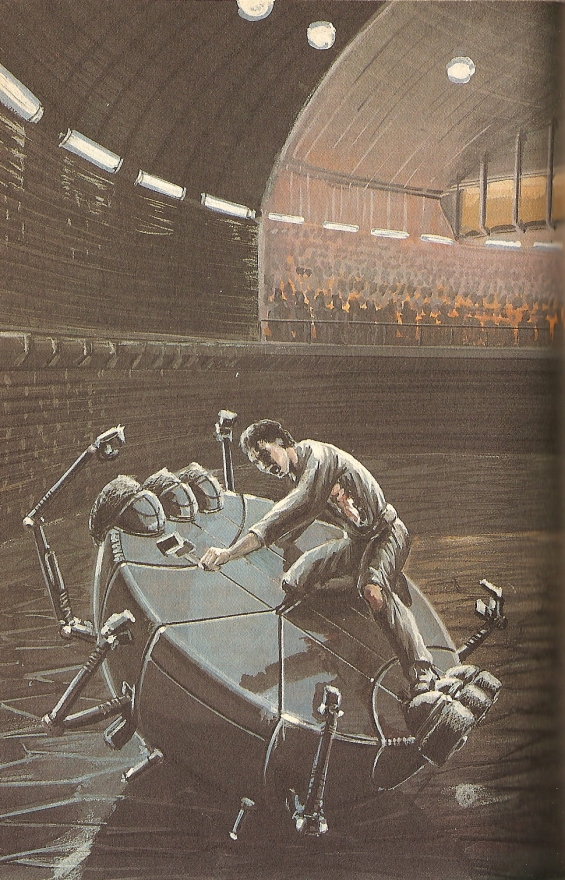
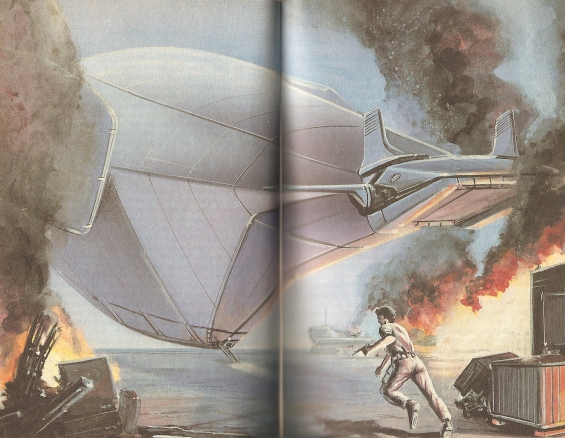
The Status Civilzation (Planet Of The Criminals) GERMAN INTERIOR
The Status Civilization (Planet Of The Criminals) GERMAN INTERIOR
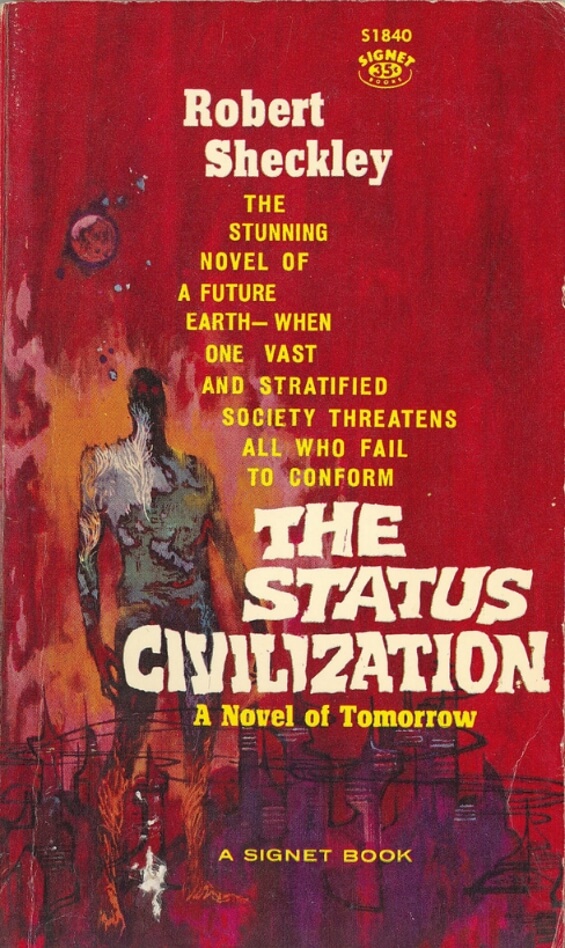
The Status Civilization by Robert Sheckley
Signet - The Status Civilization by Robert Sheckley

Posted by Jesse Willis

Review of The Unincorporated Man by Dani Kollin and Eytan Kollin

SFFaudio Review

TANTOR MEDIA - The Unincorporated Man by Dani Kollin and Eytan KollinThe Unincorporated Man
By Dani Kollin and Eytan Kollin; Read by Todd McLaren
2 MP3-CDs – Approx. 24 Hours 30 Minutes [UNABRIDGED]
Publisher: Tantor Media
Published: May 2009
ISBN: 9781400161720
Themes: / Science Fiction / Utopia / Dystopia / Time Travel / Slavery / Economics / Business / Cryonics / Immortality / Virtual Reality / Philosophy / Law / Alaska / Colorado / Los Angeles / Switzerland / Nanotechnology / Space Elevator /

The Unincorporated Man is a provocative social/political/economic novel that takes place in the future, after civilization has fallen into complete economic collapse. This reborn civilization is one in which every individual is incorporated at birth and spends many years trying to attain control over his or her own life by getting a majority of his or her own shares. Life extension has made life very long indeed. Now the incredible has happened: a billionaire businessman from our time, frozen in secret in the early twenty-first century, is discovered and resurrected, given health and a vigorous younger body. Justin Cord is the only unincorporated man in the world, a true stranger in this strange land. Justin survived because he is tough and smart. He cannot accept only part ownership of himself, even if that places him in conflict with a civilization that extends outside the solar system to the Oort Cloud. People will be arguing about this novel and this world for decades.

Even though I had never heard of the authors I like this book right from the start. The title reminded me of a Philip K. Dick novel called The Unteleported Man. There are probably a whole bunch of SF books following the formula “The (negative attribution) Man”, with The Invisible Man perhaps being the first of them. But there’s a lot more to like about this novel than the title alone. Among the pleasures it brings is good, old-fashioned idea based SF. It has been quite a while since I was so intellectually engaged by a novel’s central premise. And The Unincorporated Man has one. Set on a future Earth The Unincorporated Man is fundamentally different in both tone and scope than most SF novels I’ve read recently. Authors Dani and Eytan Kollin have envisioned a future in which the institution known as “the corporation” has replaced the convention of “person.” When born each child has stock of 1000 shares issued in his or her name. 10 percent of these stocks are held by each parent, the government gets another 5 percent and the rest is held in trust until the age of majority after which the balance of the stock is given to the child-cum-adult. He or she can then sell, or keep his or her stocks as they so desire. Holding a majority of your own stock insures relative autonomy (based on the amount above 50% you hold). The primary difficulty comes when you realize that you’ll need to invest in yourself. If you want an education you’ll need to pay for it. But without an education the pay won’t be much. So, you can either get education money by working at a low-wage job, and deriving whatever profit percentage your current stock level allows, or by selling your stock off for cash. This typically manifests itself in the majority of humanity not owning majority in themselves. With the possibility of living for centuries, thanks to the ubiquitous nanotechnology, you’d be wise to invest in an education. But in so doing you’ll loose control of your majority, and thus perhaps have to work at jobs that your shareholders choose, take vacations when your shareholders agree and generally have your life dictated to you by those that hold your stock. Why not just take the money and loaf? Who cares what the shareholders say? They can’t make you work can they? Well, yes they can. The corporate system is enforced by a forced mental audit that is applicable whenever shareholders think a corporation, who they hold stock in, is committing malfeasance (shirking their job, deliberately getting fired, etc.). Every corporation is trackable, thanks to GPS-like implants, and is thus ultimately accountable to his or her shareholders. It is the ultimate invasive tyranny, a slavery to the bottom line, a profit motive enforced by an invisible hand that you shook a deal with.

But things aren’t all doom and gloom. Those who are lucky enough to have been born with enough money, drive, intelligence, talent or beauty are able to do pretty much whatever they like with their time – that is assuming they don’t loose too much of their stock in luxuries or in judgments rendered against them in civil lawsuits. You can live like a king, wear any kind of clothing you like, read the newsies and travel the world in an endless party. But, as the centuries have rolled past it seems that fewer and fewer people have found it fashionable (or is the correct word possible?) to retain or even re-seek their majority stock. After all, in their nanotechnological society material abundance sees that no-one starves, no-one remains un-housed. Freedom, it seems, is just out of fashion. Enter Justin Cord and his unincorporated status.

I really liked this novel, but it isn’t without a few caveats. I found the fascinating society portrayed to be the most interesting thing about The Unincorporated Man. The characters are all pretty stiff and the problems facing Jason Cord, our hero, were far less interesting than they were useful in exploring this strange new society. Like many novels I review this one suffers most greatly from excessive page count. At 480 pages the novel takes 24.5 hours to listen to. I’d have preferred the novel with a steadier editorial hand. The editor could have done two relatively easy things. First he or she could have cut out a lot of the filler. I’m not just talking about empty sentences, there are many scenes that could have been eliminated or described in just a sentence or two. There are, for instance, two big court cases in this nove. Would it have been impossible to tell this story in one? Second, there was a useless detour along the way. I enjoyed it, but don’t see any reason it was needed in this novel. It could have been easily explored separately, in another novel. Dani Kollin and Eytan Kollin wanted to talk about the relatively unexplored idea, a social scourge in the form of really vivid virtual reality. Larry Niven did something similar with his idea of the “tasp,” but that wasn’t exactly VR. If you could live your whole life in an artificial reality that was extremely cheap why wouldn’t you? The answer, cooked up by Kollins, is less persuasive than I’d have hoped. And again it doesn’t really need to be in this particular novel. They foresee a coming global catastrophe created not by ecological destruction, but rather by an addictive technological neuropathology. That’s great, but like I said it doesn’t need to be in this novel. When a false reality is far more enjoyable than a real one why should we care about the real one? Good question. Just don’t ask it here.

Narrator Todd McLaren, who I first encountered in Richard K. Morgan’s Altered Carbon |READ OUR REVIEW|, is very talented. He mispronounce one or two words. “Concomitant.” being one of them. McLaren isn’t called to do many accents here, but he gives voice to a fairly large cast of characters. There are also several scenes in which he is required to portray a man giving impassioned speeches to crowds. These don’t sound like shouts, thankfully, but instead give the impression of a strained voice, speaking so as to be heard.

Posted by Jesse Willis

SFBRP: Luke Burrage in conversation with Jesse Willis

SFFaudio Online Audio

The Science Fiction Book Review Podcast My friend Luke Burrage, of the Science Fiction Book Review Podcast, has placed a candid conversation that we had into his podcast feed! I’m shocked. Shocked!

How dare he do such a thing?!?

Admittedly, he did ask my permission (and did receive it) but still … the effrontery is absolutely unbelievable.

Have a listen for yourself: SFBRP #072.5 – Luke and Jesse in Conversation |MP3|

Here’s what we talked about:

R. Scott Bakker, audiobooks, Warbreaker by Brandon Sanderson, Wheel of Time series by Robert Jordan, Blindsight by Peter Watts, Moving Mars by Greg Bear, Courtney Brown, Science Fiction and Politics Podcast, feminism, utopias, Herland by Charlotte Perkins Gilman, cloning, remote viewing, nature vs. nurture, nurture as a subset of nature, epistemology, The Invisible Man by H.G. Wells, The Incredible Shrinking Man by Richard Matheson |READ OUR REVIEW|, Fantastic Voyage and Fantastic Voyage II by Isaac Asimov, the strange life of a photon, combat, Aristotelian values, Darwin’s Radio by Greg Bear, Century Rain by Alastair Reynolds, The SFFaudio Podcast #041, FlashForward by Robert J. Sawyer, FlashForward the TV show, Michael Crichton, podcast production, savvy marketing, good women writers, Ursula K. Le Guin, Octavia Butler, prolific authors, Out Of Sight by Elmore Leonard, Lobsters by Charles Stross |READ OUR REVIEW|, Halting State by Charles Stross, End of an Era by Robert J. Sawyer, science as a basis of fiction, Luke’s second novel (tentatively titled either Monster Story or Teeth and Claws).

Here’s SFBRP‘s podcast feed:

http://www.sfbrp.com/?feed=podcast

Posted by Jesse Willis

LibriVox: Looking Backward: 2000-1887 by Edward Bellamy

SFFaudio Online Audio

LibriVoxThe newest release over on LibriVox is a solo reading of an 1888 SF novel. It should be of interest to our regular SFF literati and pretty much anyone else interested in things going on in 20th century history and modern American politics. Edward Bellamy’s novel, Looking Backward: 2000-1887, describes: unregulated stock markets, the use (and abuse) of credit cards, the rise of big box stores like Costco, socialism, and music downloading. In fact, Bellamy’s novel reflects certain aspects of our world rather uncannily! In particular: the present of the United States of America and the past of the Union of Soviet Socialist Republics.

In addition to the narrator, Anna Simon, this audio book was produced dedicated proof-listener Marian Martin. Thanks ladies!

LibriVox - Looking Backward 2000-1887 by Edward BellamyLooking Backward: 2000-1887
By Edward Bellamy; Read by Anna Simon
17 Zipped MP3 Files or Podcast – Approx. 7 Hours 45 Minutes [UNABRIDGED]
Publisher: LibriVox.org
Published: September 19, 2009
Looking Backward: 2000-1887 is a utopian novel by Edward Bellamy, first published in 1888. It was the third largest bestseller of its time, after Uncle Tom’s Cabin and Ben-Hur: A Tale of the Christ. The book tells the story of Julian West, a young American who, towards the end of the 19th century, falls into a deep, hypnosis-induced sleep and wakes up more than a century later. He finds himself in the same location (Boston, Massachusetts) but in a totally changed world: It is the year 2000 and, while he was sleeping, the U.S.A. has been transformed into a socialist utopia. This book outlines Bellamy’s complex thoughts about improving the future, and is an indictment of industrial capitalism.

Podcast feed:

http://librivox.org/bookfeeds/looking-backward-2000-1887-by-edward-bellamy.xml

iTunes 1-Click |SUBSCRIBE|

Posted by Jesse Willis

LibriVox: Starman’s Quest by Robert Silverberg

SFFaudio Online Audio

LibriVoxHey now! Check out the FREE audiobook of Robert Silverberg’s second ever novel, a “juvenile” written by a juvenile…

“This was my second novel, which I wrote when I was 19, in my junior year at Columbia. I’ve written better ones since. But readers interested in the archaeology of a writing career will probably find much to explore here.”
-Robert Silverberg 17 May 2008

Starman’s Quest is probably most famously remembered for employing the “twin paradox.” Other elements included in the book include a dystopian/utopian earth of the 37th century. Earth overpopulated and jobs are few and far between for anyone who isn’t in a hereditary guild. There’s also “a kind of enforced consumerism” in which it is considered immoral to save money – “everyone must buy, buy, buy.” The only legal profession open to those without a guild is gambling.


LibriVox - Starman's Quest by Robert Silverberg
Starman’s Quest
By Robert Silverberg; Read by Dawn Larsen
20 Zipped MP3 Files or Podcast – Approx. 5 Hours 17 Minutes [UNABRIDGED]
Publisher: LibriVox.org
Published: June 12, 2009
Traveling at speeds close to that of light, spacemen lived at an accelerated pace. When one of the twin boys left the starship, he grew older while his twin in space barely aged. So the starship twin left the ship to find what happened to his brother who was aging away on earth.

Podcast feed: http://librivox.org/bookfeeds/starmans-quest-by-robert-silverberg.xml

iTunes 1-Click |SUBSCRIBE|

Posted by Jesse Willis

LibriVox: Short Science Fiction Collection Vol. 012

SFFaudio Online Audio

LibriVox - Short Science Fiction Collection Vol. 012Short Science Fiction Collection Vol. 012
By various; Read by various
10 Zipped MP3 Files or Podcast – Approx. 4 Hours 22 Minutes [UNABRIDGED]
Publisher: LibriVox.org
Published: March 12, 2009
Science fiction (abbreviated SF or sci-fi with varying punctuation and case) is a broad genre of fiction that often involves sociological and technical speculations based on current or future science or technology. This is a reader-selected collection of short stories that entered the US public domain when their copyright was not renewed.

Podcast feed:

http://librivox.org/bookfeeds/short-science-fiction-collection-vol-012.xml

iTunes 1-Click |SUBSCRIBE|

LibriVox Science Fiction - As Long As You Wish by John O'KeefeAs Long As You Wish
By John O’Keefe; Read by Joelle Peebles
1 |MP3| – Approx. 11 Minutes [UNABRIDGED]
Publisher: LibriVox.org
Published: March 12, 2009
From Astounding Science Fiction, June, 1955.
If, somehow, you get trapped in a circular time system . . . how long is the circumference of an infinitely retraced circle?

LibriVox - The Big Fix by George O. SmithThe Big Fix
By George O. Smith; Read by Alan Winterrowd
1 |MP3| – Approx. 58 Minutes [UNABRIDGED]
Publisher: LibriVox.org
Published: March 12, 2009
Anyone who holds that telepathy and psi powers would mean an end to crime quite obviously underestimates the ingenuity of the human race. Now consider a horserace that had to be fixed…
From Astounding Science Fiction December 1959.

Future Science Fiction No. 30, 1956The Fourth Invasion
By Henry Josephs; Read by Tibbi Scott
1 |MP3| – Approx. 10 Minutes [UNABRIDGED]
Publisher: LibriVox.org
Published: March 12, 2009
Psychopathology has offered possible answers to why, from time to time, people in large quantities “see” strange things in the sky which manage to evade trained scientific observers, or conform to what is known about the behavior of falling or flying bodies. And mass hysteria is by no means a product of the present century. But—what if these human foibles were deliberately being exploited? From Future Science Fiction No. 30 1956.

Goliah
By Jack London; Read by Gregg Margarite
1 |MP3| – Approx. 57 Minutes [UNABRIDGED]
Publisher: LibriVox.org
Published: March 12, 2009

LibriVox - The Man Who Saw The Future by Edmond HamiltonThe Man Who Saw The Future
By Edmond Hamilton; Read by Gregg Margarite
1 |MP3| – Approx. 31 Minutes [UNABRIDGED]
Publisher: LibriVox.org
Published: March 12, 2009
“Jean de Marselait, Inquisitor Extraordinary of the King of France, raised his head from the parchments that littered the crude desk at which he sat. His glance shifted along the long stone-walled, torchlit room to the file of mail-clad soldiers who stood like steel statues by its door. A word from him and two of them sprang forward.” First published in Amazing Stories, October 1930. Later reprinted in the February 1961 issue of Amazing Stories.

LibriVox Science Fiction - The Nothing Equation by Tom GodwinThe Nothing Equation
By Tom Godwin; Read by Janet Moursund
1 |MP3| – Approx. 20 Minutes [UNABRIDGED]
Publisher: LibriVox.org
Published: March 12, 2009
From Amazing Stories December 1957. The space ships were miracles of power and precision; the men who manned them, rich in endurance and courage. Every detail had been checked and double checked; every detail except—

LibriVox - The Putnam Tradition by Sonya DormanThe Putnam Tradition
By Sonya Dorman; Read by Tibbi Scott
1 |MP3| -Approx. 15 Minutes [UNABRIDGED]
Publisher: LibriVox.org
Published: March 12, 2009
Through generations the power has descended, now weaker, now stronger. And which way did the power run in the four-year-old in the garden, playing with a pie plate? From Amazing Stories January 1963.

Astounding Stories November 1932A Scientist Rises
By D.W. Hall; Read by David Adamson
1 |MP3| – Approx. 19 Minutes [UNABRIDGED]
Publisher: LibriVox.org
Published: March 12, 2009
All gazed, transfixed, at the vast form that towered above them. From the November 1932 issue of Astounding Stories.

The Shadow And the Flash
By Jack London; Read by Gregg Margarite
1 |MP3| – Approx. 34 Minutes [UNABRIDGED]
Publisher: LibriVox.org
Published: March 12, 2009

LibriVox - We Didn't Do Anything Wrong, Hardly by Roger KuykendallWe Didn’t Do Anything Wrong, Hardly
By Roger Kuykendall; Read by Joelle Peebles
1 |MP3| – Approx. 8 Hours 55 Minutes [UNABRIDGED]
Publisher: LibriVox.org
Published: March 12, 2009
After all—they only borrowed it a little while, just to fix it— From Astounding Science Fiction May 1959.


Posted by Jesse Willis