Archive.org: CBC Radio Vancouver – The Kraken Wakes based on the novel by John Wyndham

SFFaudio Online Audio

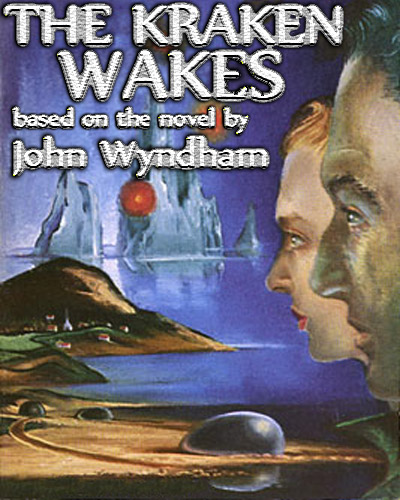
Someone has posted a 1965 CBC Radio dramatization of the “apocalyptic science fiction novel” by John Wyndham’s novel The Kraken Wakes to Archive.org. Unlike a lot of OTR (old time radio) this is very likely not in the public domain (as claimed on the site), but does qualify as the audio drama equivalent of abandonware (as CBC never rebroadcast it or made it commercially available) – either way if you’re going to hear it it’d be wise to be quick about it.

CBC Radio Vancouver - The Kraken Wakes based on the novel by John WyndhamThe Kraken Wakes
Based on the novel by John Wyndham; Adapted by Eric Cameron; Performed by a full cast
5 Zipped MP3 Files – Approx. 2.5 Hours [RADIO DRAMA]
Broadcaster: CBC Radio Vancouver
Broadcast: 1965
Provider: Archive.org
At first, the fireballs seemed to be nothing more than a dazzling display of lights in the sky, plunging into the deepest oceans and disappearing without trace. But when ships started sinking inexplicably and the sea-lanes became impassable it seemed that the world was facing a threat of unprecedented proportions. Recorded at CBC Radio Vancouver.

Starring:
Sam Paine
Shirley Broderick
Michael Irwin
Derek Ralston
Allan Routon
John White
Ivar Harries
Greg Barnes
Peter Brockington
Otto Lowy
Roland Hunter
Sound effects by Lars Eastholm
Produced and directed by Norman Euton
Technical operations by Ian Stephens

Incidently there is a BBC radio drama version of The Kraken Wakes that’s commercially available.

Posted by Jesse Willis

LibriVox: The Brighton Boys In The Radio Service by

SFFaudio Online Audio

LibriVoxWhat ho chaps! Now that it’s 1918 and all let’s all go fight in The Great War! It’ll be trenches of fun. Hey look our teacher thinks it’s a smashing idea! Even better, our parents seem to have no objections at all! Now we’re being trained by these jolly good officers! I tell you Uncle Sam is doing us the favor here. My don’t our uniforms look smart.
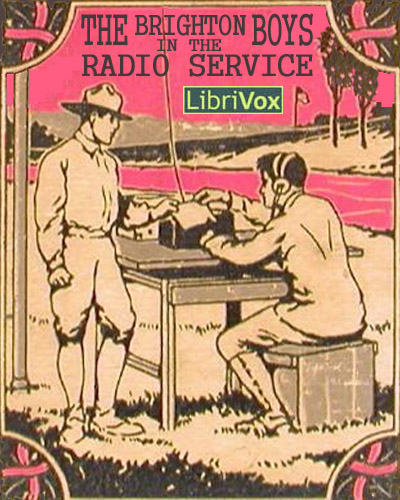
Yep. You see where this is going don’t you?

Early on in this whip-fast boy’s adventure the bad boy of Brighton, an evil sort named Herbert Wallace, tries to discourage Slim Goodwin, one of our heroes, from enlisting in the U.S. Army’s signal corp. He is of course soundly trounced by the school’s headmaster:

“Well, Wallace,” said the principal of Brighton, “I hear you’ve been studying up on military subjects. Intending to get into the fight?”

Herbert Wallace hung his head and muttered an unintelligible reply.

“Now look here, Wallace,” spoke the headmaster sternly, “where did you get the military manual from which you gave Goodwin the information that he could not pass the examination for the army?”

“I—I got it from the library, sir.”

“Got it without permission, too, didn’t you?” pursued the headmaster.

“Yes, sir,” said Wallace, in confusion.

“And didn’t know that it was out of date, and that the requirements were completely changed after the United States entered this war, eh?”

“No, sir,” answered Wallace, on the verge of a breakdown.

“I’ll decide upon your punishment later,” announced the headmaster. “See me here at four o’clock. Meanwhile, Wallace, be careful where you get information, and be careful how you dispense it.”

Yep. Almost 100 years after the event itself I’m still freaked out by the prospect of shipping off to fight in meat-grinder that was World War I. I find it hard to make a case for censorship. But if I was forced to write an essay arguing in favour of it I would present this book as my primary evidence. And since when should you get permission to go to the school library?

Still, narrator Tom Clifton seems to be having a lot of fun reading this adventure. He’s also added in some morse code transmissions with the actual sounds rather than just reading the dot dashes as they appear in the text.

LibriVox - The Brighton Boys In The Radio Service by Samuel Frances AaronThe Brighton Boys In The Radio Service
By Samuel Frances Aaron; Read by Tom Clifton
20 Zipped MP3 Files or Podcast – Approx. 3 Hours 41 Minutes [UNABRIDGED]
Publisher: LibriVox.org
Published: September 21, 2009
The Brighton Boys in the Radio Service is a boys adventure story set in WWI – Three College Chums join the military and face the perils of spies, submarines and enemy soldiers in the trenches of embattled Europe. An engaging story set in a period where good guys wore white hats, bad guys wore black hats and every chapter ends with a cliffhanger so you have to come back for more!

Podcast feed:
http://librivox.org/bookfeeds/the-brighton-boys-in-the-radio-service-by-james-driscoll.xml

iTunes 1-Click |SUBSCRIBE|

Posted by Jesse Willis

BBC7: Brian Aldiss Presents: Imposter by Philip K. Dick

SFFaudio Online Audio

BBC Radio 7 - BBC7BBC Radio 7 has just started a new 5 part series, a “new commission” called Brian Aldiss Presents. The idea is that for five weekends “the UK’s master of the genre” will personally select and introduce a Science Fiction short story for our listening pleasure.

Great idea sez me!

BBC iPlayerAldiss’ first selection is already theoretically available for listening over on the BBC website (using the BBC iPlayer):

Radio Downloader… is definitely subscribable via Radio Downloader


RadioArchive.cc…and will likely be showing up on RadioArchive.cc in mere moments.


And that selection is…

BBC Radio 7 - Brian Aldiss Presents - Imposter by Philip K. DickBrian Aldiss Presents – Imposter
By Philip K. Dick; Read by Peter Marinker
1 Broadcast – Approx. 15 Minutes [ABRIDGED?]
Broadcaster: BBC Radio 7
Broadcast: Saturday September 19th, 2009 @ 6.30pm and 00.30am
Spence Olham is confronted by a colleague and accused of being an android impostor designed to sabotage Earth’s defences. The impostor’s ship was damaged and has crashed just outside the city. The android is supposed to detonate a planet destroying bomb on the utterance of a deadly code phrase. Olham must escape and prove his innocence, providing he is actually Spence Olham. First published in Astounding magazine’s June 1953 issue.

Update:
BBC iPlayer users can listen by clicking the “lower quality version.” This production has some sound effects/music.

Posted by Jesse Willis

BBC Radio 3: Slaughterhouse 5 [RADIO DRAMA]

SFFaudio Online Audio

Radio Times - Slaughterhouse 5 [RADIO DRAMA] Airing on BBC Radio 3BBC Radio 3This Radio Times column is announcing that BBC Radio 3 will have a radio drama adaptation of Kurt Vonnegut’s novel Slaughterhouse 5 airing on September 20, 2009. I belive this makes it the world exclusive premiere of this novel in radio drama. I’m betting that because of it a lot of people are going to be visiting RadioArchive.cc or installing Radio Downloader just to get it.

BBC Radio 3 - Slaughter House 5 - RADIO DRAMASlaughterhouse 5
Based on the novel by Kurt Vonnegut Jr.; Performed by a full cast
1 Broadcast – Approx. 90 Minutes [RADIO DRAMA]
Broadcaster: BBC R3 / Drama On 3
Broadcast: 20:00-21:30 Sunday 20th September
Written by Kurt Vonnegut and dramatised by Dave Sheasby.
“Adapted from arguably one of the greatest anti-war stories of all time, the play centres on Billy Pilgrim, who hops back and forth in time, reliving various moments in his real and fantasy lives, as a prisoner of war, optometrist and time traveller.”

Narrator …… John Guerassio
Billy Pilgrim …… Andrew Scott
Bernard V O’Hare …… Nathan Osgood
Mary …… Joanne McQuinn
Montana …… Annabelle Dowler
Barbara …… Sarah Goldberg
Valencia …… Madeleine Potter
Roland Weary …… Simon Lee Philips
Mother …… Liza Ross
Eliot Rosewater …… Kerry Shale
Howard J Campbell Jnr …… Stephen Hogan
Bertram Rumfoord …… Peter Marinker
English Officer …… Michael Mears
Cinderella …… Philip Fox
Paul Lazarro …… Gunnar Cauthery
Soldiers …… Orlando James, Michael Shelford

Music by 65 Days of Static
Directed by David Hunter

[Thanks Roy!]

Posted by Jesse Willis

Review of Dune, Messiah by Frank Herbert

SFFaudio Review

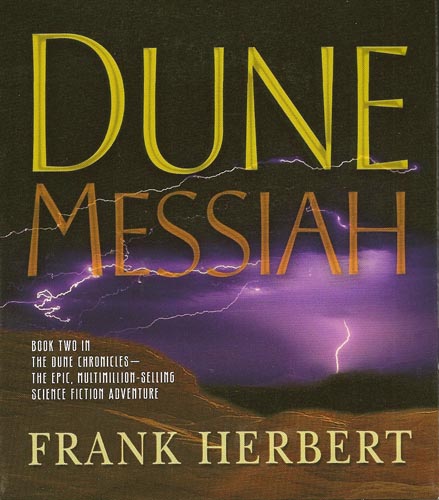
Dune Messiah by Frank HerbertDune, Messiah
By Frank Herbert, Read by Scott Brick, Katherine Kellgren, Euan Morton, and Simon Vance
9 hours – [UNABRIDGED]
Publisher: Macmillan Audio
Published: 2007
Themes: / Science Fiction / ESP / Religion / War / Charismatic Leader /

Its 12 years after the triumph of Paul Atriedes on Arrakis, as presented in Dune. But “happily ever after” wasn’t the kind of book that Frank Herbert was interested in writing. Nor was a “Dune Part II” in which Paul would be presented with another challenge, maybe greater than the first, which he would conquer – with much rejoicing. (Yayyyyy!) Instead, Frank Herbert gave us something (here it comes) completely different.

Dune, Messiah opens with a discussion between members of the Spacing Guild, the Bene Gesserit, the Bene Tleiaxu, and the Princess Irulan about how to bring about the fall of the Emperor Paul, making it immediately apparent that things are not going well for Paul. The known universe has not fared well under his rule. The religious fervor around Paul has increased over time, with people, acting in Paul’s name, performing atrocities on various planets. The Fremen way of life has been completely devastated by the changes brought about by Paul’s government. Paul’s ability to see the future has become something of a burden. He’s often acting in ways to fulfill his role rather than of his own volition. He acts to fulfill fate rather than to fight against it.

It’s not hardly the stuff of heroic literature, like Dune was. Instead, it’s decidedly anti-heroic, which is precisely what Frank Herbert was aiming for. He was writing a book in which his hero makes mistakes in order to illustrate the danger presented by a charismatic leader. From Dreamer of Dune, a biography of Frank Herbert written by his son, Brian:

Among the dangerous leaders of human history, my father sometimes mentioned General George S. Patton, because of his charismatic qualities — but more often his example was President John F. Kennedy. Around Kennedy a myth of kingship formed, and of Camelot. His followers did not question him, and would have gone with him virtually anywhere.

To Frank Herbert, this kind of thing was extremely dangerous. This is an especially interesting counter-viewpoint here in 2009, where the United States has another very charismatic leader. One can’t help but to wonder what Herbert would have to say today.

So Dune can be considered to be the rise of Paul Atreides, and Dune, Messiah could be considered the fall. There’s no question that Dune, Messiah is not the masterpiece that Dune is, but it’s still very interesting. Besides the continued exploration of science fiction ideas like the ghola (Duncan Idaho returns as a ghola in this book – a reanimated man that is Duncan Idaho, but is he really?), the overall exploration of an anti-hero is something that is rare enough in science fiction to make it an refreshing read. Children of Dune, the next book, was definitely on Herbert’s mind as he wrote this one, so it’s difficult to present any kind of final judgment until I read that one. Perhaps the fact that I’m interested enough to continue is judgment enough.

Macmillan Audio’s presentation of the book was excellent. There are multiple narrators, each reading sections of the book. All the narrators are top-notch, so I was very pleased with it.

I found some of the history of Dune, Messiah‘s publication to be interesting as well. John W. Campbell couldn’t wait to serialize Dune in Analog magazine, and did so. But when Dune, Messiah came around, he was disappointed enough in the direction of the story that he wouldn’t buy it for his magazine, despite the popularity of Dune. Galaxy Magazine ended up serializing it.

In Road to Dune, Brian Herbert and Kevin J. Anderson quote a letter from John W. Campbell about Dune, Messiah:

The reactions of science-fictioneers, however, over the last few decades have persistently and quite explicitly been that they want heroes – not anti-heroes. They want stories of strong men who exert themselves, inspire others, and make a monkeys uncle out of malign fates!

Perhaps that’s so, but I enjoyed the book very much, partly because it was different.

Posted by Scott D. Danielson

Review of The Steel Remains by Richard K. Morgan

SFFaudio Review

Science Fiction Audiobook - The Steel Remains by Richard K. MorganThe Steel Remains
By Richard K. Morgan; Read by Simon Vance
[UNABRIDGED]
Publisher: Tantor Media
Published: 2009
ISBN: 9781400139637
Themes: / Fantasy / Noir / Hard Boiled / Magic / War / Homosexuality /

“Men were like blades, they would all break sooner or later, you included. But you looked around at the men you led, and in their eyes you saw what kind of steel you had to hand, how it had been forged and tempered, what blows, if any, it would take.”

—Richard Morgan, The Steel Remains

With his new book The Steel Remains, Richard Morgan sets out to (as main character Ringil Eskiath might say) “prick the bloated arse” of J.R.R. Tolkien and post-Tolkien fantasy. Elsewhere on the web Morgan has expressed his deep dissatisfaction with traditional high fantasy, which often pits stainless forces of good against hordes of irredeemable evil in bloodless, antiseptic sword play. He’s accused Tolkien of the same shortcomings (a flawed analysis with which I vehemently disagree). Against this backdrop, Morgan set out to write The Steel Remains as a deliberately gray, grimy, alternative viewpoint. His book succeeds in sliding cold steel into the lie of childlike fantasy, with which my favorite genre of fiction is admittedly littered.

But when the screaming of gutted men and the skirling of steel dies down, and the full extent of the destruction is laid bare for us to see, The Steel Remains does not have much to offer. The old cliché that it’s easier to tear down and destroy than to build anew applies here. In its falling over itself desire to slice and dice fantasy’s traditional conservatism, The Steel Remains indulges in plenty of its own predictable clichés: Every priest is a religious fanatic and a sex fiend, every leader a morally and ethically corrupt, egotistic blowhard, for example. The book lacks a moral compass; Morgan the author’s world view must be a bleak one, indeed.

The action of The Steel Remains focuses on the converging storylines of three uneven characters—one very well done (Ringil, a sarcastic, war-weary, homosexual master swordsman), one middling (Egar, a brawling, boisterous, randy barbarian from the steppes), and one rather forgettable (Archeth, a black, female half-breed of human and Kiriath, deadly with throwing knives and hooked on drugs). All three are veterans of a recent war against an invading race of “scaly folk,” in which humanity staved off utter destruction at a very high price. Ringil, a war hero but now combat- and world-weary, has retreated from his mercenary lifestyle and is living a slothful, under-the-radar existence, until he’s summoned by an urgent message from his mother: Ringil’s cousin, Sherin, has been sold into slavery to repay a debt, and Ringil’s mother wants her back. Ringil reluctantly agrees.

Soon Ringil finds out that the slavery web in which Sherin has been caught is very dark, wide, and sinister. At its centre are a race of alien beings called the dwenda—tall, attractive, human-like, magic-using creatures that are a combination of Michael Moorcock’s Melniboneans with their cruel and alien immorality, and Poul Anderson’s Nordic-inspired, haughty, and warlike elves (Morgan lists Anderson and Moorcock as two of his sources of inspiration; the third is, unsurprisingly, Karl Edward Wagner). The dwenda are planning to incite a second war on earth and then destroy the victor, taking back their ancestral lands (the dwenda dwelled on earth many years ago). The dwenda require the sacrifice of barren human females to fuel the dark powers that are the source of their sorcery.

There’s much to like in The Steel Remains. Morgan’s prose is sharp and highly readable, and he shows a fine eye for detail and realism in his culture and city-building. Trelayne—a nasty, sprawling, brawling city in which whoring, slavery, and public executions are practiced openly—feels real. Egar’s Majak culture is based on pre-colonized North American Indians, and is well-done with its shamans and superstitions, trade in vast herds of buffalo, and armor and weapons suited to a nomadic lifestyle on the plains.

In addition, if you like your battles bloody and realistic, Morgan is your man. His fight scenes are well-done and you get a great sense of Ringil’s skill with his deadly broadsword of Kiriath steel, and Egar’s brutal butcher’s work with his two-bladed Majak lance. Disembowelings, beheadings, and other ghastly wounds are rife.

Much of the book passed under my eyes as well-oiled but heartless machinery producing graphic combat carnage and highly explicit sex (I’ll pause here to state that the blood and semen-soaked pages of The Steel Remains would make George R.R. Martin blanch, and Eric Van Lustbader—author of The Ninja—green with envy). I found the characters rather unlikeable and unengaging, and the plot fair at best. Very little actually clicked with me until the concluding act, in which Ringil, Egar, and Archeth reunite to fight a desperate last stand against the duenda. This was one of the few moving scenes in the book in which I actually felt some measure of concern and identification with our heroes. Ringil’s rousing speech is of the stuff with which great heroic fantasy is made. I wish there was more like this.

In summary, we know that life is can be dirty and horrible. War is hell, yes, and men are weak and piggish. But Morgan drives the same points home, again and again, over 400 dark, cynical, iconoclastic pages of The Steel Remains, which by the end is too one-note and sacrifices story at the expense of the author’s agenda.

Narrator Simon Vance does a terrific job as narrator, changing his voice to suit the temperaments and personalities of the various characters in Morgan’s novel. Clarity and precision are among Vance’s strengths as a reader and he does not disappoint here. When I began listening to The Steel Remains, and before I had seen the narration credits, I recognized Vance’s distinctive voice from his wonderful depiction of Count Dracula and the rest of the characters from Bram Stoker’s Dracula (Blackstone Audiobooks). For unknown reasons Vance performed Dracula under the pseudonym, Robert Whitfield.

[For more of Brian’s thoughts on The Steel Remains check out The SFFaudio Podcast #034]

Posted by Brian Murphy