William Gibson interviews about Spook Country

SFFaudio Online Audio

CBC Radio One North By North West Studio One Book Club - Hosted by Sheryl MacKay of CBC Radio and John Burns of the Georgia Straight - image credits go to http://www.flickr.com/photos/jmv/

CBC Radio Podcast - Words At LargeThe Words At Large podcast, an amalgam of book related tidbits from CBC radio programs, has an in-depth interview with William Gibson about his latest novel Spook Country. This originally aired in the NXNW Studio One Book Club slot on Saturday September 15th. You can download the |MP3| direct or get the file by subscribing to the podcast feed:

http://www.cbc.ca/podcasting/includes/wordsatlarge.xml

NPR - On PointAlso, there was a great interview with William Gibson on NPR’s “On Point” program, in which Gibson speaks about Spook Country. From the introduction…
“Now the man who coined the term cyberspace is writing wild fiction set in the here and now”

Gibson’s recent writing (starting with Pattern Recognition) is a swing away from futuristic science fiction – about this, Gibson later remarks, “One of the conclusions that I’ve come to is that science fiction is never about the future, really . . . it’s always about the day in which it was written.” Gibson also predicts “within a decade from now cyberspace with be a nostalgic term”; much in the same way that the use of “electric” as a prefixed adjective in the 19th century went away when electric devices became commonplace, so will the term “digital” be subsumed.

Here’s the direct link to the |MP3| file for the interview.

[Special thanks to Moriond]

And of course, this post mentioning CBC means I must mention that… Apocalypse Al must be freed!

German language Radio Drama alive and well

SFFaudio Commentary

“Der Himmel ueber dem hafen hatte die farbe eines fernsehers, der auf einen toten kanal eingestellt ist.”

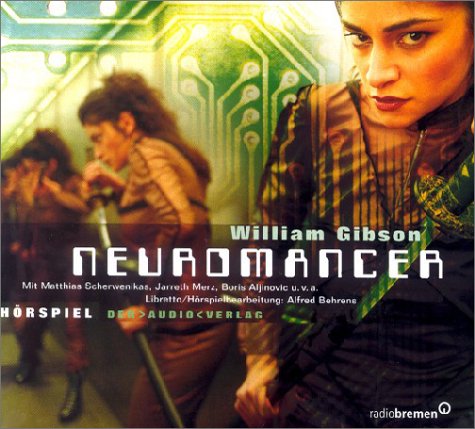
Neuromancer Radio Drama in GERMAN

If regular old Neuromancer is just too prosaic for your discerning tastes might I recommend the German language radio drama version?

Have a listen to a sample RealAudio track, its an urbane, laid-back delivery of William Gibson’s familiar story in audio dramatization form. The production is speckled with subtle musical cues and unexpected lines in English. It’s awesome. Thanks to Carsten Schmitt for the tip-off!

The entire drama is available on a 3-CD set through Der Audio Verlag (which translates into “The Audio Publishinghouse”). Also in the Der Audio Verlag catalogue are more German language radio dramatizations of the works of Isaac Asimov, Stanislaw Lem and many others. Especially cool sounding is the one titled Erinnerungsmechanismus by Philip K. Dick (which translates back into English as “Memory Mechanism”) There’s something comforting about the idea that radio drama is alive and well in Germany… aber es drückt mich nieder, daß mein Deutscher nicht bis zur Aufgabe ist.

BBC7 presents Doctor Who and William Gibson’s Pattern Recognition

BBC 7's The 7th DimensionBBC7’s The Seventh Dimension have two specially commissioned treats this week:

Doctor Who: Human Resources – An Eighth Doctor Adventure
2 Parts – [RADIO DRAMA]
Broadcaster: BBC Radio 7 / The 7th Dimension
Broadcast: Sunday at 6pm and 12am (UK Time)
Part one of a new two-part adventure of the vagabond Time Lord, look for part two next Sunday. The doctor’s companion Lucie has been headhunted by a respectable blue-chip firm in Telford, and the doctor confronts a terrifying enemy. Stars Paul McGann produced by Big Finish Productions.

Pattern Recognition
By William Gibson; Read by Lorelei King
5 Part reading – [ABRIDGED?]
Broadcaster: BBC Radio 7 / The 7th Dimension
Broadcast: Monday to Friday at 6.30pm and 12.30am (UK Time)
Cayce Pollard is a coolhunter. Her gifts are an innate ability in pattern recognition, a skill essential in trendspotting, and a unique allergy to, and therefore an ability to identify, winning logos. These gifts make her an indispensable tool for multinational marketing magnates.

Both programs and all their parts are re-listenable via BBC7’s time-shifting “Listen Again” feature.

FREE MP3 audiobook of Neuromancer by William Gibson

Online Audio

GPod Audio BooksHere is another must listen from the Greylodge Podcasting Company archives!

Now it isn’t too often that we recommend an abridged audiobook, but this one is a can’t miss – you’ll really dig it. With original music by U2 and a reading by the author himself, Neuromancer is the unstoppably compelling novel that spawned a whole sub-genre of Science Fiction.

[Read the SFFaudio Review]

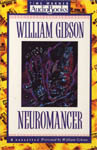
Science Fiction Audiobook - Neuromancer by William GibsonNeuromancer
By William Gibson; Read by William Gibson
8 MP3s – Approx. 6 Hours [ABRIDGED]
Publisher: Time Warner AudioBooks
Published: 1994
ISBN: 1570420599
Case was the sharpest data thief in the Matrix, until an ex-employer crippled his nervous system. Now a new employer has recruited him for a last-chance heist. To do the job Case is teamed with a street samurai razor-girl, an illusionist and a reconstructed Green Beret. Their mission, break into the mansion of a high orbiting space habitation and find the key that will release… something.

Download all 8 MP3s:
|Part 1|Part 2|Part 3|Part 4|Part 5|Part 6|Part 7|Part 8|

BBC7 has William Gibson’s Burning Chrome + Douglas Hill’s Blade Of The Poisoner

Online Audio

BBC 7's The 7th DimensionBBC7‘s has some good stuff for us this week. First up, a dramatized version of a late 1980s fantasy novel by Douglas Hill. Next an early 1980s short story by William Gibson. I heard the Gibson story when it we first broadcast on BBC a while back, it is a terrific listen with narration done by Adam Sims.

Blade Of The Poisoner
Based on the novel by Douglas Hill; FULL CAST
4 Parts – [RADIO DRAMA]
BROADCASTER: BBC 7
BROADCAST: Saturday at 6pm and 12am (UK Time)
Young Jarral narrowly escapes the slaughter of his village by the evil Prince Mephtik – the Poisoner. Adapted by Wally K Daly and first broadcast on BBC Radio 5 in 1991.

Burning Chrome
By William Gibson; Read by Adam Sims
2 Parts – [UNABRIDGED]
BROADCASTER: BBC 7
BROADCAST:Thursday and Friday at 6.30pm and 12.30am (UK Time)
Set in the world of cyberspace and computer hacking. Bobby Quine and Automatic Jack are trying to figure out a way of pulling off the one big score that will make them rich. But industrial espionage is a dangerous business, especially when they decide to rip off Chrome, the most ruthless figure in the local mob subsidiary.

Review of Pattern Recognition by William Gibson

Science Fiction Audiobook Review

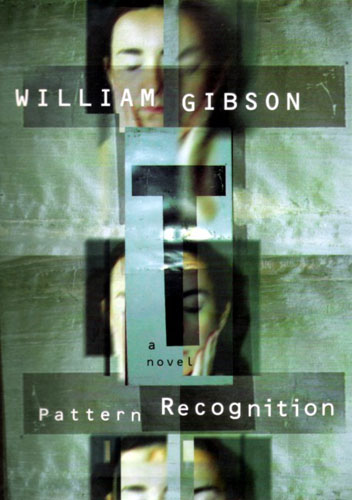
Science Fiction Audiobook – Pattern Recognition by William GibsonPattern Recognition
By William Gibson; Read by Shelley Frasier
9 CDs – 10.5 hours – [UNABRIDGED]
Publisher: Tantor Media
Published: 2004
ISBN: 140010095X
Themes: / Science Fiction / Internet / 9-11 / Crime /

“Cool Hunter.” How about that for a dream job? Companies pay you (and ply you with the latest technological goodies) to identify trends and fashions that spring up at street level so that they can commodify them and turn a buck. As far as I know, William Gibson (the man responsible for the term “cyberspace”) didn’t coin “cool hunting,” but he makes good use of the idea in “Pattern Recognition.” Cayce Pollard is Gibson’s heroine and the consummate cool hunter. Cayce can spend an afternoon walking through the teenagers clogging the streets of London when school lets out and identify at least three of tomorrow’s money-making fashion trends. She can look at two potential logos for a company and immediately know which of them will connect better with the targeted demographic. Like any other talent, though, being able to tell what works and what doesn’t has its downside. Cayce has an almost allergic reaction to most brand names; she’s got to have the labels removed from and the words filed off of the rivets on her black 501’s, her Casio G-Shock has got to be logo-free, and don’t even think about coming near her with a picture of the Michelin Man. Cayce is also deeply obsessed with a captivating film that has been mysteriously released, bit-by-bit, over the Internet, an obsession that opens the door for Gibson’s intricate plot.

Pattern Recognition was written soon after 9-11 (the events of which it references regularly), and is set in a very realistic 2002. The book probably doesn’t even technically qualify as science fiction, but Gibson keeps his ear so close to the tech-development ground that the story gives the impression of being futuristic. In fact, the book can be used as a sort of barometer to gauge your level of tech-geekiness. Are image-based search engines and vintage calculator fetishes old-hat to you? Congratulations, you’re ready to tackle Doctorow and Stross. Is the idea of a “render farm” unknown to you, and do you still double-take when you hear “google” used as a verb? Better stick to Card and Haldeman.

Having said that, this is probably the most accessible of all of Gibson’s books. His embrace of a post-cash economy era heroine and his tangential explorations of Internet forum social hierarchies and information-age Russian Mafia thugs will satisfy sci-fi vets (and provides solid evidence of Gibson’s place as a powerful influence on the new wave of cyber-post-punk writers), but the realness of Cayce’s femininity, the lack of one-dimensional characters, and, particularly, the overall attractive melancholy mood of the book make it one that you can safely recommend to your sci-fi avoidant spouse and friends.

I read the text version of Pattern Recognition soon after it came out, and was pleasantly surprised at how much enjoyment the audio book added to my experience. Shelley Frasier’s pleasantly dry narration, able handling of accents, and especially the sexy innocence she gives Cayce’s voice had me popping discs in one after another. I have a very pleasant memory of taking a break from a late-night Fawlty Towers marathon to get some Burger King, and staying in my garage five extra minutes just to finish listening to Shelley describe a British noodle bar called “Charlie Don’t Surf”.

The text version of the book includes a drawing of an object that is vital to the plot, and I was worried that the audio book might get awkward at that point, but truth be told, I didn’t even notice the absence of the drawing.

So, hats off to Gibson, Frasier, and the folks at Tantor Media for putting together an excellent reading of a great science fiction novel (that isn’t even really science fiction). As wonderful as Gibson’s more speculative work is, if Pattern Recognition is what it looks like when both of his feet touch ground, then I wouldn’t mind if he came down to earth more often.