Review of The Red Panda Adventures – Season 7

SFFaudio Review

If you haven’t already started listening to The Red Panda Adventures you’re doing yourself a grave disservice. Go back to the beginning and start with Season 1 (that’s HERE).

Superhero Audio Drama - The Red Panda Adventures - Season SevenThe Red Panda Adventures – Season 7
By Gregg Taylor; Performed by a full cast
12 MP3 Files via podcast – Approx. 6 Hours [AUDIO DRAMA]
Podcaster: Decoder Ring Theatre
Podcast: August 2011 – July 2012
Themes: / Fantasy / Superheroes / Mystery / Crime / Nazis / War / WWII / Adventure / Toronto / Androids / Espionage / Zombies / Magic / Aliens / Poetry / Astral Projection / Hypnosis / France / Germany / Berlin / Dinosaurs / Identity / Forgery / Romance /

The Red Panda Adventures is a comic book superhero series with a world, now in it’s seventh season, that is only comparable in scale to the entire Marvel or DC universes. But unlike either DC and Marvel, the Red Panda universe has all been written by one man, Greg Taylor. Because of that it has a consistency like the best seasons of Babylon 5.

The first episode of Season 7 follows right on the heels of last season’s final episode. In the season opener, From the Ashes, Kit Baxter gets a visit from the highest power in the land. And what with the Red Panda being presumed dead there’s only one thing to do – find a replacement for Canada’s greatest superhero. The government suggests that an unkillable machine, bent on vengeance, become the new Red Panda. And Kit, is fairly forced to accept the government’s choice. Now I won’t summarize any more of the plot. But, I will say this – Season 7 is a very different season than the previous six seasons.

What isn’t different is Taylor’s scripting. It’s still great, in fact its almost unbelievably great. Taylor has one of those highly distinctive writing styles, one that’s instantly recognizable – he’s like an Aaron Sorkin, a David Mamet, or an Ian Mackintosh. And with Taylor’s style comes a whole lot of substance too. He does incredible things with each half-hour script. Each standalone tale features a carefully measured combination of snappy repartee, genuine mystery, thrilling suspense, and clever action. And he does it all within a expanded universe so consistent so as to have become a kind of complete alternate history. His seven year series, and running, has created an image so vivid as to be completely realized. Taylor’s 1930s-1940s Toronto is far realer to me than any Gotham or Metropolis offered up in comics or movies. In fact to find anything comparable you’d have to go to the Springfield of The Simpsons!

Indeed, for the last seven years I’ve followed The Red Panda Adventures rather avidly and with each season I’ve become more engrossed in the show. The release of a new episode has become so inextricably linked to my listening habits so as to become like a good a visit from an old friend. It’s truly wonderful.

In my re-listening to the first eleven episodes of this Season 7 I picked up dozens and dozens of minor details in dialogue and plot that I’d missed the first time around. Take one point, early in the season, as an example – a character quotes the tagline of the CBS Radio series Suspense as a part of her dialogue.

How wonderful to find that!

And of course there are all the usual line echoes that we know from all past seasons (if you’re curious there’s a whole thread of Taylorisms over on AudioDramaTalk).

As for Season 7 as a whole, it has a sense of deep loss, very much in keeping with the times in which the story is set and the fallout from Season 6. Earlier I mentioned that Season 7 was unlike previous seasons, that’s because it features two overarching, and eventually intersecting, plots. The first, set in Toronto, deals with Kit Baxter, her new sidekick, her new job as associate editor of the Chronicle, and her developing pregnancy. The other plotline, set in Europe introduces us to a new character, a Lieutenant Flynn, a man in a deep denial, and his attempts to fight the Nazis behind their lines. It’s a radical change, and unforeseen change of pace, but not an unpleasant one.

The smaller scale stories from this season, like The Milk Run, work terrifically well too. As even the characters themselves will admit a plot about the forgery of rationing books doesn’t sound very dramatic next to the events unfolding in war torn France. But it’s a job that has to be done, and should be done, and done well it is. And that’s because the relatively harmless domestic crime of forgery is an important part of the story of WWII Toronto. The The Milk Run script tackles it in a way that makes it seem as if such a story could not not be told. In fact, this whole home-front end of the season’s story holds up very well next to the very dramatic later episodes.

One other such, The Case Of The Missing Muse, works very similairly. It’s a story in which we meet a super-villain, with a super-vocabulary, in a mystery that could have been set in any of the previous episodes. But what with the war time setting it of Season 7, and a new Red Panda running the show, it has a resolution that has its own unique wartime fit.

That replacement Red Panda, who in fact is a character from a previous season is still voiced by the wonderful Christopher Mott. The new Panda has a very different personality and temperament than our good friend August Fenwick. His goals as Red Panda are different, his methods are different, and it’s basically everything you like about when a hero regular superhero, from the comics gets, a replacement. It’s a new origins story – a fresh start – with all the promise that brings.

Some have argued that The Red Panda Adventures is really Kit Baxter’s story – and that certainly could be argued especially within the first arc of Season 7. Indeed, Kit Baxter, aka Flying Squirrel, does not get short shrift there. Besides her regular superhero duties, Kit’s also required to train the new Panda, fill in for the shattered Home Team (from last season) and somehow deal with the fact that her butler now knows she’s the Flying Squirrel! But that’s not all over at The Chronicle, the fictional Toronto newspaper that Kit works for, she, and we, get to visit with one of the best editor voices I’ve ever heard. Editor Pearly is your typical fatherly J. Jonah Jameson type caricature of an editor, but with a voice so crazily stressed out, a voice with lines so quickly delivered, you’ll barely understand a word he’s saying. It’s both fun and funny.

Then, just short of the midway point, a kind of focal transition takes place in between episodes 78 and 79, The Darkness Beyond and Flying Blind. The second arc begins slowly but soon ramps up. The aforementioned “Lieutenant Flynn”, and a team of commandos lead by one Captain Parker must escape from a Nazi stalag prison. Once achieved they spend much of the rest of the season either on the run or doing Special Operations Executive style missions in Nazi occupied France or in Berlin itself! And long time fans of the series will recognize the return of a certain Australian accented commando in one episode.

This new military aspect of the show is actually rather remarkable, being like a kind of Canadian version of WWII Captain America. It features a large male cast, allied soldiers, that act like something like a hybrid of the comics like Sgt. Rock, Sgt. Fury And His Howling Commandos, and The Unknown Soldier. Indeed, in the final episode of Season 7, The Black Heart, the show even gives a nice tip of the hat towards the later Nick Fury (the one who’s an agent for S.H.I.E.L.D.). That final season episode, incidentally, is set to be podcast later this month and features several other reveals, and dare I say reunions, which fans will be sure to love – I know I sure did. Suffice it to say, the Season 7 season-ender is definitely not a cliffhanger.

Here’s the podcast feed:

http://decoderring.libsyn.com/rss

Happy Canada Day everybody, go celebrate with some RED PANDA!

Posted by Jesse Willis

Guardian Short Stories Podcast: My Dream Of Flying To Wake Island by J.G. Ballard
SFFaudio Online Audio

Willliam Boyd explains his love of J.G. Ballard’s short story My Dream Of Flying To Wake Island:

In the short history of the short story – not much longer than 150 years – very few writers have completely redefined the form. Chekhov, pre-eminently, but also Hemingway and Borges. JG Ballard has to be added to this exclusive list, in my opinion. Ballard’s models for his haunting stories are closer to art and music, it seems to me, than to literature. These are fictions inspired by the paintings of De Chirico and Max Ernst, which summon up the mesmerising ostinatos of Philip Glass and Steve Reich. Character and narrative are secondary – image and symbol dominate with a surreal and hypnotic intensity, and the language reflects this. Ballardian tropes – empty swimming pools, abandoned resorts, psychotic astronauts, damaged doctors, the alluring nihilism of consumer society and so forth – are unmistakably and uniquely his. “My Dream of Flying to Wake Island” is a true Ballardian classic.

This is a story you can listen to again and again.

Guardian Short Stories PodcastMy Dream Of Flying To Wake Island

By J.G. Ballard; Read by William Boyd
1 |MP3| – Approx. 30 Minutes [UNABRIDGED]
Podcaster: Guardian Short Stories Podcast
Podcast: December 11, 2010
First published in Ambit #60 (Autumn, 1974).

Posted by Jesse Willis

The SFFaudio Podcast #158 – READALONG: The Syndic by C.M. Kornbluth

Podcast

The SFFaudio PodcastThe SFFaudio Podcast #158 – Last week’s podcast was an unabridged reading of The Syndic by C.M. Kornbluth. This week Jesse discusses it with the narrator, Mark Douglas Nelson!

Talked about on today’s show:
SciPodBooks.com, the SciPodCast, The Syndic by C.M. Kornbluth, The City At World’s End by Edmond Hamilton, the virtues of democracy, Oath Of Fealty by Larry Niven and Jerry Pournelle, H. Beam Piper, Space Viking, a wealth of ideas, Frederik Pohl, the story as a straw man, Robert A. Heinlein, telepathy, witches, dystopia, utopia, polo played with jeeps (mounted with 50 caliber machine guns), the syndicate vs. the mob, Ireland, Iceland, libertarianism, the Prometheus Unbound review of The Syndic, polyandry, an economy run on alcohol, sex, and gambling, laissez faire capitalism, monopolies, robber barons, taxes vs. shakedowns, “a real mess of a book”, should a society compromise its ideals to save itself?, is the joke on us?, a velvet gloved invisible hand, The High Crusade by Poul Anderson, the children’s crusade, WWII, rule by mob vs. rule by mobsters, Ron Paul, the sustainability of a war based economy need not much concern the arms manufacturer, Isaac Asimov, The City At World’s End has a real plot, disaster stories, new ideas trump big flaws, “writing by the seat of your pants”, space opera, E.E. “Doc” Smith, respect for science and scientists, Farnham’s Freehold by Robert A. Heinlein, The Green Odyssey by Philip Jose Farmer, LibriVox.org, Riverworld series, rolling ships, Hyperion by Dan Simmons, the problem of endless series, StarShipSofa, The Truth Is A Cave In The Black Mountains by Neil Gaiman, A Princess Of Mars by Edgar Rice Burroughs, A Voyage To Arcturus by David Lindsay, “philosophy, philosophy, philosophy”, it starts with a séance, C.S. Lewis, Right Ho, Jeeves by P.G. Wodehouse, Jeeves And Wooster, Leave It To Jeeves, LibriVox’s new funding (from the Andrew W. Mellon Foundation), Orson Scott Card, Harlan Ellison, Airborn by Kenneth Oppel, Gregg Margarite, Lone Star Planet by H. Beam Piper, Kevin J. Anderson, Principles Of Economics, iambik audio, Wonder Audio, All Or Nothing by Preston L. Allen, The Tattoo Murder Case by Akimitsu Takagi, Toshiro Mifune, Akira Kurosawa, High And Low, Netflix, Sweet And Lowdown, One O’Clock Jump by Lise McClendon, A Is For Alibi by Sue Grafton, Talents Incorporated by Murray Leinster, goofy, the William Woodsworth Microphone Showdown, do expensive mics make great narrators?

Posted by Jesse Willis

CBC Radio Drama in Vancouver during WWII – photo

SFFaudio News

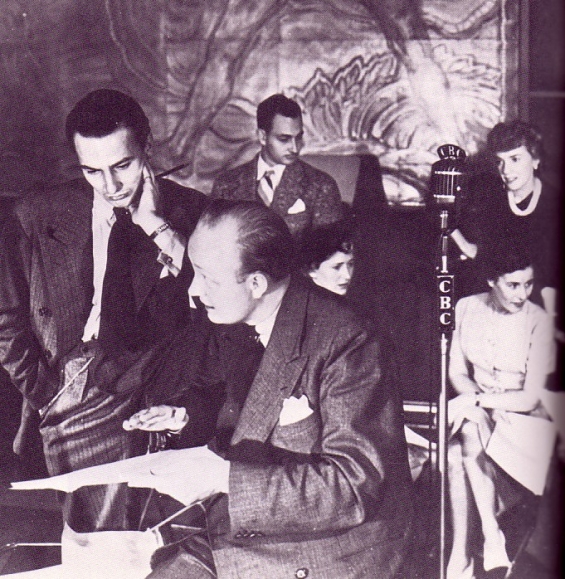
imagine-p72 - During a drama rehearsal in CBR's studio A, actor-writer Fletcher Markle (left), confers with CBC producer Andrew Allan. In the background are cast members Al Pearce, Claire Murray, Peggy Hazard and Kathy Graham.  The play in production is probably from the series "Baker's Dozen" written by Markle and broadcast in 1941 & 1942.

“During a drama rehearsal in CBR’s studio A, actor-writer Fletcher Markle (left), confers with CBC producer Andrew Allan. In the background are cast members Al Pearce, Claire Murray, Peggy Hazard and Kathy Graham. The play in production is probably from the series “Baker’s Dozen” written by Markle and broadcast in 1941 & 1942.”

[via the Vancouver Radio Museum]

Posted by Jesse Willis

Dan Carlin’s Hardcore History: #42 Logical Insanity

SFFaudio Online Audio

Dan Carlin’s Hardcore History podcastPowerful podcasting, that’s what Dan Carlin’s Hardcore History was. Carlin used to put out the most powerful podcasts I’d ever heard. With episodes like Punic Nightmares, Ghosts Of The Ostfront, and Steppe Stories (now available as audiobook downloads). Half-way through them I’d be calling up friends and telling them “Hey, new Dan Carlin is out!” and then start telling them how awesome the show was.

And over the years I can’t say the show ever went bad – because it really never did – it just didn’t consistently hit the incredibly high highs that it had earlier. That is until just before this point this morning…

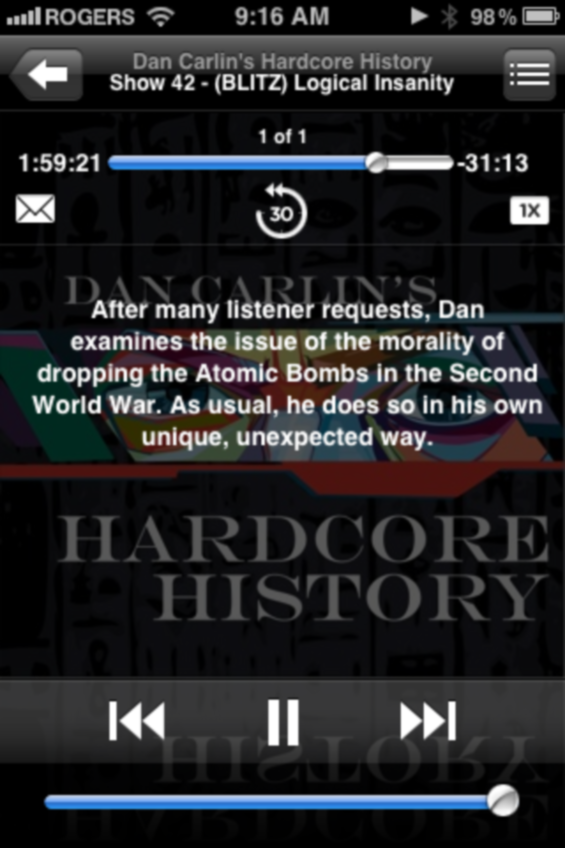
Dan Carlin's Hardcore History - #42 Logical Insanity

…where I realized that there was a new classic Dan Carlin out.

Carlin’s connective thread in this episode – that the insane choices of 20th century history are in fact a kind of horrific logic – delivered with fascinating historical evidence and illustrated with his incredible storytelling skill, shows the inevitable, frightening, awful logic of bombing cities full of people – even with nuclear weapons.

Carlin poses questions like. ‘In war, how many enemy civilians are you willing to kill in order to save one of your own people’s lives?’

And of course if that number is not equal to zero you’re down the path towards logical insanity.

Here’s the episode |MP3|

Podcast feed:
http://feeds.feedburner.com/dancarlin/history?format=xml

Posted by Jesse Willis

The SFFaudio Podcast #153 – AUDIOBOOK/READALONG: Small Town by Philip K. Dick

Podcast

The SFFaudio PodcastThe SFFaudio Podcast #153 – Small Town by Philip K. Dick, read by Gregg Margarite. This is a complete and unabridged reading of the short story followed by a discussion of it with Jesse, Tamahome, and Gregg Margarite!

Of Small Town Philip K. Dick wrote:

“Here the frustrations of a defeated small person — small in terms of power, in particular power over others — gradually become transformed into something sinister: the force of death. In rereading this story (which is of course a fantasy, not science fiction) I am impressed by the subtle change which takes place in the protagonist from Trod Upon to Treader. Verne Haskel initially appears as the prototype of the impotent human being, but this conceals a drive at his core self which is anything but weak. It is as if I am saying, The put-upon person may be very dangerous. Be careful as to how you misuse him; he may be a mask for thanatos: the antagonist of life; he may not secretly wish to rule; he may wish to destroy.”

Talked about on today’s show:
Gregg is getting better at girls, girls are always questioning you, horror, urban fantasy, The Twilight Zone, Science Fiction, Fantasy, Rod Serling, paranoid Verne Haskell, a lead quarter, the redistribution of wealth, playing god, “…and he rested and he made a sandwich”, god games, SimCity 2000, churches can’t be stopped, Microcosmic God, “shoved into the next dimension”, is it slipstream?, Stopover In A Quiet Town, transformers are the science, diorama, the train doesn’t run them over, “moral”, “extremely moral”, train guys, Lego, erector sets, Lincoln Logs, Meccano, matchbox cars, small towns can be hell, comic book stores, “urbane-al-ity”, is Verne the god of Woodland?, pet shops and mortuaries, little man, SFSignal’s Sword And Sorcery Panel suggest characters should be the focus, “Finished!”, world warping, John Carter, handwavium, “make out”, Beyond The Door, Dick’s faithless women, Clans Of The Alphane Moon, how risque were SF mags in the 1950s?, San Fransisco, Silvia is one of Dick’s most common female character names, a life sized diorama, The Tell Tale Heart, The Days Of Perky Pat, The Three Stigmata Of Palmer Eldritch, the game of Life, Barbie, chew-z, the documentary Marwencol (2010), “he wants love”, Mark Hogancamp’s world is open, living in a real dream world, Deja Thoris has a time machine, Jeff Malmberg, A Clockwork Orange, adding layers, “well done Jeff”, R. Crumb, Blade Runner‘s androids take photographs to take memories, “reality and consciousness are fluid constructs”, crazy vs. differently enabled, Esopus magazine, a world without irony, authenticity, people are complicated, Greenwich Village, cross-dressing, WWII.

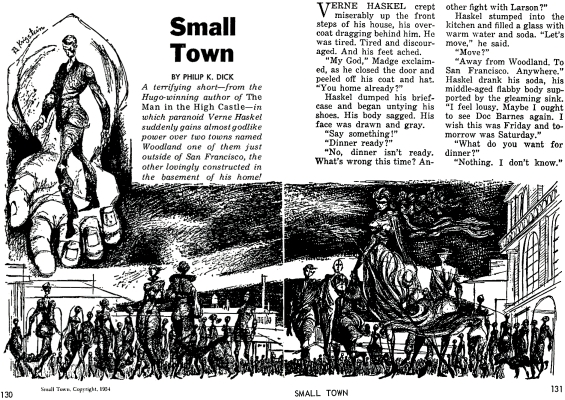
Small Town by Philip K. Dick second publication in the April 1967 issue of Amazing Stories

Marwencol

Posted by Jesse Willis