Review of The Engines of God by Jack McDevitt

SFFaudio Review

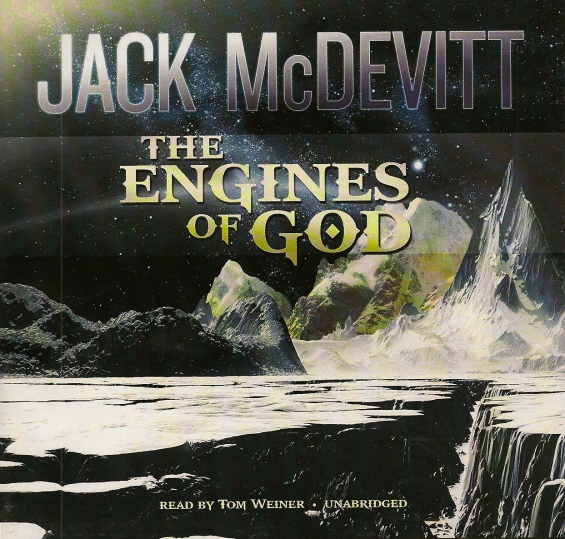
Science Fiction Audiobooks - The Engines of God by Jack McDevittThe Engines of God
By Jack McDevitt; Read by Tom Weiner
14 Hours – [UNABRIDGED]
Publisher: Blackstone Audio
Published: 2012
Themes: / Science Fiction / Archaeology / Climate Change / Aliens / Space / Space Exploration /

Climate change has Earth on the brink of disaster. The only viable solution is terraforming other planets to ensure survival. For a small group of archaeologists, however, terraforming is the worst possible solution. The only suitable planet is also the one planet with the most promising artifacts of an unknown alien race. Known as the Monument Makers, the aliens’ buildings feature a seemingly uncrackable code on them. The team is looking for the alien equivalent of the Rosetta Stone and must race against time to finish excavations before terraforming begins.

Despite the fact that the book begins by talking about climate change, which always gives me a sinking feeling, that is just the pretext for launching readers into a mystery. The team’s quest takes them to outer space, other planets, and into extreme danger as they follow the Monument Makers’ trail to discover their whereabouts and why every alien civilization has been abandoned.

This book reads as if it were a series of four novellas strung together with the common thread of tracking the Monument Makers. Each of the completed stories gives Jack McDevitt the opportunity to take the reader a bit further into archaeological mysteries while also examining different planets, space travel, and alien beings. Transitions between “novellas” are minimal at best and character development is weak. Still McDevitt wove a mystery that kept me listening at a red-hot pace. This is surprising because the author revealed his story in a very straight forward manner with plenty of foreshadowing. In McDevitt’s case, however, the telling itself was so compelling that I was fascinated to hear what would happen next.

In short, I enjoyed this very much, although at the end the story suddenly threw off narrative and resorted to bullet points to finish things off. “In audio, it was an abrupt ending that startled me, however, that didn’t spoil it as the story itself was done. In fact, I didn’t care about the “[insert name here] went on to do this” summary and it could have been left out without hurting anything.

Tom Weiner did a fine job of narrating the book. His reading was not something that stood out for any reason but which carried the story along very well. It left me with the memory of story rather than reader, which is surely what good narration should accomplish.

McDevitt tells a very good mystery that gives answers to some questions and leaves others to the readers’ speculation. Engines of God is ultimately a satisfying adventure which introduces us to a universe that he went on to write other novels about and which I will be seeking out.

Posted by Julie D.

Review of The Magician King by Lev Grossman

SFFaudio Review

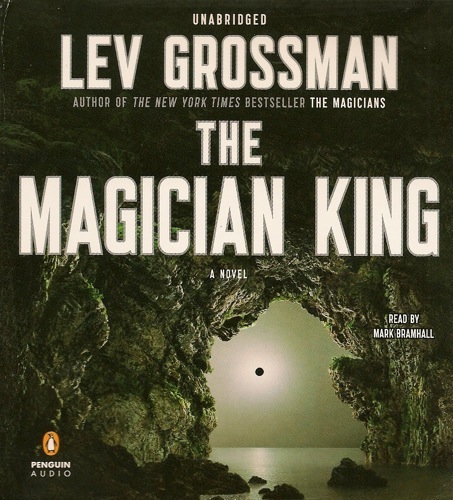
Fantasy Audiobook - The Magician King by Lev GrossmanThe Magician King
By Lev Grossman; Read by Mark Bramhall
13 CDs – Approx. 16 Hours [UNABRIDGED]
Publisher: Penguin Audio
Published: 2011
ISBN: 1611760259
Themes: / Fantasy / Magic / Wizard School / Alternate Worlds / Gods /

What does it mean to be the Hero on a Quest? What does it cost? Perhaps this is something you might want to find out before you go looking everywhere for one.

It is two years since the final scene in The Magicians (Read the Review). Quentin Coldwater is now one of the Kings of Fillory, that Narnia-esque fantasy land from the series of books he read as a child. Fellow King and Queens are fellow Brakebills Academy graduates Elliot, the self-obsessed fop, and Janet with whom Quentin had a very brief dalliance, with tragic consequences. There are to be two Kings and two Queens of Fillory with Quentin’s pre-Brakebills friend Julia taking the fourth crown.

Quentin is still emotionally scarred from the tragedies of the first book and is struggling to find a reason in his life. Again this leads him towards a search for a Quest. Despite being a King in a magical realm where you would have to go far out of your way to prevent the land from producing a bountiful harvest. It still isn’t enough, Quentin feels the need to be doing something important. One thing the Fillory was good for in the books about it that he read while growing up, was that the Chatwin children always had a quest to complete when they visited.

After a false start on a quest involving a madly thrashing over-sized clock-tree, Quentin embarks on a trip to the most remote island of the realm of Fillory. To collect on unpaid taxes. He was getting desperate to find his quest and this come up at the wrong time. Never mind that the cost of outfitting the ship and getting there would out strip the value of the unpaid taxed several times over.

Accompanying Quentin on his fools quest is Queen Julia. In The Magicians Julia was the school friend that also sat the Brakebills entrance exam, but didn’t make the cut. Half of The Magician King is told from Julia’s perspective, as we follow what brought her from failing that exam to where we found her floating in the air beside Elliot and Janet at the end of The Magicians. This half of the book is the more compelling of the two as we learn about the world of Magic that isn’t controlled by the establishment as exemplified by the Brakebills Academy.

The main quest that Quentin and Julia follow, The Search for the Seven Golden Keys of Fillory, inadvertantly takes them out beyond the furthest isle of Fillory and lands them in the one place neither of them ever wanted to be. Back home of Earth. Although Earth isn’t as magical as Fillory, there are still wonders here to be found, such as Dragons.

Julia is the real treasure in this novel. A minor character in the first book, she rivals and surpasses Quentin for the position of protaginist. Although half the book is written from Quentin’s perspective, you should pay close attention to Julia. The two halfs tell of the terrible path that this poor tortured woman drove herself along after glimpsing the secret world of Brakebills. She is a broken and empty shell as Queen Julia, slowly finding parts of herself as she and Quentin struggle to find the Keys that will prevent Magic from dissappearing from all of the different realities. Especially important to Fillory as it can’t even exist without Magic. For the Old Gods have returned. No, not Cthulu. The Gods who created the Neitherlands, and accidentily left open the loophole that allows humans to do magic at all.  Something got there attention and now they know that there is a loophole, and they are working to close it.

Quentin and Julia are both compelling characters. Quentin is still a bit of the Emo kid he was in the first book and his desire to be the Hero teaches him the cost real Heros must be prepared to pay. Julia through the two storylines has a woderful depth to her. She isn’t necessarily likeable, she is even more obsessive then Quentin in the flashback story. An obsession that costs her dearly.

Grossman’s world of Magic, although having some of the trappings of a Narial-like fairytale, it has much more in common with the original dark fairytales before they were sweetened for Victorian children. Magic is powerfull and the consequences, when they come, are swift, severe and utterly pittyless. We do get to see the awesome potential of the Magic that Quentin wields as he finds in himself the real Magician King. What he and his friends had been doing before was just playing with kid-gloves.

Mark Branhall again narrates, bringing out each character well and maintains consistent voices for characters from The Magicians.

This is a more developed narrative than the first book, which stood well on it’s own and didn’t leave you feeling there was a need for a sequel. The Magician King‘s story is also self-contained, but you should have read book one to appreciate it properly.

Posted by Paul [W] Campbell

Review of Steel by Richard Matheson (from Steel And Other Stories)

SFFaudio Review

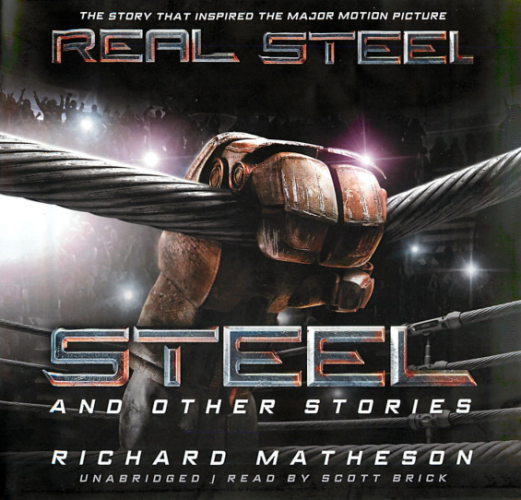
BLACKSTONE AUDIO - Steel And Other Stories by Richard MathesonSteel And Other Stories – Steel
By Richard Matheson; Read by Scott Brick
Approx. 59 Minutes [UNABRIDGED]
Publisher: Blackstone Audio
Published: 2011
ISBN: 1455112127
Themes: / Science Fiction / Boxing / Robots /

Steel, a novelette, was first published in the May 1956 issue of The Magazine of Fantasy & Science Fiction.
The editorial introduction preceding it described Steel as a “tale of strength and endurance” and as “a science fiction sports story so realistic, simple and powerful that it should prove moving even to sports-loathing readers who have never let a boxing bout darken their television screens.” The story would just a few years later, in a 1963 adaptation as an episode of the Twilight Zone brighten the living rooms of many. And, in 2011 it would inspire the big budget movie Real Steel. So, how does the original novellete, stand up to repeated blows of history?

Pretty well. If you like Matheson’s writing Steel is definitely worth hearing. This story captures in a relatively short space the oddity, the kind of quirk that Matheson seems forever working on. It’s something I’ve noticed in practically every story by Matheson that I’ve read. His main characters always seem to want to make a human connection with strangers, and in their efforts to do so always fail – and always for the same reason. In their desire to be heard, and be understood, they always disregard the needs and desires of those strangers. I’ve never seen a writer tackle anthing like this, over and over, like Matheson always seems to. Let’s tale Steel as our example. One of the two main characters, Paul, goes to great lengths to get engage an uninterested stranger in a conversation about the exploits of his dilapidated robot boxer. That the stranger, who doesn’t know anything about boxing, doesn’t care about boxing, and has never even heard of Paul’s robot, is obviously completely uninterested in what Paul is saying. This doesn’t seem to occur to Paul. It’s as if Paul’s own need to reach out and be heard – to be something – is greater than the interests of the stranger – whatevber those interests might be. It’s not so much a Science Fiction issue as it is an existential one. It’s almost as if Matheson is using his fiction to try to find a way to navigate around a massive blind spot in human relations. Like in his novel The Incredible Shrinking Man Matheson has the plot of Steel be a manifestation of a character’s internal difficulties.

Scott Brick narrates this bare bones dialogue driven story. I’m often ambivalent about Brick’s narrations. Sometimes he works for me, sometimes he doesn’t – and I think I’ve finally realized why. Brick is excellent at delivering emotion. But if the emotion is from a third person perspective it comes across as too operatic. But, if the story is told in first person perspective then it work well. In Steel there are basically only two voices – Paul’s and Kelly’s. And when Brick voices either one I can’t readily enough distinguish difference between them. Yet when a story is told in first person Brick’s narration really works. Take this sample |MP3| from Nelson DeMille’s The Lion’s Game (which is first person perspective). And now compare it with this |MP3| from Steel.

I came away feeling somewhat unsatisfied with Steel. It’s not that the story is uninteresting, or unoriginal, Steel is both original and interesting. Kelly and Paul are a pair of boxing enthusiasts – and I’m more of an enthusiast of ideas. There’s just not enough intellectual heft to their journey. I think The Twilight Zone adaptation, penned by Matheson himself and starring Lee Marvin, does the story better mostly because it’s a lot quicker too it. The movie version is hardly an adaptation, being much more of a family father and son traditional conservative values tale than an existential exploration. None of versions of the story did what I wanted them to do, namely get into the robot’s POV. The fact that none of the adaptations treat the robot as anything other than an external manifestation of their root interests is kind of depressing. But then again, I don’t go to Matheson for uplifting, I like his depressing ideas.

Posted by Jesse Willis

Review of The Red Panda Adventures – Season 7

SFFaudio Review

If you haven’t already started listening to The Red Panda Adventures you’re doing yourself a grave disservice. Go back to the beginning and start with Season 1 (that’s HERE).

Superhero Audio Drama - The Red Panda Adventures - Season SevenThe Red Panda Adventures – Season 7
By Gregg Taylor; Performed by a full cast
12 MP3 Files via podcast – Approx. 6 Hours [AUDIO DRAMA]
Podcaster: Decoder Ring Theatre
Podcast: August 2011 – July 2012
Themes: / Fantasy / Superheroes / Mystery / Crime / Nazis / War / WWII / Adventure / Toronto / Androids / Espionage / Zombies / Magic / Aliens / Poetry / Astral Projection / Hypnosis / France / Germany / Berlin / Dinosaurs / Identity / Forgery / Romance /

The Red Panda Adventures is a comic book superhero series with a world, now in it’s seventh season, that is only comparable in scale to the entire Marvel or DC universes. But unlike either DC and Marvel, the Red Panda universe has all been written by one man, Greg Taylor. Because of that it has a consistency like the best seasons of Babylon 5.

The first episode of Season 7 follows right on the heels of last season’s final episode. In the season opener, From the Ashes, Kit Baxter gets a visit from the highest power in the land. And what with the Red Panda being presumed dead there’s only one thing to do – find a replacement for Canada’s greatest superhero. The government suggests that an unkillable machine, bent on vengeance, become the new Red Panda. And Kit, is fairly forced to accept the government’s choice. Now I won’t summarize any more of the plot. But, I will say this – Season 7 is a very different season than the previous six seasons.

What isn’t different is Taylor’s scripting. It’s still great, in fact its almost unbelievably great. Taylor has one of those highly distinctive writing styles, one that’s instantly recognizable – he’s like an Aaron Sorkin, a David Mamet, or an Ian Mackintosh. And with Taylor’s style comes a whole lot of substance too. He does incredible things with each half-hour script. Each standalone tale features a carefully measured combination of snappy repartee, genuine mystery, thrilling suspense, and clever action. And he does it all within a expanded universe so consistent so as to have become a kind of complete alternate history. His seven year series, and running, has created an image so vivid as to be completely realized. Taylor’s 1930s-1940s Toronto is far realer to me than any Gotham or Metropolis offered up in comics or movies. In fact to find anything comparable you’d have to go to the Springfield of The Simpsons!

Indeed, for the last seven years I’ve followed The Red Panda Adventures rather avidly and with each season I’ve become more engrossed in the show. The release of a new episode has become so inextricably linked to my listening habits so as to become like a good a visit from an old friend. It’s truly wonderful.

In my re-listening to the first eleven episodes of this Season 7 I picked up dozens and dozens of minor details in dialogue and plot that I’d missed the first time around. Take one point, early in the season, as an example – a character quotes the tagline of the CBS Radio series Suspense as a part of her dialogue.

How wonderful to find that!

And of course there are all the usual line echoes that we know from all past seasons (if you’re curious there’s a whole thread of Taylorisms over on AudioDramaTalk).

As for Season 7 as a whole, it has a sense of deep loss, very much in keeping with the times in which the story is set and the fallout from Season 6. Earlier I mentioned that Season 7 was unlike previous seasons, that’s because it features two overarching, and eventually intersecting, plots. The first, set in Toronto, deals with Kit Baxter, her new sidekick, her new job as associate editor of the Chronicle, and her developing pregnancy. The other plotline, set in Europe introduces us to a new character, a Lieutenant Flynn, a man in a deep denial, and his attempts to fight the Nazis behind their lines. It’s a radical change, and unforeseen change of pace, but not an unpleasant one.

The smaller scale stories from this season, like The Milk Run, work terrifically well too. As even the characters themselves will admit a plot about the forgery of rationing books doesn’t sound very dramatic next to the events unfolding in war torn France. But it’s a job that has to be done, and should be done, and done well it is. And that’s because the relatively harmless domestic crime of forgery is an important part of the story of WWII Toronto. The The Milk Run script tackles it in a way that makes it seem as if such a story could not not be told. In fact, this whole home-front end of the season’s story holds up very well next to the very dramatic later episodes.

One other such, The Case Of The Missing Muse, works very similairly. It’s a story in which we meet a super-villain, with a super-vocabulary, in a mystery that could have been set in any of the previous episodes. But what with the war time setting it of Season 7, and a new Red Panda running the show, it has a resolution that has its own unique wartime fit.

That replacement Red Panda, who in fact is a character from a previous season is still voiced by the wonderful Christopher Mott. The new Panda has a very different personality and temperament than our good friend August Fenwick. His goals as Red Panda are different, his methods are different, and it’s basically everything you like about when a hero regular superhero, from the comics gets, a replacement. It’s a new origins story – a fresh start – with all the promise that brings.

Some have argued that The Red Panda Adventures is really Kit Baxter’s story – and that certainly could be argued especially within the first arc of Season 7. Indeed, Kit Baxter, aka Flying Squirrel, does not get short shrift there. Besides her regular superhero duties, Kit’s also required to train the new Panda, fill in for the shattered Home Team (from last season) and somehow deal with the fact that her butler now knows she’s the Flying Squirrel! But that’s not all over at The Chronicle, the fictional Toronto newspaper that Kit works for, she, and we, get to visit with one of the best editor voices I’ve ever heard. Editor Pearly is your typical fatherly J. Jonah Jameson type caricature of an editor, but with a voice so crazily stressed out, a voice with lines so quickly delivered, you’ll barely understand a word he’s saying. It’s both fun and funny.

Then, just short of the midway point, a kind of focal transition takes place in between episodes 78 and 79, The Darkness Beyond and Flying Blind. The second arc begins slowly but soon ramps up. The aforementioned “Lieutenant Flynn”, and a team of commandos lead by one Captain Parker must escape from a Nazi stalag prison. Once achieved they spend much of the rest of the season either on the run or doing Special Operations Executive style missions in Nazi occupied France or in Berlin itself! And long time fans of the series will recognize the return of a certain Australian accented commando in one episode.

This new military aspect of the show is actually rather remarkable, being like a kind of Canadian version of WWII Captain America. It features a large male cast, allied soldiers, that act like something like a hybrid of the comics like Sgt. Rock, Sgt. Fury And His Howling Commandos, and The Unknown Soldier. Indeed, in the final episode of Season 7, The Black Heart, the show even gives a nice tip of the hat towards the later Nick Fury (the one who’s an agent for S.H.I.E.L.D.). That final season episode, incidentally, is set to be podcast later this month and features several other reveals, and dare I say reunions, which fans will be sure to love – I know I sure did. Suffice it to say, the Season 7 season-ender is definitely not a cliffhanger.

Here’s the podcast feed:

http://decoderring.libsyn.com/rss

Happy Canada Day everybody, go celebrate with some RED PANDA!

Posted by Jesse Willis

Review of Dark Adventure Audio Theatre: The Shadow Over Innsmouth

SFFaudio Review

SFFaudio EssentialThe Shadow over Innsmouth cover artDark Adventure Radio Theatre: H.P. Lovecraft’s The Shadow Over Innsmouth
Adapted from the novella by H.P. Lovecraft; Performed by a full cast
1 CD – Approx. 77 Minutes [AUDIO DRAMA]
Publisher: HPLHS
Published: October 27, 2009
Themes: / Horror / Cultists / Deep Ones / Cthulhu Mythos /

The final installment of a great series of faux Old Time Radio dramatisations of Lovecraft stories by the H.P. Lovecraft Historical Society’s very own Dark Adventure Radio Theatre is probably the easiest to convert in their point of view. By no means do I want to belittle their skill and effort but of all of Lovecrafts stories “Innsmouth”‘s dramaturgy comes easier to audio than, say, The Shadow out of Time [Review]. Bear in mind that Lovecraft was not exactly known for his use of action or suspense in the traditional sense, but  this novella about a degenerated community on New England’s seaside features his attempt of a chase and narrow escape plus a final plot twist.
I assume that most readers will at least be vaguely familiar with the plot but for those who are not here’s a very brief overview.
A young man tours New England, more precisly the fictional area that became known as “Lovecraft Country”, in a search for antiques and his family’s history. He learns of the town of Innsmouth which used to be a prosperous fishing and trading port but which has long ago fallen into gloom and decay, shunned by outsiders and inhabited by secretive people on whom generations of inbreeding have not been kind.
Of course, he disregards all warning not to go there and buys a ticket for the bus to Innsmouth. Ahh, the carelessnes of youth!
Sure, he only wants to get a quick peek and then leave again with the evening bus. What he learns from his own observations and the only two people willing to talk to him – an outside shopkeeper and the town drunkard – is bad enough. All the churches of Innsmouth have  either been abandoned or have been converted for use by the town’s sinister cult the Esoteric Order of Dagon. The cult that was brought to Innsmouth from the Pacific by one of its most prominent captains at a time when Innsmouth’s economy was failing. The new gods helped but at what terrible price our young protagonist is abuot to find out. Too bad that the bus that was supposed to bring him out of town in the evening has most inconveniently broken down leaves him stranded and cut-off in a town filled with people who are not entirely human anymore and even less keen on snooping outsiders than your usual run-of-the-mill hillbillies. Fortunately, there is a room available in the best (and only) hotel in town… and this is where the fun begins – our protagonist has to escape from Innsmouth.
But remember… you may take a man out of Innsmouth but can you take Innsmouth out of the man?
Find out more and watch <a title=” Shadow over Innsmouth Trailer” href=””>the trailer on Youtube.
There is not really much more  to say about the last and thus far final installment of DART that is different from the previous ones. Although the crew does not produce audio dramas for a living they take this serious enough to be on par with most professional publishers, and indeed even better than some. Luckily they don’t take it so serious as to avoid the tongue-in-cheek humour which stands ol’ Lovecraft better than you might think.
The story has been dramatised well, music and sound design are great, the acting convincing and the feeling of an Old Time Radio show has been well preserved. The fact that DART have invented a visit from a government official to the protagonist (a fact actually mentioned in the original story) not only provides a convincing reason why the narrator keeps going on in the typical Lovecraftian monologues but also made it possible to tell  the  story’s ending a bit more dramatic than its literary predecessor.
Every DART show comes as both MP3 download and “enhanced” physical CD. The Shadow over Innsmouth  is no different and the CD contains such props as a “real” match book (with one final match left) of the Gilman hotel, a handdrawn map of Insmouth, a fake newspaper clipping, and a postcard. A nice extra (and free for all) service is the downloadable script to read along.
To round off this the final audio drama the HPLHS offers a nicely designed box in the shape of a classic tube radio that holds all four currently available CDs.
The only thing that this leaves me wanting is more. I want more Dark Adventure Radio shows! Alas, the HPLHS has been awfully quiet on the audio front recently. One can only assume that their resources have been eaten up mainly by their film endeavours.

Posted by Carsten Schmitt

Review of We’re Alive: A Story of Survival – Season One

SFFaudio Review

Blackstone Audio - We're Alive: A Story of Survival - the First SeasonWe’re Alive: A Story of Survival – Season One
By Kc Waylan and Shane Salk; Performed by a full cast
12 CDs – Approx. 14.2 Hours [AUDIO DRAMA]
Publisher: Blackstone Audio
Published: 2011
ISBN: 9781455114580
Themes: / Horror / Zombies / Post-Apocalypse / Los Angeles /

This exciting audio drama is based on an immensely popular podcast that has received hundreds of positive reviews and has had over four million downloads—and counting.

Uneven and slightly amateurish, but also fun, mildly addictive and highly listenable, We’re Alive: A Story of Survival, the first season (Modern Myth Productions, LLC) should appeal to fans of the zombie/post-apocalyptic/survivalist genres.

Unlike most audiobooks, which typically feature a single narrator reading text in unadorned style, We’re Alive is an audio drama. It employs a large cast, incorporates a wide range of sound effects, and is scripted in a way that caters to the ear, emphasizing dialogue and interpersonal relationships over lengthy descriptive narrative. Our minds are left to fill in the gory details, and it works. It’s simultaneously fresh and retro, reminding me of what the old radio shows of yesteryear must have been like. We’re Alive was launched and remains an ongoing podcast (check it out HERE) but you can obtain the entire first two seasons from Blackstone Audio, Inc.

The storyline is about what you’d expect: A zombie apocalypse strikes without warning, quickly overwhelming most of the population. Three young Army reservists (Michael, Angel, and Saul) commandeer a humvee and seek out survivors in downtown Los Angeles. After rescuing a couple civilians they find an apartment building, clear it of zombies, and begin to fortify it, rigging it up with a generator and stocking up on food, water, and ammunition. More survivors eventually trickle in and/or are rescued by the group, including Burt, an aging Vietnam veteran who acts and sounds a lot like Clint Eastwood. Soon there’s a small but thriving community holed up in the apartment building.

We’re Alive has a few problems. I had a hard time distinguishing between some of the women. The men are generally given more agency and are more fully developed characters. There are some writing weaknesses, including characters that bicker and bitch over trifles and at times seem more concerned with saving face than staying alive. This creates plenty of distractions and gets the group in more trouble than it should, at first with zombies and later with a greedy, nasty group of human convicts (the “Mallers”). Also, a few of the characters’ skill-sets seem a bit too fortuitous (one of the women is a pro archer — rather convenient).

The story also uses zombies that break sharply with most undead traditions. Some have a rudimentary intelligence, at least one can talk and strategize, and at times they are directed by some unseen controlling force to capture and carry away their victims rather than consuming them. While I’m not a strict zombie purist, these traits lessen their scare factor and weakened them as a threat. Zombies are at their best when they’re relentless, merciless eating machines; take away that characteristic and they become caricatures. There’s even some species of large zombie monsters lurking in the background, though they’re not described well and it’s impossible at least through season one to determine if they’re a large zombified animal or a creature of pure fancy. In short, if you’re a zombie purist, or expecting undead in the Romero mold or new Dawn Of The Dead style, be prepared for a lot of “rule breaking.”

But We’re Alive also has plenty of good things going on, enough to give it my recommendation. Most of the characters grow on you and the voice acting is reasonably good. There are enough plot twists and turns to keep you guessing. There’s a hardly a dull moment—when not fighting the undead or the Mallers, the survivors are fighting amongst themselves, often chafing against Michael’s inflexible never-question-my-orders military style of leadership. Ex-lawyers and teachers find themselves growing vegetables on the rooftop, serving as quartermasters, or standing guard duty, with inevitable grousing and dereliction of duties. As the survivors’ supplies start to dwindle, they’re forced to take increasingly dangerous runs for food and ammo into the “hot zone” of zombie and looter-infested downtown L.A. There’s also a larger backstory about the hows and whys of the zombie outbreak that’s still unrevealed but will undoubtedly be a part of latter seasons.

While it lacks the moral/philosophical questions and hardcore grittiness of The Walking Dead, We’re Alive is nevertheless fun stuff and I’m looking forward to listening to season two.

Posted by Brian Murphy