Review of Earthbound by Richard Matheson

SFFaudio Review

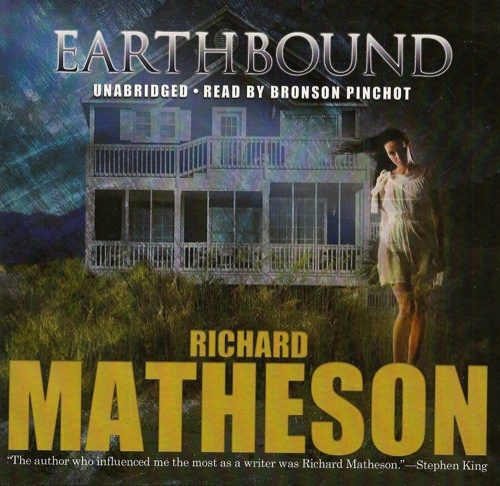
Blackstone Audio - Earthbound by Richard MathesonEarthbound
By Richard Matheson; Read by Bronson Pinchot
6 CDs – Approx. 6.5 Hours [UNABRIDGED]
Publisher: Blackstone Audio
Published: September 2010
ISBN: 1441756886
Themes: / Fantasy / Horror / Gothic Horror / Haunted House / Ghosts / Succubi / Marriage / Sex /

David and Ellen Cooper came to the lonely beach-side cottage in hopes of rekindling their troubled marriage. Yet they are not alone on their second honeymoon. Marianna, a beautiful and enigmatic stranger, comes to visit David whenever Ellen is away. Who is Marianna, and where has she come from? Even as he succumbs to her seductive charms, David realizes that Marianna is far more than a threat to his marriage, for her secrets lie deep in the past and beyond the grave. And her unholy desires endanger the life and soul of everyone she touches.

TV writer David Cooper is trying to revitalize his shaky marriage by returning with his wife to their original honeymoon location. While the Coopers do end up in the same sea-side resort, they find their original digs are unavailable and have to stay in a disused beach cottage. There, every time Ellen steps out, or goes to sleep, a sexy woman named Marianna appears and quickly seduces David. She fucks him harder than he’s ever been fucked and that’s the entirety of Earthbound‘s simple setup. The plot from there is but a dance between David’s realization of it and his doing something.

There are essentially four characters in Earthbound. Approximately ninety-five percent of the novel is set within the confines of the haunted cottage. It’s all told in a tight third person, over the shoulder perspective. We get the thoughts of David’s mind in elaborate detail and hear the other two characters exclusively from his POV. It becomes immediately clear to the reader that Marianna is not only a ghost but also a quasi-succubus. Matheson never actually names the marriage-ruining ghost as a sexual vampire, instead the characters only describe Marianna as simply the ghost of a depraved woman. It takes nearly a half-dozen sex sessions with the vitality draining Marianna, and several visits from a helpful neighbor (who lives just up the beach) to point this out to David. It then takes several more for him to actually believe what he’s being told and experiencing. David wants to believe he’s just been cheating on his wife with a mysterious stranger – but the evidence he’s been presented with is fairly convincing. In the meantime David gets into several, what I would call, disappointment swaps with Ellen, they go out to dinner once and have some unsatisfying sex. About half way through the book I began expecting that Ellen’s many convenient absences would be explained by her being haunted by an incubus – I was wrong on that score.

I don’t think this book is really all that horrible. The storytelling flows quite smoothly and likely achieves the purpose intended. Unfortunately it carries no lasting impression. Being a confirmed bachelor, I guess I just don’t want to read about people fixing their marriages at haunted seaside cottages. And, as for it being one of the gothic novels of psychology, I far prefer the depths of ambiguity in Henry James’ The Turn Of The Screw to the shallows of Earthbound. This is the fourth Matheson novel I’ve read, the first being I Am Legend |READ OUR REVIEW| and the second being The Incredible Shrinking Man |READ OUR REVIEW|. Like the former, Earthbound lacks the one thing I really cared about: a haunting message to go with its competent psychological character study. Like the second, The Incredible Shrinking Man, I came away from Earthbound thinking it was absolutely the kind of book I never need read again, a story premise with a character who was too wrapped up in his own psychology for me to care what was happening to him. I guess I just want some ideas to go with my characters and not to simply see them interacting or responding to a set of unusual circumstances. Earthbound, therefore, is most similar to the third Matheson novel I read, A Stir Of Echoes |READ OUR REVIEW|. If you liked A Stir Of Echoes I suspect you will enjoy Earthbound. Myself, I can only recommend the earth-shatteringly good I Am Legend and Matheson’s truly amazing short story Born Of Man And Woman.

Speaking of short stories, when Earthbound was first published (by Playboy Paperbacks in 1982) Richard Matheson used a pseudonym, “Logan Swanson.” Reading around the internet, I got the impression that he’d balked at some editorial changes in the Playboy Paperbacks edition – and so declined to have his real name put on the cover. But, the story is probably a little more complicated than that. After doing some more digging I noted that one Amazon reviewer had this to say: “…not a lot of people realize this, but this book started out as a short story written very early in Matheson’s career.” Noting that the succubi in fiction article on Wikipedia includes one Matheson story, called The Likeness Of Julie. I dug up my copy of Shock II (it’s also collected in Hot Blood: Tales Of Erotic Horror) and read it. The Likeness Of Julie, which is just 9 or 10 pages, has a bit more of a punch than Earthbound, and is clearly the predecessor to a novelized re-working. Interestingly, it too was first published “as written by Logan Swanson” in a 1962 anthology called Alone By Night. And the pseudonym there was not likely due to a protest, but rather the fact that there was another story by Matheson in the collection. In any case, this Blackstone Audio edition uses the author’s full text version of Earthbound.

Bronson Pinchot, has been recording up a storm for Blackstone Audio of late (there are currently 44 titles with him as a narrator). For Earthbound he does little extraordinary other than voicing three females, two carnal women and one ethereal succubus. Surprisingly, he doesn’t have to stretch very much for in this small scale novel; he pretty much makes himself invisible in the text. I’d like to see him tackle some more meaty material.

Posted by Jesse Willis
Review of Starstruck by Elaine Lee, Susan Norfleet and Dale Place

SFFaudio Review

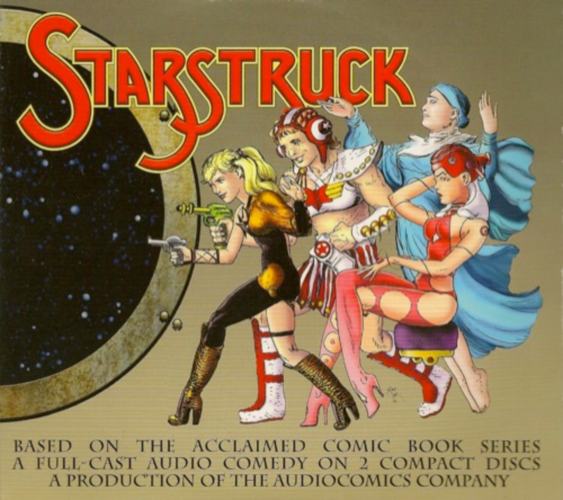
AUDIO DRAMA - StarstruckStarstruck
Based on the comic series and the play by Elaine Lee and Mike Kaluta; Adapted by Elaine Lee, Susan Norfleet and Dale Place; Performed by a full cast
2 CDs – Approx. 2 Hours 11 Minutes
Publisher: The Audio Comics Company
Published: 2010
ISBN: 9780615411439
Themes: / Humor / Science Fiction / Space Opera / Feminism / Galactic Civilization /

The basis for the critically acclaimed comic book series, Starstruck was first presented off-off-Broadway in 1980, and again off-Broadway in 1983. In a far-flung and very alternative future, Captain Galatia 9 and the crew of the Harpy and on a mission for the United Federation of Female Freedom Fighters. When the Harpy runs into a living ship inhabited by a team of galactic evildoers, including Galatia’s insidious sister Verloona Ti, the outcome of the battle may well decide the fate of the free universe. The AudioComics Company is proud to present the audio adaptation of the play script as its inaugural production! Often hilarious, always surprising, Starstruck is a spine-tingling joy-ride to the far side of the spiral arm!

I’ve listened to all 2 hours or so. There’s certainly a rich variety of different voices, special effects, and music, on a level with Graphic Audio. You can hear a lot of samples at Amazon. But I found the plot and the humor challenging to follow. Wikipedia called the original play obtuse (as in not staightforward), and I agree. Maybe they should give you a 10 minute sample, to show what you’re getting into. The acting is played for humor, and way over the top. I’m a fan of Michael Kaluta’s run on the old Shadow DC comic, but there are no visuals here. I’ll definitely check out the reprint of the Starstruck comic in hardcover, when it comes out soon. Those not familiar with the play or the comics will find this audiodrama difficult to get into.

Posted by Tamahome

Review of Dust by Joan Frances Turner

SFFaudio Review

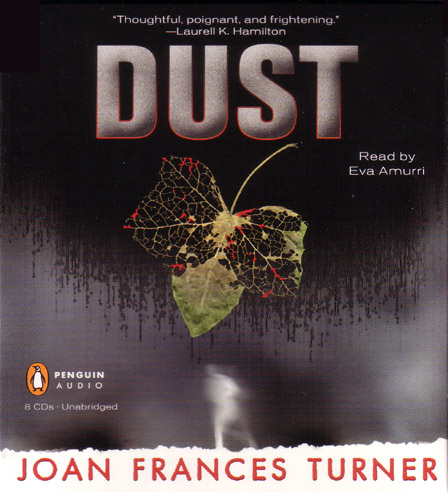
PENGUIN AUDIO - Dust by Joan Frances TurnerDust
By Joan Frances Turner; Read by Eva Amurri
8 CDs – Approx. 9 Hours 57 Minutes [UNABRIDGED]
Publisher: Penguin Audio
Published: September 02, 2010
ISBN: 9780142428535
Themes: / Horror / Fantasy / Zombies / Disease / Death / Resentment / Indiana /

Nine years ago, Jessie had a family. Now, she has a gang. Nine years ago, Jessie was a vegetarian. Now, she eats very fresh meat. Nine years ago, Jessie was in a car crash and died. Nine years ago, Jessie was human. Now, she’s not. After she was buried, Jessie awoke and tore through the earth to arise, reborn, as a zombie. Jessie’s gang is the Fly-by-Nights. She loves the ancient, skeletal Florian and his memories of time gone by. She’s in love with Joe, a maggot-infested corpse. They fight, hunt, dance together as one—something humans can never understand. There are dark places humans have learned to avoid, lest they run into the zombie gangs. But now, Jessie and the Fly-by-Nights have seen new creatures in the woods—things not human and not zombie. A strange new illness has flamed up out of nowhere, causing the undeads to become more alive and the living to exist on the brink of death. As bits and pieces of the truth fall around Jessie, like the flesh off her bones, she’ll have to choose between looking away or staring down the madness—and hanging onto everything she has come to know as life…

Here’s my take on Dust: Jessie is full of resentment, having died young in a car accident. Besides dying Jessie lost an arm and Jessie turned zombie. When Jessie was alive Jessie was a vegan – but now in Jessie’s undead form – Jessie works with a gang of bitter former humans (don’t call them zombies) that eat free range and organic animals like squirrels, possum and deer. Jessie and her associates communicate telepathically (because their mouths don’t make speech very well anymore). The undead very frequently address Jessie by her first name, which is Jessie. Jessie has many indignant conversations with her fellow embittered undead. They often punctuate their sentences with kicks, shoves and punches that break each other’s bones and dislodge sloughing off flesh. This is to be expected for Jessie. Despite these seemingly acrimonious interactions Jessie seems to love and respect her spiteful companions. They all share Jessie’s disdain for the un-undead (living people). Jessie and her surly companions have a hard life, having to deal with maggots, bloating and living out of doors all-year round. Then, after we understand Jessie well enough, Jessie’s living brother turns up, he’s interested in making peace with Jessie. But, Jessie isn’t having any of it. Jessie thinks he’s just a stupid “hoo” (that’s what Jessie and her friends call living humans). Jessie’s brother has a story to tell, but Jessie isn’t really willing to hear it. Next, a disease starts plaguing some of Jessie’s companions. Jessie thinks this is bad, but typical. Jessie also discovers something bad is happening to the stupid hoos. Jessie thinks that is what they get for being stupid hoos. But then the bad thing that hurts Jessie’s friends is something that turns the undead into less-rotty versions of themselves Jessie is angry. Jessie resents that her severed arm regrows. Jessie doesn’t want to look like a stupid hoo. The disease makes Jessie and everyone, even the stupid hoos, very hungry. That is bad, for Jessie, but deserving for the stupid hoos. The end (for Jesse).

You may be able to tell that I intensely disliked this novel. It was well written, with clear exposition, and it has clearly delineated story. Unfortunately Dust taught me nothing except that a clear exposition of the disagreeable does not improve it much. If you’re not teaching me anything, at least make the book fun. My dislike of Dust also stems from the fact that it posits multiple gimmes (a singular central conceit which may remain unexamined). Dust lets the reader assume nothing, the ground-rules aren’t fixed, and new rules are seemingly arbitrarily added on every tenth page. This means I, as a reader, cannot participate in the world of the book as much as sit back and observe what the author does with it. That is not fun. Based on the clarity of Dust I expect that Joan Frances Turner is capable of writing a fine novel, one that explores something more fruitful than resentment (which I will admit is a way to go with a zombie story told from the perspective of a zombie). But the zombie novel, as a phenomenon, may also be the problem. It may be time for people to stop writing stories from the perspective of a zombie. From my perspective Dust puts the final nail in the coffin of zombie stories told from the zombie’s perspective.

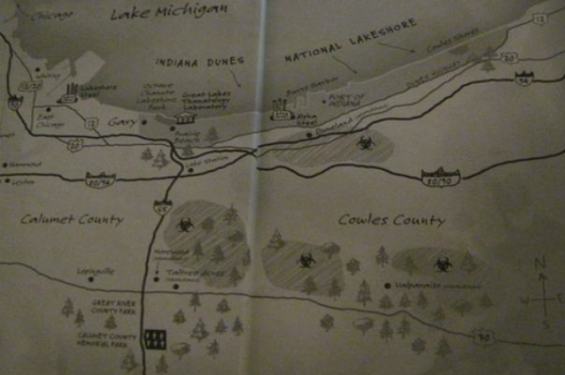
The audiobook of Dust does not contain the handy map that’s in the paperbook’s endpapers. Turner herself writes on her blog saying “the geography of the book is so vital to the story.” As to the narrator, typically when a narrator isn’t doing it for me I start looking for notable defects – asking myself “what is it that specifically bugs me about the narration?” Often this delivers some sort of gripe, like bad word pronunciation, an unconvincing accent or improper emphasis in important passages. I thought I spotted one badly pronounced word (“onerous”), but as it turns out, at least according to the Dictionary.com pronunciation guide, it is I who had been pronouncing “onerous” wrong! That said, Eva Amurri’s narration still doesn’t work for me. I’m not sure why. Other reviewers have praised her performance.

Here is the paperbook’s map (as illustrated by Claudia Carlson and designed by Tiffany Estreicher):

DUST by Joan Frances Turner MAP

Posted by Jesse Willis

Review of Around The World In Eighty Days by Jules Verne

SFFaudio Review

LISTENING LIBRARY - Around The World In Eighty Days by Jules VerneAround The World In Eighty Days
By Jules Verne; Read by Jim Dale
7 CDs – Approx. 7 Hours 42 Minutes [UNABRIDGED]
Publisher: Listening Library
Published: 2005
ISBN: 0307206424
Themes: / Adventure / 19th Century / Gambling / Religion / Mormonism /

Shocking his stodgy colleagues at the exclusive Reform Club, enigmatic Englishman Phileas Fogg wagers his fortune, undertaking an extraordinary and daring enterprise to circumnavigate the globe in eighty days. With his French valet Passepartout in tow, Verne’s hero traverses the far reaches of the earth, all the while tracked by the intrepid Detective Fix, a bounty hunter certain he is on the trail of a notorious bank robber. Combining exploration, adventure, and a thrilling race against time, Around The World In Eighty Days gripped audiences upon its original publication and remains hugely popular to this day.

When I get into a subject, I really get into it. I think I’m becoming something of an Around The World In Eighty Days expert. I’ve tracked down the episode of Have Gun Will Travel that includes a visit from Phileas Fogg. I’ve gotten my mitts on several audiobook versions, and a BBC radio dramatization too. I’ve watched the Michael Palin series that took inspiration from the novel. I poured over the Classics Illustrated comics version.

Phileas Fogg, who seems to epitomize a certain kind of stereotypical Englishman, is described as emotionless. He makes his calculations, and like the watch he carries, ticks away without a wasted movement. At one point a certain travelling companion makes a remark something like “this is the only time I’ve seen you become emotional” this when confronted by the prospect of sitting idly by while a woman is burned alive. Fogg’s reponse: “I am emotional, when I have the time.” That burning, by the way, takes the form of a Hindu “suttee.” Later on in Utah, Passepartout, Fogg’s manservant, takes in a sermon in the form of a lecture on the history of Mormonism. It’s a hilarious scene, and as such this book is one of the few classics that I will probably re-read. Around The World In Eighty Days overflows such gems. It’s biggest failing is that a good deal of the suspense Verne injects comes from out of nowhere, clunks around the pages, making waste, only to sputter out into utter forgetability at the end.

Narrator Jim Dale, best known for his work on the Listening Library Harry Potter audiobooks, brings a full range of accents and voices to this audiobook. Dale does a really terrific Passepartout! The production includes some seemingly randomly insterted music and sound effects that nearly drown out Dale’s performance. That’s bad. Additional mistakes include an image of a hot air balloon on the cover. There is absolutely no balloon in this novel, though one appears in a couple of video adaptations.

Posted by Jesse Willis

FREE LISTENS REVIEW: The Land that Time Forgot by Edgar Rice Burroughs

Review

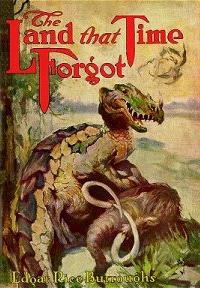
The Land that Time Forgot by Edgar Rice Burroughs

SourceLibriVox (zipped mp3’s)
Length: 3 hr, 49 min
Reader: Ralph Snelson

The book: Set during World War I, this adventure novel starts with the sinking of an Allied ship by a German U-boat. Bowen Tyler, his dog, and the beautiful Miss Lys La Rue are rescued by a British tug, then captured by the same U-boat. Through a series of prisoner revolts, double-crosses and sabotage, the U-boat ends up at an uncharted island near Antarctica. Here, they are attacked by dinosaurs and other prehistoric beasts.

Sounds like a good, old-fashioned adventure, right? Well, it is for the first two-thirds of the book. The final third consists of Burroughs dragging his characters to an unsatisfying conclusion. As in The Lost World, I expect some amount of pseudoscience in these types of early science fiction adventures, but Burroughs’ mystical version of evolution on the island severely strained my suspended believability. Perhaps the narrative is more fully resolved in the sequels, but after finishing, I felt cheated rather than wanting to know more.

Rating: 6 / 10

The reader: Snelson has a deep voice with an American Southern accent. His reading and recording quality are amateur, but satisfactory. His characters have distinctive, but not silly, voices. Snelson’s matter-of-fact narrating tone doesn’t add much to the story, but neither does he ruin the novel by trying to over-embellish the action.

Posted by Seth

Review of The Stainless Steel Rat by Harry Harrison

SFFaudio Review

Science Fiction Audiobook - The Stainless Steel Rat by Harry HarrisonSFFaudio EssentialThe Stainless Steel Rat
By Harry Harrison; Read by Phil Gigante
4 CDs – Approx. 5 Hours [UNABRIDGED]
Publisher: Brilliance Audio
Published: 2010
ISBN: 9781441881076
Themes: / Science Fiction / Crime / Espionage / Galactic Civilization / Humor /

Jim DiGriz is caught during one of his crimes and recruited into the Special Corps. Boring, routine desk work during his probationary period results in his discovering that someone is building a battleship, thinly disguised as an industrial vessel. In the peaceful League no one has battleships anymore, so the builder of this one would be unstoppable. DiGriz’ hunt for the guilty becomes a personal battle between himself and the beautiful but deadly Angelina, who is planning a coup on one of the feudal worlds. DiGriz’ dilemma is whether he will turn Angelina over to the Special Corps, or join with her, since he has fallen in love with her.

As I write this dilatory review of Harry Harrison’s The Stainless Steel Rat I am just a few minutes away from finishing the follow up, The Stainless Steel Rat’s Revenge. Thus I feel doubly guilty. For while the intellectual mulling over of a book is a natural part of the reviewing process – it is but certainly ungenerous to actually begin the sequel without having delivered the original its full due. Worse, listening to this lightweight series is very much like gobbling down fisfull after fistful of a delightful confection – I am enjoying it immensely but can`t say it is particularly good at nourishing my intellect.

The Stainless Steel Rat very much deserves its due! The Stainless Steel Rat is a rollicking first person perspective adventure set amongst the resplendent plenitude of an interstellar empire. Slippery Jim DeGriz, our convivial protagonist, has a heart half filled with the milk of human kindness and half filled with a contempt of rules and rituals that the social contract requires of him. Thus he is a both anti-hero and hero, and twice as virtuous in his roguish thievery. In this, his first recorded adventure, Slippery Jim outlines the shape of his variegated and thoroughgoingly criminal career thus far, is quickly inducted into a corps of criminal conspirators that`s working for the galactic government (it`s funded by bank robberies), and falls in love (with a mortiferous murderess). The adventure is slick, quick and comic – the many scenes composing the plot are portrayed in an almost cartoonish manner (in the best possible sense of that term). And when Slippery Jim finally catches the arch-criminal he`s after – the plot follows the centuries old axiom of ìt takes a thief to catch a thief – and Slippery Jim finds that Angelina, his Lady MacBeth, is no fan of the milk of human kindness, thinking it rather distasteful stuff.

Narrator Phil Gigante reads the first person perspective tale with a transparency that`s expected of a professional narrator – his wry delivery follows the text, and gently brushes the voices of all the other speaking characters with the aural equivalent of a glistening gloss. This is the first audiobook publication of The Stainless Steel Rat, which was first published in its complete form nearly 50 years ago. The audiobook is an utter delight, being fun and funny, short, to the point, and utterly, utterly consumable. Highly recommended!

Update:

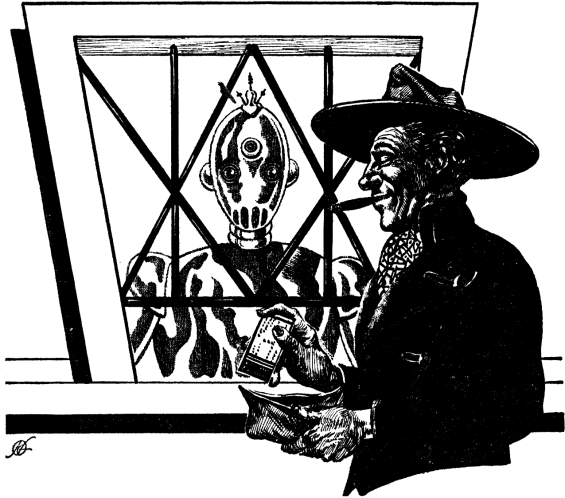
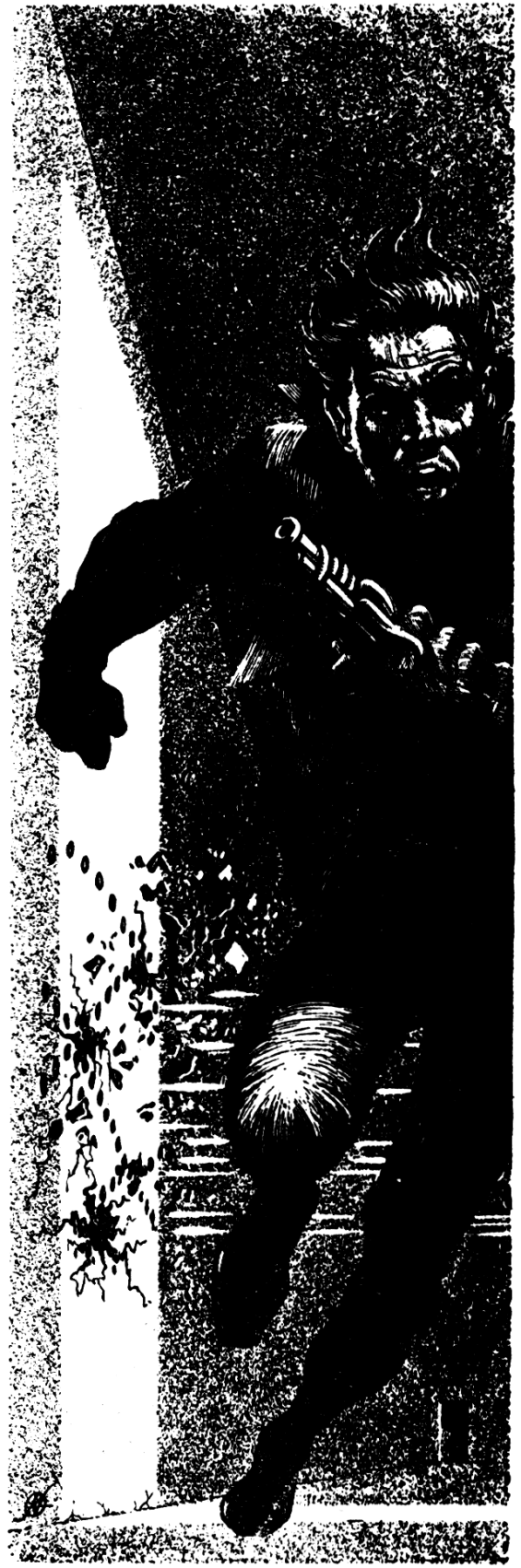
Here are the very first illustrations of The Stainless Steel Rat, from the August 1957 issue of Astounding Science Fiction (which contained the original short story):

The Stainless Steel Rat - Illustrated by Frank Kelly Freas - from Astounding Science Fiction, August 1957

The Stainless Steel Rat - Illustrated by Frank Kelly Freas - from Astounding Science Fiction, August 1957

The Stainless Steel Rat - Illustrated by Frank Kelly Freas - from Astounding Science Fiction, August 1957

Posted by Jesse Willis