
Aural Noir Review of Dimiter by William Peter Blatty

Aural Noir: Review

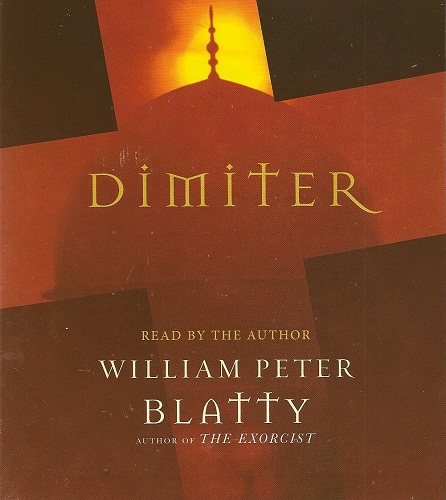
Audiobook - Dimiter by William Peter BlattyDimiter
By William Peter Blatty; Read by William Peter Blatty
8 Hours – [UNABRIDGED]
Publisher: Macmillan Audio
Published: 2010
Themes: / Thriller / Religion / Christianity / Espionage /

In 1973 a nameless prisoner is being tortured in an Albanian prison, where “grace and hope had never touched.” Colonel Vlora, known as “The Interrogator,” is frustrated and mystified by a man they have come to call The Prisoner because they cannot even make him speak. Is he an American spy, Paul Dimiter, known as the “agent from hell?” The solution to this stalemate while expected on one level is a complete surprise on another. This turns out to be emblematic of William Blatty’s book. Part 1 is an appropriate foretaste of this complex, suspenseful, and fast paced thriller.

The scene shifts to Jerusalem where we meet Moses Mayo, a neurologist, who is investigating a series of seemingly natural deaths that are nevertheless linked. He also is plagued by a gruesome murder, reports of apparitions and mysterious miraculous healings. We also meet Mayo’s life-long friend, Peter Meral, an Arab Christian, who is a police detective. Among other things, Meral is investigating a strange car explosion and the mysterious disappearance of the men involved, a CIA cover-up, and a body found at the Tomb of Christ.

The body count climbs and complications arise from the interweaving of all the events. This sounds somewhat like a standard thriller, however, it is anything but. We know the deaths are real but what about the reported miracles? Is everything really connected and, if so, what could possibly be the logical link? The solution is not only surprising but also provides an extremely moving moment of redemption.

Dimiter‘s suspense keeps the listener fascinated while also raising it above the ordinary by not being afraid to have characters who care about spiritual searching, loss, redemption, and love. The spiritual element will make this work especially interesting to those who are drawn to themes that investigate good versus evil. This is not an element that should surprise those who remember that Blatty is the author of the justly famous horror novel The Exorcist. Although this novel is strictly in the thriller vein, I must admit that I did find the torture scenes rather horrific and did fast forward through a few of them.

The author narrates his work and does such an effective job that I often forgot I was not listening to a professional voice talent. The only downfall was that during fast-paced scenes with more than two male characters, such as CIA interrogations, there was not enough differentiation between all the voices to make it easy to tell when dialogue shifted from one person to another. This was not a huge problem but it did require me to back up a couple of times until I figured out the tempo. Otherwise, William Blatty’s reading was a sheer pleasure, especially in voicing his more eccentric characters who he brought to life in a most vivid fashion.

Highly recommended.

Posted by Julie D.

Review of Saturn’s Children by Charles Stross

SFFaudio Review

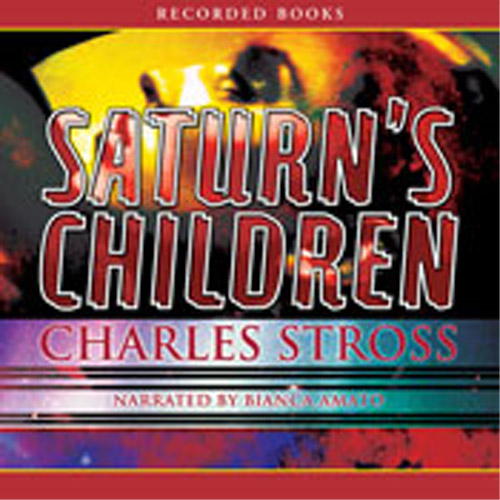
RECORDED BOOKS - Saturn's Children by Charles StrossSaturn’s Children
By Charles Stross; Read by Bianca Amato
11 CDs – Approx. 13 Hours 45 Minutes [UNABRIDGED]
Publisher: Recorded Books
Published: 2009
ISBN: 9781440750113, 9781440750106
Themes: / Science Fiction / Androids / Robots / Sex / Slavery / Identity / Venus / Mars / Mercury / Eris /

The Hugo Award-winning author of numerous best-sellers, Charles Stross crafts tales that push the limits of the genre. In Saturn’s Children, Freya is an obsolete android concubine in a society where humans haven’t existed for hundreds of years. A rigid caste system keeps the Aristos, a vindictive group of humanoids, well in control of the lower, slave-chipped classes. So when Freya offends one particularly nasty Aristo, she’s forced to take a dangerous courier job off-planet.

This novel’s title comes from the myth that Saturn (the Roman god of agriculture and harvest), ate his children at birth for fear of them usurping him. Its an apt starting point for a tale about robots More interesting is that Saturn’s Children opens with a reading of Asimov’s three laws of robotics

1. A robot may not injure a human being or, through inaction, allow a human being to come to harm.
2. A robot must obey any orders given to it by human beings, except where such orders would conflict with the First Law.
3. A robot must protect its own existence as long as such protection does not conflict with the First or Second Law.

…and then informs us that there are no humans left alive. There is, however, a whole solar system full of robots, all willing and able to obey all three laws. So what happened to all those humans? The novel is the answer to that question.

Saturn’s Children is told from the point of view of Freya Nakamichi-47 a gynoid (that’s a female android). She was activated (born) long after the last human had died. Freya, despite never having met one, still longs for her lost love (any human). Indeed, even the mere thought a human being makes her sexually excited. This is because, as a self described grande horizontale, Freya’s destiny was to be a sexual companion to any human that owned her. Now, without a master, she finds work where and when she can. But after a nasty run-in with an Aristo, a wealthy robot that owns other robots (called Arbiters), Freya will take any work that gets her off planet. Soon she’s employed by Jeeves, a masculine android who is more like her in shape and purpose than most robots. Freya’s first assignment is to transport a bio-engineered package across the solar system. But the pink police (a kind of anti biological proliferation organization), and another, more shadowy, organization are determined to stop her. Along the way Freya visits Cinnabar (a city on rails) that’s perpetually in Mercury’s shadow, drawing power from the temperature difference between Mercury’s light and dark sides), has sex with a rocket ship and grows some new hair.

Freya does a whole lot more than that too. She has a lot more sex for one. But beyond the sex there is some more fully cerebral stimulation going on in Saturn’s Children. The idea of a post-human solar system is an interesting one, and Stross plays with it quite effectively. This is a theme that I think hasn’t been done often enough in SF. The closest novel, in scope, if not in tone, is perhaps Clifford D. Simak’s City (in which intelligent dogs and robots have inherited a humanless Earth). This humanless solar system is, as I mentioned, quite vividly explored, with floating cities (like Bespin’s Cloud City) on Venus, waste heated bio-labs on the frozen dwarf planet of Eris, and a truly frightening description of what’s happened to poor old Earth. Stross has quite a lot of fun playing with the world he’s created here, naming a city Heinleingrad, naming a robot butler character after P.G. Wodehouse’s famous “gentleman’s personal gentleman.” It all mostly works with Saturn’s Children seeming to take most of its inspiration though from Heinlein’s novel Friday. Both novels feature artificial female persons as secret couriers, both tell their own stories, both secrete their smuggled cargos in their abdomens. Later on in Saturn’s Children there is some playing with the ideas promulgated in Heinlein’s 1970 novel I Will Fear No Evil. And, identity, in a world where brain data, and brain states, are easily and quickly copyable, isn’t as simple as it is with us meatbags. On the whole I enjoyed Saturn’s Children and found it full of interestingness. It was as most novels are these days, too long, and in need of a critical editor. The worst sin here is that the ending is rather weak, and features an afterword that leaves open the possibility of a sequel or seven.

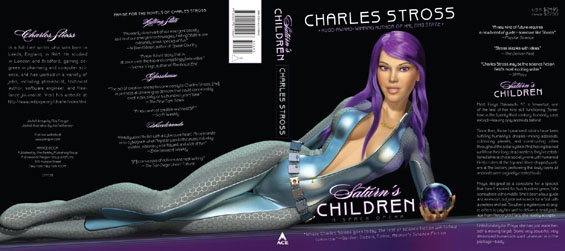
Narrator Bianca Amato, a South African accented “ALIEN OF EXTRAORDINARY ABILITY” (according to her resume), mispronounces a couple of the more obscure words but the general gist of her reading is highly competent. It helps a whole lot that Freya’s story is told in first person. I’m not sure what the present tense adds to the narrative other than being a little noticeable and not particularly harmful. Also, as I mentioned in a recent podcast, the Recorded Books cover art is boring, whereas the Ace Books paperbook edition is fabulous!

Check out the dust jacket from the paperbook edition:

Saturn's Children by Charles Stross - The PAPERBOOK's Dustjacket

Posted by Jesse Willis

Review of Red Planet by Robert A. Heinlein

SFFaudio Review

Science Fiction Audiobook - Red Planet by Robert A. HeinleinSFFaudio EssentialRed Planet
By Robert A. Heinlein; Read by a full cast
6 CDs – 7 Hours [UNABRIDGED]
Publisher: Full Cast Audio
Published: 2009
ISBN: 9781934180518
Themes: / Science Fiction / Mars / Politics / Gender /
Sample |MP3|
Jim Marlowe’s Martian pet, Willis, seems like nothing more than an adorable ball of fur with an astonishing ability to mimic the human voice. But when Jim takes the creature to academy and runs afoul of a militantly rigid headmaster, his devotion to his pet launches the young man on a death-defying trek across Mars. Accompanied by his buddy, Frank, Jim must battle the dangers of a hostile planet. But it is not only the boys’ lives that are at stake: They have discovered explosive information about a threat to the survival of the entire colony—information that may mean life or death for their families.

Listening to Heinlein’s stories brought to life is a wonderful experience. One of the things I enjoy most about Heinlein’s quirky novels is that the politics are never fully aligned with any conventional ideology. There are repeated themes, to be sure, but they play out fairly differently in each story. I had read Red Planet at least once before and upon listening to this terrific audiobook version I was actually quite surprised by the relevance to modern politics and social phenomena. First published in 1949, and set on a Mars that is surprisingly believable, it has some very modern protagonists teenagers. Jim Marlowe and Frank Sutton get into some rather exciting adventures. They spend chilly days outside on Mars suited up in mechanical counter-pressure suits, with supercharging helmets that provide a suitable pressurized oxygen from the wispy (but oxygenated) atmosphere of Heinlein’s Mars. These suits, are much lighter than conventional air pressure suits and allow the extreme mobility needed for their skating down the frozen canals of Mars. When not outside fighting off water seekers Jim, Frank, and almost every other colonist on Mars dresses like they live on a tropical beach (they live, go to school, and work in pressurized domes). Virtually no one goes outdoors during the Martian nights (or winters) as they are cold enough to freeze even a stolid martian kid solid. Indeed, part of the excitement of the novel comes when Jim, and Frank find themselves trapped in the Martian desert far from any habitable shelter just as sunset is approaching. Heinlein’s solution is both ingenious and original.

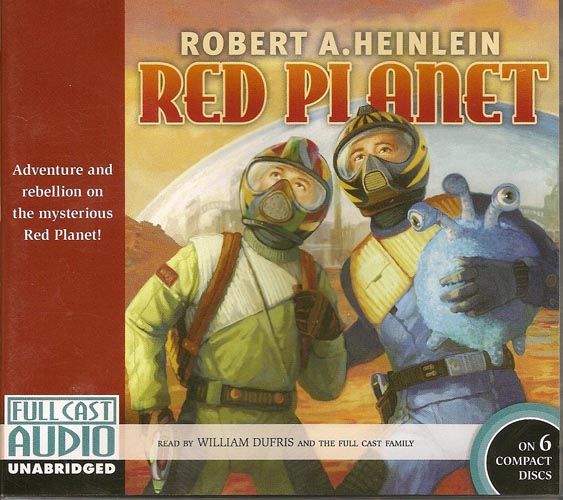
Unlike some previous Heinlein novels produced by Full Cast Audio, Red Planet is not told in first person by the main character. Instead the voice talent of William Dufris is employed to narrate. I’m a big fan of Dufris’ narrative abilities, and he does a terrific job with Red Planet. Jacob Coppola as Jim Marlowe, and Christopher Reiling as Frank Frank Sutton are both vigorous and youthful but also distinct enough to tell apart. The rest of the cast supports the story with an assortment of villainous, larcenous good humor, and stubborn contrariness – in other words nearly the full Heinleinian character spectrum. One other note, the voice of Willis is often performed by whichever actor Willis is imitating and this works just fine! Finally, check out the gorgeous cover art by Jerry Russell, it’s absolutely fantastic!

Posted by Jesse Willis

Aural Noir review of The Monster Of Florence by Douglas Preston and Mario Spezi

Aural Noir: Review

HACHETTE AUDIO - The Monster Of Florence by Douglas Preston and Mario SpeziThe Monster Of Florence: A True Story
By Douglas Preston and Mario Spezi; Read by Dennis Boutsikaris
8 CDs – Approx. 9.5 Hours [UNABRIDGED]
Publisher: Hachette Audio
Published: 2008
ISBN: 9781600242090
Themes: / Crime / History / Mystery / Murder / Serial Killer / Conspiracy / Italy / Florence / Sardinia / The Renaissance /

In 2000, Douglas Preston and his family moved to Florence, Italy, fulfilling a long-held dream. They put their children in Italian schools and settled into a 14th century farmhouse in the green hills of Florence, where they devoted themselves to living la dolce vita while Preston wrote his best-selling suspense novels. All that changes when he discovers that the lovely olive grove in front of their house had been the scene of the most infamous double-murders in Italian history, committed by a serial killer known only as the Monster of Florence.

If you’re a fan of Douglas Preston’s fiction you’ll be all into digging the biographical details he adds to this illuminating non-fiction account of a real monster and the labyrinthine twists and turns the investigation took. Those readers looking for insight into Thomas Harris’ Hannibal novels can find this story impactful too. Myself, I was most interested in the unparalleled access this fearsome story details, namely the historical forces that shaped Florence, Tuscany and Sardinia from ancient days, through the Renaissance, the 1960s, 1970s, and on up to the present. Preston, with help from Spezi, provides elucidating details about how the killer (or killers) got away with 16 murders that took place between 1968 and 1985. Their book, this audiobook, is an indictment of Florentine and Italian journalists, the Italian national police , the Florentine investigators, and one prosecutor in particular. In short, after more than 30 years of criminal investigation the case remains an unsolved mystery. Spezi and Preston do take a guess at the culprit, and they back that guess up with a logic chain that is a helluva-lot-more compelling than the official explanation. But, just thinking about it all, a week or two later, I’m still shaking my head. The final disgrace of this story came as a result of a convergence between the Public Minister of Perugia, Giuliano Mignini, and a fraud psychic named Gabriella Carlizzi. Together they explained to themselves, and the arresting police, that Mario Spezi was actually involved in the murders and was a member of a satanic cult.

Even more worrisome, if it is possible to imagine, is what Preston argues is a fairly widespread Italian cultural embrace of something called “dietrologia.” Literally meaning “behindology,” dietrologia is the practice of assuming that nothing notable is as it actually appears – that something hidden (often sinister, cynical and/or conspiratorial) is behind any and all notable events. In Canada we might call it acting paranoid, or being a conspiracy theorist. In Italy, apparently, it is regularly practiced around the dinner table. And it’s all fun and games, I guess, until you end up throwing innocent people in jail. During the writing of The Monster Of Florence Spezi was arrested for either being a collaborator with the Monster or actually being the serial killer himself. Meanwhile Douglas Preston was interrogated, told to confess, threatened with arrest, and forced to leave Italy upon pain of prosecution. The Monster Of Florence case was completely bungled. This was a clusterfuck on par with the notorious California’s McMartin preschool investigation and trial. I guess it all goes to show that police and prosecutorial incompetence is alive and well in the new and old worlds both.

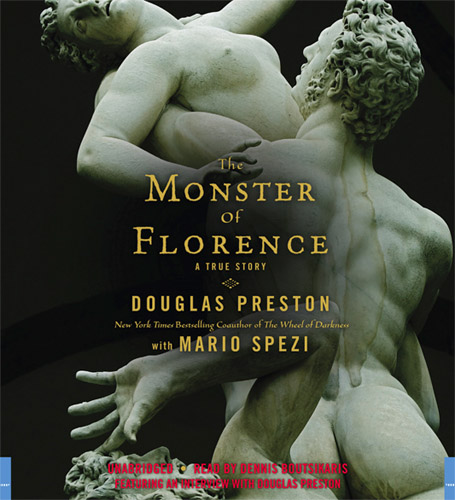
Reader Dennis Boutskaris takes full control of the narrative, becoming the voice of Preston (and Spezi) for the entire audiobook. To my untrained ears his Italian accent sounded fine. The cover art, as mentioned in the audiobook, comes from a photograph of a statue in Piazza della Signoria, in Florence (The Rape of the Sabine Women by Giambologna |JPG|). In addition, on the final disc, there is an informative interview with Douglas Preston.

Posted by Jesse Willis

Review of Podkayne Of Mars by Robert A. Heinlein

SFFaudio Review

[Jesse’s Note: This is a first time review from one of my students. Rose sat down with a tattered old paperback copy of Podkayne Of Mars and a brand new Blackstone Audio CD audiobook of Podkayne Of Mars for a readalong – the result was this terrific review – Thanks Rose!]

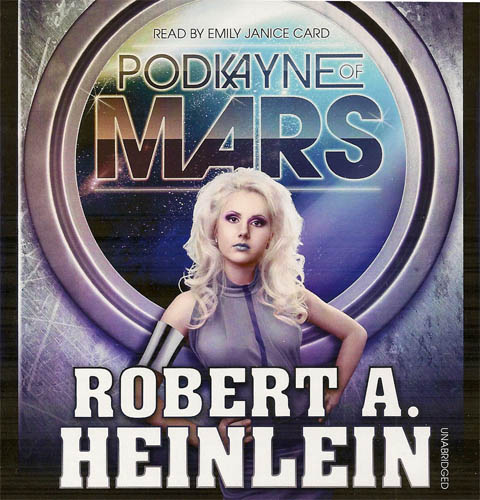
Fantasy Audiobook - Podkayne of Mars by Robert A. HeinleinSFFaudio EssentialPodkayne of Mars
By Robert A. Heinlein; Read by Emily Janice Card
5 CDs – Approx. 6 Hours [UNABRIDGED]
Publisher: Blackstone Audio
Published: 2009
ISBN: 1433251612
Themes: / Science Fiction / Adventure / Reproduction / Politics / Family / Gambling / Venus / Mars /

From the author of Friday and Rocketship Galileo comes this classic tale featuring the grand master of science fiction’s most remarkable heroine. Podkayne Fries, a smart and determined maid of Mars, has just one goal in life: to become the first female starship pilot and rise through the ranks to command deep-space explorations. So when she is offered a chance to join her diplomatic uncle on an interstellar journey to distant Earth via Venus, it’s a dream come true—even if her only experience with diplomacy is handling her brilliant but pesky younger brother, Clark. But she’s about to learn some things about war and peace because Uncle Tom, the ambassador plenipotentiary from Mars to the Three Planets Conference, is traveling not quite incognito enough, and certain parties will stop at nothing to sabotage negotiations between the three worlds….

This is the first Robert A. Heinlein audiobook, or Heinlein book, and my first audiobook that I have ever read. I also hadn’t read any Science Fiction before. This was mostly because I thought Science Fiction was just fiction that was “beyond reality,” so I wasn’t really interested in it. However, after reading and listening to Podkayne Of Mars, I found myself considering reading another. Heinlein’s idea, that to freeze babies and decant them whenever the parents want, is fascinating. Since many women are busy with their work and have no time to take care of their babies, I think this practice and technology may come true in the future. One issue for me was I didn’t really like Clark at first. He acts brusquely, seemed selfish and didn’t seem to care about his family. I was, therefore, impressed by Clark when he decided to become more responsible and caring.

Emily Janice Card, daughter of Orson Scott Card, narrated Podkayne Of Mars. Card narrates the whole 176 page story all as Poddy, except seven pages from the end when Clark, her younger brother, takes over. I think Card’s voicing of Poddy was in-sync with a sentimental, skeptical, and ambitious young teen. It made me feel as if Poddy was reading her own story. However, Card’s voicing of Clark wasn’t as harmonious. Probably, this was because she is female. Compared to 1979 paperback edition, Poddy on this cover doesn’t really look like Poddy. Poddy looks quite cynical. I much prefer the 1979 edition because there Poddy looks more of a sentimentalist.

Posted by Rose [장미]

Review of Silence Please by Arthur C. Clarke

SFFaudio Review

Finis! Happy Birthday to us!

Science Fiction Audiobooks - Earthlight and Other Stories by Arthur C. ClarkeSilence Please
Contained in Earthlight and Other Stories: The Collected Stories of Arthur C. Clarke 1950-1951
By Arthur C. Clarke; Read by Various
Publisher: Phoenix Books
Published: 2010
Themes: / Science Fiction / Pubs / Sound / Opera / Physics /

What is it about a good pub that makes it such a good place to tell a story? Spider Robinson’s Callahan says “Shared pain is lessened; shared joy, increased.” That’s a good enough reason for me. Someone line me up with a pint, and one for my friend Spider. Let’s see who comes along.

“Silence Please” is Arthur C. Clarke’s first White Hart story of the fifteen that were later collected as The Tales of the White Hart. After the unnamed main character tells us of his surroundings (and how difficult this pub called The White Hart is to find), Harry Purvis sidles up to tell the tale of The Felton Silencer, a device that uses noise-canceling technology to deaden sound over a large area. The best use for such an engineering marvel? Revenge, of course!

The physics behind The Felton Silencer are explained fully. Never has an info dump been more entertaining! And the results make me eye those noise-canceling headphones suspiciously. Best use them only for emergencies.

The presentation is superior – Christopher Cazenove gives this one a dramatic read that comes off like a great British comedy.

A long while ago, Fantastic Audio published a series of audiobooks that contained all of the stories in The Collected Stories of Arthur C. Clarke, a huge collection of Clarke’s short fiction that was published (appropriately enough) in 2001. Phoenix Books is now re-issuing these audiobooks on Audible, at excellent prices. The Earthlight and Other Stories (1950-1951) collection is a great one to start with because in addition to this White Hart story, “The Sentinel” (which later inspired 2001: A Space Odyssey), “Time’s Arrow”, and “Earthlight” are there, too.

Posted by Scott D. Danielson