Review of The Crossroads by L. Ron Hubbard

SFFaudio Review

The penultimate review in the story-a-day 7th Anniversary Fun Run!
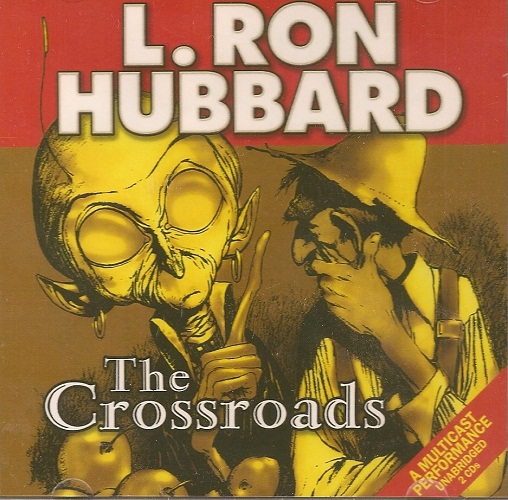
Science Fiction Audiobook - The Crossroads by L. Ron HubbardThe Crossroads
By L. Ron Hubbard; Read by a Full Cast
Approx 50 mins – [UNABRIDGED]
Publisher: Galaxy Audio
Published: 2010
Themes: / Science Fiction / Farming / Economics / Politics / Time / Trading / Vegetables /

Eben Smith is frustrated with government, who has offered (ordered?) to pay him to plow under his crops. But, these crops are “tangibles”, as Eben says, and it don’t make no sense to him. So he piles up the vegetables in his wagon, and heads off to find a buyer, leaving his wife to worry about him causing trouble with the government.

A day or so later, he arrives at The Crossroads. Four roads meet there; one concrete, one full of boulders, not passable except on foot. Another was made of metal. That leaves his own, a dirt road with a double row of ruts made by wagon wheels. Eben, not sure where to go from there, stops and waits for “someone with information”.

Eben has visitors, of course, and is a shrewd trader. Each visitor has his own quirks, and his own things he finds valuable. Eben sees things no farmer from the 1940’s has ever seen.

The story has a good quality. It’s very enjoyable pulp fiction, originally published in Unknown Fantasy Fiction in February 1941. It reminds me a bit of Clifford D. Simak, who, 17 years later, wrote “The Big Front Yard”. Eben has the same sort of can-do attitude as the main character in that story. Just as interesting are Eben’s distrust and criticism of the US government. Not much has changed in the last 70 years.

This CD is one of many in a series of L. Ron Hubbard stories published by Galaxy Press. It was extremely well done. There’s a main narrator, behind which are sound effects. Other actors perform the dialogue. Birds chirping set the roadside scene at high noon, and none of the effect are overpowering. Most of Eben’s visitors speak English, but one of them doesn’t. The spoken language was very well done, too. I become convinced after listening to this, the excellent Warhammer titles from The Black Library, and the great stuff coming from Graphic Audio, that it is not this type of audiobook I dislike. If it’s done well, it’s good stuff. It’s just so easy to do terribly.

With a pair of headphones, this was a very enjoyable listen.

Posted by Scott D. Danielson

Review of Breaking Point by James Gunn

SFFaudio Review

Welcome to Reviewopolis! Three stories to go…

Breaking Point
By James Gunn; Read by Julie Davis
Approx 2 Hours – [UNABRIDGED]
Podcaster: Forgotten Classics
Podcast: March 2009 (Episodes 111-113)
Themes: / Science Fiction / Aliens / Space Travel / Psychology /

The strength of the unit is the sum of the strengths of its members. The weakness of the unit can be a single small failing in a single man.

First, a few notes about the Forgotten Classics podcast: I really enjoy this podcast for a few reasons. Julie is an avid podcast listener, and if you are looking for podcast recommendations, look no further. She opens most episodes with something interesting from the Podosphere. These Podcast Highlights come from all over the map! For example, at the beginning of one the episodes containing this story (Episode 113), she highlights “Bob Dylan’s Themetime Radio Hour”. Would you have predicted Bob Dylan and James Gunn in the same podcast?

Another thing I like about Forgotten Classics is Julie’s commentary. She comments on the material she’s reading at the end of each podcast, providing a denouement that makes me think she’s just closed the book and knows everything I know up to this point in the story and nothing more.

Perhaps most important is the fact that Julie is a very good narrator. She reads clearly and with emotion. Stories are well-paced and enhanced by her pleasant voice.

The story at hand is “Breaking Point”, by James Gunn, which was first published in Space Science Fiction in March of 1953. A starship crew lands on an alien planet, crew a fairly well-oiled machine. The Captain recalls Leinster’s “First Contact”, when he mentions to the crew the importance of keeping the location of Earth secret “at all costs, until we’re sure we’re not going to turn up a potentially dangerous, possibly superior alien culture.” They quickly realize that they have done exactly that, when some external force, through unknown technology, won’t allow the hatch to be opened.

At this point, one of the crew members snaps. How could the hatch not open? There are many safeguards – this should not be happening! Cue the hysterial laughter. The aliens then start closing the crew in with a mysterious black (nothingness!) wall. Crew members flip out, one by one, as they try to figure out what’s happening before the walls close in completely. Are the aliens moving to close them all in, or are the alien moves specifically designed to unnerve specific crew members one at a time?

Julie said exactly what I was thinking when she mentioned that this story would be a comfortable fit on The Twilight Zone. Very weird stuff. It also reminded me of Stephen King’s The Langoliers, with the real world being blacked out in sections while people flee. Here, though, there’s nowhere to flee.

At the heart of the story is a conversation between the Captain and the medical officer about teams and how they are put together. Paresi, the medical officer tells the Captain:

Look, this is supposed to be restricted information, but the Exploration Service doesn’t rely on individual aptitude tests alone to make up a crew. There’s another factor—call it an inaptitude factor. In its simplest terms, it comes to this: that a crew can’t work together only if each member is the most efficient at his job. He has to need the others, each one of the others. And the word need predicates lack. In other words, none of us is a balanced individual. And the imbalances are chosen to match and blend, so that we will react as a balanced unit.

This while their living space continues to shrink. Is the medical officer saying that there is no such thing as a balanced individual, or that unbalanced people were purposefully selected and fitted together to make “a crew”? Either way, interesting. Thanks, Julie, for the story!

This story was completed as part of The 4th Annual SFFaudio Challenge.
Podcast Feed: http://feeds.feedburner.com/forgottenclassics

Posted by Scott D. Danielson

Review of The Illustrated Man by Ray Bradbury

SFFaudio Review

Here’s a review of The Veldt, story #20 in our 7th Anniversary Review Spree!

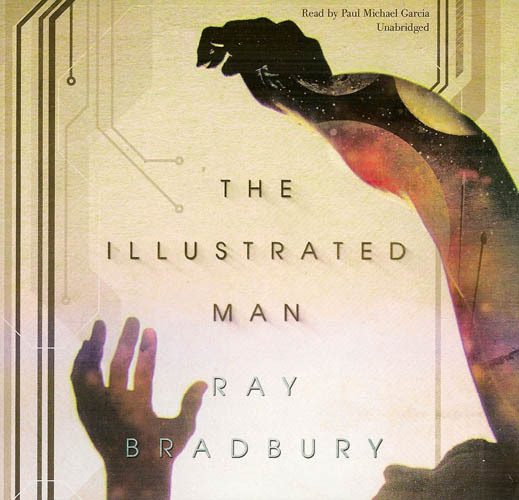
The Illustrated Man by Ray BradburyThe Veldt
Contained in The Illustrated Man
By Ray Bradbury; Read by Paul Michael Garcia
8 CDs – 9 Hours – [UNABRIDGED]
Publisher: Blackstone Audio
Published: 2009
ISBN: 9781433297199
Themes: / Science Fiction / Automated House / Computers / Children / Simulation /

In a house that cost them “thirty thousand dollars installed”, George and Lydia Hadley and their two children lived happily. Their shoes were tied with automatic shoe-tyers, their bacon was automatically fried, and, most importantly, their children were kept entertained. Life was good in their soundproof Happylife(tm) Home. Of course, things go terribly wrong. In the nursery, the kids seem to be spending a lot of time in Africa. With the lions.

The story was published in 1950, and though nobody’s tying my shoes, here in 2010 I can identify strongly with some of what Bradbury says here. At one point, George gets so upset that he decides to shut the house down:

“Lydia, it’s off, and it stays off. And the whole damn house dies as of here and now. The more I see of the mess we’ve put ourselves in, the more it sickens me. We’ve been contemplating our mechanical, electronic navels for too long. My God, how we need a breath of honest air!”

And he marched about the house turning off the voice clocks, the stoves, the heaters, the shoe shiners, the shoe lacers, the body scrubbers and swabbers and massagers, and every other machine he could put his hand to.

The house was full of dead bodies, it seemed. It felt like a mechanical cemetery. So silent. None of the humming hidden energy of machines waiting to function at the tap of a button.

Every so often I experience the same kind of angst and run around shutting things down. Things don’t end up so well for George, though. Maybe I better just leave it all on… and let the kids play with the lions. moohoowahahaha!

I’ve heard this story many many times, but I don’t know that I’ve actually heard an audiobook version before now. They’ve always been radio dramas, and this story has appeared several times: It was a Dimension X episode (1951), an X Minus One episode (1955), and Episode 11 of Bradbury 13. It was also televised as an episode of The Ray Bradbury Theater in the 1980’s.

Posted by Scott D. Danielson

Review of Press Enter_ by John Varley

SFFaudio Review

SFFaudio’s 7th Anniversary Reviewathon continues!

Science Fiction Audiobook - Press Enter_ by John VarleyPress Enter_
By John Varley; Read by Peter Ganim
2 Hours 53 Minutes – [UNABRIDGED]
Publisher: Audible Frontiers
Published: 2008
Themes: / Science Fiction / Mystery / Murder / Computers / Hacking /

This novella won the Best Novella Hugo in 1985 and the Best Novella Nebula in 1984. In 1984 I was 16, and my prize possession was a Commodore 64 computer. I recall programming on it, writing stories, and playing games. hmm. Not much has changed since then but the hardware, it looks like.

A story published in 1984 in which computers play a huge role is a history lesson. Floppy disks, modems, BBS’s – made me long for the good ole days. What was science fiction in 1984 now reads like historical fiction with an SF twist.

Victor receives a phone call one day from a computer, which tells him to run next door to his neighbor’s house. It will keep calling until he does it, says the computer. So he does, entering the house of a man he didn’t know well and finding him dead, an apparent suicide. Police and others are called in because this dead neighbor was into a lot of stuff: surveillance of neighbors, hacking into government systems, manipulation and theft of big money, all through his computers and his phones. Peter Ganim narrates the mystery well.

This is the longest story I’ve reviewed so far this month; it clocks in at 2 hours, 53 minutes. I LOVE novellas, and there is so much great science fiction out there at this length. Hollywood, take note! If you are mining for material, check out the science fiction novella.

Audible Frontiers has published many novellas, including more by John Varley (The Persistance of Vision is really excellent) and some by Connie Willis and Allen Steele.

Posted by Scott D. Danielson

Review of Dagon by H.P. Lovecraft

SFFaudio Review

This is the 18th story this month, and I’m still clinging to my sanity…

Horror Audiobooks - The Dark Worlds of H.P. Lovecraft, Volume 2Dagon
Contained in The Dark Worlds of H.P. Lovecraft: Volume 2
By H.P. Lovecraft; Read by Wayne June
3 CDs – 3.5 hours – [UNABRIDGED]
Publisher: Audio Realms
ISBN: 9781897304013
Themes: / Horror / The Sea / Cthulhu / Black Slime / Insanity /

I am writing this under an appreciable mental strain, since by tonight, I shall be no more. Penniless and at the end of my supply of the drug which alone makes life endurable, I can bear the torture no longer.

This poor guy then goes on to tell a story that starts at sea, middles with a wallow in black slime and other crazifying ancient things, and ends right where it starts – with the narrator’s “appreciable mental strain”. The trip takes about 15 minutes and Lovecraft does plenty in that space. If someone wanted a brief introduction to him, “Dagon” would be an excellent choice because it’s short yet contains some of Lovecraft’s trademark subject matter, including a lone man taking a long walk to an ancient place, seeing things no man should see, and struggling with his sanity afterward.

Wayne June narrates, and we’ve said it here before – he was born to read this stuff. Instantly compelling and chilling. Lovecraft and June are a perfect match.

Audio Realms published a whole line of these Lovecraft collections, all read by June. Since the last time we posted about them, they have become available for purchase and download at The Audiobook Shop. The downloads are DRM-free, and most of the excellent Audio Realms audiobooks are there.

Posted by Scott D. Danielson

Review of Pretty Maggie Moneyeyes by Harlan Ellison

SFFaudio Review

We’re in the home stretch now… Pick up the ball, and throw it to Who.

Audiobook - Pretty Maggie Moneyeyes by Harlan EllisonPretty Maggie Moneyeyes
Contained in The Voice from the Edge, Volume 3: Pretty Maggie Moneyeyes
By Harlan Ellison; Read by Harlan Ellison
1 Hour – [UNABRIDGED]
Publisher: Blackstone Audio
Published: 2010
Themes: / Fantasy / Ghosts / Gambling / Slot Machines /

Why don’t more narrators read stories like Harlan Ellison reads stories? I would say that the insistence with which he reads has to do with the fact that he’s delivering his own material, but he won an Audie Award for his narration of a Ben Bova story a while back. So he pours the same personality – and that’s what the quality really is; a personal one, like he’s right there with you – he pours the same personality into stories other than his own. I would therefore love to hear him read an anthology of his favorite stories from other writers.

But the story at hand is “Pretty Maggie Moneyeyes”, a sharp tale about a guy near the end of his luck who pulls the handle on a dollar slot machine and wins the jackpot. Then pulls the handle and wins again. Impossible, you say? Maybe. Maybe not.

I love the fact that after the story Ellison talks about writing it. And that’s an interesting story, too.

Visit the Blackstone Audio website for an audio sample from another of the stories in the Voice from the Edge, Vol. 3 collection.

Posted by Scott D. Danielson