Review of Lost Gods by Drew Beatty

SFFaudio Review

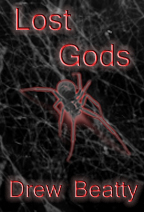
Fantasy Audiobook - Lost Gods by Drew BeattyLost Gods
By Drew Beatty; Read by Drew Beatty
Publisher: Podiobooks.com
Published: 2008
Themes: / Fantasy / Gods / Con Men /

Kweku Anansi is just another down-on-his luck con man who preys on the more fortunate during the day and goes home to his loving wife at night. That seems rather a comedown for the African trickster god, which is his real identity. However, Anansi is close to one of the “lost gods” whose powers are fading as the number of people who believe in him grow fewer with time. He meets up with another con man who has a good idea for a big haul when they are confronted by a group of gods who would do anything to be worshipped again. When they offer him the chance to regain his lost power and worshippers Anansi must make a choice between the mortal world which includes his wife and that of the gods.

I always enjoy stories about Anansi whether the authentic folk tales or the modernized use of the character such as is found in Neil Gaiman’s Anansi Boys. This is a smaller tale than Gaiman’s but still well told. We like Anansi from the beginning and pull for him along the winding path his adventures take. Author Drew Beatty does a good job of reading the book, slightly changing his voice to portray characters so that one can really visualize them well. The only problem I came across was that the last three chapters had unedited duplications where the author had reread for proper wording or emphasis.If these are fixed then the story will be much smoother.

I enjoyed this book thoroughly, especially Beatty’s inclusion of the trickster gods from pantheons of both current and long gone religions around the world. If you enjoy modernized tales of gods among us, of the urban fantasy oeuvre, this this will be your cup of tea as well.

Posted by Julie D.

Review of On Basilisk Station by David Weber

SFFaudio Review

Ed. – Welcome to Paul [W] Campbell, prestidigitator with Cossmass Productions. This is his first review for SFFaudio.

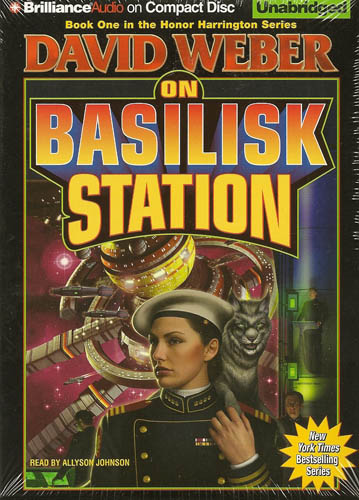
Science Fiction Audiobook - On Basilisk Station by David WeberOn Basilisk Station (Book One in the Honor Harrington Series)
By David Weber; Read by Allyson Johnson
15 Hours, 15 Minutes – [UNABRIDGED]
Publisher: Brilliance Audio
Published: 2009
ISBN: 9781423393382 (CD)
Themes: / Science Fiction / Military SF / War / Space Opera / Politics /

On Basilisk Station is the first of Weber’s Honor Harrington series. A great space opera that quickly builds up to a full out war between the Star Kingdom of Manticoran and her allies against the aggressive and expansionist Republic of Haven. So far there are eleven main novels in the series in print, plus over a half-dozen anthologies and spin-offs.

Mankind has spread out into the stars using a form of Hyperspace which offers the ability of sail along dangerous gravity waves at hundreds, even thousands, of times the speed of light. Some star systems are linked by wormhole termini that offer instantaneous travel between their end points. The benefit to interstellar trade and to fleet maneuvers that this offers is significant. Thus, Basilisk Station is the Royal Manticoran Navy’s picket at one such wormhole. In fact it is a collection of several wormholes that turn the star system of Basilisk into a major hub for commerce. Unfortunately the Republic of Haven’s economy is straining and they are looking at the worlds on the
far side of Basilisk as candidates to bolster their economy. Of course, having Basilisk Station under their control would make their annexation efforts and resultant ‘trade’ much simpler.

Commander Honor Harrington finds her aged and understrength ship being responsible for the entire picket On Basilisk Station. Her crew blame her for their posting to this punishment detail. Honor has been set up to fail. The Havenites are plotting to invade, the aboriginals on the planet below are taking homicide inducing drugs and her Executive Officer hates her.

As an opening volume in a series of this size, On Basilisk Station sets the initial pieces on the board for the following books and the war that develops. However, it doesn’t feel like that is what it is doing. The story is self contained and complete, as are all of the books in the series. Later books do benefit from reading the preceding ones, but it isn’t required. But, I’m not reviewing the series here. It can be a little heavy on the info-dumps at times, such as the history of the Founding of the Manticoran Nobility, Gravity Sails and a few others. Allyson Johnson gets through them well enough, but in audio they do interrupt the flow of the story. Otherwise she brings all the characters to life very well and covers quite a range, from Honor’s soprano all the way down to some gruff old sailors indeed.

Actually hearing Honor’s dialog in a soprano was quite jarring at first as I had read the books before and hadn’t properly assimilated that aspect of her character. Allyson stays truer to the characters and their voices than I had when reading myself. A good performance overall.

There was some slight confusion at times during the climactic battle as the point of view jumped from ship to ship. In print there would be a clear break in the text, but here the scenes flow together perhaps a little too quickly. They do resolves with a few seconds that there has been a scene change, but it still threw me a couple of times.

If you like your space opera with a well thought out political backdrop and with space battles that take into account the danger aboard ship and the scale of space, then On Basilisk Station should keep you happy.

Posted by Paul [W] Campbell

Review of Way Station by Clifford D. Simak

SFFaudio Review

Audible Frontiers - Way Station by Clifford D. SimakSFFaudio EssentialWay Station
By Clifford D. Simak; Read by Eric Michael Summerer
Audible Download – Approx. 7 Hours 5 Minutes [UNABRIDGED]
Publisher: Audible Frontiers
Published: 2009
Themes: / Science Fiction / Aliens / Galactic Civilization / Immortality /

In this Hugo Award-winning classic, Enoch Wallace is an ageless hermit, striding across his untended farm as he has done for over a century, still carrying the gun with which he had served in the Civil War. But what his neighbors must never know is that, inside his unchanging house, he meets with a host of unimaginable friends from the farthest stars.

This story spans more than a century, but most of the ‘action’ takes place in the middle of the 20th century, over a couple of months. See, a friendly alien recruited Enoch Wallace to become something of a galactic station master shortly after the American Civil War. Now, with his neighbors generally accepting his mysterious eternal youth, Enoch has a curious and unseen visitor watching him from the woods. Enoch is lonely, with his only friends being a completely deaf and mute young woman and his kindly mailman. Will the visitor in the trees learn the truth? Will Enoch help guide the Earth to its ultimate destiny? Read on!

I find myself arguing with a lot of my fiction writing friends about what makes a good story. They typically talk about ‘the rules’ or ‘the formula’ that makes a story work. I typically talk about clarity, consistency (story logic) and originality of a story. We usually agree about style.

A couple years back a friend of mine (a filmmaker and used bookstore owner) was telling me about one of the scripts he was working on. He said something to the effect of “every story must have conflict.” That’s probably not a new concept, not original to him, but it was new to me – at least in those words. Now I love such sweeping declarations – they give my dialectical brain something to hack away at. It seems a fairly straightforward a concept – and on the face of it seems likely – but, that always gets me thinking: If it sounds so obvious it is probably at least partially false. So I thought about it for maybe thirty seconds and then pointed out that ‘pornographic films need not have conflict – but they can still have a story.’ Illustrating I said “Pizza delivery guy comes to the door – half naked woman answers – sex follows.” It has a beginning, a middle and a money shot. My friend and I both laughed. But, I’ve been thinking about this meme ever since. Now, with Way Station I think I have a more serious defeater to my friend’s all encompassing rule about storytelling. There is very little conflict in Way Station. That is actually a pretty common thing for author Clifford D. Simak. His stories are highly pastoral, full of backstories being revealed, mysterious farmers and friendly aliens. Conflict may be mentioned, as having happened long ago (or in some distant future) – but shots are rarely fired in anger. I’m thinking back on all of the Simak I’ve read, and in it all I can’t recall much conflict at all. And yet, I love his stories.

Eric Michael Summerer does a terrific job narrating this pastoral masterpiece. He portrays Simak’s characters with all the honesty, decency, and humanity that Clifford D. Simak put into them. Audible Frontiers has very kindly added an excellent and informative introduction written and read by another of Science Fiction’s most humane authors, Mike Resnick! Audible Frontiers has been adding so many new titles it is hard to keep up. This one will slow things down for you and even make life a little simpler. Thanks Simak!

Posted by Jesse Willis

Review of The Three Stigmata Of Palmer Eldritch by Philip K. Dick

SFFaudio Review

The Three Stigmata of Palmer Eldritch by Philip K. DickThe Three Stigmata of Palmer Eldritch
By Philip K. Dick; Read by Tom Weiner
6 CDs – 6.8 Hours [UNABRIDGED]
Publisher: Blackstone Audio
Published: 2008
ISBN: 9781433248221
Themes: / Science Fiction / Religion / Drugs / Mars / Aliens /

Not too long from now, when exiles from a blistering Earth huddle miserably in Martian colonies, the only things that make life bearable are the drugs. Can-D “translates” those who take it into the bodies of Barbie-like dolls. Now there’s competition: a substance called Chew-Z, marketed under the slogan “God promises eternal life. We can deliver it.” The question is: What kind of eternity? And who—or what—is the deliverer?

Reading Philip K. Dick is the literary equivalent of taking deliriants in church. Dick’s world is fully realized, his characters being windows into Dick’s own sympathies, his own passions. Dick seems to have observed the writing advice that goes: “Write what you know.” What Dick knows about is drugs, suburban druggie life, revealed religion, the conflict between an individual and the group, between women and men. If you look at the basic plot The Three Stigmata Of Palmer Eldritch scans as most similar to Alfred Bester’s The Demolished Man, in that a corporate war between the solar system’s two biggest multi-planetaries drives the action. But it doesn’t feel that way, it feels like a scaled-up version of Dick’s short story Wargame. Sure, the novel is supposed to be about life on Mars and big corporate business, but Dick’s Mars is mostly confined to a few intemperate draftees who couldn’t fake their way out of the draft. Upset with their new colonial life they spend all their time playing with Barbie style playhouses and taking mind altering drugs. I can almost picture Dick sitting in his living room watching his young daughters playing with their Barbie dolls. They sit on the floor, coveting their Barbie corvettes, their Barbie clothes and decorating their Barbie dream houses while Dick, sitting in an armchair above, looks down compassionately and philosophicaly as he reaches for the typewriter. Strangely, the novel also feels extremely prescient. At multiple times throughout I paused and thought about the PC game called The Sims – a game where your avatar must eat, sleep, and furnish her virtual home with virtual goods as you plan her idealized life. We seem to have gotten what Dick was driving at. For what is World Of Warcraft if not a Dickian reality minus the drugs? William Gibson would describe it as “a consensual hallucination” – Dick called it The Three Stigmata Of Palmer Eldritch.

Originally published in 1965, this is the first commercial audiobook release of The Three Stigmata Of Palmer Eldritch. Narrator Tom Weiner seems to be Blackstone Audio’s go-to guy when it comes to narrating the heavy hitters of Science Fiction. This is a good thing as Weiner brings a vast gravitas to his reading. Fans of George Guidall’s narrations will find Weiner similarly impactful. The cover art for The Three Stigmata Of Palmer Eldritch is all original for this production. This is more and more the case at Blackstone, which makes me happy, for I am covetous.

Posted by Jesse Willis

Review of Star Wars: Outcast by Aaron Allston

SFFaudio Review

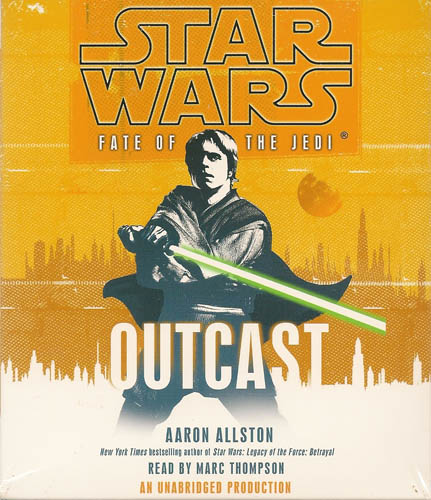
Star Wars: Fate of the Jedi Book 1: OutcastStar Wars: Fate of the Jedi (Book 1): Outcast
By Aaron Allston; Read by Marc Thompson
10 hours – [UNABRIDGED]
Publisher: Random House Audio
Published: 2009
ISBN: 9780739376614 (CD)
Themes: / Science Fiction / Fantasy / Star Wars /

A quick word of warning: It’s impossible to review this book without spoilers for previous books in the series.

Star Wars: Outcast is the first book in a new series of novels, collectively called The Fate of the Jedi. The series is connected to the previous 40 or so (!) Star Wars books. Here’s a timeline from Random House’s Star Wars page; this series falls on there after the Legacy of the Force series. I appreciate that some attempt is being made at continuity between movies/TV/comics/novels, but I’m not the guy to tell you whether or not it’s working. I do know that the characters aren’t static – Han and Leia are not eternally in their 30’s. At the open of this series, in fact, they’ve got grandkids.

To bring you up to speed: Han and Leia’s son Jacen fell to the Dark Side. This happened in the Legacy of the Force series, I believe. If anyone out there can correct me, please do. Stuff happened, Jacen ended up dead, and in the aftermath the Galactic Alliance is wondering if Jedi cause more trouble than they prevent. That’s where we are at the beginning of this book.

Now in this volume, Luke Skywalker (that’s Jedi Grand Master Luke Skywalker, thank you very much) is arrested by the Alliance for his part in Jacen Solo’s fall. He negotiates a ten year exile, and decides to use the time to retrace Jacen’s steps in an attempt to understand why he fell. Luke has a young son named Ben who wants to come along, and does. Nothing could possibly go wrong there, I’m sure, since Luke is an expert with the whole father-son thing. And the Force thing. Meanwhile and elsewhere, a young padawan named Valin Horn decides that his mom is not really his mom, but a disguised agent. He thinks his Jedi dad is not his dad, either, so out pop the light sabers. Valin is incorrect, though – his parents are his parents. His padawan mind is being influenced by something outside, like what happens to a lot of teenagers.

And we’re off! I’m not sure how many books will be in this series, but this is the first Star Wars series of books that is being released unabridged, so I’ve decided that I’ll give it a go and try to keep up. I’ve got the next book (Omens by Christie Golden) ready and waiting.

I enjoy the Star Wars universe, and found this to be a good listen. It’s a return to a comfortable setting, with familiar characters Luke, Leia, and Han, yet with enough growth of those characters to make them interesting for additional reasons. There are also a bunch of new characters, but this book lets you know whatever you need to know about their pasts. It’s not difficult to follow. As an adult I find these books entertaining, but with occasional eye-rolling moments that I probably wouldn’t put up with in other books. Example: Valin Horn telling his dad (who Valin thinks is an impostor) that, because of readily available electronic prosthetics, Jedi “don’t feel too bad cutting the hand off a very bad person”. Narrator Marc Thompson, in true Star Wars fashion, recites those occasional awkward lines as naturally as possible.

Thompson is a superior narrator. Lots of sound effects surround his narration (a feature I often dislike, but in the Star Wars novels, I really like the effects) as he performs many voices, some of them enhanced with audio equipment. No need for me to vouch for his great skill – here’s a sample from the opening of the book:


If you enjoy Star Wars, this is more of the same kind of thing and you’ll probably like it, too. It’s entertaining, it sounds terrific, but it’s not groundbreaking.

Posted by Scott D. Danielson

The SFFaudio Podcast #031 – NEW RELEASES/AUDIOBOOK: Founding Fathers by Robert Bloch

Podcast

The SFFaudio PodcastThe SFFaudio Podcast #031 – Jesse (that’s me) and Scott (my buddy) are again joined by Rick Jackson of Wonder Audio. We talk about audiobooks, new and newer, a little about radio drama, throw in some politics, some Canada bashing, and then add in two complete short stories. The first short story is read by me (it is only two sentences long) and the other runs about 40 minutes and is performed by a professional narrator. Enjoy it folks!

Talked about on today’s show:
Full Cast Audio, Graceling by Kristin Cashore, Hugo Nominees, Young Adult novels, Little Brother by Cory Doctorow |READ OUR REVIEW|, The Graveyard Book by Neil Gaiman |READ OUR REVIEW|, The Hunger Games by Suzanne Collins |READ OUR REVIEW|, On Basilisk Station by David Weber, Grover Gardner, Shards Of Honor by Lois McMaster Bujold, Barayar, The Honor Of The Queen, Paul W. Campbell, Honor Of The Clan by John Ringo and Julie Cochrane, Cally’s War, Audible Frontiers, Brilliance Audio, Paperback Digital, Hyperion by Dan Simmons, The Canterbury Tales, The Kick-Ass Mystic Ninjas, Black Library Audio, Warhammer 40,000: Heart Of Rage by James Swallow, Warhammer 40,000: Slayer Of The Storm God by Nathan Long, Infinivox, The Year’s Top Ten Tales Of Science Fiction edited by Alan Kaster, Ted Chiang is awesome, Zombie Astronaut posts 5 adaptations of Knock by Frederic Brown, Earthmen Bearing Gifts, Expedition, Arena, Rocket Men: The Epic Story of the First Men On The Moon by Craig Nelson, Penguin Audio, 40th Anniversary of Apollo 11, Digital Apollo by David A. Mindell, MIT Press, Wernher von Braun, I Aim For The Stars (1960), Ascent by Jed Mercurio |READ OUR REVIEW|, Voyage by Stephen Baxter (and adapted by Dirk Maggs to radio drama), Four Sided Triangle by William F. Temple, Ray Bradbury, Damon Knight, William Coon, The Fabulous Clip-Joint by Frederic Brown, The Alcoholics by Jim Thompson, Audible.com/wonderaudio, Rule Golden by Damon Knight, Worlds Of The Imperium by Keith Laumer, Mark Douglas Nelson, This Crowded Earth and Other Stories by Robert Bloch, overpopulation, James Powell, The Vanishing Venusians by Leigh Brackett, noir, The Empire Strikes Back (1980), Lawrence Kasdan, Body Heat (1981), Wolfbane by Frederik Pohl and C.M. Kornbluth, Plague Of Pythons by Frederik Pohl, Passengers by Robert Silverberg, The Ghost Brigades by John Scalzi, Old Man’s War, Zoe’s Tale, The Sagan Diaries, Lord Valentines Castle by Robert Silverberg |READ OUR REVIEW|, Stephan Rudnicki, Greg Margarite, LibriVox.org, Deathworld by Harry Harrison, Philip K. Dick, Andre Norton, William Coon, Amazon Kindle, ebooks, where the great lakes came from, Comics, The Iliad by Homer; Adapted by Roy Thomas, The Punisher: From First To Last by Garth Ennis, The Golden Slave by Poul Anderson, The Lies Of Loch Lamora by Scott Lynch = Lankhmar meets Oliver Twist, Harry Potter, Dune Messiah by Frank Herbert, messiahs, clairvoyance, the dangers of charismatic leaders, Dune, Harkonnen government was poor management, BBC versions of the Falco books by Lindsey Davis, Radio Downloader, the Brother Cadfael series by Ellis Peters, The Name Of The Rose (1986), Umberto Eco.

And last, but not least, a complete short story, courtesy of Wonder Audio, by Robert Bloch:

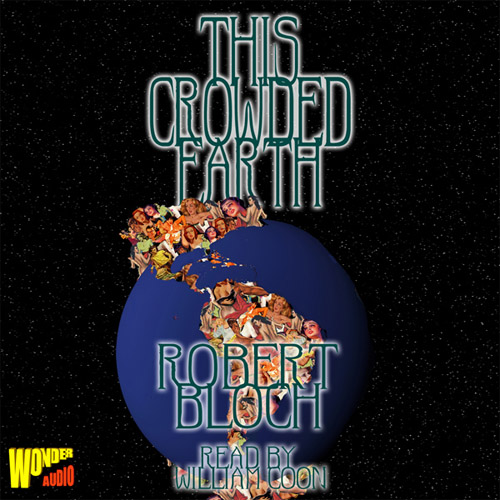
This Crowded Earth and Other Stories by Robert BlochFounding Fathers
By Robert Bloch; Read by William Coon
Approx. 40 Minutes [UNABRIDGED]
Podcaster: The SFFaudio Podcast
Podcast: July 20th, 2009
A humorous time travel tale.
First published in Fantastic Universe July 1956.

Get more Robert Bloch read by Willam Coon HERE.

Posted by Jesse Willis