Review of The Night Of The Triffids By Simon Clark

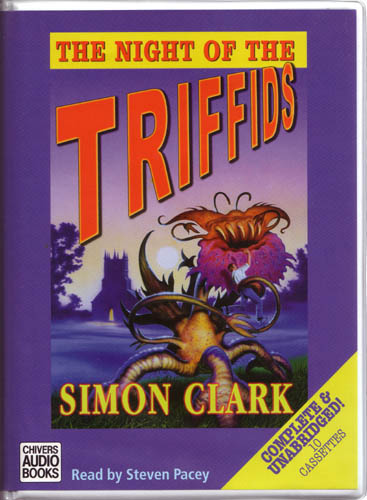
The Night of the Triffids by Simon ClarkThe Night Of The Triffids
By Simon Clark; Read by Stephen Pacey
10 Cassettes – 12 Hours 30 Minutes [UNABRIDGED]
Publisher: Chivers Audio
Published: 2002
ISBN: 0754007669
Themes: / Science Fiction / Disaster / Society /

I was twelve years old when I discovered John Wyndham’s awe-inspiring The Day of the Triffids. For me, standing between the world of childhood and the mysterious new world of adulthood, it was a revelation [it] wasn’t merely a good story; it was such a powerful transforming experience that the hero’s struggle for survival has stayed with me ever since.”
-Author Simon Clark

Chock full of adventure, action, politics, revolution, and romance, The Night Of The Triffids is horror author Simon Clark’s sequel to the venerable 1951 John Wyndham novel The Day Of The Triffids. Wyndam’s story was about a confluence of two natural disasters – the appearance of some strange green lights in the sky that blinded anyone who looked at them and the subsequent rampage of a carnivorous walking plant called a Triffid – which was previously only a curiosity. The narrator of that tale was Bill Masen, a man who by pure chance managed to avoid becoming blinded like 99% of humanity. At the end of The Day Of The Triffids, the hero, Bill Masen and his wife and four-year-old son David leave the British mainland to join a new colony on the Isle of Wight. In a way that story was a kind of retelling of The War Of The Worlds, excepting that the aliens weren’t from Mars. That novel was a powerful disaster tale heavily influenced by the cold war era in which it was set. Simon Clark’s sequel takes place twenty-five years. It is told by David Masen, Bill Masen’s now grown-up son, who is an aviator in the fledgling Isle of Wight Airforce. The Masen family, along with a handful of other British survivors, have started rebuilding society on that Island off the south of Britain. But when a new disaster strikes humanity in its weakened state may not survive.

There are very few genuine science fiction elements in this book, the closest being the soft science fiction idea of adopting new values for new situations. As an example, the few remaining people have decided to take a crash effort to increase the population – and in so doing have created something called “Mother Houses”. These are convent-like homes where fertile women give birth and infertile women raise babies – all in an effort to maximize the birth rate. I’m not sure if Clark knew it or not but frighteningly, the Nazis’, had something similar – the “Lebensborn,” which were mother houses, set up by Heinrich Himmler to care for unmarried pregnant women whose “racial” characteristics (blond hair, blue eyes) fit the Nazis’ Aryan ideal. “Racially pure” SS members were encouraged to visit often and sire many young children for the Fuhrer. Horrific as such a baby factory sounds in The Night Of The Triffids this is but one of the ‘necessary evils’ that society is experimenting with. The good news is that it all manages to replicate
much of the feel of The Day Of The Triffids, but where Clark really stumbles is with the plotting. The opening scene and the ensuing couple of chapters are very interesting, and made me wonder where it all was going. But that mystery was dropped until a throw away explanation in the final chapter. And as the Brits say that ‘just isn’t cricket’. The whole book has a stumbling along bumbling along plot that doesn’t allow you to guess where it might be going – perhaps this was in part due to what I would assume was to be its target audience – preteens and young teens – heck it may have even been a stylistic choice. I don’t know.

What I do know is that what success Night Of The Triffids does have is due in no small part to the first person perspective. English narrator Stephen Pacey does good work with the compassionate everyman David Masen, his other voices including variously accented Americans are good too, though they were fairly easy to tell that it was a ‘put-on’ accents. If you’re not expecting it to surpass much less equal the original The Night Of The Triffids will be acceptable entertainment.

Posted by Jesse Willis

Guy Gavriel Kay interview

OnlineAudio

http://www.brightweavings.com/ggkswords/cbc.htm”>HERE‘s an interesting 12 minute interview from March 2000 with fantasy author Guy Gavriel Kay -the link is to a section of Kay’s offical website, but the interview was originally recorded for CBC Radio One. Topics covered in the interview include the blurring of boundaries between mainstream and fantasy fiction, and adapting novels into film.

Posted by Jesse Willis

NPR Weekend Edition "Arkham House & H.P. Lovecraf…

SFFaudio Online Audio

NPR Weekend EditionNPR Weekend Edition – Arkham House & H.P. Lovecraft
Sunday, October 31, 2004, 7 Minutes 31 Seconds
LINK TO THE NPR SHOW:
http://www.npr.org/templates/story/story.php?storyId=4133870 This all to short radio feature outline’s the history of small press publisher Arkham House, talks about H.P. Lovecraft and includes brief interviews with Gary Gygax, Greg Bear and Ray Bradbury. It also includes a snippet from Sunset Audio’s The Dunwich Horror audio dramatization. Cool stuff!

Posted by Jesse Willis

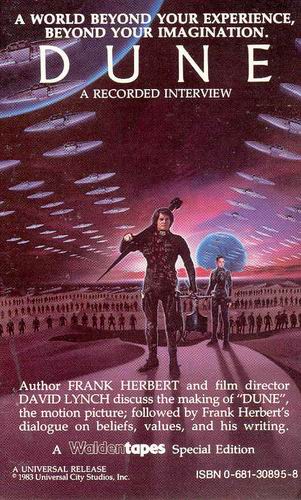
Review of Dune: An Interview with Frank Herbert and David Lynch

Dune: An Interview with Frank Herbert and David LynchDune: An Interview with Frank Herbert and David Lynch
1 Cassette – Approx. 1 Hour [INTERVIEW]
Publisher: Waldentapes
Published: 1983
ISBN: 0681308958
Themes: / Interview / Science Fiction / Moviemaking / Politics / Messiah / Power structures /

After reviewing Recorded Books unabridged Dune by Frank Herbert, Jesse suggested that I listen to this cassette which contains 2 interviews. One with Frank Herbert and David Lynch, the director of the first Dune movie, and an interview with Frank Herbert alone.

The interview with Lynch and Herbert shows how pleased Herbert was with Lynch’s film. The interview was recorded before the film’s release, and Lynch expressed nervousness while Herbert expressed satisfaction, along with some discussion of the difference between film and print, and the process of getting one to the other.

To me, the interview with Herbert alone (the bulk of the cassette) was the most interesting. Of Dune he said that what he wanted was “something that showed the impact of a messiah on history as the creator of a power structure.” His theory was that a messiah creates a power structure that attracts corruptible people, no matter how well-meaning the messiah might be. This led into a discussion of how a messiah is accepted by a culture in the first place, then into the nature of the power structure a messiah leaves behind, and into how this applies to contemporary power structures in government.

Another tidbit I picked up that I didn’t know is that Herbert considered Dune, Dune, Messiah, and Children of Dune one book, with Dune, Messiah being the pivotal book. I have not read past the first novel, so now I’ve got a couple more books on my TBR pile.

The entire program was interesting enough to listen to twice. If you are a fan of Dune, find yourself a copy of this! I think you’ll enjoy it.

Posted by Scott D. Danielson

Review of Night On Mispec Moor By Larry Niven

Night on Mispec Moor by Larry NivenNight On Mispec Moor
By Larry Niven, Read by Warren James
ARCHIVED ONLINE – Click here to visit Hour 25 and listen
27 Minutes [UNABRIDGED]
Publisher: Hour25Online.com
Published: 2001
Themes: / Horror / Science Fiction / War /

“Now I know that most of you quite rightly associate Larry’s writings with hard SF, not horror. But that doesn’t mean he can’t write a cracking good horror yarn when he sets his mind to it. But being one of the premiere writers of hard SF; when he writes horror it’s with his own unique twist. In Night on Mispec Moor Larry tells a tale about a man trapped in a place where the fog lies thick and close to the ground and where the dead really return to life. And though this story is most certainly horror, it is also hard SF. Way cool and highly memorable.”
-Warren James, Hour 25

For the 2001 Halloween broadcast of Hour 25, Warren James, the show’s host, with the kind permission of author Larry Niven, read the short story “Night On Mispec Moor”. This excellent tale was first published in Vertex Magazine‘s August 1974 issue. Thankfully, internet archiving allows us to still listen to this gem of a story! And though Warren James is not a professional audiobook narrator, his reading is a good! One minor issue though – as with any Hour 25 broadcast the volume has to be turned way up and there is some digitization to the sound. James also includes a short introduction to the story, and its well worth hearing. So if your in the mood for a really spooky hard SF horror story check it out.

Posted by Jesse Willis

ITConversations debuted a new online audio intervi…

SFFaudio Online Audio

ITConversations debuted a new online audio interview show this week called Voices in Your Head. The description:

Can you hear it, even as you read this, speaking to you inside your mind? What are those Voices in Your Head? Host Dave Slusher interviews writers, musicians and other creative people about the effect of technology on their art and vice versa.

Dave Slusher’s first guest is SF author James Patrick Kelly.

Click here to go to ITConversations and listen to the show!

And while we’re on the subject, the best SF interview show online is Hour 25. Their latest interview is with Laurell K. Hamilton.

Posted by Jesse Willis