Here’s the first review by a long time internet ally, fellow proponent of all things Donald E. Westlake, and soon a guest on The SFFaudio Podcast.
 Downtown
By Ed McBain; Read by Michael Prichard
8 Cassettes – Approx. 8 Hours [UNABRIDGED]
Publisher: Books On Tape
Published: 1992
ISBN: 0736621423
Themes: / Crime / New York / Humor / Murder / Mistaken Identity /
Michael Barnes is in New York on business. He has a couple of hours to kill before his plane leaves. It’s Christmas Eve. When he stops for a drink, he finds a young woman very attracted to him. He swells with masculine pride. But soon Michael’s wallet and then his rented car are stolen – only to resurface on the other side of town in unexpected company – a corpse!
There’s nothing quite like picking up a book (metaphorically) you’ve never heard of and know nothing about and discovering that you’ve stumbled across a classic. This was my experience with Ed McBain’s Downtown.
A classic? Strong words, there, Trent. But I mean it. I just recently read Donald Westlake’s The Hot Rock, which I loved and which is considered the classic comic crime novel. Downtown is nearly if not just as good (although very different).
Our protagonist is Michael Barnes, an orange-grower from Florida who is about to fly out of New York City on Christmas Eve, after a meeting with his advertising agency, when he gets hustled by a gorgeous woman and her fake police detective accomplice in an airport bar. His drivers license, credit cards, and money now gone, he goes downtown to report the crime to the police, getting his rental car stolen along the way. From there, he ends up on the lam accused of murder, running hither and thither meeting all sorts of strange people and ending up in all sorts of strange situations as he tries to figure out just what the hell is going on.
Tempering this craziness is the fact that Michael Barnes has some serious emotional baggage–he’s a cuckold and bitter about it, has issues with his mother, and was scarred by his combat experience in Vietnam (although he’s not an offensive psycho stereotype, thank God). These emotional scars are played upon masterfully by McBain, for dark humor or for grounding moments of pathos as appropriate, and they give Downtown a humanity that makes the whole farce unexpectedly powerful.
I don’t know why Downtown isn’t better known. Maybe Ed McBain just pumped out so many books that lots of his stuff falls through the cracks while readers get stuck trying to read the 87th Precinct and Matthew Hope novels in order. Maybe it’s because nobody made a movie out of it (although see below). Maybe, and this is a strong possibility, the style of humor doesn’t appeal to a broad enough audience.
Whatever the reason, Downtown deserves much better than obscurity. It’s clever, witty, touching, and terrific.
That’s the book review portion of this write-up, but I don’t want to end without bringing up something that struck me while listening to Downtown.
With a movie director figuring prominently in the plot, Downtown is loaded with film references (including to Evan Hunter/Ed McBain films The Birds and Fuzz). A movie not mentioned is one that Downtown bears a great resemblance to–Martin Scorsese’s After Hours.
If you’re not familiar with this film (too few people are), After Hours is a comedy about a fairly-average Joe who meets all sorts of strange people and ends up in all sorts of strange situations in late-night Manhattan. Oh, and he also gets accused of a crime he didn’t commit.
The setting and several story elements in After Hours are very similar to Downtown. The style of humor (dry with repetitive absurdity) also bears a marked resemblance. Both even feature prominent references to The Wizard Of Oz.
Coincidence? Homage? Rip-off (I doubt that)? Subconscious borrowing? We’ll likely never know. But if you liked After Hours, you’ll probably like Downtown, and vice versa. And if you’re not familiar with either, do yourself a favor and check them both out.
I listened to the 1992 edition of Downtown from Books on Tape, read by Michael Prichard. When I started the book, I thought his reading was stiff, but I quickly recognized that he had done a great job capturing the somewhat-uptight, neurotic lead character. Mr. Prichard is also quite skilled in creating voices to distinguish the many other characters without resorting to ridiculous exaggerations or outrageous accents (in a book with a lot of ethnic characters, no less). Downtown is written in a highly rhythmic style, with lots of short sentences and lots of repetition. Prichard grasps this and captures the novel’s rhythms superbly. It’s a really good reading.
There are two other editions of Downtown (both available at Audible.com), an abridged version from Phoenix Books read by Stephen Macht and an unabridged version from Brilliance Audio read by David Regal. For the sake of comparison, I listened to the available samples of both.
Downtown is a lousy candidate for abridgment, but even if it wasn’t I wouldn’t care for Stephen Macht’s reading, which is overdramatic.
David Regal’s reading is considerably better. His interpretation is quite different from Michael Prichard’s, making Michael Barnes sound like a traveling salesman. I would have to hear more to have a real sense of how well this works but I heard enough that I think I can judge it a solid effort. Go with the Books on Tape edition if you can find it, but if you can’t, Regal’s version will likely do as a substitute.
Posted by Trent Reynolds

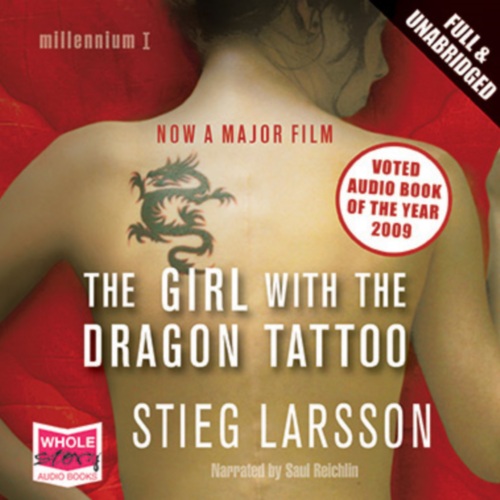 The Girl With The Dragon Tattoo



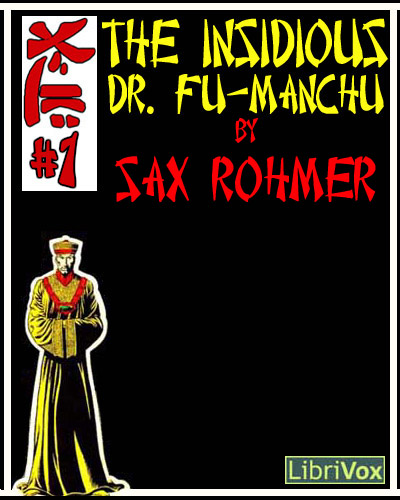
 Now this is strange, I recommend you read this audiobook despite it having some pretty awful writing. I’ve never found myself rooting the the villain as much as with this book, a book in which the mostly off-screen antagonist outshines the on-screen protagonists. First published in 1913 the titular character of The Insidious Dr. Fu-Manchu (aka The Mystery of Dr. Fu-Manchu) has come to epitomize a the embodiment of a socio-cultural meme known as THE YELLOW PERIL. The purported protagonists, Dr. Petrie and Sir Denis Nayland Smith, are a pair of casually racist assholes. They carry their ignorant colonial bully-boy tactics with them into every scene like a foul and infecting stench. Their agenda, to protect white supremacy at all costs, makes their foe’s vaguely villainous goals all the more palatable. But what is it that their enemy, Dr. Fu-Manchu, wants to do exactly? He is clearly ruthless. Is it simply world domination? Maybe. But even if that’s true, I can’t imagine he’d be as offensive as these two English assholes. When Fu Manchu does finally show up he seems more of a curious zoologist than an arch-fiend. It sounds bad, and it is, with bad writing for the most part, but it’s also very something iconic, and in that sense it is both important and worthwhile.