
The SFFaudio Podcast #051 – TOPIC: THE YELLOW PERIL

Podcast

The SFFaudio PodcastThe SFFaudio Podcast #051 – Jesse and Scott are joined by Luke Burrage and Professor Eric S. Rabkin to discuss THE YELLOW PERIL.

Talked about on today’s show:
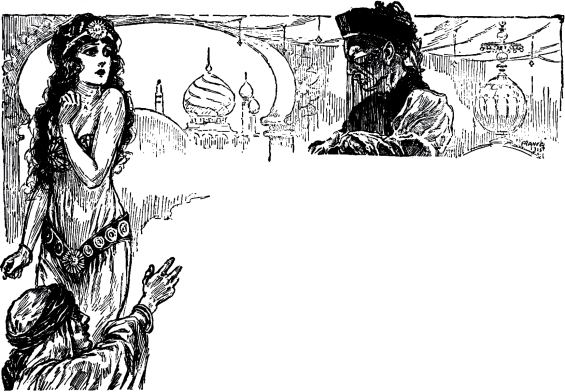
The Insidious Dr. Fu-Manchu by Sax Rohmer (aka The Mysterious Dr. Fu-Manchu) – available via Tantor Media, fix-up novel, hypnosis, Sherlock Holmes, the yellow peril incarnate, the yellow peril as the hordes of asia, the Chinese Exclusion Act (USA), Chinese Immigration Act, 1923 (Canada), Tamerlane (the scourge of god), The Yellow Peril by M.P. Shiel, The Purple Cloud by M.P. Shiel, racism, WWI, colonialism, Burma, Thuggees, Boxer Rebellion, genius, The Talons Of Weng Chiang, if you read it as Fu-Manchu being the hero you may like the story more, mad scientist, Faust, Paradise Lost by John Milton, Robur-Le-Conquérant by Jules Verne (aka Robur-The-Conqueror aka The Clipper of the Clouds), The Island of Doctor Moreau by H.G. Wells, The White Man’s Burden by Rudyard Kipling, colonialism, The Invisible Man, the other colored other, The League Of Extraordinary Gentleman by Alan Moore, Hawley Griffin (The Invisible Man), Allan Quatermain, Captain Nemo, Dr. Henry Jekyll/Mr. Edward Hyde, Mina Murray (from Dracula by Bram Stoker), English 418/549: GRAPHIC NARRATIVE (Winter 2010), The Invisible Man shows I and II, If I Ran The Zoo by Dr. Seuss, Jonah And The Whale, Suess’ anti-Japanese propaganda during WWII, Japanese internment during WWII in USA and Canada, Aryan, India, Nazi Germany, The Thule Society, Sri Lanka, racial stereotypes, Marco Polo, Kubla Khan by Samuel Taylor Coleridge, gender and skin color, blondness, Karamaneh (the love interest in The Insidious Dr. Fu-Manchu), femme fatale, Black Widow (1987), miscegenation, the Chinese hordes vs. the insidious Japanese, War With The Newts by Karel Čapek, Japan, LibriVox.org, Sixth Column by Robert A. Heinlein, beauty as goodness (in fairy tales), King Kong, Last And First Men by Olaf Stapledon, Star Maker, The Iliad by Homer, The Old Testament, The Science Fiction Hall Of Fame edited by Robert Silverberg, Arena by Fredric Brown, Plato, the red scare, Jack London, The Lathe Of Heaven by Ursula K. Le Guin, Arslan by M.J. Engh, Chung Kuo by David Windgrove, selective memory, polarized memory, Middlemarch by George Eliot, Encounter With Tiber by Buzz Aldrin and John Barnes, China Mountain Zhang by Maureen F. McHugh, Superfusion: How China and America Became One Economy and Why the World’s Prosperity Depends on It by Zachary Karabell, Firefly, Limehouse, London, Detroit, The Man In The High Castle by Philip K. Dick |READ OUR REVIEW|, alternate history, SS-GB by Len Deighton, Fatherland by Robert Harris, Gorky Park, North Korea, the North Korea embassy in East Berlin.
The Yellow Peril

The Fiendish Plot Of Fu-Manchu (Thanks Gregg!):

Posted by Jesse Willis

Entilted Opinions: The Disenchantment and Re-Echantment Of The World

SFFaudio Online Audio

Entitled Opinions (about life and literature)Entitled Opinions is a radio program (and podcast) from Stanford university’s radio station KZSU. In discussion from a program in May 2009 are the editors of
The Re-Enchantment of the World: Secular Magic in a Rational Age: Joshua Landy (a professor of French at Stanford) and Michael Saler (professor of history at the UC Davis). Together they are responding to Max Weber’s famous statement:

“The fate of our times is characterized by rationalization and intellectualization, and, above all, by the ‘disenchantment of the world.’ —Max Weber

This concept, disenchantment (entzauberung), was introduced by Weber to describe the character of his modernized, and increasingly secularized society, where scientific understanding had become more highly valued than religious belief. In their discussion Saler and Landy ask questions like:

‘Do all philosophical inquiries begin in wonder?’

‘Why does Science Fiction take off as a genre?’

‘Can we replace God and the Devil with Sherlock Holmes’ rationality and Moriarty’s criminality?’

‘Is the hierarchy of Middle Earth something we’d like to see in our world?’

It’s a fascinating discussion! |MP3|

Posted by Jesse Willis

LibriVox.org: Around The World In Eighty Days by Jules Verne

SFFaudio Online Audio

LibriVoxI like it when SFFaudio gets cited on Wikipedia. One of the citations there is a point I made about The Green Odyssey |READ OUR REVIEW| and the Dungeons & Dragons module Dragonlance: DL6 Dragons of Ice. I compared The Green Odyssey‘s roller-ships (a kind of wind powered land ship) with the iceboats of Dragons Of Ice And it was just yesterday I came across another similar variant on the sail-powered-terrestrial-ship:

“Mr. Fogg examined a curious vehicle, a kind of frame on two long beams, a little raised in front like the runners of a sledge, and upon which there was room for five or six persons. A high mast was fixed on the frame, held firmly by metallic lashings, to which was attached a large brigantine sail. This mast held an iron stay upon which to hoist a jib-sail. Behind, a sort of rudder served to guide the vehicle. It was, in short, a sledge rigged like a sloop. During the winter, when the trains are blocked up by the snow, these sledges make extremely rapid journeys across the frozen plains from one station to another. Provided with more sails than a cutter, and with the wind behind them, they slip over the surface of the prairies with a speed equal if not superior to that of the express trains.”

-From Around The World In Eighty Days (chapter XXXI) by Jules Verne

Here’s an image of it from a Golden Picture Classic edition of Around The World In Eighty Days:

An iceboat from Around The World In Eighty Days by Jules Verne

LIBRIVOX - Around The World In Eighty Days by Jules VerneAround The World in Eighty Days
By Jules Verne; Read by Mark F. Smith
37 Zipped MP3 Files or Podcast – Approx. 6 Hours 33 Minutes [UNABRIDGED]
Publisher: LibriVox.org
Published: April 16, 2008
Mysterious Phileas Fogg is a cool customer. A man of the most repetitious and punctual habit – with no apparent sense of adventure whatsoever – he gambles his considerable fortune that he can complete a journey around the world in just 80 days… immediately after a newspaper calculates the feat as just barely possible. With his excitable French manservant in tow, Fogg undertakes the exercise immediately, with no preparations, trusting that his traveling funds will make up for delays along the way. But unbeknownst to him, British police are desperately seeking to arrest him for the theft of a huge sum by someone who resembles him, and they will track him around the world, if necessary, to apprehend him. This is an adventure novel of the first water, with wholly unexpected perils, hair-breadth escapes, brilliant solutions to insoluble problems, and even a love story. And can this be? – That he returns to London just five minutes too late to win his wager and retain his fortune?

Podcast feed:

http://librivox.org/bookfeeds/around-the-world-in-80-days-by-jules-verne-2.xml

iTunes 1-Click |SUBSCRIBE|

Posted by Jesse Willis

ABC Radio National: The Philosopher’s Zone – conciousness, sensation and BLINDSIGHT

SFFaudio Online Audio

ABC Radio National - The Philosopher’s ZonePeter Watts‘ novel Blindsight (the audiobook for which is available from Recorded Books) takes its title from a phenomenon, of the same name, first observed by philosopher and psychologist Nicholas Humphrey. Humphrey is the guest on an episode of my favourite Australian podcast The Philosopher’s Zone. Here’s the description:

You are in a darkened lecture hall looking at a patch of red projected onto a screen in front of you. What’s involved in “seeing red”? This week, we meet the philosopher and psychologist Nicholas Humphrey who uses the phenomenon of seeing red as way into the mystery of consciousness.

If you think the phenomena of consciousness is interesting and wonder whether dogs think about themselves then have a listen |MP3|

Podcast feed:

http://abc.net.au/rn/podcast/feeds/pze.xml

Posted by Jesse Willis

Review of A Cask of Amontillado by Edgar Allan Poe

SFFaudio Review

Another short story! Will he ever stop?

Audiobooks - The Classic Tales PodcastThe Cask of Amontillado
By Edgar Allan Poe; Read by B.J. Harrison
17 Minutes – [UNABRIDGED]
Publisher: The Classic Tales Podcast
Published: 2008
Themes: / Horror / Murder / Revenge / Pride / Bricklaying /

It must be understood, that neither by word nor deed had I given Fortunato cause to doubt my good will. I continued, as was my wont, to smile in his face, and he did not perceive that my smile now was at the thought of his immolation.

From the two birds, one stone department, this classic story by Edgar Allan Poe. I wanted to read it again because it is the first story covered in a Teaching Company course I bought a while back called Masterpieces of Short Fiction, taught by Michael Kransky. I selected this particular audio version because I like the stories I’ve heard on B.J. Harrison’s The Classic Tales Podcast, and expected that he’d be particularly good with this one. I wasn’t disappointed! Very well done.

I’m enamored with this story, and not because I’d like to brick someone in myself. It’s a perfect little story, and horrifying. An inner portrait of a murderer, who calmly does his thing, and is disturbingly resolute. At one point, Fortunato refuses to speak to him. All he hears is the jingling of the bells on the victim’s cap in the dark. The story works so well.

The Teaching Company lecture was good. I looked at the Wikipedia entry for “Cask” and learned that Poe wrote this story as a response to a rival named Thomas Dunn English. The explanation is very clear, and things like the wild masonic gesture made by Fortunato make sense in that context. The lecture didn’t mention that, even though the origin of the story was discussed. Kransky said that it’s origin lay in an anecdotal story that Poe heard about someone who got buried alive, combined with class envy. Does the Wikipedia article overstate the case? Something to look into.

I’d love a course on the science fiction short story. I wonder which stories should be included in such a course? Click here to see which stories Michael Kransky included in Masterpieces of Short Fiction.

And be sure to check out B.J. Harrison’s The Classic Tales. I got this story from Audible.com, which is where The Classic Tales go after they are podcast. Here’s the podcast feed:

http://classictales.libsyn.com/rss

Posted by Scott D. Danielson

Aural Noir Review of the Improbable Adventures of Sherlock Holmes

Aural Noir: Review

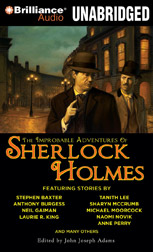
The Improbable Adventures of Sherlock HolmesThe Improbable Adventures of Sherlock Holmes
Edited by John Joseph Adams; Read by Simon Vance and Anne Flosnik, John Joseph Adams (uncredited)
18 CDs – 22 hours [UNABRIDGED]
Publisher: Brilliance Audio
Published: 2010
ISBN: 1441839070
Themes: / Mystery / Crime / Alternate History / Science Fiction / Horror / 19th Century / London /

“When you have eliminated the impossible, whatever remains, however improbable, must be the truth.” This famous Sherlock Holmes quote is the impetus which drives this intelligent, inventive, and at times irreverent compilation of Sherlock Holmes stories written in the last few decades. As John Joseph Adams explains in his introduction, his aim in compiling these stories is to explore the uneasy peace between the cold clear logic of the deerstalker-wearing, pipe-smoking detective and the unanswered, perhaps unanswerable mysteries which continue to thwart human investigation to this very day. While many of the stories miss the mark of this goal entirely, the collection as a whole succeeds in pushing Holmes in new directions while staying true to the spirit of Sir Arthur Conan Doyles’s original work.

The stories in this collection fall into one of three categories. First, there are the traditional mysteries. These are stories that, with but slight alteration, might easily have found a home among Conan Doyle’s own work. The best of these tales expand upon characters or cases mentioned in the original œuvre only in passing. Mrs. Hudson’s Case by Laurie R. King, for instance, features Holmes’s protégé Mary Russell as its protagonist and reveals the character of Holmes’s long-suffering landlady. Edward D. Hoch’s A Scandal In Montreal, meanwhile, reunites Sherlock Holmes with his sometime nemesis Irene Adler. As a whole, however, this category fits rather uneasily into the collection because, by and large, there is little in the way of “the improbable” in any of these stories. All are well-written and most are engaging; they simply miss the point.

The second category I would call historical, or pseudo-historical. In most respect these stories are similar to those of the first category, with one redeeming addition: Sherlock Holmes crosses paths with historical figures from the Victorian era. Stephen Baxter’s The Adventure of the Inertial Adventure sees our detective join forces with author of scientific romances H.G. Wells, while Tony Pi’s Dynamics Of A Hanging brings mathematician Charles Dodgson (better known as Lewis Carroll) into the Holmesian world. The highlight of this grouping, though, is The Adventure Of The Field Theorem by Vonda N. McIntyre, in which Sherlock Holmes investigates crop circles at the behest of none other than Arthur Conan Doyle.

The last category throws Sherlock Holmes–and let’s not forget Doctor Watson, through whose eyes we see most of these tales unfold–into genres as wide-ranging as alternate history, horror, and science fiction. Subjectively, I liked these stories best because they fall into genres which I most commonly read. Objectively, these stories succeed because they deliver on the promise of “improbable adventures.” The collection opens with a chilling tale by horror master Tim Lebbon, which unlike most Holmes stories is never intellectually resolved. The Singular Habits Of Wasps by Geoffrey A. Landis, perhaps my favorite story in the collection, puts a fascinating otherworldly spin on the mysterious murders of Jack the Ripper. Robert J. Sawyer’s closing story, You See But You Do Not Observe, pits Holmes’s intellect against the fermi paradox concerning extraterrestrial life. The collection is worth the price of admission for these entries alone.

Simon Vance carries the bulk of the narration, with Anne Flosnik reading only a few stories featuring female protagonists. Flosnik performs solidly in her few appearances. Simon Vance’s portrayal of Holmes and Watson is spot-on; the former speaks with a whip-sharp voice, while the latter lumbers along in a more lugubrious manner. He falls short only when narrating the few “New World” characters who figure in the stories, but these cases are uncommon and Vance’s accent isn’t off by much. John Joseph Adams himself narrates the collection’s introduction, as well as introductory passages to each story.

Whether you’re a fan of mystery, history, or something further afield, chances are high you’ll find something to sate your appetite in The Improbable Adventures of Sherlock Holmes. I’ll venture out on a limb and say that visitors to this site will likely be most interested in the tales of speculative fiction. I assure you, in particular, that you’ll not be disappointed.

Posted by Seth Wilson