
Aural Noir Review of Dimiter by William Peter Blatty

Aural Noir: Review

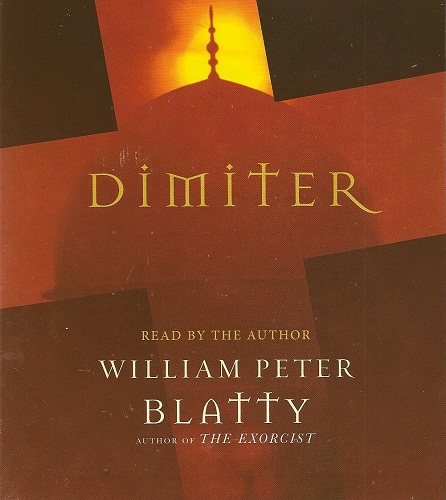
Audiobook - Dimiter by William Peter BlattyDimiter
By William Peter Blatty; Read by William Peter Blatty
8 Hours – [UNABRIDGED]
Publisher: Macmillan Audio
Published: 2010
Themes: / Thriller / Religion / Christianity / Espionage /

In 1973 a nameless prisoner is being tortured in an Albanian prison, where “grace and hope had never touched.” Colonel Vlora, known as “The Interrogator,” is frustrated and mystified by a man they have come to call The Prisoner because they cannot even make him speak. Is he an American spy, Paul Dimiter, known as the “agent from hell?” The solution to this stalemate while expected on one level is a complete surprise on another. This turns out to be emblematic of William Blatty’s book. Part 1 is an appropriate foretaste of this complex, suspenseful, and fast paced thriller.

The scene shifts to Jerusalem where we meet Moses Mayo, a neurologist, who is investigating a series of seemingly natural deaths that are nevertheless linked. He also is plagued by a gruesome murder, reports of apparitions and mysterious miraculous healings. We also meet Mayo’s life-long friend, Peter Meral, an Arab Christian, who is a police detective. Among other things, Meral is investigating a strange car explosion and the mysterious disappearance of the men involved, a CIA cover-up, and a body found at the Tomb of Christ.

The body count climbs and complications arise from the interweaving of all the events. This sounds somewhat like a standard thriller, however, it is anything but. We know the deaths are real but what about the reported miracles? Is everything really connected and, if so, what could possibly be the logical link? The solution is not only surprising but also provides an extremely moving moment of redemption.

Dimiter‘s suspense keeps the listener fascinated while also raising it above the ordinary by not being afraid to have characters who care about spiritual searching, loss, redemption, and love. The spiritual element will make this work especially interesting to those who are drawn to themes that investigate good versus evil. This is not an element that should surprise those who remember that Blatty is the author of the justly famous horror novel The Exorcist. Although this novel is strictly in the thriller vein, I must admit that I did find the torture scenes rather horrific and did fast forward through a few of them.

The author narrates his work and does such an effective job that I often forgot I was not listening to a professional voice talent. The only downfall was that during fast-paced scenes with more than two male characters, such as CIA interrogations, there was not enough differentiation between all the voices to make it easy to tell when dialogue shifted from one person to another. This was not a huge problem but it did require me to back up a couple of times until I figured out the tempo. Otherwise, William Blatty’s reading was a sheer pleasure, especially in voicing his more eccentric characters who he brought to life in a most vivid fashion.

Highly recommended.

Posted by Julie D.

The Twilight Zone Companion

SFFaudio News

TowerReview.com has posted an excerpt from the new Blackstone Audio audiobook called The Twilight Zone Companion (Second Edition) by Marc Scott Zicree. Here’s the description:

The commentary is an excerpt detailing the episode “Nothing in the Dark” by George Clayton Johnson, with Gladys Cooper as the old woman. Death is played by Robert Redford. The audiobook is narrated by Tom Weiner for Blackstone. All five seasons are covered, with author’s notes on this second edition, intros, cast, a PDF of photos, and commentary on each episode, and an interview with Burgess Meredith.

[via burjreview.blogspot.com]

Posted by Jesse Willis

Galaxy Audio: The Ghost Town Gun-Ghost by L. Ron Hubbard

SFFaudio Online Audio

Available FREE for a limited (but unspecified) time…

GALAXY AUDIO - The Ghost Town Gun-Ghost by L. Ron HubbardThe Ghost Town Gun-Ghost
By L. Ron Hubbard; Performed by Rob Paulsen
1 |MP3| – Approx. 52 Minutes [UNABRIDGED]
Publisher: Galaxy Audio
Published: October 22, 2009
“A man on the run from the law escapes to an nearly empty settlement populated only by a man named Pokey McKay. Pokey fills in the gaps of his loneliness by performing all the needed functions of the town under other names, and speaking of them in the third person.” First published in the August 1938 issue of Western Story magazine.

And check out the promotional videos for the Stories From The Golden Age series:

Posted by Jesse Willis

Review of Saturn’s Children by Charles Stross

SFFaudio Review

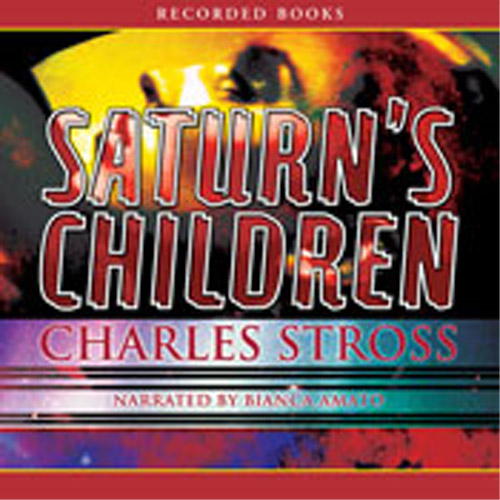
RECORDED BOOKS - Saturn's Children by Charles StrossSaturn’s Children
By Charles Stross; Read by Bianca Amato
11 CDs – Approx. 13 Hours 45 Minutes [UNABRIDGED]
Publisher: Recorded Books
Published: 2009
ISBN: 9781440750113, 9781440750106
Themes: / Science Fiction / Androids / Robots / Sex / Slavery / Identity / Venus / Mars / Mercury / Eris /

The Hugo Award-winning author of numerous best-sellers, Charles Stross crafts tales that push the limits of the genre. In Saturn’s Children, Freya is an obsolete android concubine in a society where humans haven’t existed for hundreds of years. A rigid caste system keeps the Aristos, a vindictive group of humanoids, well in control of the lower, slave-chipped classes. So when Freya offends one particularly nasty Aristo, she’s forced to take a dangerous courier job off-planet.

This novel’s title comes from the myth that Saturn (the Roman god of agriculture and harvest), ate his children at birth for fear of them usurping him. Its an apt starting point for a tale about robots More interesting is that Saturn’s Children opens with a reading of Asimov’s three laws of robotics

1. A robot may not injure a human being or, through inaction, allow a human being to come to harm.
2. A robot must obey any orders given to it by human beings, except where such orders would conflict with the First Law.
3. A robot must protect its own existence as long as such protection does not conflict with the First or Second Law.

…and then informs us that there are no humans left alive. There is, however, a whole solar system full of robots, all willing and able to obey all three laws. So what happened to all those humans? The novel is the answer to that question.

Saturn’s Children is told from the point of view of Freya Nakamichi-47 a gynoid (that’s a female android). She was activated (born) long after the last human had died. Freya, despite never having met one, still longs for her lost love (any human). Indeed, even the mere thought a human being makes her sexually excited. This is because, as a self described grande horizontale, Freya’s destiny was to be a sexual companion to any human that owned her. Now, without a master, she finds work where and when she can. But after a nasty run-in with an Aristo, a wealthy robot that owns other robots (called Arbiters), Freya will take any work that gets her off planet. Soon she’s employed by Jeeves, a masculine android who is more like her in shape and purpose than most robots. Freya’s first assignment is to transport a bio-engineered package across the solar system. But the pink police (a kind of anti biological proliferation organization), and another, more shadowy, organization are determined to stop her. Along the way Freya visits Cinnabar (a city on rails) that’s perpetually in Mercury’s shadow, drawing power from the temperature difference between Mercury’s light and dark sides), has sex with a rocket ship and grows some new hair.

Freya does a whole lot more than that too. She has a lot more sex for one. But beyond the sex there is some more fully cerebral stimulation going on in Saturn’s Children. The idea of a post-human solar system is an interesting one, and Stross plays with it quite effectively. This is a theme that I think hasn’t been done often enough in SF. The closest novel, in scope, if not in tone, is perhaps Clifford D. Simak’s City (in which intelligent dogs and robots have inherited a humanless Earth). This humanless solar system is, as I mentioned, quite vividly explored, with floating cities (like Bespin’s Cloud City) on Venus, waste heated bio-labs on the frozen dwarf planet of Eris, and a truly frightening description of what’s happened to poor old Earth. Stross has quite a lot of fun playing with the world he’s created here, naming a city Heinleingrad, naming a robot butler character after P.G. Wodehouse’s famous “gentleman’s personal gentleman.” It all mostly works with Saturn’s Children seeming to take most of its inspiration though from Heinlein’s novel Friday. Both novels feature artificial female persons as secret couriers, both tell their own stories, both secrete their smuggled cargos in their abdomens. Later on in Saturn’s Children there is some playing with the ideas promulgated in Heinlein’s 1970 novel I Will Fear No Evil. And, identity, in a world where brain data, and brain states, are easily and quickly copyable, isn’t as simple as it is with us meatbags. On the whole I enjoyed Saturn’s Children and found it full of interestingness. It was as most novels are these days, too long, and in need of a critical editor. The worst sin here is that the ending is rather weak, and features an afterword that leaves open the possibility of a sequel or seven.

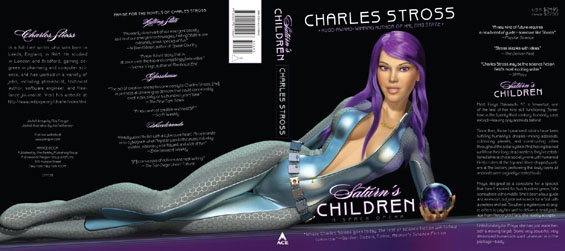
Narrator Bianca Amato, a South African accented “ALIEN OF EXTRAORDINARY ABILITY” (according to her resume), mispronounces a couple of the more obscure words but the general gist of her reading is highly competent. It helps a whole lot that Freya’s story is told in first person. I’m not sure what the present tense adds to the narrative other than being a little noticeable and not particularly harmful. Also, as I mentioned in a recent podcast, the Recorded Books cover art is boring, whereas the Ace Books paperbook edition is fabulous!

Check out the dust jacket from the paperbook edition:

Saturn's Children by Charles Stross - The PAPERBOOK's Dustjacket

Posted by Jesse Willis

Zombie Astronaut’s Frequency Of Fear: Dawn Of The Dummies

SFFaudio Online Audio

The latest episode of The Frequency Of Fear, entitled Dawn Of The Dummies, features me in a very minor role. I play a surprised military convention attendee who is upset when a zombified mouse eats my “Gordon Rush oxfords.”

I should also tell you that because of my meager acting skills I’ve declined far more audio drama roles than I’ve been offered, but this is the second time I’ve been enlisted into the Zombie Astronaut’s craziness. Zombie knows my secret weakness. He knows that I am always proud to associate myself with any script which includes a “mustachioed woman” in it. Sadly, in this instance, I did not get the role of the mustachioed woman.

You can hear my contributions in either the full show, including all the ventriloquist dummy themed OTR |MP3| or with just the new material |MP3|. Fun stuff!

“But wait,” you ask. “what is The Frequency Of Fear?” Here’s the Zombie Astronaut‘s answer:

Follow the adventures of a zombie, two mad scientists and a particularly disgusting pirate as they battle government do-gooders (and do-badders), Martian girlfriends, Moon men, vomiting dolls, monsters and evil so evil we dare not speak its evil name…

The Frequency Of Fear Lite is a horror/sci-fi/suspense/action comedy spin-off of the much larger Frequency Of Fear podcast, which also features thematically linked Old Time Radio, Halloween novelty music and horror and sci-fi audio in general.

And it has also, occasionally, featured some very hard to find Canadian radio drama too!

Posted by Jesse Willis

The SFFaudio Podcast #056 – READALONG: The Status Civilization by Robert Sheckley

Podcast

The SFFaudio PodcastThe SFFaudio Podcast #056 – Jesse and Scott talk with Rick Jackson, Gregg Margarite, Jerry Stearns and Julie Davis about Robert Sheckley’s The Status Civilization!

Talked about on today’s show:
Wonder Publishing Group (Wonder Audio and Wonder Ebooks), LibriVox.org, Acoustic Pulp, Sound Affects, Great Northern Audio Theatre, Doctor Who, The Prisoner, Riverworld by Philip Jose Farmer, deep Science Fiction, Deathworld by Harry Harrison, The Space Merchants (aka Gravy Planet) by Frederik Pohl and Cyril M. Kornbluth, Preferred Risk by Frederik Pohl and Lester del Rey, Gladiator At Law by Frederik Pohl and Cyril M. Kornbluth, Anarchaos by Donald E. Westlake, a religion based on evil, satire, Friedrich Nietzsche‘s “master-slave morality,” good and evil, David Hume‘, the naturalistic fallacy, cognitive dissonance, original sin (aka atavistic guilt), Skulking Permit by Robert Sheckley, Breaking Point by James Gunn |READ OUR REVIEW|, psychology, society, robots, This Perfect Day by Ira Levin, utopia, dystopia, libertarianism, rebellion, “a benign evil,” narrating audiobooks, Mark Douglas Nelson, This Crowded Earth by Robert Bloch, Deathworld 2 by Harry Harrison, Watchbird by Robert Sheckley, Second Variety by Philip K. Dick, Tunnel Under The World by Frederik Pohl, Bellona Times, X-Minus One, Mark Time , Yuri Rasovsky, Raymond Z. Gallun, Bing, Seeing Ear Theatre, Orson And The Alien, The SFFaudio Challenge, turning modern public domain books into audio drama, Night Of The Cooters by Howard Waldrop, Jack J. Ward, The Sonic Society, Brian Price, Alfred Bester‘s review of The Status Civilization (from The Magazine Of Fantasy And Science Fiction, December 1960), the naming of “Tetrahyde”, a readalong on The Stars My Destination by Alfred Bester, the “amazing” audio drama version from BBC Tiger Tiger, The Count Of Monte Cristo by Alexandre Dumas, Frederik Pohl’s review of The Status Civilization (from January 1961 issue of Worlds Of If), the competition between the LibriVox and the commercial versions of audiobooks, Plato’s Cave, precognition, John W. Campbell, skrenning, scrying, Icelandic cook books!

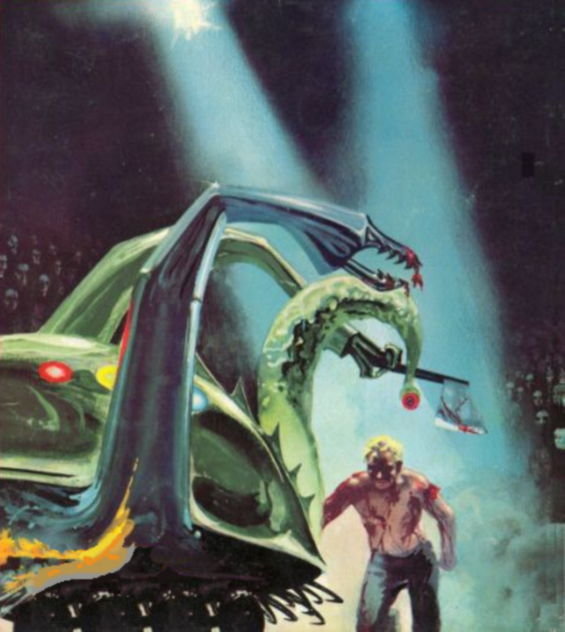
The Status Civilzation (Planet Of The Criminals) GERMAN INTERIOR
The Status Civilization (Planet Of The Criminals) GERMAN INTERIOR
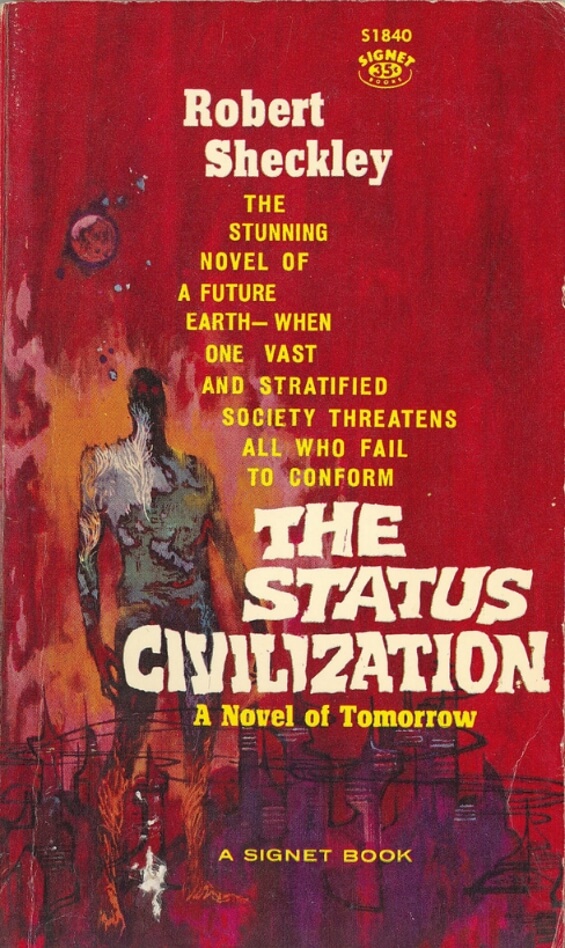
The Status Civilization by Robert Sheckley
Signet - The Status Civilization by Robert Sheckley

Posted by Jesse Willis