Review of The Invisible Man by H.G. Wells

SFFaudio Review

Science Fiction Audiobook - The Invisible Man by H.G. WellsThe Invisible Man
By H.G. Wells; Read by James Adams
5 CDs – Approx. 5.5 Hours [UNABRIDGED]
Publisher: Blackstone Audio
Published: 2009
ISBN: 9781433277528
Themes: / Science Fiction / Invisibility / Chemistry / Biology / Crime / 19th Century / Sussex / Morality / Personal Responsibility /

On a freezing February day, a stranger emerges from out of the gray to request a room at a local provincial inn. Who is this out-of-season traveler? More confounding is the thick mask of bandages obscuring his face. Why does he disguise himself in this manner and keep himself hidden away in his room? Aroused by trepidation and curiosity, the local villagers bring it upon themselves to find the answers. What they discover is a man trapped in a terror of his own creation, and a chilling reflection of the unsolvable mysteries of their own souls.

While nobody could really deny H.G. Wells was an amazing and talented Science Fiction author I think we can all agree that some of his fictions are superior to others. Among those that are not superior is The Invisible Man. This is not from any serious defect in the novel’s writing. Indeed, I cannot see anything that H.G. Wells has really done badly or that he could have done better. So, if it couldn’t have been done better then why isn’t it better? I think the problem stems from two interrelated factors: One is a serious technical gripe, something in the book and unavoidable, and the other being the smallness of that idea. Taken together they make it difficult to fully engage with. What holds back The Invisible Man from an utter perfection is at the weak premise at the very core of the novel, invisibility. Invisibility is both impossible and small. I’ve expanded on its impossibility in another essay. Its smallness is a problem I will tackle here.

Invisibility is a long standing meme in human culture: Plato describes invisibility in the legend of The Ring Of Gyges, Tolkien used a similarly endowed ring in The Lord Of The Rings, and even modern scientific versions of invisibility (the invisible-like camouflage in Predator) are still with us. The problem is invisibility isn’t a story, its barely a half of an idea in terms of ideas – its a place to take a story, but it isn’t a very fruitful one. I felt the same way when I read Richard Matheson’s The Incredible Shrinking Man |READ OUR REVIEW|READ OUR REVIEW|. I though: “A man shrinking, that’s new!” It was new and completely unfruitful. See the fallout from the idea of a man shirking inexorably towards nothingness is a feeling of emptiness. The man shrinks, the world gets bigger. A man shrinks, everyday objects become like mountains and house pets like dragons. Its interesting, to be sure, but it isn’t a story. Like invisibility, no amount of hand-waving can make the explanation scientifically plausible. Unlike, the The Incredible Shrinking Man however I can still recommend The Invisible Man – Wells is the master of Science Fiction. In The Invisible Man he takes a fatally flawed concept, invisibility, and writes the shit out of it. When Griffin, the scientist and anti-hero of the title goes about explaining his methodological reasoning in a Socratic dialogue, he is fully persuasive. Check this passage out:

“Phew!” said Kemp. “That’s odd! But still I don’t see quite … I can understand that thereby you could spoil a valuable stone, but personal invisibility is a far cry.”

“Precisely,” said Griffin. “But consider, visibility depends on the action of the visible bodies on light. Either a body absorbs light, or it reflects or refracts it, or does all these things. If it neither reflects nor refracts nor absorbs light, it cannot of itself be visible. You see an opaque red box, for instance, because the colour absorbs some of the light and reflects the rest, all the red part of the light, to you. If it did not absorb any particular part of the light, but reflected it all, then it would be a shining white box. Silver! A diamond box would neither absorb much of the light nor reflect much from the general surface, but just here and there where the surfaces were favourable the light would be reflected and refracted, so that you would get a brilliant appearance of flashing reflections and translucencies—a sort of skeleton of light. A glass box would not be so brilliant, not so clearly visible, as a diamond box, because there would be less refraction and reflection. See that? From certain points of view you would see quite clearly through it. Some kinds of glass would be more visible than others, a box of flint glass would be brighter than a box of ordinary window glass. A box of very thin common glass would be hard to see in a bad light, because it would absorb hardly any light and refract and reflect very little. And if you put a sheet of common white glass in water, still more if you put it in some denser liquid than water, it would vanish almost altogether, because light passing from water to glass is only slightly refracted or reflected or indeed affected in any way. It is almost as invisible as a jet of coal gas or hydrogen is in air. And for precisely the same reason!”

“Yes,” said Kemp, “that is pretty plain sailing.”

So, I’m of two minds on The Invisible Man. It derives its heart from a weak concept – and like the phlogiston theory of combustion it is discredited, and undeserving of serious consideration. Despite all this I still find myself willing to recommend you read the novella. The psychological rigor that Wells brings to the novel makes The Invisible Man quite possibly the first and last straight Science Fiction story worthy of our attentions.

Narrator James Adams is a capable reader, he reads the third person perspective text with what sounds like an authentic English accent. The clam-shell style case, for the library CD edition that I received, features a bit of fading text on the cover, a design inspired by the invisibility of the title. Unfortunately this makes the details hard to make out in anything other than a bright light environment. Blackstone Audio has four other formats available too: Cassette, MP3-CD, digital download (via Audible.com) and playaway (a kind of disposable MP3 player that can only play one book). Given the widespread availability of The Invisible Man by other audiobook publishers I’d like to have seen some value added materials, perhaps a specially commisioned introduction by Professor Eric Rabkin and or an afterward by Professor Michael D.C. Drout.

One thing I like about paperbooks that rarely (if ever) gets included in an audiobook is a map. Maps are fun and informative. One of the funnest paperback series ever was the old Dell Mapbacks. Here’s the Map from the back of Dell’s edition of The Invisible Man:

The Invisible Man by H.G. Wells - A Dell Book (MAPBACK)

Posted by Jesse Willis

The Guardian Books Podcast: Looking ahead in Science Fiction

SFFaudio Online Audio

The Guardian Books PodcastSays The Guardian…

“Science fiction is the marmite of literature – people tend to love it or hate it. Yet no one could deny that it has produced many of the great myths of our age, from Frankenstein’s monster to William Gibson’s cyber-reality.

SF blogger Damien Walter joins our panellists to discuss where it is now, and why we should all tune in to a genre that can be satirical, prophetic, political and plain good fun, often all at the same time. He also outlines some of the titles to look out for in 2010.

We also look at John Wyndham’s previously unpublished novel, Plan For Chaos, and interview China Miéville, rising star of the ‘new weird’.”

Sez Damien G. Walter:

“I have the pleasure of being a guest on this week’s Guardian Books Podcast. This was my second time on the show, but this time around the whole episode is dedicated to speculative fiction. Hurrah! We discuss the new John Wyndham novel (yes, you heard that right) and the reasons why there are so many sub-genres in SF. Michelle Pauli interviews China Mieville, and I give my SF picks for 2010.”

That old/new John Wyndham novel, Plan For Chaos, sounds very interesting, apparently its a kind of hybrid Science Fiction/Hard Boiled Crime novel. The rest of the podcast is also well worth listening to.

Have a listen |MP3|

Or get it via The Guardian’s podcast feed:

http://www.guardian.co.uk/books/series/books/podcast.xml

[via Clampants on HuffDuffer]

Posted by Jesse Willis

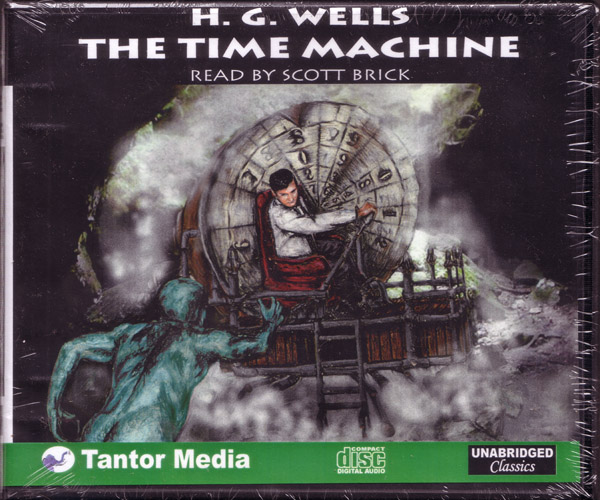
Recent Arrivals: The Time Machine by H.G. Wells

SFFaudio Recent Arrivals

Tantor MediaDid you read our post about how to get FREE SWAG from Tantor Media? If you did you know Tantor Media is actually delivering on its promise of a FREE AUDIOBOOK for feedback about their new website!

And now I’ve got the physical proof in hand!

After I checked out out their improved website I left some feedback (I actually suggested they start a podcast) and waited two weeks for my audiobook’s delivery. I picked it up at the PO Box yesterday. Two weeks isn’t too shabby for a delivery to Canada.

If you haven’t already go on over to Tantor Media, check out their new website, and get your own FREE audiobook by mail!

TANTOR MEDIA - The Time Machine by H.G. WellsThe Time Machine
By H.G. Wells; Read by Scott Brick
4 CDs – Approx. 3 Hours 58 Minutes [UNABRIDGED]
Publisher: Tantor Media
Published: 2002
ISBN: 1400100771

They’ve also got their February 2010 catalogue available in a downloadable |PDF|!

Posted by Jesse Willis

BBCR4 + RA.cc: Double Indemnity

Aural Noir: Online Audio

BBC Radio 4RadioArchives.ccFor me Double Indemnity is the best of Film Noir. It takes the filmic art form to the highest of the black and white heights. It faithfully captures James M. Cain’s novella like no other film has done with any novel.

When I read about this BBC radio dramatization of Double Indemnity I kept my expectations low – that probably helped me enjoy it all the more – but I can’t imagine any fan of either the novel or the film being disappointed by this rare gem. It is more than terrific! Theresa Russell as Phyllis Deitrichson is superior to Barbara Stanwyck‘s iconic role. Her performance has me wanting to watch Black Widow again.

James M. Cain's Double IndemnityDouble Indemnity
Based on the novella by James M. Cain;
Adapted by John Fletcher; Performed by a full cast
1 MP3 (via torrent) – 1 Hour 29 Minutes [RADIO DRAMA]
Broadcaster: BBC Radio 4 / Saturday Night Theatre
Broadcast: 1993

Cast:
Walter Huff …. Frederic Forrest
Lola …. Molly Ringwald
Phyllis …. Theresa Russell
Keyes …. John Wood
Nerdlinger …. Michael Drew
Norton …. John Goraczio
Jackson …. John Baddeley
Nettie …. Geraldine Fitzgerald
Zachetti …. Roger May

Original Music by Barrington Pheloung
Technical presentation by Graham Hoyland, Dave Parkinson, Andrew Lawrence, Fiona Baker, Christine Hall, Mark Decker
Directed at Christchurch Studios in Bristol by Andy Jordan

You can get Double Indemnity via TORRENT at RadioArchive.cc.

And speaking of FILM NOIR, has anybody got room for a hitchhiker? I’d really like to be in San Fransisco by tomorrow afternoon…

NOIR CITY 2010 - The 8th Annual San Fransisco Film Noir Festival

NOIR CITY from Film Noir Foundation on Vimeo.

Posted by Jesse Willis

Luke Burrage: Planetary Juggler

SFFaudio News

My friend Luke Burrage has a cool lifestyle. He travels all over the planet. He isn’t fabulously wealthy. He doesn’t fly from airport to airport on business. No, Luke is a professional entertainer, a world famous juggler. He made this video during his many cruise ship voyages in 2009.

If his name seems familiar to you its probably because you’ve been listening to either his Science Fiction Book Review Podcast or our own SFFaudio Podcast (where he’s been a guest a few times). To read the full story on this video go HERE.

Posted by Jesse Willis

Radio Drama Revival Celebrates 3 Years

SFFaudio News

Radio Drama Revival is celebrating three excellent years on the internet! Fred Greenhalgh looks back on that three years, in part by providing a list of five episodes to hear again:

1 – Dialogue with Martian Trombone (Episode 13) – What can I say? I’m a lover of jazz music and this absurd martian tale showcases the endless wit of Great Northern Audio Theater. Having David Ossman and Philip Proctor from the Firesign Theatre certainly doesn’t hurt, either.
2 – Buried in Falling Sand (Episode 16) – While Dreamseeed has not produced much else, this gem of a sci-fi bears deserves a listen.This inspired, eerie tale does what science-fiction does best: use a society not so unlike our own to tell us truths we’d rather not know. What WOULD happen if we had a drug that made us forget the work day?
3 – God of the Razor (Episode 94) – The Grist Mill has produced many fine tales, but God of the Razor may be the best.Moody, atmospheric, and unremittingly dark, Joe Lansdale’s God of the Razor tells of the dark that lurks in the basements of East Texas… and in the hearts of men.
4 – The Salmon of Blackpool (Episode 52, Episode 53, Episode 54, and Episode 55) – Okay, here’s a cheat, because it’s a series of four episodes, not just one, but it is worth it.Crazy Dog Audio Theatre’s “Salmon of Blackpool” is simply one of the most compelling produced and moving pieces of audio drama I’ve ever heard. The only thing I’ve listened to that deserves the name “audio cinema.” Give a listen and tell me you don’t agree.
5 – Hayward Sanitarium (Episode 126) – And let’s not miss this entry from the catalogue of audio suspense.While we only featured one episode of it, “Hayward” is a masterfully written and produced tale of the goings-on at one strange home for the mentally in coastal Maine. The precedent for shows like Wormwood and Shadow Falls, even if they don’t know it!
6 – Medusa on the Beach (Episode 138) – Okay, well this is #6, but I couldn’t help myself. I’m addicted to myth and Wireless Theatre Company’s “Medusa on the Beach” retells the myth of medusa beautifully. Cheeky, moving, and dark, I’m delighted from the first few minutes.

Congratulations to Radio Drama Revival from your friends at SFFaudio, and thanks for the great audio drama!

We were lucky to have Fred on one of our own podcasts – The SFFaudio Podcast #039.

Posted by Scott D. Danielson