LibriVox: Short Science Fiction Collection Vol. 007

SFFaudio Online Audio

Despite the title, this is the 8th Short Science Fiction Collection from LibriVox. The accounting is wonky because #007 was preceded by #008 by a month or so (#008 was completed first). New narrators in this volume include David N. Castle, Bryden Jones, Alex Clarke and Corey M. Snow. Some of these tales are rehashes of previously incarnated recordings, but with new narrators (its time to stop re-recording Kurt Vonnegut’s 2 B R 0 2 B Librivoxers). Still, most of the ten stories are new to audio. Of most significance to me personally is the release of Ralph William’s Cat and Mouse, as read by Betsie Bush. This is a story from our 3rd Annual SFFaudio Challenge! Betsie is the first to complete an audiobook from the 3rd Challenge (she took just 3 weeks to file her claim and finish) and will soon be enjoying her pick from among the prizes. Thanks Betsie! Thanks Librivoxers!

LibriVox Short Science Fiction Stories Collection #007Short Science Fiction Collection Vol. 007
By various; Read by various
10 Zipped MP3 Files or Podcast – Approx. 4 Hours 5 Minutes [UNABRIDGED]
Publisher: LibriVox.org
Published: December 05, 2008
Science fiction (abbreviated SF or sci-fi with varying punctuation and case) is a broad genre of fiction that often involves sociological and technical speculations based on current or future science and technology. This is a reader-selected collection of short stories that entered the US public domain when their copyright was not renewed.

Stories included:

LibriVox - 2BR02B by Kurt Vonnegut Jr. 2 B R 0 2 B
By Kurt Vonnegut; Read by Alex Clarke
1 |MP3| – Approx. 18 Minutes [UNABRIDGED]
Previous FREE MP3 versions of this story are HERE, HERE, and HERE.

… After A Few Words …
By Randall Garrett; Read by Corey M. Snow
1 |MP3| – Approx. 18 Minutes [UNABRIDGED]
A previously recorded version exists HERE. Described as “a 1960’s virtual reality” by Brian Edwards on the LibriVox Forums.

The Beast of Space
By F.E. Hardart; Read by Bryden Jones
1 |MP3| – Approx. 30 Minutes [UNABRIDGED]
First published in the July 1941 issue of Comet magazine. A tale of the prospectors of the starways.

The Bell Tone
By Edmund H. Leftwich; Read by Alex Clarke
1 |MP3| – Approx. 12 Minutes [UNABRIDGED]
First published in the July 1941 issue of Comet magazine. It is no use. It’s too late. The earth—I must dig—alone.
*This story has been recorded by Miette for her podcast too |MP3|!

LibriVox Science Fiction Audiobook - Cat And Mouse by Ralph WilliamsCat And Mouse
By Ralph Williams; Read by Betsie Bush
1 |MP3| – Approx. 1 Hour 3 Minutes [UNABRIDGED]
Publisher: LibriVox.org
Published: December 5th 2008
This was the cover story for the Astounding Science Fiction issue for June 1959. Set in Alaska, and being a most unusual Science Fiction story – it’s about hunting!

Cry From A Far Planet
By Tom Godwin; Read by Bryden Jones
1 |MP3| – Approx. 35 Minutes [UNABRIDGED]
First appeared in the September 1958 issue of Amazing Science Fiction Stories. The problem of separating the friends from the enemies was a major one in the conquest of space as many a dead spacer could have testified. A tough job when you could see an alien and judge appearances; far tougher when they were only whispers on the wind.

Droozle
By Frank Banta; Read by Mooseboy Alfonzo
1 |MP3| – Approx. 17 Minutes [UNABRIDGED]
Taken from the pages of Galaxy magazine’s December 1962 issue. Droozle was probably the greatest writer in the world—any world!
LibriVox short story - An Incident On Route 12 by James H. SchmitzAn Incident on Route 12
By James H. Schmitz; Read by James Christopher
1 |MP3| – Approx. 10 Minutes [UNABRIDGED]
Publisher: LibriVox.org
Published: December 5th 2008
Previous iterations are found HERE and HERE.


The Man Who Hated Mars
By Randall Garrett; Read by David N. Castle
1 |MP3| – Approx 32 Minutes [UNABRIDGED]
First published in the September 1956 issue of Amazing Stories. To escape from Mars, all Clayton had to do was the impossible. Break out of a crack-proof exile camp—get onto a ship that couldn’t be boarded—smash through an impenetrable wall of steel. Perhaps he could do all these things, but he discovered that Mars did evil things to men; that he wasn’t even Clayton any more.

The Mightiest Man
By Patrick Fahy; Read by David N. Castle
1 |MP3| – Approx. 11 Minutes [UNABRIDGED]
From the pages of Worlds of If magazine (November 1961). “He had betrayed mankind, but he was not afraid of the consequences—ever!”

Podcast feed:

http://librivox.org/bookfeeds/short-science-fiction-collection-vol-007.xml

Posted by Jesse Willis

Review of Simon Bloom, the Gravity Keeper by Michael Reisman

SFFaudio Review

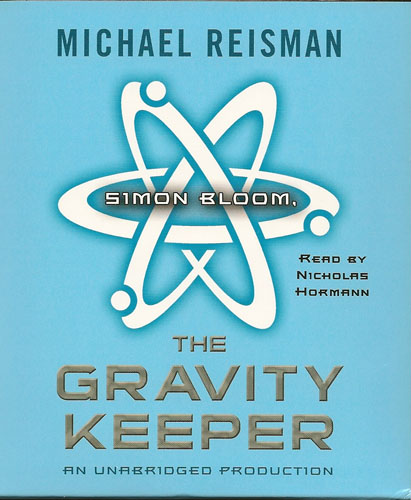
Fantasy Audiobook - Simon Bloom, the Gravity Keeper by Michael ReismanSimon Bloom, the Gravity Keeper
By Michael Reisman; Read by Nicholas Hormann
6 CDs – 7 hours, 22 minutes – [UNABRIDGED]
Publisher: Listening Library
Published: 2008
ISBN: 9780739363539
Themes: / Science Fiction / YA / Physics / School /

Ordinary sixth-grader Simon Bloom has just made the biggest discovery since gravity–and it literally fell into his lap.

This is just an ordinary universe with one little twist. There is something called the Council of Knowledge that controls everything in the universe — how it runs, events that happen, and things like this. One part of this group is the Council of Sciences, and part of that is the Order of Physics. A man named Ralphagon Wintrofly (or Ralph Winters, as other people call him) is the keeper of this group and very special book called the Teachers Edition of Physics. The group meets every week in a forest near Simon Bloom’s hometown, but this forest is hidden from people who aren’t in the Council of Knowledge.

Simon Bloom was never special in any way, just an ordinary kid at school who had average grades and no friends. He spent his time daydreaming, and hoping that something would happen to his life. He got his wish. He met another sixth-grader at his school (Owen) and they find themselves in a patch of woods on the way home from school one day. Simon accidentally calls the Teachers Edition of Physics to him, and now it calls him “Keeper”.

The book contains formulas for controlling the field of physics. Certain people want this book and it isn’t safe for long. Simon has to face the horrific Seerbetta who has formulas of her own. Simon and his friends must find a way to defeat her and figure out what the Teachers Edition of Physics is for.

Nicholas Hormann is the narrator of this story. He has a great talent for creating voices. The characters voices that he provided this story put an emphasis on their specific character. The females in this story sound a bit more male than female but it did not make it so I couldn’t understand who the character was.

I recommend this book to kids 11+. This is a great book to listen to for its mild intensity and its surprising scenes. I was surprised at what happened next and was always ready for more.

Posted by DanielsonKid, Age 14

FREE LISTENS Review: Anthem by Ayn Rand

SFFaudio Review

Free Listens BlogAnthem
By Ayn Rand
Source: Thought Audio
Length: 2 hr, 12 min
Reader: Michael Scott

The book:Set in the future following a catastrophic war, the society portrayed in Anthem is collectivism taken to the extreme. Individuality has been nearly wiped out. The first person singular is outlawed and forgotten, replacing “I” with “we”. People do not not have names, but designations containing a societal quality combined with a number. Equality 7-2521 is a man who feels the pull of individualism and is punished for it. When in the course of his duties, he discovers an old tunnel from before the wars, he gains a chance to break free.

Rand’s portray of this society has much in common with works produced during the rise of communism, such as George Orwell’s Nineteen Eighty-Four and Aldus Huxley’s Brave New World. Unlike these other examples of the sub-genre, I found Rand’s dystopia lacking in realism and therefore less compelling. Anthem‘s society is a city all on its own without any sense of a larger world other than an ill-defined wilderness. Surely other pockets of humanity would have survived even the most horrific war and become a rival society to out-compete the anti-technology society portrayed here.

The other main problem that I have with the book is that the danger it forecasts in collectivism is no longer the pressing spectre it was to Rand, who had lived in Stalinist Russia. In the present, we are more in danger of the opposite, a world of complete individuals with no sense of brotherhood or the collective good. Just as science in Anthem is impossible because no one can become any greater than others, science in a world where every technique or discovery is patented and jealously guarded is equally impossible. Likewise art is equally difficult when the artist or writer is not allowed to be different as when anything mildly derivative runs the danger of a copyright lawsuit. For this reason, I see Anthem not as a story for our time, but as a historical document of the fear that collective society once held.

Rating: 7/10

The Reader: Scott has a deep, announcer-sounding voice that is very pleasant for listening. This stentorian voice, however, is one of the drawbacks as well. Scott speaks with such confidence and power that it is sometimes discordant with the position of the protagonist, who has been trained to see himself as just like everyone else. The steady patterns of his cadence and the radio-quality voice are great assets to make the words very understandable, so only true purists need worry about the incongruity of the voice. Some edits are audible through digital artifacts, but otherwise the audio is professionally produced with very little background noise.

Note: Thought Audio’s books have sometimes been free and other times behind a pay wall. If you would like this book, but find you cannot download it, try the always-free LibriVox version.

Posted by Seth

The SFFaudio Podcast #015

Podcast

The SFFaudio PodcastThe SFFaudio Podcast #015 – On today’s podcast we take you on a merry chase ending with… “governments can do things right.”

Talked about on today’s show:
SFFvideo.com!, The January Dancer, Michael Flynn, Blackstone Audio, Eifelheim, big dumb object (also a website), Earthfall, Orson Scott Card and his interview, the Homecoming Series, the book of Mormon, The Book Of Lies, Brad Meltzer, Ender In Exile, Tor.com podcast, in what order should you read a sprawlling series? answer = publication order, First Meetings, Orson Scott Card’s InterGalactic Medicine Show, Scott’s story Adrift and my reviewlette of it, MrAudiobook.com/ReQuest Audiobooks, Eye For Eye, Run For The Stars, Harlan Ellison, Tony Smith’s StarShipSofa podcast (roundtable discussion #6), Anathem, Neal Stephenson, Snow Crash, The Diamond Age, Quicksilver, William Dufris, Red Mars, Kim Stanley Robinson, Richard Ferrone, Blue Mars, Green Mars, Cryptonomicon a 1000-page novel, Scott Brick, A History Of English In 28 Minutes, The Hour Of The Dragon podcast, Robert E. Howard, Conan, Already Dead, Charlie Huston, Elantris, Recorded Books’s Sci-Fi Audio imprint, Audible’s RSS feeds, Love In The Time Of Fridges, Tim Scott, Forty Signs Of Rain, The Coming, Joe Haldeman, Elizabeth Bear, Moth Storm: The Horror From Beyond, Philip Reeve, DRM isn’t inherently evil, my solution to the problem = government (libraries), the future of digital distribution, video game models: Battlefield Heroes, Battlefield 2, Sudden Attack, Steam, what if Audible.com went out of business tomorrow?, Starship: Mercenary, Mike Resnick, iTunes, digital estates, abandonware, Steve Feldberg (director of content at Audible.com sez: Mike Resnick’s Starship book 4 is coming to Audible in mid-December! Huzzah!

Posted by Jesse Willis

Review of The Little Book by Selden Edwards

SFFaudio Review

The Little Book by Selden EdwardsThe Little Book
By Selden Edwards; Read by Jeff Woodman
13 CDs – 15 Hours – [UNABRIDGED]
Publisher: Penguin Audio
Published: Aug 2008
ISBN: 9780143143512
Themes: / Fantasy / Time Travel / Vienna / 19th Century / Philosophy /

The Little Book is the extraordinary tale of Wheeler Burden, California-exiled heir of the famous Boston banking Burdens, philosopher, student of history, legend’s son, rock idol, writer, lover of women, recluse, half-Jew, and Harvard baseball hero. In 1988 he is forty-seven, living in San Francisco. Suddenly he is—still his modern self—wandering in a city and time he knows mysteriously well: fin de siècle Vienna. It is 1897, precisely ninety-one years before his last memory and a half-century before his birth.

The genre aspects of this novel are not, well, novel. At least to the genre-savvy. Like Mark Twain’s Connecticut Yankee in King Arthur’s Court, the method of time travel is irrelevant. What’s important and interesting is the interaction of Selden Edwards’s fictional characters with their forebears and with historical characters, most notably Sigmund Freud and Mark Twain.

Wheeler Burden has lengthy discussions with Freud, seeming to shape in some way the later ideas that Freud published. He also spends a great deal of time with his own father, who was also in the past for an unknown reason. Since Wheeler’s father had died during World War II, this was an opportunity to get to know each other. Add a very beautiful grandmother, and one can almost hear Freud furiously scribbling notes in the background.

Jeff Woodman is a terrific narrator. He performs accents in a completely believable (and completely understandable) manner. Also notable is his performance of female characters, which is subtle and effective. I’m looking forward to hearing more of his audiobooks.

Posted by Scott D. Danielson