Review of Blake’s 7: The Early Years: Zen: Escape Velocity

SFFaudio Review

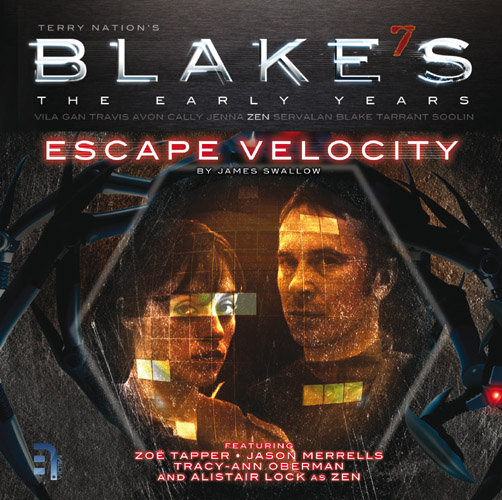
B7 PRODUCTIONS - Blake's 7: The Early Years: Zen: Escape VelocitySFFaudio EssentialBlake’s 7: The Early Years: Zen: Escape Velocity (Volume 2.1)
By James Swallow; Directed by Andrew Mark Sewell; Performed by a full cast
1 CD – Approx. 1 Hour [AUDIO DRAMA]
Publisher: B7 Productions
Published: April 26, 2010
ISBN: 978190657709
Themes: / Science Fiction / Artificial Intelligence / Cloning / War / Aliens /

Based on Terry Nation’s seminal 70s science fiction TV series, The Early Years is a prequel series of audio stories that explores the origins of key Blake’s 7 characters prior to them meeting rebel leader Roj Blake. This latest entry to the ever-expanding series takes a new twist, concentrating on a character that doesn’t breathe or have any parents, the synthetic intelligence known only as Zen. When Roj Blake first stepped on board the mysterious, derelict alien spaceship Liberator, his every movement was monitored by the ship’s controlling intelligence, Zen Luckily, Blake and his rebel crew managed to gain the ‘confidence’ of this creation from an alien world and so he was able to use the Liberator in their quest for justice against the Federation. But the origins of Zen have remained a mystery, until now. What terrible catastrophe left the Liberator drifting and shattered? What drove the ship’s intelligence to murder its original crew? What dark secrets lie at the heart of this alien machine? And are Blake and his crew really safe on board the Liberator?

Often, you’ll want to know somebody’s back-story, and then later, when you actually get it – in a prequel story – you’ll find that it is far, far, far less interesting than whatever was going on in your imagination. For me, the years between 1980 and 1999 were ones filled with near-reverence for a fascinating character, the ultimate baddie: Darth Vader. But no amount of apologetics can possibly remove the sickly saccharine story of a nine-year-old Darth Vader filled with “a high concentration” of midichlorians. Yuck. And yet “prequel” is not always a dirty word. I don’t feel that way about The Young Indiana Jones Chronicles, and likewise the Blake’s 7 prequel stories (1.1 |READ OUR REVIEW|, v.1.2 & 1.3 |READ OUR REVIEW|, 1.4 |READ OUR REVIEW|). By far the most mysterious character in the original TV series was Zen, the artificial intelligence. Zen was pretty closed-circuit about its past, not revealing much over the two years it appeared in the series (1978 – 1980). In life Zen “projected a dour, non-committal personality” and would “reply to certain questions with the phrase ‘That information is not available.'” This left left open the possibility that Zen was hiding secrets or “secretly executing its own agenda.” In this magnificent audio drama we are given a genuinely interesting explanation as to why Zen was so very melancholic, why the ship was found crew-less, seemingly abandoned and drifting near Cygnus Alpha.

Zen: Escape Velocity clearly reveals the frightening truth about all of Zen’s character quirks and its cryptic answers from the TV series. But it also shows more. Back in 2008 I reviewed the Blake’s 7 – Audio Adventures boxed set |READ OUR REVIEW| – the first three episodes of the new B7 audio drama series. One detail found within that review was that Zen was, unlike the original series, suicidal at the time of its discovery. Listening to Zen: Escape Velocity you will discovery exactly why that was so.

Six actors, Zoë Tapper, Jason Merrells, Tracy-Ann Oberman, Alastair Lock, Sam Woodward and Pamela Banks play different members of the original crew of the Liberator (back when it was still called “Deep Space Vehicle 2” and when Zen was called “SHIP-MIND”). The story, told by a careful cross-cutting backwards and forwards in time, shows the original crew welcoming their new PILOT, Zoë Tapper, aboard DSV2. Strangely, she is having memory problems and needs shepherding by the ship’s doctor. As the crew takes its positions and readies themselves for battle, we learn about their fascinating society. This is wonderful social Science Fiction like nothing exactly I’ve read or seen or heard before!

Zen (SHIP-MIND) only used the first-person, singular personal pronoun (“I”) once on the television series – it is used multiple times in this production. Zoë Tapper (who appeared in another Terry Nation re-imagined series) and Jason Merrells (playing the doctor), are the central sympathetic heroes of Zen: Escape Velocity. Alastair Lock, who also acts as a post-producer, musician and sound effects man for the CD, portrays SHIP-MIND (Zen). Sounds are rich, deep and best experienced in a quiet room. The stereo effect and a good set-of headphones,as I used, will bring an immense visual experience that belies the fifty-six minute running time. A five minute “Bonus Music Track” (original to this episode) rounds out the disc.

Posted by Jesse Willis

A Princess Of Mars by Edgar Rice Burroughs COMPLETE, UNABRIDGED and FREE – Read by a professional actor!

SFFaudio Online Audio

SFFaudio Podcast #137, out today, it is a discussion of A Princess Of Mars. If you’d like to prepare, we’ve got the perfect audiobook version for you to check out. It’s narrated David Stifel, of Marsbooks.libsyn.com. David is actually reading all of the public domain Barsoom books, under the collected title of “The Fantastic Worlds of Edgar Rice Burroughs“, and in the process he’s become something of a Burroughs expert. I think you’ll be mightily impressed by the first audiobook because we sure were!

A Princess Of Mars by Edgar Rice BurroughsA Princess Of Mars
By Edgar Rice Burroughs; Read by David Stifel
16 Podcast Episodes – Approx. 8 Hours 38 Minutes [UNABRIDGED]
Podcaster: Marsbooks.libsyn.com
Podcast: May 2011 – July 2011
John Carter, a veteran American Civil War, goes to Arizona at the war’s end. But when he runs afoul of the Apaches he attempts to evade their pursuit by hiding in a strange cave. The cave has strange properties though as Carter finds himself mysteriously transported to Mars! There, Carter discovers that he possess incredible strength, which he uses to escape imprisonment from a fierce tribe of Green Martians. The aliens soon capture the beautiful Dejah Thoris, Princess of Helium and Carter’s mission becomes clear. He’ll need to free himself, his newly found love and save the entire planet from a coming doom.

Episode 01 |MP3| Episode 02 |MP3| Episode 03 |MP3| Episode 04 |MP3|
Episode 05 |MP3| Episode 06 |MP3| Episode 07 |MP3| Episode 08 |MP3|
Episode 09 |MP3| Episode 10 |MP3| Episode 11 |MP3| Episode 12 |MP3|
Episode 13 |MP3| Episode 14 |MP3| Episode 15 |MP3| Episode 16 |MP3|

Podcast feed: http://www.marsbooks.libsyn.com/rss

Posted by Jesse Willis

Writing Class by Robert Sheckley

SFFaudio Online Audio

In a provocative move (for a novice) one of Robert Sheckley’s earliest stories, Writing Class, is 1,000 word wonder about the proper construction of stories. This story came at the beginning of a career that would later produce 250 short stories. It took more than fifty years for it to get reprinted.

The audiobook for it was narrated by our friend William Coon for SFFaudio Challenge #6. Thanks Bill!

Eloquent VoiceWriting Class
By Robert Sheckley; Read by William Coon
1 |MP3| – Approx. 7 Minutes [UNABRIDGED]
Provider: Eloquent Voice
Recorded: November 13, 2011
Etext: |RTF|
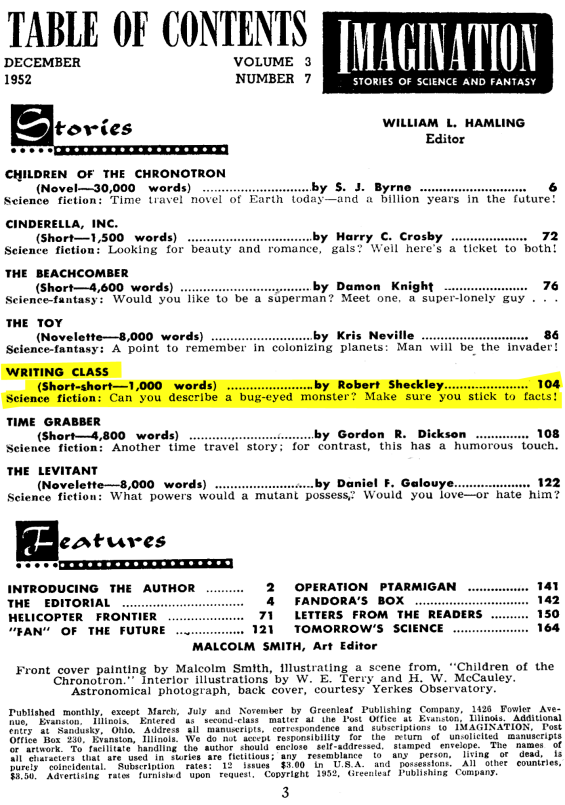
“Never use cliches in describing alien life-forms,” Professor Carner admonished his class. But Eddie persisted—with good reason! First published in Imagination, December 1952.

And here’s the |PDF|!

Imagination December 1952 - Table Of Contents - includes Writing Class by Robert Sheckley

Posted by Jesse Willis

Review of Out of the Dark by David Weber

SFFaudio Review

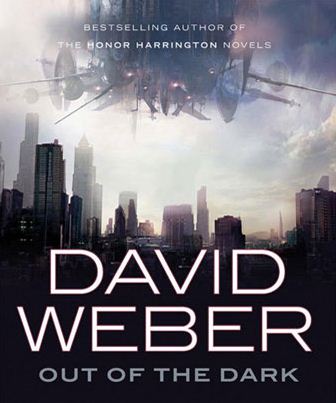
Science fiction audiobook - Out of the Dark by David WeberOut of the Dark
By David Weber; Read by Charles Keating
17 hours – [UNABRIDGED]
Publisher: Macmillan Audio
Published: 2011
Themes: / Science Fiction / Military / Aliens / Alien invasion / Historical /

No one would have believed in the early years of the 15th Century that human affairs were being watched from the orbiting ships of the Galactic Hegemony’s Survey Force. No-one could have dreamed that we were being scrutinised as the French and English forces advanced towards each other across the field of Agincourt. Few men even considered the possibility of life more vegetarian than ours and yet, from their survey ships, minds immeasurably more craven than ours, regarded this Earth with horrified revulsion. And slowly and surely, they drew their plans against us.

David Weber attempts to take the traditional alien invasion and add an unusual twist. The twist, unfortunately, isn’t brought to fruition until very nearly the end of the book, where it clangs into place more like a late addition, a Deus Ex Machina.

Out of the Dark starts as a typical alien invasion: ships arrive in-system, observe us for a while to find where the big cities and military bases are, then strike them from orbit. Wipeout the majority of the population and then attempt to sweep in to rule over the cowering survivors. Shock and Awe. Unsurprisingly the aliens discover how tenacious we humans are. They struggle to comprehend why we are unhappy about having half the population of Earth wiped out in an afternoon. Is there something wrong with us? Are we not civilised?

In the Galactic Hegemony vegetarianism is the norm for intelligent star-faring races. Omnivores and carnivores being too aggressive to develop the required technological base required to reach the stars without wiping themselves out. There is one exception to this rule, the Shongairi, and they make the other races in the Hegemony nervous just by existing. So, in an attempt to weaken the Shongairi, the Hegemony grant them the right to colonise three other worlds, including one discovered some 500 years before. A world that also has the pacifistic Hegemony worried.

According to the Colonisation rules of the Hegemony, any race that has not advanced enough technologically are fair game to be colonised. Naturally their assumption is that Earth, being populated by a crazy race that commits such bloodthirsty battles as that observed at Agincourt five centuries earlier, will still be very low on their technology scale. The Shongairi are then somewhat surprised to find that we have developed so far as we have, indeed possessing some technologies that rival their own. We may still be trapped upon our home planet, but we have advanced computer technology and encryption techniques that make them think we should really be classed at a level where we would be granted a protected status. Considering the expense of the time and resources involved in the launch this offensive, the Shongairi Commander decides to sweep that data under the carpet and hope that no-one notices. Bombing us back to the stone-age to hide the evidence if necessary. And thus the invasion goes ahead and half the world’s population is lost to a kinetic bombardment.

The novel follows several characters, although most are expended showing how effective our weaponry is against an alien ground force that expected to face nothing more advanced than a bow and arrow. They are expended in that they demonstrate, repeatedly, that the Shongairi react with overwhelming orbital strikes. This pattern repeats several times through out the book and does become a little tedious.

The Shongairi alien nature is basically that of a predatory pack animal, almost canine in nature. Their philosophy is that when faced with an overwhelming opponent you surrender. That humans refuse to acknowledge the Shongairi’s superiority confuses them. This mentality reminded me a lot of the elephant-like aliens from Larry Niven and Jerry Pournelle’s Footfall from the ’80’s.

The characters include Master Sergeant Stephen Buchevsky who finds himself a passenger on a military cargo plane flying over Eastern Europe when the aliens strike and his plane is force to make a crash landing. With only a handfull of other US personnel from the plane he begins gathering locals around him as he becomes their protector. He joins up with a local group who’s charismatic leader seems to be too friendly, helpful and successful at defending against the Shongairi. Buchevsky is a gee-shucks hero doing the best he can.

One of the other main characters is Dave Dvorak. Or, as I think of him, Dave “Mary Sue” Dvorak. Dvorak is one of the most prepared people to hide out in the Carolina hills, in what reads like a palatial cabin with his family and friends. Although he actually does very little plot-wise he becomes a middle-man for lots of other survivors in the area and through these contacts we hear about much of what is happening in the world. When we aren’t watching sacrificial attacks against Shongairi troops. We do get to hear in excruciating detail how, over the previous few years, he and his brother-in-law converted a family cabin in the woods into a home away from home, complete with redundant power generators, hidden food and weapon caches and a huge underground fresh water tank.

We are also shown the invasion from the alien’s perspective. Much of their emotions are expressed in the positioning and twitching of their ears, reinforcing the K-9 impression that their omnivore and pack nature suggests. There is almost no physical description of them, that I remember, beyond this.

The cover blurb talks of the survivors receiving help from an “old enemy”. I’m not going to spoil this aspect of the book, although I guessed it just from reading the blurb and was actually looking forward to it. Other readers have claimed to have been blind-sided by it. I can see why, but only if they simply hadn’t read the book cover. It is not a genre I’m aware Weber has written in before. I was disappointed with the execution of this aspect. The surprise element doesn’t feel integrated into the book as a whole. It really felt like the story had originally been written without it, then realising that he had dug a hole too deep for humanity to get out of, he had to go back and add this in to tip the scales in our favour. The conclusion wraps up very quickly; like a TV series been told they are being cancelled and only have two episodes to wrap everything up. Or he got bored with the story and wanted to finish it and move on to something else.

And yet, this is not the worst aspect of this book for me. I have also been listening to Weber’s Safehold series, but have abandoned it after the third book, in large part due to this flaw. Weber has started writing massive monologues for many of his characters that run on for tens of minutes at a time. They are both internal and external discourses where the characters go into minute detail about what has already happened, their current position, beliefs, expectations and plans. Two or three times per book I could swallow, but this feels like it is becoming Weber’s go-to method of filling out a scene. They feel completely unnatural, especially when it is one character talking at another. In some situations this would be okay, a specific character who was prone to this sort of thing, or that the situation called for the character to speak for such an extended time, without any apparent aide-memoire or time to prepare. Even if it helped to move the plot on quickly, I might be tempted to forgive it, but it seldom does. It is often a repeat of information we already know, explained from the current character’s slightly different perspective. Yet not actually adding anything to the story other than word count. Unfortunately any interruption to my listen during one of these monologues meant that when I returned I had no little or no idea who was talking. I could eventually infer who was talking, after a few minutes, based on the geography and names of characters they mentioned, but seldom from how the character spoke. Neither the writing nor unfortunately the narration had enough colour when it came to most of the character voices.

The narrator, Charles Keating, does well with most of the book, especially the alien lisping Shongairi. Unfortunately he too struggles to bring life into Weber’s indigestible, interminable speeches.

This had the potential to be an interesting hybrid of genres, but really feels like something bolted on at the end. Weber’s editor needs to get tough with him and curtail those endless monologues.

Posted by Paul [W] Campbell

The SFFaudio Podcast #129 – READALONG: The Mote In God’s Eye by Larry Niven and Jerry Pournelle

Podcast

The SFFaudio PodcastThe SFFaudio Podcast #129 – Jesse, Tamahome, Julie and Jenny discuss the Audible Frontiers audiobook of The Mote In God’s Eye by Larry Niven and Jerry Pournelle.

Talked about on today’s show:
Aliens, first contact, alien aliens, Theodore Sturgeon, Microcosmic God by Theodore Sturgeon, evil genius inventor, a society in a bottle, how do we figure out which information is true, L.J. Ganser, “Fyunch(click)”, space empire, the Horse-Head Nebula, the depth of the alien alienness, who has free will in The Mote In God’s Eye?, “there was little of free will in an engineer”, “humans have free will – we know that”, Ron Paul has gone Crazy Eddie, Outies, The Gripping Hand, Renner is an independent minded contrarian, the CoDominium Series, “an American eagle holding the hammer and sickle”, MacArthur and Lenin, brownies, espionage, Sally never questioned her Fyunch(click), the characters are peripheral to the novel’s power, Niven and Pournelle arguing with each other, perfunctory romance, The Sandkings by George R.R. Martin, Treehouse of Horror VII, god games, Populous, Sid Meier’s Civilization, Master Of Orion, Science Fiction is not really about the future it’s about the present (except for Niven/Pournelle books), Protector by Larry Niven (in which humans are infantilized aliens), “only bad girls take birth control”, Footfall by Larry Niven and Jerry Pournelle, The Mote In God’s Eye is a yellow peril story!, Philip K. Dick’s The Man In The High Castle, gunboat diplomacy, “China has fake Apple stores”, the exotic East, “I asked myself … would that be so bad?”, “they’re not evil, they’re just our enemies”, Declare by Tim Powers, Soviet goals, “every place should be communist”, Russia vs. The USA, an unsustainable quarantine, this book is really about “the pill”, overpopulation, Malthus, Moties are people too (at least most of them are), a non-ideological clash of species, what “sentient” means, Eric S. Rabkin, do they have souls?, is it “scientifically proven” that an untrained kitten can never hunt?, “I don’t eat monkeys”, “nuclear war is the continuation of evolution by other means”, the long pig, is there an unused Chekov’s Gun in this book?, ozone smells good, imitations and perma-smiles, anti-yellow peril blinders, John W. Campbell, “give me an alien that thinks as well as a man but not like a man”, “if only the humans wee more human.”

Posted by Jesse Willis

LibriVox: The Big Time by Fritz Leiber

SFFaudio Online Audio

Narrator Karen Savage has finished her SFFaudio Challenge #5 audiobook, calling The Big Time, by Fritz Leiber, “A classic locked room mystery, in a not-so-classic setting.” And she’s right about that, this is an SF/Mystery classic.

Fritz Leiber says, in his 1982 introduction to The Big Time, that the novella was written over the course of exactly 100 days in 1956 and 1957.

For more on the plot |READ OUR REVIEW| of the Audible Frontiers edition. Savage has a great voice, this is an amazingly clear recording, and she affects a very serviceable set of intonations and accents for the half dozen or so characters with speaking parts in this excellent reading. My only complaint, as with the Audible edition, Savage does not use the tune of Lili Marlene for the reading of the lyrics at the end of chapter 3. Oh well.

LibriVoxThe Big Time
By Fritz Leiber; Read by Karen Savage
16 Zipped MP3 Files or Podcast – Approx. 3 Hours 44 Minutes [UNABRIDGED]
Publisher: LibriVox.org
Published: September 16, 2011
|ETEXT|
You can’t know there’s a war on—for the Snakes coil and Spiders weave to keep you from knowing it’s being fought over your live and dead body! First published in Galaxy Science Fiction’s March and April 1958 issues.

Podcast feed: http://librivox.org/rss/5355

iTunes 1-Click |SUBSCRIBE|

Here’s Ed Emshwiller’s cover for the Ace Double (D-491) edition of The Big Time:

Ace Double D-491 - The Big Time by Fritz Leiber - cover by Ed Emshwiller

Here are the stunning Virgil Finlay illustrations from the original Galaxy publications:

The Big Time by Fritz Leiber - Illustrated by Virgil Finlay

The Big Time by Fritz Leiber - Illustrated by Virgil Finlay

The Big Time by Fritz Leiber - Illustrated by Virgil Finlay

The Big Time by Fritz Leiber - Illustrated by Virgil Finlay

The Big Time by Fritz Leiber - Illustrated by Virgil Finlay

The Big Time by Fritz Leiber - Illustrated by Virgil Finlay

[Thanks also to AnnSterling]

Posted by Jesse Willis