
Review of The Three Stigmata Of Palmer Eldritch by Philip K. Dick

SFFaudio Review

The Three Stigmata of Palmer Eldritch by Philip K. DickThe Three Stigmata of Palmer Eldritch
By Philip K. Dick; Read by Tom Weiner
6 CDs – 6.8 Hours [UNABRIDGED]
Publisher: Blackstone Audio
Published: 2008
ISBN: 9781433248221
Themes: / Science Fiction / Religion / Drugs / Mars / Aliens /

Not too long from now, when exiles from a blistering Earth huddle miserably in Martian colonies, the only things that make life bearable are the drugs. Can-D “translates” those who take it into the bodies of Barbie-like dolls. Now there’s competition: a substance called Chew-Z, marketed under the slogan “God promises eternal life. We can deliver it.” The question is: What kind of eternity? And who—or what—is the deliverer?

Reading Philip K. Dick is the literary equivalent of taking deliriants in church. Dick’s world is fully realized, his characters being windows into Dick’s own sympathies, his own passions. Dick seems to have observed the writing advice that goes: “Write what you know.” What Dick knows about is drugs, suburban druggie life, revealed religion, the conflict between an individual and the group, between women and men. If you look at the basic plot The Three Stigmata Of Palmer Eldritch scans as most similar to Alfred Bester’s The Demolished Man, in that a corporate war between the solar system’s two biggest multi-planetaries drives the action. But it doesn’t feel that way, it feels like a scaled-up version of Dick’s short story Wargame. Sure, the novel is supposed to be about life on Mars and big corporate business, but Dick’s Mars is mostly confined to a few intemperate draftees who couldn’t fake their way out of the draft. Upset with their new colonial life they spend all their time playing with Barbie style playhouses and taking mind altering drugs. I can almost picture Dick sitting in his living room watching his young daughters playing with their Barbie dolls. They sit on the floor, coveting their Barbie corvettes, their Barbie clothes and decorating their Barbie dream houses while Dick, sitting in an armchair above, looks down compassionately and philosophicaly as he reaches for the typewriter. Strangely, the novel also feels extremely prescient. At multiple times throughout I paused and thought about the PC game called The Sims – a game where your avatar must eat, sleep, and furnish her virtual home with virtual goods as you plan her idealized life. We seem to have gotten what Dick was driving at. For what is World Of Warcraft if not a Dickian reality minus the drugs? William Gibson would describe it as “a consensual hallucination” – Dick called it The Three Stigmata Of Palmer Eldritch.

Originally published in 1965, this is the first commercial audiobook release of The Three Stigmata Of Palmer Eldritch. Narrator Tom Weiner seems to be Blackstone Audio’s go-to guy when it comes to narrating the heavy hitters of Science Fiction. This is a good thing as Weiner brings a vast gravitas to his reading. Fans of George Guidall’s narrations will find Weiner similarly impactful. The cover art for The Three Stigmata Of Palmer Eldritch is all original for this production. This is more and more the case at Blackstone, which makes me happy, for I am covetous.

Posted by Jesse Willis

LibriVox: Triplanetary by E.E. “Doc” Smith

SFFaudio Online Audio

LibriVoxThanks go to LibriVox for Triplanetary. This is the first book length public domain audiobook by E.E. “Doc” Smith. Here’s the editorial from the first issue of its serialization in Amazing Stories:

“We are sure that our readers will be highly pleased to have us give the first installment of a story [Triplanetary] by Dr. Smith. It will continue for several numbers and is a worthy follower of the ‘Skylark’ stories which were so much appreciated by our readers. We think that they will find this story superior to the earlier ones. Dr. Smith certainly has the narrative power, and that, joined with his scientific position, makes him an ideal author for our columns.”

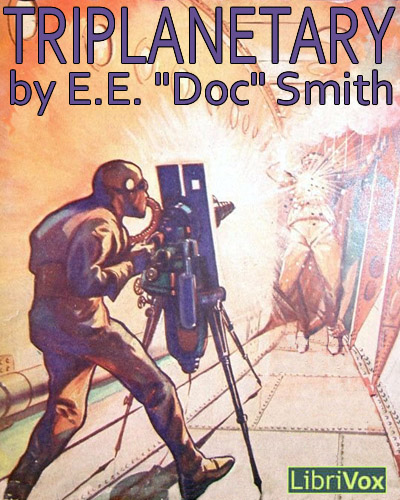
LibriVox - Triplanetary by E.E. Doc SmithTriplanetary
By E.E. “Doc” Smith; Read by Mark F. Smith
13 Zipped MP3 Files or Podcast – Approx. 6 Hours 25 Minutes [UNABRIDGED]
Publisher: LibriVox.org
Published: July 21, 2009
E.E. “Doc” Smith virtually invented the space opera sub-genre singelhandedly. In Triplanetary physics, time, and politics never stand in the way of a plot that gallops ahead without letup. The heroes of Smith’s story are all scientists. In their hands the electromagnetic spectrum becomes a raw material to be molded into ever-more amazing and lethal forms, and the speed of light is no bar to their traveling through the interstellar void. Come enjoy this story of yesteryear, set in tomorrow, where real women ignite love at a glance, real men achieve in days what governments manage in decades, and aliens are an ever-present threat to Life-As-We-Know-It! First published in the January, February, March and April 1934 issues of Amazing Stories magazine.

Podcast feed:

http://librivox.org/bookfeeds/triplanetary-by-ee-doc-smith.xml

iTunes 1-Click |SUBSCRIBE|

Additional credit for this audiobook goes to:

Dedicated Proof-Listener: Ans Wink
Meta-Coordinator/Cataloging: David Lawrence

Posted by Jesse Willis

LibriVox: Short Science Fiction Collection Vol. 017

SFFaudio Online Audio

LibriVox - Short Science Fiction Collection Vol. 017Short Science Fiction Collection Vol. 017
By various; Read by various
10 Zipped MP3 Files or Podcast – Approx. 4 Hours 6 Minutes [UNABRIDGED]
Publisher: LibriVox.org
Published: May 21, 2009
Science fiction (abbreviated SF or sci-fi with varying punctuation and case) is a broad genre of fiction that often involves sociological and technical speculations based on current or future science or technology. This is a reader-selected collection of short stories, first published between 1951 and 1962, that entered the US public domain when their copyright was not renewed.

Podcast feed: http://librivox.org/bookfeeds/short-science-fiction-collection-017.xml

iTunes 1-Click |SUBSCRIBE|

LibriVox - Belly Laugh by Randall GarrettBelly Laugh
By Randall Garrett; Read by Jozef Nagy
1 |MP3| – Approx. 5 Minutes [UNABRIDGED]
Publisher: LibriVox.org
Published: May 21, 2009
You hear a lot of talk these days about secret weapons. If it’s not a new wrinkle in nuclear fission, it’s a gun to shoot around corners and down winding staircases. Or maybe a nice new strain of bacteria guaranteed to give you radio-active dandruff. Our own suggestion is to pipe a few of our television commercials into Russia and bore the enemy to death.

LibriVox - Citadel by Algis BudrysCitadel
By Algis Budrys; Read by Gregg Margarite
1 |MP3| – Approx. 53 Minutes [UNABRIDGED]
Publisher: LibriVox.org
Published: May 21, 2009
He was looking for a privacy his strange personality needed. And—never quite seemed to achieve it. All his efforts were, somehow—great triumphs of the race, and great failures for him! From the February 1955 issue of Astounding Science Fiction. This story is told from only one side of the conversation.

LibriVox - Cully by Jack EganCully
By Jack Egan; Read by Jozef Nagy
1 |MP3| – Approx. 11 Minutes [UNABRIDGED]
Publisher: LibriVox.org
Published: May 21, 2009
By all the laws of nature, he should have been dead. But if he were alive … then there was something he had to find. From Amazing Stories, January 1963.

LibriVox - The Defenders by Philip K. DickThe Defenders
By Philip K. Dick; Read by Gregg Margarite
1 |MP3| – Approx. 50 Minutes [UNABRIDGED]
Publisher: LibriVox.org
Published: May 21, 2009
No weapon has ever been frightful enough to put a stop to war—perhaps because we never before had any that thought for themselves! From Galaxy Science Fiction January 1953.

LibriVox - The Good Neighbors by Edgar PangbornThe Good Neighbors
By Edgar Pangborn; Read by Bellona Times
1 |MP3| – Approx. 15 Minutes [UNABRIDGED]
Publisher: LibriVox.org
Published: May 21, 2009
You can’t blame an alien for a little inconvenience—as long as he makes up for it! First published in Galaxy magazine, June 1960.
A first contact story.

LibriVox - In The Avu Observatory by H.G. WellsIn The Avu Observatory
By H.G. Wells; Read by Nacelle Droll
1 |MP3| – Approx. 19 Minutes [UNABRIDGED]
Publisher: LibriVox.org
Published: May 21, 2009
“The observatory at Avu, in Borneo, stands on the spur of the mountain. To the north rises the old crater, black at night against the unfathomable blue of the sky. From the little circular building, with its mushroom dome, the slopes plunge steeply downward into the black mysteries of the tropical forest beneath.” Set in Borneo. First published in 1894.

LibriVox - Postmark Ganymede by Robert SilverbergPostmark Ganymede
By Robert Silverberg; Read by tabithat
1 |MP3| – Approx. 17 Minutes [UNABRIDGED]
Publisher: LibriVox.org
Published: May 21, 2009
Consider the poor mailman of the future. To “sleet and snow and dead of night”—things that must not keep him from his appointed rounds—will be added, sub-zero void, meteors, and planets that won’t stay put. Maybe he’ll decide that for six cents an ounce it just ain’t worth it. From Amazing Stories, September 1957.

LibriVox - Toy Shop by Harry HarrisonToy Shop
By Harry Harrison; Read by Albatross
1 |MP3| – Approx. 12 Minutes [UNABRIDGED]
Publisher: LibriVox.org
Published: May 21, 2009
The gadget was strictly, beyond any question, a toy. Not a real, workable device. Except for the way it could work under a man’s mental skin… From Analog April 1962.

LibriVox - Vital Ingredient by Gerald VanceVital Ingredient
By Gerald Vance*; Read by James Christopher
1 |MP3| – Approx. 16 Minutes [UNABRIDGED]
Publisher: LibriVox.org
Published: May 21, 2009
Frankie was ready for the big test—Ten-Time Winner of the world title. He was young and fit and able; also, he had Milt’s cunning brain to direct every feint and punch. This left only one thing in doubt, the— From Amazing Stories September 1956. *This story may have been written by Randall Garrett.

LibriVox Science Fiction - Vortex Blaster by E. E. Doc SmithThe Vortex Blaster
By E. E. “Doc” Smith; Read by Gregg Margarite
1 |MP3| – Approx. 46 Minutes [UNABRIDGED]
Publisher: LibriVox.org
Published: May 21, 2009
The Lensman and the observer helped Storm into his heavily padded armor. Their movements were automatic—the ointment, the devices— From the pages of the pulp magazine Comet, July 1941.

Posted by Jesse Willis

LibriVox: Short Science Fiction Collection Vol. 015

SFFaudio Online Audio

LibriVoxH.G. Wells has two tales in this collection. The New Accelerator features a fascinating depiction of the invention of what sounds a lot like an amphetamine (though technically they had already been invented a dozen years earlier). It will also remind Star Trek fans of the episode called Wink of an Eye.

The other story by Wells here is The Crystal Egg which is set in a pawn shop in London. It’s likely one of the first tales featuring a kind of CCTV television technology.

The Philip K. Dick story called Beyond Lies The Wub is one of the best Dick short stories printed. It makes for excellent repeated listening. Gregg Margarite does a great job with it too.

As Long As You Wish is not new to this collection but I mention it because it is a bit tricky – remember to pay close attention to the beginning so as to help you understand the ending.

LibriVox - Short Science Fiction Collection Vol. 015Short Science Fiction Collection Vol. 015
By various; Read by various
10 Zipped MP3 Files or Podcast – Approx 3 Hours 40 Minutes [UNABRIDGED]
Publisher: LibriVox.org
Published: May 4th, 2009
Science fiction (abbreviated SF or sci-fi with varying punctuation and case) is a broad genre of fiction that often involves sociological and technical speculations based on current or future science or technology. This is a reader-selected collection of short stories that entered the US public domain when their copyright was not renewed.

Podcast feed: http://librivox.org/bookfeeds/short-science-fiction-collection-015.xml

iTunes 1-Click |SUBSCRIBE|

LibriVox Science Fiction - As Long As You Wish by John O'KeefeAs Long As You Wish
By John O’Keefe; Read by Wally Reed
1 |MP3| – Approx. 11 Minutes [UNABRIDGED]
Publisher: LibriVox.org
Published: May 4th, 2009
If, somehow, you get trapped in a circular time system . . . how long is the circumference of an infinitely retraced circle? From Astounding Science Fiction, June, 1955.

LibriVox - Beyond Lies The Wub by Philip K. DickBeyond Lies The Wub
By Philip K. Dick; Read by Gregg Margarite
1 |MP3| – Approx. 16 Minutes [UNABRIDGED]
Publisher: LibriVox.org
Published: May 4th, 2009
The slovenly wub might well have said: Many men talk like philosophers and live like fools. From Planet Stories July 1952.


LibriVox - The Crystal Egg by H.G. WellsThe Crystal Egg
By H.G. Wells; Read by Gregg Margarite
1 |MP3| – Approx. 40 Minutes [UNABRIDGED]
Publisher: LibriVox.org
Published: May 4th, 2009
The story tells of a shop owner, named Mr. Cave, who finds a strange crystal egg that serves as a window into the planet Mars. Written in the same year in which The War of the Worlds was being serialized. This story is often considered a prequel to The War of the Worlds, though there is no clear foreshadowing of the events that transpire in the novel.

LibriVox - Hard Guy by H.B. CarletonHard Guy
By H.B. Carelton; Read by Bookman
1 |MP3| – Approx. 7 Minutes [UNABRIDGED]
Publisher: LibriVox.org
Published: May 4th, 2009
There will be fine, glittering, streamlined automobiles in 2000 A.D. Possibly they will run themselves while the driver sits back with an old-fashioned in his hands. Perhaps they will carry folks down the highways at ninety miles an hour in perfect safety. But picking up a hitch-hiker will still be as dangerous as it is today. First published in Amazing Stories November 1942, later reprinted in Amazing Stories April 1956.

Amazing Stories December 1960I’m A Stranger Here Myself
By Mack Reynolds; Read by William Haseltine
1 |MP3| – Approx. 11 Minutes [UNABRIDGED]
Publisher: LibriVox.org
Published: May 4th, 2009
One can’t be too cautious about the people one meets in Tangier. They’re all weirdies of one kind or another. Me? Oh, From Amazing Stories, December 1960.

LibriVox - The New Accelerator by H.G. WellsThe New Accelerator
By H.G. Wells; Read by Gregg Margarite
1 |MP3| – Approx. 30 Minutes [UNABRIDGED]
Publisher: LibriVox.org
Published: May 4th, 2009
A friend of H.G. Wells is on the verge of making a scientific breakthrough which promises to revolutionise human life – so the two friends decide to road-test the new drug – with exciting but dangerous consequences.

LibriVox - The Radiant Shell by Paul ErnstThe Radiant Shell
By Paul Ernst; Read by Bellona Times
1 |MP3| – Approx. 52 Minutes [UNABRIDGED]
Publisher: LibriVox.org
Published: May 4th, 2009
The man on the metal plate was vanishing. From Astounding Stories January 1932.


Astounding Stories November 1932A Scientist Rises
By D.W. Hall; Read by Epistomolus
1 |MP3| – Approx. 18 Minutes [UNABRIDGED]
Publisher: LibriVox.org
Published: May 4th, 2009
All gazed, transfixed, at the vast form that towered above them. From the November 1932 issue of Astounding Stories.


LibriVox - Vanishing Point by C.C. BeckVanishing Point
By C.C. Beck; Read by Bellona Times
1 |MP3| – Approx. 12 Minutes [UNABRIDGED]
Publisher: LibriVox.org
Published: May 4th, 2009
In perspective, theoretically the vanishing point is at infinity, and therefore unattainable. But reality is different; vanishment occurs a lot sooner than theory suggests .. From Astounding Science Fiction July 1959.

LibriVox - Viewpoint by Randall GarrettViewpoint
By Randall Garrett; Read by Ray Smith
1 |MP3| – Approx. 22 Minutes [UNABRIDGED]
Publisher: LibriVox.org
Published: May 4th, 2009
A fearsome thing is a thing you’re afraid of—and it has nothing whatever to do with whether others are afraid, nor with whether it is in fact dangerous. It’s your view of the matter that counts! From Astounding Science Fiction January 1960.

Posted by Jesse Willis

Review of Slaughterhouse-Five by Kurt Vonnegut

SFFaudio Review

Slaughterhouse Five by Kurt VonnegutSFFaudio EssentialSlaughterhouse-Five
By Kurt Vonnegut; Read by Ethan Hawke
5 CDs – 6 hours – [UNABRIDGED]
Publisher: Blackstone Audio
Published: 2009
ISBN: 9781433269691
Themes: / Science Fiction (or maybe not) / World War II / Time Travel / War / Aliens / Mind /

And Lot’s wife, of course, was told not to look back where all those people and their homes had been. But she did look back, and I love her for that, because it was so human.

So she was turned to a pillar of salt. So it goes.

—Kurt Vonnegut, Slaughterhouse Five

During World War II, author Kurt Vonnegut was taken prisoner by the Germans and held captive in the city of Dresden, which was later reduced to flaming rubble during a harrowing fire-bombing by American forces. According to Vonnegut, the city was a gorgeous center of art, architecture, and fine civilian life; its value as a military target was negligible. “What I’ve said about the firebombing of Dresden is that not one person got out of a concentration camp a microsecond earlier, not one German deserted his defensive position a microsecond earlier,” Vonnegut said.

Somewhere between 25,000 and 120,000 civilians (the upper figure is an early estimate, which has since been revised downward to 25,000-40,000) were killed in the inferno of incendiary and high explosive bombs. As such, Dresden remains a controversial, dark chapter of America’s involvement in the war.

Slaughterhouse-Five is Vonnegut’s look back on this dreadful event. It’s not a traditional biography, but a modified account of his own experiences as seen through the eyes of Billy Pilgrim, a tall, awkward, disconnected dreamer who is drafted into the army and thrust into combat. Pilgrim is a pathetic soul with the appearance of a “filthy flamingo,” involved in tragic events beyond his control.

Captured during the Battle of the Bulge, Pilgrim and 100 other soldiers are shipped to Dresden to serve as prison-labor. At night they sleep in a storage-cave beneath a slaughterhouse amidst the butchered carcasses of animals, and it’s this arrangement that allows them to survive the attack. After the firebombing, they emerge the next morning to find the once-beautiful Dresden so utterly destroyed that it resembles the surface of the moon.

A part of me feels guilty for reviewing Kurt Vonnegut’s Slaughterhouse-Five on a science fiction/fantasy Web site. The connections of this classic anti-war novel to the science fiction genre are tenuous, but it attains this designation (in some circles) due to the presence of the Tralfamadorians, a race of aliens that capture Pilgrim and bring him back to their planet for examination. During his months on Tralfamadore, Pilgrim is placed in a sort of zoo, his body and mind laid bare to the curious aliens.

The Tralfamadorians may be simply the imagination of an unwell, traumatized mind. Pilgrim is emotionally unbalanced, suffers a head injury after the war, and reads voraciously of the novels of science fiction writer Kilgore Trout, one of whose novels concerns an alien abduction that sounds suspiciously like Pilgrim’s own experiences on Trafalmadore. But the Tralfamadorians—real or not—allow Vonnegut to explore the concept of time and our place in it, which is the larger theme of the novel. The Tralfamadorians can see in four dimensions and have no concept of time; life just is, and human existence is a series of events and happenings with no beginnings and ends. Events simply occur; wars are fought, we are powerless to stop them and it’s ridiculous to think we can. Free will is a farce.

Pilgrim’s time among the Tralfamadorians allows him to experience his life in this fourth dimension, moving his mind back and forth to the past and future, seemingly at will. He is able to see his own death, and relive events from his childhood, his marriage, and his career as an optometrist. But Pilgrim’s wandering, time-traveling mind returns again and again to the terrible events of Dresden, an experience so powerful that his mind is unable to make sense of it. It just is, and all he can do with the rest of life is to try and look upon the good times in his life, the moments of joy, and not linger too long over the blackened, shrunken bodies, or a fellow American and friend executed for salvaging a teapot from the ruins.

Actor Ethan Hawke (of Dead Poets Society and Hamlet fame) serves as the narrator and does a nice job reading with an understated, dispassionate voice that perfectly fits the tone of the novel. This Blackstone Audio production also includes an unexpected and enlightening 10-minute interview with Vonnegut on the final disc. Here Vonnegut reveals that Pilgrim’s character was based on a real person, Edward Crone, an American who died in Dresden. “He just didn’t understand the war at all, what was going on, and of course there was nothing to understand—he was right,” Vonnegut says.

Posted by Brian Murphy

Review of Starman Jones by Robert A. Heinlein

SFFaudio Review

Blackstone Audio - Starman Jones by Robert A. HeinleinStarman Jones
By Robert A. Heinlein; Read by Paul Michael Garcia
7 CDs – 8.5 Hours [UNABRIDGED]
Publisher: Blackstone Audio
Published: 2008
ISBN: 9781433230387
Themes: / Science Fiction / Space Travel / Aliens / Dystopia /

It was a desperate time, when one’s next meal and the comforts of home couldn’t be taken for granted. Max Jones, a practical, hard-working young man, found his escape in his beloved astronomy books. When reality comes crashing in and his troubled home life forces him out on the road, Max finds himself adrift in a downtrodden land. Until an unexpected, ultimate adventure carries him away as a stowaway aboard an intergalactic spaceship—but to where? And when? And how could he ever get back? With the ship’s pilot dead and his charts and tables all destroyed, Max must call upon all of his untested knowledge and skills in order to survive.

There’s nothing like going back to that old-time Science Fiction. Heinlein’s novels are steeped in the inspissate brew of American idealism. Puritanical hard work, honesty and humility are mixed with the libertarian and the liberal, the conservative and the anarchistic. These aren’t just the bywords of Heinleinian characters, they’re the fundamentals of their character – all that, and tempered too with happy portions of both skepticism and hucksterism. A Heinlein character is just as likely to be a gruff middle aged con-man (honest in his own fashion) as a naive wundderkind. The naive wundderkind is often found with a variously doting, tolerant, and even brighter sweetheart. We find all three, the canny conman, the boy genius and his devoted young woman, along with a whole lot more in Starman Jones.

There are three main sections of Starman Jones. Most of the folks who talk about the novel talk about the middle section – where Max works his way up the chain of command in a luxury spaceliner. Indeed, this is what gives the novel its title. The third section, set on board a primitive alien planet has some nicely interesting aliens (a whole novel could have been done there). Personally I liked the first third, set on a vaguely dystopic planet Earth. This is a land of no-opportunity, in order to get a decent job you have to inherit it. Vested interests, taking the form of professional guilds, seem to have staked out every possible avenue for advancement. Sure, there are people there willing to bend the rules to kind-hearted kids like Jones, but the general rule is a complacency towards pervasive corruption. At one point during this first third a kindly truck driver, hopped up on amphetamines, gets Max to help him break the rules of the road (that you have to pull over and sleep once in a while). That scene and another, gives an odd kind of atmosphere of low-level-corruption that Heinlein seems fairly comfortable with. Later still, with the only ticket off the sewed-up planet Earth is via false documents and bribery – Max goes for it, to the detriment of his conscience only after the fact.

In other juvenile novels, like Citizen Of The Galaxy, a Heinleinian protagonist will stay “dirtside” where he’ll grift and finagle his way through life – justifying each action step by step – here and frankly in every single Heinlein story that I’ve ever read, the bad guys are never bad because of the greed or corruption per se, but rather because they are dumb, ignorant and vain.This is a Heinlein failing I think. His cardboard cut-out villians are too dim, too dull-humored and too officious to be any real threat. There are at least two of these lame-brains in this novel. That got me to thinking. If one were to rewrite a Heinlein novel from the strawman’s point of view – it’d be extremely obvious who Heinlein had meant the hero to be [namely Heinlein’s own ideas and values – however ambivalent they are]. But, don’t let this criticism let you think I don’t like Starman Jones because, warts and all, I really did enjoy it.

Paul Michael Garcia is ably suited to reading Heinlein’s well chosen words – giving the dialogue-heavy prose a banter-like give and take. Garcia’s range too is very impressive, voicing Max Jones as youthful and energetic, his older pal Sam as languid and confident, the girl, the mom, the step-dad, the alien spacepet, and everyone else – all in unique voice. It really is the ideal reading. I’ve been a fan of Garcia’s narration since Blackstone picked him for Kirinyaga. Despite a lot of technical jargon, especially while talking astrogation, I only heard one tiny mispronunciation in the whole novel. Concomitant meaning “occurring or existing concurrently.” Garcia read it as “konk-mittant.” The original art that Blackstone has given Starman Jones looks good, if a bit generic, but a closer inspection – past the silhouetted landscape and into the roiling clouds will admit a bit more detail in the night’s overcast sky.

Posted by Jesse Willis