from ASTOUNDING: A Transmutation Of Muddles by Horace Brown Fyfe

SFFaudio Online Audio

From the pages of Astounding Science Fiction’s September 1960 issue comes a workmanlike SF story from one of the minor pitchers of SF. Horace Brown Fyfe (aka Andrew MacDuff) seems to have gotten just 15 or so his SF tales into Astounding over the years. The narrator, on the other hand, has a prolific website, and has even written and recorded his own tales including one about Alex a ‘half parrot and half penguin’ who travels from Tierra del Fuego to an Antarctic island inhabited by ancient Egyptians who hail him as their god incarnate (which reminds me of an episode of Tales Of The Gold Monkey). Here’s the story, read by Roy Trumbull, that caught my ears…

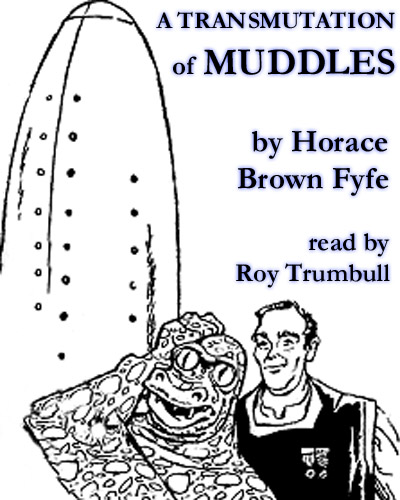
Story Speiler Science Fiction - A Transmutation Of Muddles by Horace B. FyfeA Transmutation Of Muddles
By Horace Brown Fyfe; Read by Roy Trumbull
2 MP3s – Approx. 39 Minutes [UNABRIDGED]
Publisher: StorySpieler.com
Published: 2008?
A judge is sent to a distant planet to mediate between a spaceship captain and an insurance adjuster. The natives have seized the captain’s spaceship as a gift from the great god Meeg and are turning it into a temple dedicated to Meeg.
Part 1 |MP3| Part 2 |MP3|

Check out plenty more tales, read by the same dude, over on the StorySpieler website HERE.

Posted by Jesse Willis

Review of The Standards of Creation by James Campanella

SFFaudio Review

The Standards of Creation
By James Campanella; Read by James Campanella
MP3 Download – Approx 16.5 hours – [UNABRIDGED]
Publisher: Uvula Audio
Published: 2008
Themes: / Science Fiction / Mars / cybernetics / aliens / telepathy / genetic manipulation /

J.J. Campanella is perhaps best known in audio circles as a frequent narrator on StarShipSofa, which is where I first encountered him. His website, Uvula Audio, features Campanella’s narration of a wide variety of audiobooks ranging from L. Frank Baum to Doc Savage to P.G. Wodehouse. It does not take long to discover that narration is indeed a skill at which Campanella is expert. He handles foreign accents and different voices with an ease that makes it easy for the listener to visualize each speaker.

What is easy to miss, perhaps, is that Campanella’s own written work, The Standards of Creation, is included among the archived files. This is a shame as Campanella has written a fast-paced, multi-layered book that combines the best of action thrillers and science fiction. It definitely deserves to be noticed by more people.

Just a few of the elements woven into the story include:

• Martian colonies of Chinese and Americans, each hiding their secrets while trying to discover those of the other.

• Yarrow Hayes, a Nobel Prize winning biologist born and raised on Mars, who ironically is dying of an incurable disease.

• Alex Arodyne, a young scientific genius whose cynical outlooks threatens to cripple his promise.

• Belle, an undercover NATO agent whose cybernetic enhancements give her unparalleled skills but carry with them a price that lead her to take surprising steps.

• Who are Gabe and his mysterious boss? Is he really an alien using telepathy to speak to Alex in his dreams?

• What is the mysterious alien ship voyaging through the solar system?

• Just what are the standards of creation? How will they change the lives of each person in the story?

All this is set against a background containing some of the most classic science fiction elements: terraforming on Mars, life in the Martian colony, biological scientific development in the future such as the different versions of the cloned NATO officers, and an alien device that looks like a huge black marble silently making its way toward the sun while scientists struggle to communicate. All of this is laced with characters in impossible situations for which there is seemingly no solution.

Above all this is a book of secrets. Every person and every situation has at least one secret beyond those that we think have been revealed. This leads to an indepth look at free will and personal responsibility that both surprisd and delighted me.

I am not even including some of the subplots involving drug trafficking or an order of priests with a surprising yet practical hidden agenda. It might sound as if there is too much crammed into the story to make a good book. However, Campanella handles the many elements with ease to provide us with a truly original novel that is not only thought provoking but which also hearkens back to the times when science fiction included real science. We hope that his future endeavors branch out again from narration to include more novels such as this one.

Posted by Julie D.

Review of The Greatest Science Fiction Stories Of The 20th Century

SFFaudio Review

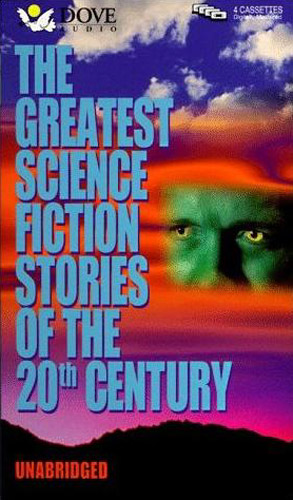
Science Fiction Audiobook - The Greatest Science Fiction Stories Of The 20th CenturyThe Greatest Science Fiction Stories Of The 20th Century
By various; Read by various
4 Cassettes – 6 Hours [Unabridged]
Publisher: Dove Audio
Published: 1998
ISBN: 0787116807
Themes: / Science Fiction / Magical Realism / Aliens / Time Travel / Parallel Worlds / Space Travel / Mutation / Nuclear Winter /

What would a long time SF fan consider a collection called The Greatest Science Fiction Stories Of The 20th Century when none of the stories would make his top ten list, and some aren’t even SF? In this case, I consider it a very good collection of stories. If anything, this seems a collection of well-read and written, but randomly chosen, speculative fiction stories.

Clearly intended to present a wide variety of “Science Fiction,” this audio-anthology has neither theme nor consistency but it doesn’t need them. The stories, with only two exceptions, are quite entertaining. They are all extremely well read, my quibble with a poor attempt at an accent notwithstanding, ranging from Harlan Ellison’s wonderfully passionate reading of his story to Nana Visitor’s aesthetically perfect interpretation of “The Ones Who Walk Away from Omelas.”

Each story is briefly commented on below.

“Jeffty Is Five”
By Harlan Ellison; Read by Harlan Ellison
Reality is distorted around a boy who doesn’t age. This is Magical Realism, not SF, but an amazing story nonetheless. Ellison’s response to the bitter cynicism of modernity will tear at the core of your soul unless A) you’re very young or B) you don’t have a soul. The best story in the collection.

“Twilight”
By John W. Campbell; Read by Richard McGonagle
A good early SF story but not quite great. It feels a bit to much like Wells’ The Time Machine, but it entertaining enough. A retelling of a time traveler’s visit to the twilight of humanity.

“The Ones Who Walk Away Fom Omelas”
By Ursula K. Le Guin; Read by Nana Visitor
Virtually everyone knows this Fantasy, again not SF, story. It has all the strengths and weakness of Le Guin’s writing, amazing authorial voice and great storytelling, but a strong tendency to be overly didactic to the point of sanctimoniousness. Still as with most of her stories, the strengths far outweigh the weaknesses.

“Bears Discover Fire”
By Terry Bisson; Read by Arte Johnson
Bears start using fire in an otherwise normal Kentucky. This Magical Realism, not an SF. This story was the only one that bored me. It also had my only, relatively minor, reading complaint. The reader’s Kentucky accent is a bit off and sounds a bit condescending.

“The Crystal Spheres”
By David Brin; Read by Alexander Siddig
A very interesting, though highly implausible, story about a universe in which all stars are encircled by invisible, impenetrable, crystal spheres.

“That Only a Mother”
By Judith Merril; Read by Terry Farrell
Due to radiation poisoning, a baby is born mentally gifted but physically impaired. A disturbing, unpleasant story that is only marginally SF.

“Allamagoosa”
By Eric Frank Russell; Read by James A. Watson
Wonderful over-the-top humor. This story of a spaceship facing an inspection while missing an offog, an item no one knows what is, is a gem.

“Tangents”
By Greg Bear; Read by Melissa Manchester.
A boy can see into the the fourth physical dimension and a scientist helps him play music for the beings there. Interesting enough, but forgettable.

“The Nine Billion Names of God”
By Arthur C. Clarke; Read by Alexander Siddig
Tibetan monks have a computer print out all the names possible names of God with the intent of fulfilling the purpose of creation. Good enough but not even Clarke’s best short story.

“Huddling Place”
By Clifford D. Simak; Read by David Ackroyd
In a future with robots and space travel agoraphobia has become a serious threat. This story would have been just acceptable filler except for the fact that in this story from 1944, Simak predicts the internet, though he describes it in terms of a television with knobs.

“Why I Left Harry’s All-Night Diner”
By Lawrence Watt Evans; Read by Wil Wheaton
A fun, interesting take on the the idea of parallel universes. Certainly an enjoyable story.

“Fermi And Frost”
By Frederik Pohl; Read by Denise Crosby
Icelanders face the prospects of nuclear winter in the post-apocalyptic tale. A good downbeat story to balance some of the lighthearted stories.

Conclusion: This is a very good anthology. It definitely isn’t a collection of the best stories, but it may be the best collection of stories available. Highly recommended.

I started reviewing this collection on the expectation that it was out of print and I would have to recommend Amazon or eBay as a source of a used cassette copy. So imagine my surprise when a mere day after finishing it, I hear an Audible.com ad for it on Pseudopod. So, it is easily available for those interested.

Posted by David Tackett
Review of Now and Forever by Ray Bradbury

SFFaudio Review

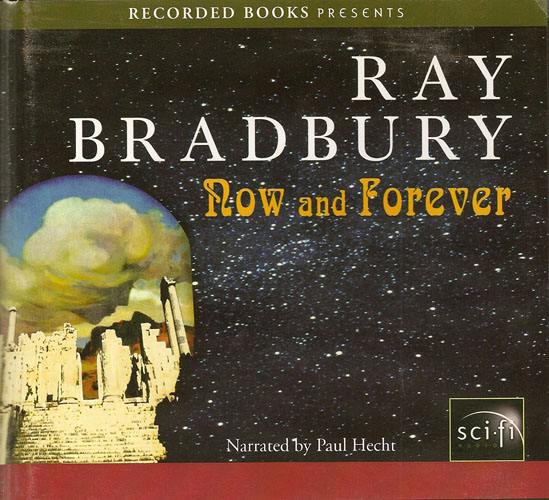
Science Fiction Audiobook - Now and Forever by Ray BradburyNow and Forever
By Ray Bradbury; Read by Paul Hecht
4 CDs – 4.75 hours – [UNABRIDGED]
Publisher: Recorded Books
Published: 2008
ISBN: 9781428198258
Themes: / Fantasy / Collection / Novella / Small town / Nostalgia / Starship / Aliens / Telepathy /

In some ways the most interesting part of the two novellas that make up this book are Ray Bradbury’s introductions. He explains that both “Somewhere the Band is Playing” and “Leviathan ‘99” have their origins in his long ago days as a Hollywood screenwriter. These explanations hang on in the listener’s mind and provide insights and color for the stories that follow.

“Somewhere the Band is Playing” evokes the memories of the idyllic towns that Bradbury loves to write about, a la “Mars is Heaven” in The Martian Chronicles. One wonders if this bucolic turn-of-the-20th-century setting has its roots in his own youth in Waukegan, Illinois. The story is told by James Cardiff, a reporter who awakens one morning mysteriously drawn to Summerton, Arizona, which does not appear on the map although the train stops there. As he explores the town he finds it is full of mysteries that seemingly defy explanation such as adult inhabitants, but no children; a graveyard, but no dates of death on the tombstones. This story gently invites the listener to consider questions of immortality, paradise, and the consequences of our choices.

Moby Dick was the inspiration for “Leviathan ‘99”. In Bradbury’s tale, the white whale has become a huge comet, Ishmael is a young astronaut, Queequeg is a mind-reading alien, and Captain Ahab a nameless starship captain who is madly pursuing his nemesis after their original encounter left him blind. Ray Bradbury is known for his love of words which comes through strongly in in the Shakespearean-like soliloquies through which The Captain shows his descent into madness. I especially liked the use of Quell the mind-reader to show us The Captain’s true frame of mind when he was elsewhere. Even the reader who has barely a speaking acquaintance with Moby Dick will appreciate the parallels that Bradbury employs and thrill to the question of how he will choose to end the story.

Neither of these stories has the depth of Ray Bradbury’s great works such as Something Evil This Way Comes or Fahrenheit 451. However, they are novellas and perhaps it may be better to compare them to his short stories. On a first listening, they left me rather flat, wondering, “Is that all there is?” However, further contemplation made it obvious that there is a common theme of man’s blindness, the wonders that are just within reach, and the consequences of our choices. I would not recommend these as a first outing for someone who hasn’t read Bradbury before but to the reader who already appreciates this author, they have much to recommend them.

Paul Hecht’s narration is perfect and his ability to voice characters is exceptional. It is a mystery to me how such a deep voice can portray a woman so well without using falsetto or sounding ridiculous but Hecht does it with little effort. His characters spring to life within the listener’s mind and add depth to the story.

Highly recommended for those who enjoy Ray Bradbury’s writing.

Posted by Julie D.

ed. – This is our first review of an audiobook from the new Sci-Fi imprint from Recorded Books. Click here for a look of what’s coming up from this imprint, which is shaping up to be a fine selection from the literary end of science fiction and fantasy.

Hey, Want To Watch A Movie? ZULU

SFFaudio Online Audio

Recorded just last night, and available now, is the Hey Want To Watch A Movie? podcast commentary track for Zulu the 1964 film classic starring Michael Caine. The film, besides being completely awesome, is highly influential – informing such films as Dog Soldiers, Ghosts Of Mars, Gladiator, Starship Troopers and Aliens. If you haven’t already seen Zulu get it and watch it. It’s public domain in the United States. If you’ve already got a copy, press play and listen to our commentary track. It’s kind of informative and kind of fun too.

Hey Want To Watch A Movie? - Zulu (1964)Hey, Want To Watch A Movie?Zulu
Commentators Christiana Ellis, Mike Meitin, Jesse Willis, Adam Morey, Paul Fischer and Martha Holloway
1 |MP3| – 2 Hours 43 Minutes [FILM COMMENTARY]
Podcaster: Hey, Want To Watch A Movie?
Podcast: August 10th 2008

Subscribe to the podcast feed via this link:

http://watchamovie.libsyn.com/rss

And, don’t forget there are previous commentary tracks for Blade Runner and Galaxy Quest still available too!

Posted by Jesse Willis

Review of The Dreaming Void by Peter F. Hamilton

SFFaudio Review

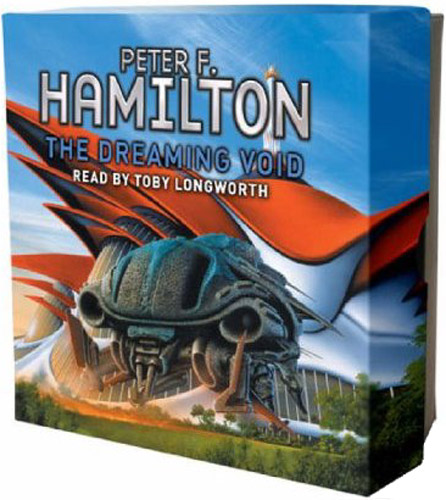
Science Fiction Audiobook - The Dreaming Void by Peter F. HamiltonThe Dreaming Void
By Peter F. Hamilton; Read by Toby Longworth
20 CDs – 23 Hours [UNABRIDGED]
Publisher: Pan Macmillan Audio UK
Published: February 2008
ISBN: 9780230709829
Themes: / Science Fiction / Aliens / Artifact / Nanotechnology / Politics / Singularity / Space Travel /
AD 3580. The Intersolar Commonwealth has spread through the galaxy to over a thousand star systems. It is a culture of rich diversity with a place for everyone. Even death itself has been overcome. But at the centre of the Commonwealth is a massive black hole. This Void is not a natural artefact. Inside there is a strange universe where the laws of physics are very different to those we know. It is slowly consuming the other stars of the galactic core – one day it will devour the entire galaxy. Inigo, a human, has started to dream of a wonderful existence in the Void. He has a following of millions of believers and they now clamour to make a pilgrimage into the Void to live the life they have been shown. Other starfaring species fear their migration will cause the Void to expand again. They are prepared to stop them no matter what the cost. And so the pilgrimage begins…

The Dreaming Void is a very big book and it’s an even bigger audiobook. Peter F. Hamilton’s story is one of the better recent SF stories that I’ve experienced in any form, full of fascinating settings, situations, and ideas. It has many fully realized subplots and varied characters, too many. What could have been at least two brilliant stories, one of the commonwealth dealing with the potentially disastrous consequences of an attempted pilgrimage into the Void, and one of the much more low-key story of Inigo’s dreams, is instead merely a long opening to a longer trilogy.

The main plot(s) of the story are wonderful. It is science fiction as it should be. It takes the imagination to new vistas, mixing newer ideas (the Void, gaiafield, etc) with core traditions of SF (space travel, aliens, etc). Indeed, the basic story is nearly perfect but with all the stretching, it greatly overstays its welcome. Somewhere around the twelve hour mark, listening to The Dreaming Void became a chore. If I had not already committed so much time to the story, I would have quit then.

Final analysis: The Dreaming Void is just too big a novel, filled with many unnecessary subplots and distractions. It is far too easy loose track of the multitude of characters inhabiting this enormous beginning to the “Void Trilogy.” Yet, it is far from a hopeless audiobook. Throughout the epic story, the skill of both author and the reader are quite apparent and each part of the story is interesting. I am still of very mixed opinions about the story. I will look for more stories written by Peter F. Hamilton and more read by Toby Longworth, but only if they are about half this length or shorter. However, the audiobook might well be worth the effort for someone who has a lot of free time and is willing to take notes.

Posted by David Tackett