LibriVox Short Science Fiction Stories Collection #006

SFFaudio Online Audio

Here comes Volume #6 in the Short SF Stories Collection series – all public domain, all 100% FREE, from the folks at LibriVox…

LibriViox Short Science Fiction Collection Volume #6Short Science Fiction Collection Vol. 006
By various; Read by various
Zipped MP3 Files, Podcast or individual MP3s – Approx. 4 Hours 20 Minutes [UNABRIDGED]
Publisher: LibriVox.org
Published: July 25, 2008
Science fiction (abbreviated SF or sci-fi with varying punctuation and case) is a broad genre of fiction that often involves sociological and technical speculations based on current or future science and technology. This is a reader-selected collection of short stories, originally published between 1752 and 1962. Those published after 1922 entered the US public domain when their copyright was not renewed.

Here’s the podcast feed:

http://librivox.org/bookfeeds/short-science-fiction-collection-vol-006.xml

And here are the individual stories with my own notes on some…

LibriVox Science Fiction Short Story - Accidental Death by Peter BailyAccidental Death
By Peter Baily; Read by RK Wilcox
1 |MP3| – Approx. 23 Minutes [UNABRIDGED]
From the pages of Astounding Science Fiction magazine’s February 1959 issue. A tale about, aliens and space travel, told in a curious recorded epistolary form (and its set atop Mount Everest). Strange, but kind of familiar, worth listening to, but not likely to be at all memorable.

LibriVox Science Fiction Short Story - After A Few Words by Randall Garrett…After a Few Words…
By Randall Garrett; Read by Alex Becker
1 |MP3| – Approx. 18 Minutes [UNABRIDGED]
First published in Analog magazine’s October 1962 issue – with the LibriVox team identifying the author, “Seaton McKettrig,” as actually Randall Garrett using one of his many pseudonyms. A few off-pronunciations aren’t enough to mar this solid reading. A historical tale – that really isn’t.

LibriVox Science Fiction Short Story - The Diamond Maker by H.G. WellsThe Diamond Maker
By H.G. Wells; Read by Jerome Lawsen
1 |MP3| – Approx. 17 Minutes [UNABRIDGED]
A canvas sack full of several hundred pounds worth of diamonds, proffered on a London bridge for a paltry £100. It sounds like a con, at the very least a deal too good to be true. But the owner of the diamonds has a tale of woe to explain why he is selling them at such a cut-rate price. This one reminds me of Wells’ The Crystal Egg. Narrator, Jerome Lawsen, has a nice setup, the recording on this one is very clean.

LibriVox Science Fiction Short Story - Egocentric Orbit by John CoryEgocentric Orbit
By John Cory; Read by Perry Clayton
1 |MP3| – Approx. 7 Minutes [UNABRIDGED]
It took a long time for human beings to accept that our little piece of meteoric rubble wasn’t the exact and absolute center of the Universe. It does appear that way, doesn’t it? It may not take so long for a spaceman to learn … First published in Astounding Science Fiction’s May 1960 issue. This is the second version of this story to be recorded by LibriVox.
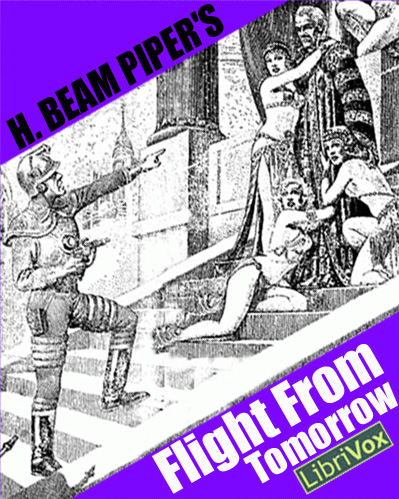
LibriVox Science Fiction Short Story - Flight From Tomorrow by H. Beam PiperFlight From Tomorrow
By H. Beam Piper; Read by Jerome Lawsen
1 |MP3| – Approx. 47 Minutes [UNABRIDGED]
First published in the unwieldy titled “‘Future’ combined with ‘Science Fiction Stories’” magazine’s September/October 1950 issue. This one’s a novelette, an out-in-out time travel tale, that though a bit predictable, and certainly very period, has a certain vintage charm. Jerome Lawsen, reads it well.

LibriVox Science Fiction Short Story - In the Year 2889 by Jules VerneIn The Year 2889
By Jules Verne; Read by James Christopher
1 |MP3| – Approx. 31 Minutes [UNABRIDGED]
First published in 1889, and credited to Jules Verne, it was actually written by Michel Verne, Jules Verne’s son. But then just to confuse matters more it was published under Jules Verne’s name correctly a year later when the senior Verne re-wrote it (and changed the title to In The Year 2890). In any case, this tale is set a mere one thousand years in the future.
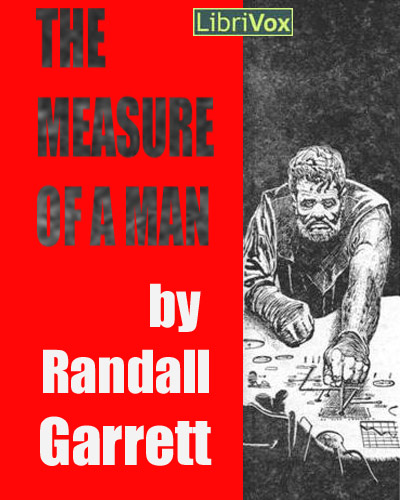
LibriVox Science Fiction Short Story - The Measure Of A Man by Randall GarrettThe Measure of a Man
By Randall Garrett; Read by D.E. Wittkower
1 |MP3| – Approx. 29 Minutes [UNABRIDGED]
“What is desirable is not always necessary, while that which is necessary may be most undesirable. Perhaps the measure of a man is the ability to tell one from the other … and act on it.” From the April 1960 of John W. Campbell’s Astounding Science Fiction magazine.

LibriVox Proto-Science Fiction Short Story - Micromegas by VoltaireMicromegas
By Voltaire; Read by Annoying Twit
1 |MP3| – Approx. 45 Minutes [UNABRIDGED]
An 18th century tale (first published in 1752), Micromegas is significant in the pre-history of SF. Earth is visited by a pair of alien visitors, one from a planet circling Sirius and the other from the planet Saturn! This reading is also significant as it was recorded using a £1800 microphone!
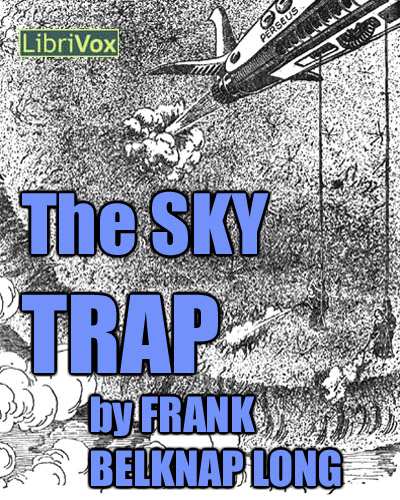
LibriVox Science Fiction Short Story - The Sky Trap by Frank Belknap LongThe Sky Trap
By Frank Belknap Long; Read by Dr Special
1 |MP3| – Approx. 35 Minutes [UNABRIDGED]
From Comet magazine’s July 1941 issue (the same issue that has Leigh Brackett’s A World Is Born – which is also available HERE). This is Dr. Special’s first recording for LibriVox. He reads it very well, even though there are a lot of lines like… “Good God Dave, do you suppose something has happened to space?”

LibriVox Science Fiction Short Story - Test Rocket by Jack DouglasTest Rocket
By Jack Douglas; Read by Lance
1 |MP3| – Approx. 5 Minutes [UNABRIDGED]
From the Amazing Science Fiction Stories magazine’s April 1959 issue (which had an amazing cover).

Posted by Jesse Willis

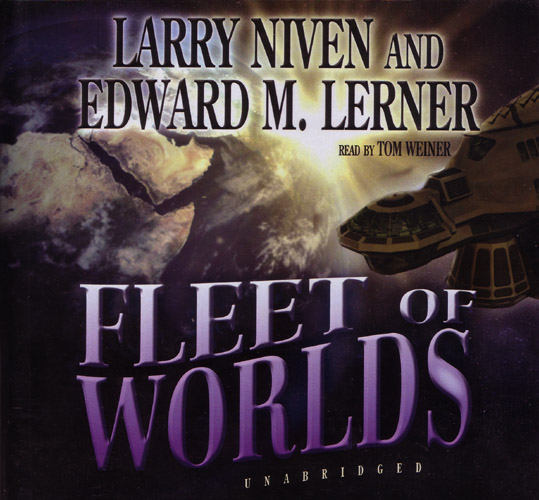
Review of Fleet Of Worlds by Larry Niven and Edward M. Lerner

SFFaudio Review

Science Fiction Audiobook - Fleet Of Worlds by Larry Niven and Edward M. LernerFleet Of Worlds
By Larry Niven and Edward M. Lerner; Read by Tom Weiner
8 CDs – Approx 9.5 Hours [UNABRIDGED]
Publisher: Blackstone Audio
Published: 2008
ISBN: 1433229420
Themes: / Science Fiction / Hard SF / Aliens / Physics / Space Travel / Sociology /

Larry Niven teams up with fellow science-fiction writer Edward M. Lerner to take a closer look at the events leading up to Niven’s first Ringworld novel. Kirsten Quinn-Kovacs is among the best and brightest of her people. She gratefully serves the gentle race that rescued her ancestors from a dying starship and nurtures them still. But, if only the Citizens knew where Kirsten’s people came from! A chain reaction of supernovae at the galaxy’s core has unleashed a wave of lethal radiation that will sterilize the galaxy. The Citizens flee, taking with them their planets, the Fleet of Worlds. Someone must scout ahead, and Kirsten and her crew eagerly volunteer. But as they set out to explore for any possible dangers in the Fleet’s path, they uncover long-hidden truths that will shake the foundations of worlds.

Not knowing much about Edward M. Lerner or his style, it’s hard to know precisely what parts of this novel he wrote. On the whole it definitely feels like a Larry Niven book. And of course that’s a very good thing. Surprisingly nice, this “known space” novel doesn’t feel like it’s just embellishing the dark corners we’d little explored before. There is material to be mined, and mine it they do. We learn more about the General Products corporation, early Puppeteer influence on Terra, and the back story to Niven’s classic The Borderland Of Sol. The heart of the novel though is Nessus’ interaction with a crew of Humans. As well, Niven and Lerner, introduce an entirely new and compelling alien species, though we really don’t get to interact with them. Its hard to get into much more without giving out a lot of spoilers. Suffice it to say, this is a fine, though definitely lesser entry into the “known space” canon. When recommending a novel universe, I would always start with the strongest book in that universe, and expand out from there. If you haven’t read any Niven novels before this one, go listen to Protector and Ringworld first. Then, if you are as enchanted as I was with it, come back to Fleet Of Worlds for more.

Tom Weiner, who is one of Blackstone Audio’s new narrators, previously heard in A Galaxy Trilogy, brings authority to the narrative of Fleet Of Worlds. He has to work pretty hard to do both the puppeteer contralto that is supposed to sound like “Cleopatra, Helen of Troy, Marilyn Monroe, and Lorelei Huntz all rolled into one.” But both it and the human females Weiner performs come off well enough – giving more of an impression of a voice change than any actual transformation.

Update: Edward M. Lerner tells me that that the follow up to Fleet Of Worlds, titled Juggler Of Worlds, is also slated for a Blackstone Audio release!

Posted by Jesse Willis

FREE SF Podiobook: The Black Star Passes by John W. Campbell

SFFaudio Online Audio

Scott D. Farquhar‘s latest audiobook effort is a complete and unabridged reading of one of our original SFFaudio Challenge titles…

You’ll probably remember Scott from either his stunningly awesome reading of Star Surgeon or as one of the stalwart troopers from the Prometheus Radio Theatre troupe. Scott claimed The Black Star Passes back in November. After you start enjoying it, please consider donating a few $$ towards his narration. At Podiobooks.com 3/4’ths of every dollar will end up in Scott’s hands, which means he’ll be all the more inclined to record another. The other 25% goes to covering Podiobooks.com’s expenses (download bandwidth, server space, etc.).

The Black Star PassesThe Black Star Passes
By John W. Campbell; Read by Scott D. Farquhar
20 MP3s – [UNABRIDGED]
Publisher: Podiobooks.com
Published: July 2008 – ????
Three separate SF stories by Campbell, written for Amazing Stories magazine: The Black Star Passes, Piracy Preferred, Solarite. These tales are tied together by a recurring cast of characters (Arcot, Morey and Wade).

Posted by Jesse Willis

Review of The Caves Of Steel by Isaac Asimov

SFFaudio Review

Science Fiction Audiobook - The Caves of Steeel by Isaac AsimovThe Caves of Steel
By Isaac Asimov; Read by William Dufris
6 CDs – 7.5 Hours [UNABRIDGED]
Publisher: Tantor Audio
Published: 2007
ISBN: 9781400104215
SAMPLE |MP3|
Themes: / Science Fiction / Mystery / Robots / Artificial Intelligence / Sociology / New York /

A millennium into the future, two advancements have altered the course of human history: the colonization of the galaxy and the creation of the positronic brain. Isaac Asimov’s Robot novels chronicle the unlikely partnership between a New York City detective and a humanoid robot who must learn to work together.

Elijah Baley and his wife and son live in an overcrowded New York city (the titular Caves Of Steel) in our distant future. Outside the insular Earth, humans have colonized many planets with their robot servants to assist them. These “Spacer” worlds are rich, have small populations, and high standards of living. The Earthers all live in vast city complexes and never venture outside. The Spacers maintain an embassy, from which they seek to help their backward progenitors – but this help is both resented and rebuffed. The latest incident is revealed when Elijah Bailey, a New York detective, is called into his superior’s office and tasked with solving a murder in the “spacer” enclave. But his boss has one more demand of him. Elijah must partner up with a robot named R. Daneel Olivaw for the duration of the case.

Asimov’s vision of New York in The Caves Of Steel fits neatly somewhere in between the well envisioned arcologies like “Todos Santos” (Larry Niven and Steve Barnes’ Oath Of Fealty), future cities like “Mega-City One” (Judge Dredd) and that of “Diaspar” (found in Arthur C. Clarke’s The City And The Stars). As such it is an experience not to be missed. The mixture of politics, psychology and sociology that’s found in Asimov’s Foundation novels is also present. But central to the experience of The Caves Of Steel is Mystery. It is a Mystery in a Science Fiction setting and not the other-way round. The well realized economy, culture, and characters (this latter in a surprisingly good turn for Asimov) are all carefully explained so as to set up the mystery – even the red-herrings are important to the plot.

Isaac Asimov basically invented the small sub-genre of the Science Fiction Mystery, and this was the novel that started it all. I’ve read lots of other books of his, including one straight Mystery that was set at a Science Fiction convention (starring a detective modeled on Harlan Ellison). And like that novel, this one keeps you guessing right up until the very end. That’s a good thing too – Asimov doesn’t cheat. We’ve got a city full of suspects, but the motive – when it’s ultimately revealed – is as logical as the deduction is sound.

It isn’t an insult to say that William Dufris sounds like a robot. He sounds like a robot when it’s a robot speaking, and sounds like a man when it’s a man speaking. He can also inflect his voice to sound more feminine – which is handy for females (and female robots too). Suffice it to say William Dufris reads Asimov’s spare and unadorned prose with alacrity. I’m excited to say the sequel, The Naked Sun is also available from Tantor!

Posted by Jesse Willis

Aural Noir Review of Dirty Money by Richard Stark

Aural Noir - Review

Back in 2005 SFFaudio spun-off a sister site called AuralNoir.com. But it didn’t take. Those who visited loved it, but too few visited. So, what we’re doing now is posting non-Science Fiction, Fantasy or Horror, reviews, news, etc, under special headers like the one above. So welcome to our first such. Stick around, we’ll see how the string plays itself out.


Crime Fiction - Dirty Money by Richard StarkDirty Money
By Richard Stark; Read by Stephen Thorne
Audible Download – 5 Hours 12 Minutes [UNABRIDGED]
Publisher: BBC Audiobooks America
Provider: Review copy provided by Audible.com
Published: 2008
Themes: / Crime / Heist / Armored Car / Double-cross / Massachusetts /

Master criminal Parker takes another turn for the worse as he tries to recover loot from a heist gone terribly wrong. Parker and two cohorts stole the assets of a bank in transit, but the police heat was so great they could only escape if they left the money behind. Now Parker and his associates plot to reclaim the loot, which they hid in the choir loft of an unused country church. As they implement the plan, people on both sides of the law use the forces at their command to stop Parker and grab the goods for themselves. Though Parker’s new getaway van is an old Ford Econoline with “Holy Redeemer Choir” on its doors, his gang is anything but holy, and Parker will do whatever it takes to redeem his prize, no matter who gets hurt in the process.

Richard Stark is the alternate personality of crime writer Donald E. Westlake. I’m a giant fan of both guys, Westlake seems to write instinctually, sometimes it all comes together sometimes it doesn’t. Dirty Money doesn’t blow my socks off. But, it is the latest installment in Stark’s long running (more than 20) series of novels about the hardened heister known only as “Parker.” What seems to have gone wrong is that Dirty Money is only a small part of the overall-arc of the last three books (the previous being Nobody Runs Forever and Ask The Parrot) – in previous decades all the action would have been crammed into one novel. There is value here, for long time Parker readers, but not enough, and it definitely isn’t the place to start reading the series.

The best place to start with Stark is his first book. In 1962 the world of paperback books was introduced to a novel about a professional thief who could do something all the previous fictional thieves could never seem to do – that is, actually get away with crime. Getting back to Dirty Money though, the plot starts as a continuation of the scene following mere moments after the closing sentence of the previous novel, Ask The Parrot. It seems Parker is still chasing the loot from the armored car heist he pulled off with a few other thugs two novels back (Nobody Runs Forever). In the back-story the crew had had to dump the money in an abandoned church so as to flee the area without carrying incriminating evidence. Now, having escaped the encircling noose, Parker’s putting his neck right back into it, but using his semi-straight common-law wife, Clarie, as his cover. As always, Parker’s not the only man after the swag though – his former partners are on the prowl, as are the cops, both local and federal. Everyone is intent on recovering the dirty money. findin. Like in every Parker tale, nothing goes quite according to plan. The twists and turns in Dirty Money, sadly, are unusually subdued. There are a lot of characters poking their noses into Parker’s business, but none of them seem quite up to the challenge of really making Parker’s life the miserable one we all like to see.

Stephen Thorne, the narrator, doesn’t project the voice of Parker all that well either. Parker seems too sedate, too settled – he’s seems almost comfortable with being a tourist in a Massachusetts autumn. Parker as a “leaf peeper” could almost be comedic, but it doesn’t quite come off that way – it comes off weak. And from what we know of him he aint weak. I still recall the kinetic menace of my favorite Parker narrator – Michael Kramer’s readings of the first dozen or so audiobooks done for Books On Tape projected danger in the most flip of lines – for me he’ll probably always be the voice of Parker. Still, knowing that Stark and Westlake novels are hit and miss affairs, I’ll be back, looking for more adventures should they come.

A note about this edition. Though originally released by BBC Audiobooks America, our review copy of Dirty Money came via Audible.com. Normally we don’t mention prices on SFFaudio, but I’m going to break that code here just for a moment. $10.48 is how much Dirty Money costs from Audible.com. The price for the CD edition on the BBC Audiobooks America website is $64.95. Normally, that wouldn’t be a big issue, I could just borrow a copy from the local library. Unfortunately, there isn’t one CD version of Dirty Money in all of Canada! Audible is definitely the deal here.

Posted by Jesse Willis