
The SFFaudio Podcast #136 – READALONG: Neuromancer by William Gibson

Podcast

NEUROMANCER
The SFFaudio PodcastThe SFFaudio Podcast #136 – Jesse, Tamahome, Eric S. Rabkin, and Jenny talk about Neuromancer by William Gibson.

Talked about on today’s show:
What was really going on in 1984, the introduction to the audiobook, 3 MB of RAM, Commodore 64, Apple IIe, TI-99/4A, the 10 Year Anniversary Edition of Neuromancer, video arcade vs. arcade, Tank War Europa, Spy Hunter, Sinistar, BBC audio drama adaptation of Neuromancer, cyberpunk, Jenny couldn’t connect with Case the first time, Alfred Bester, the revolutionary effect of Neuromancer, “a very special book”, Mexico City, “an important novel”, Yevgeny Zamyatin’s We, The New Yorker’s parody of Neuromancer, the New Wave, “one great new idea per book”, Samuel “Chip” Delany, The Einstein Intersection, The Lovesong Of J. Alfred Prufrock by T.S. Eliot, “The sky above the port…”, Blade Runner, “time to murder and create”, Hesiod, “And he never saw Molly again.”, an untethered morality, the Rastafarian religion, WWI, virtual worlds, Second Life, Gibson’s intentions, Gravity’s Rainbow by Thomas Pynchon, conspiracy, The Crying Of Lot 49, William S. Burroughs, Naked Lunch, “the silent frequency of junk”, The Wonderful Wizard Of Oz, Dorothy’s shoes, L. Frank Baum, “the face of evil is the face of total need”, The Electric Kool-Aid Acid Test by Tom Wolfe, “slouching through the streets of Paris”, Case is a “man of decided inaction”, God was Adam’s employer, Dixie Flatline wants to die, Free Will, Eric felt for Case, 1980s, Watergate, a totemic fascination with color and material, branding, Pattern Recognition, the Sanyo spacesuit, Hosaka is a computer?, a dead channel would be blue (today), Ian Fleming, James Bond, Walther PPK, “elegance and cosmopolitanism”, John Brunner’s Stand On Zanzibar, Escape From New York, Johnny Mnemonic, the fear of what technology is going to bring, Case’s youth, detritus vs. kipple, Philip K. Dick, Martian Time-Slip, Galactic Pot-Healer, “you can’t prove that the United States exists” in Neuromancer, Case was a street-kid, Gibson has built something that has mythic power, the lame Braun robot, Molly -> Mother -> Mary, SSN vs. SIN, a Case study (pun), he has been assigned a SIN, Oedipus, they function as if they were physical, Case: “You know you repeat yourself man.” Dixie: “Yeah, it’s my nature.”, the Sprawl trilogy and “when it changed”, when is Neuromancer set?, “a rich kid’s hideout”, real kipple vs. fake kipple, “built by carpenters to look rustic”, 18th century fake ruins, Versailles (and the Hameau de la reine), the Tessier-Ashpool are fucked up, Mona Lisa Overdrive, cloning, Count Zero, “they dumped themselves into this matrix”, communication technologies begin with porn, A Chorus Line, SimStim gets short shrift in Neuromancer, Strange Days, Molly’s meat-puppet memories, 1-900 numbers, the lotus eaters, Circe, the Sirens song, The Lion of Comarre by Arthur C. Clarke, the heisters are motivated or moved by their A.I. puppet-master, Case’s motivation, Molly’s motivation, Corto/Armitage’s motivation, like Rabbit in Vernor Vinge’s Rainbow’s End, these characters want to believe in their own free will, Neuromancer‘s motivation, “who’s the bad guy in this book?”, “who isn’t?”, the shuriken is the only moral totem in the book, dystopia vs. dystopic, “the wavelength of amphetamine”, spit instead of cry, Jenny is kind of cheating (because she’s read the sequels), is Molly wrong for Case?, Eric questions the new pancreas, it’s Noir (because everyone smokes), Jo Walton’s review of Neuromancer (see the top and comment 59.), Jesse appreciates the world (and the great motivation of the plot), Eric likes Case (in part) because he’s the only one who doesn’t want to physically hurt anyone else, O’Neil colony, the fake French youths, Case is not Neo, The Matrix is a fairy tale with a prophecy whereas Neuromancer is Science Fiction, the Sprawl Trilogy vs. The Matrix Trilogy, Star Wars, “stuck in bullet time”, V: For Vendetta is a fantastic movie, Jenny thinks we should listen to the soundtrack to The Matrix, “the machine and the moment”, Tama thought the second half of Neuromancer dragged, Mary Shelley’s Frankenstein is also Necromancer‘s antecedent ,”what do we owe to what we create?”
Neuromancer

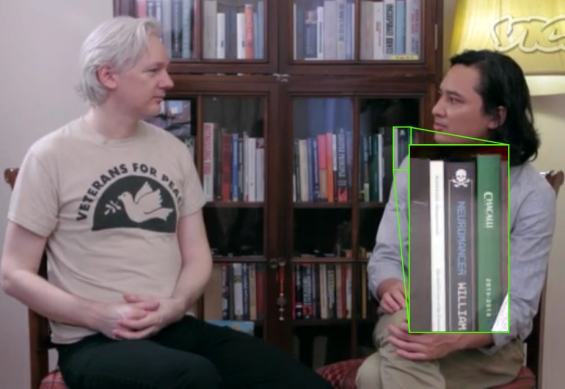
Julian Assange has a copy of Neuromancer by William Gibson

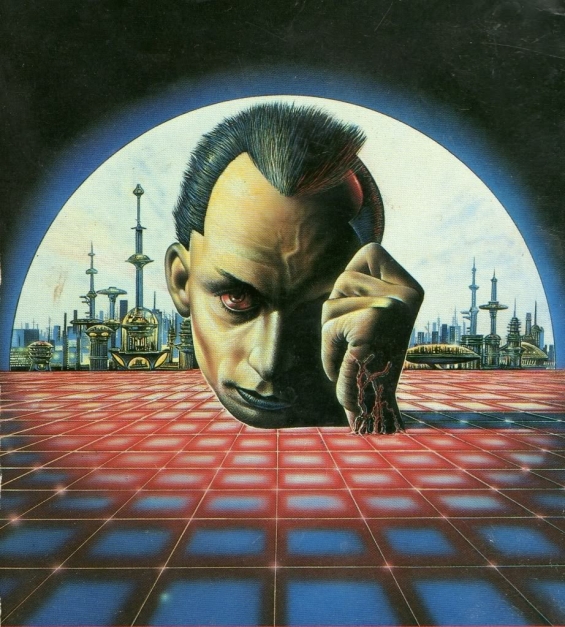
NEUROMANCER - illustration by Barclay Shaw

Posted by Jesse Willis

CBC Q: Interview with Margaret Atwood

SFFaudio Online Audio

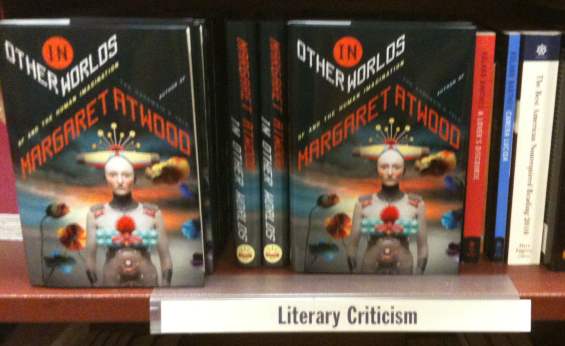
CBC Radio One - Q: The PodcastHost Jian Ghomeshi of CBC Radio One’s Q has an astounding new interview with Margaret Atwood. Atwood’s latest book, In Other Worlds: SF And The Human Imagination, can be found in the “Literary Criticism” section of your local paperbook store.

Gomeshi talked to Atwood about the realistic novel, comics, Weird Tales and the “sluttish” reputation of SF.

In Other Worlds by Margaret Atwood

One point in the interview left me confused and asking questions. Atwood claimed that “Conan the Barbarian is the literary descendant of Walt Whitman … and Henry James”.

I am floored.

What the fuck is she talking about?

Seriously, did she misspeak?

Did she mean to say that Robert E. Howard himself was their literary descendant?

Surely she didn’t mean the the character. Either way I don’t get it.

Or maybe she meant the stories themselves were somehow in the tradition of Walt Whitman and Henry James??? How could that be?

No matter how I look at it I don’t see how either Walt Whitman or Henry James ties into Howard. It just doesn’t make any kind of sense to me.

Does anybody know what the hell Atwood meant by that?

Seriously, I do not get it.

Will I have to buy her book to understand this thesis?

Have a listen |MP3|.

Podcast feed: http://www.cbc.ca/podcasting/includes/qpodcast.xml

Posted by Jesse Willis

P.S. CBC, please release Apocalypse Al. You can call it “scientific romance” or something else, just release it.

Review of Ready Player One by Ernest Cline

SFFaudio Review

Ready Player OneReady Player One
By Ernest Cline; Read by Wil Wheaton
15 hours 46 minutes [UNABRIDGED]
Publisher: Random House Audio
Published: 2011
ISBN: 0307913147
Themes: / Gaming / Virtual Reality / 1980s nostalgia / Dystopia / Near-Future /

Sample |MP3|

It’s the year 2044, and the real world is an ugly place. Like most of humanity, Wade Watts escapes his grim surroundings by spending his waking hours jacked into the OASIS, a sprawling virtual utopia that lets you be anything you want to be, and like most of humanity, Wade dreams of being the one to discover the ultimate lottery ticket that lies concealed within this virtual world. For somewhere inside this giant networked playground, OASIS creator James Halliday has hidden a series of fiendish puzzles that will yield massive fortune—and remarkable power—to whoever can unlock them.  

And then Wade stumbles upon the first puzzle…

If you are a pop culture junkie, or a gamer, or a virtual world inhabitant, this is the book for you.   It was such great fun that I found myself making up reasons to listen to the audio book.  Wil Wheaton has become one of my favorite readers, especially at 1.5 speed.  His casual tone is perfect here.

Don’t be turned away by people who claim that this book is pure nostalgia.  While not heavy-handed, and arguably YA in tone, I found it to be thoughtful on issues of identity in an increasingly virtual world.  And just try imagining the new cities of stacked mobile homes without smiling!

Other fun things – author Ernest Cline has a vibrant blog for the book, including a RP1 Game.  He even posted a Spotify playlist featuring most of the music mentioned in the book.  If that can’t get you in the mood for a little nostalgic romp, you are dead on the inside. Dead!

Posted by Jenny Colvin

The First Edition – interview with Isaac Asimov and Frederik Pohl

SFFaudio Online Audio

TVOF - The Voices Of FandomForgive me, I’ve posted part of this before, but it’s good enough to post twice. Frederik Pohl and Isaac Asimov were interviewed for a 1972 show called The First Edition. Apparently the show never aired, and was never edited.

“THE FIRST EDITION – FIRST SHOW – 1972 – Raw interview material for unfinished show”

Part 1 |MP3| Part 2 |MP3|

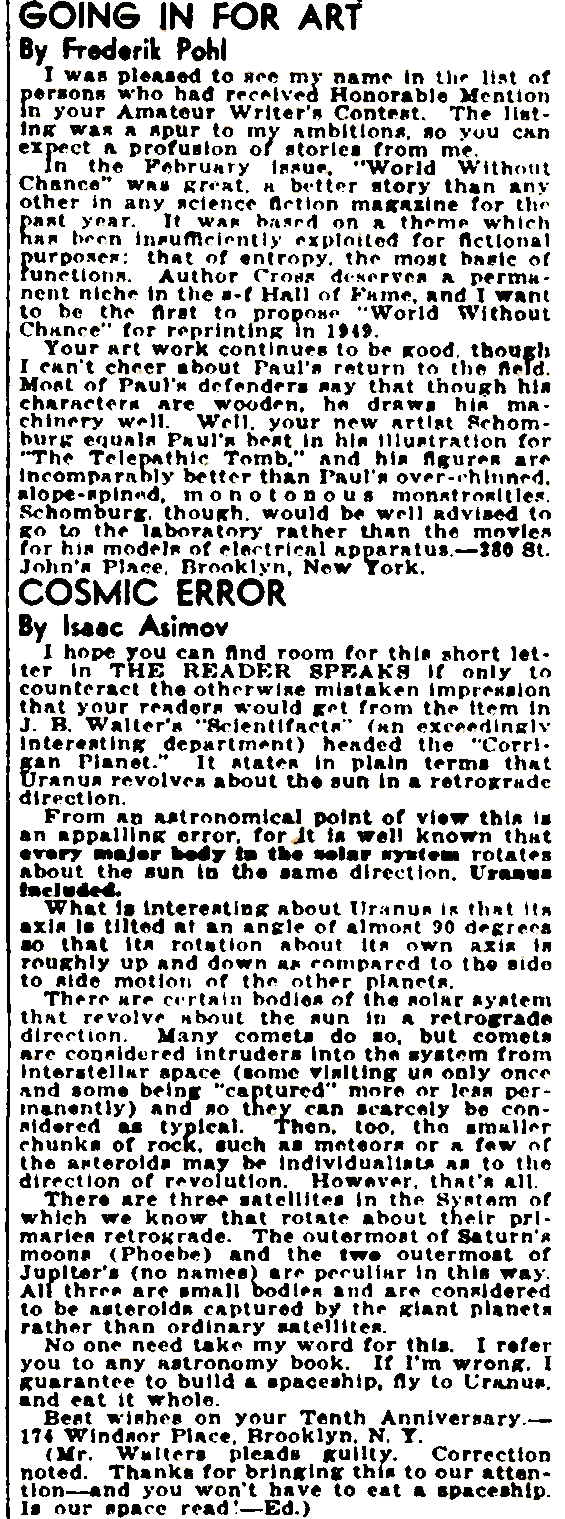
I repost the interview, in part because of how damn cool it is, and also in part because it is just the excuse I need to post what might very well be Frederik Pohl and Isaac Asimov first appearance together in print (in the letters column of the June 1939 issue of Thrilling Wonder Stories). Be sure to listen, it’s a terrific interview! In it Asimov responds to the “New Wave” and attacks neo-Luddites, and Pohl protests the takeover of Science Fiction by the “English lit majors” (Pohl didn’t finish high school).

Be sure to read the letters below in which the two Brooklyn boys, Fred and Isaac, grumble about SF. Pohl has some sharp words for the art of Frank R. Paul and Asimov swears he will eat Uranus!

Frederik Pohl and Isaac Asimov in the letters column of Thrilling Wonder Stories - June 1939

[via The Voices Of Fandom and with props to “Burbank396”]

Posted by Jesse Willis

The SFFaudio Podcast #121 – READALONG: Forever Peace by Joe Haldeman

Podcast

The SFFaudio PodcastThe SFFaudio Podcast #121 – Scott, Jesse, Tamahome and Gregg Margarite talk about Joe Haldeman’s novel Forever Peace.

Talked about on today’s show:
The Forever War, Forever Peace, Forever Free, Haldeman’s experiences in South-East Asia (during the Vietnam War), William Mandella, Mandala, Julian Class, Philip Klass (William Tenn), racism, remotely controlled soldier robots, jacks, empathy, sharing menstruation, baldness as a fashion, the nanoforge (a molecular nanotechnology), caper, Stranger In A Stranger Land, heist, “two novellas smushed together”, John W. Campbell, Ben Bova, self help groups, one conceit that remains unexamined, magic machine (aka a sub-atomic replicator), Mack Reynolds, telepathy, asymmetric warfare, prescience, Libya, Pakistan, the two peaces of Forever Peace, what of the aftermath?, applying Isaac Asimov’s Three Laws of Robotics to people, Gregg is a creature capable of killing, not everyone wants to be the black sheep, is 98% of humanity humanizable?, the earth where everyone is gay, the earth where everyone is a clone, “a giant of SF”, The Memory Of Earth by Orson Scott Card, The Moon Is A Harsh Mistress, do you grok the group?, “The Hammer of God”, Jonestown, David Koresh, a religion that requires you believe in evolution, punctuated equilibrium, treating the bible like a science book (is problematic), we’re gonna drill into you brain and then you won’t have those feelings anymore, a utopian dystopia, Malthusian theory, the singularity, A Clockwork Orange, moral conviction vs. physical restriction, Gregg needs his murderer (and we do too), Starship Troopers, false consciousness, Women’s Studies, The Tea Party,

“False consciousness is the Marxist thesis that material and institutional processes in capitalist society are misleading to the proletariat, and to other classes. These processes betray the true relations of forces between those classes, and the real state of affairs regarding the development of pre-socialist society”,

following orders (as false consciousness), Stockholm syndrome, identifying with your oppressor, why do people do things that are against their own interests?, Costa Rica, withholding technology vs. holding resources hostage, Plato’s cave, “from each according to his ability, to each according to his need”, is Jesse making an argument for absolute truth?, what is truth?, “one person’s murder is another person’s dinner”, “God exists or he doesn’t exist”, “assuming we agree on the definition of God”, “we have a bedrock of truth”, Aristotle’s law of non-contradiction, “we’re here and we’re invading your software”, our perception of reality changes, “how can it not always be this way?”, “it’s The Matrix“, Gregg can find reasonable doubt in his own existence, Cogito Ergo Sum (I think therefore I am), René Descartes, “I doubt therefore I am”, Tama has no take, good and bad vs. right and wrong, a mass of conflicting impulses (ambivalence), Heinlein’s militaristic thinking vs. Haldeman’s militaristic thinking, Heinlein’s Future History series, religious conversion, telepathy vs. total immersion, Jonathan Swift, “you can’t reasons someone out of something they weren’t reasoned into”, there are two tenets in Greggism, what you believe doesn’t has to be true, Alan Moore’s personal made-up religion, Scott isn’t a Catholic because of feeling alone, Joseph Campbell “everything is true”, “he was born with a plowshare”, magical thinking, “that’s true for you and that’s fine”, a religious wacko who wants to end the world seems like a tired villain, Source Code, Moon is fantastic (but Source Code is not), the Norwegian whack job, can’t we find another kind of religion, Carl von Clausewitz, The Operative from Serenity (played by Chiwetel Ejiofor), effective villains, Robert E. Lee, Adolph Hitler vs. Joseph Stalin vs. Mao Zedong, the Tehran Conference, “Uncle Joe”, Stalin’s ending was noir, Pandora’s Star by Peter F. Hamilton has a great (and dirty) villain, Orson Scott Card’s Buggers, Speaker For The Dead, Ender’s Game, zombies are like a force of nature, Heinleinian villains are not diabolical, the ultimate orbital platform, the English Empire, “besides we’re better than you”, why do English actors always play villains? American accents = movie stars, Vancouver is a science fiction ghetto, iambk audio, the proper pronunciation of “about” in Canada, shock vs. shark, accents are lazy ways of speaking, George Wilson (the narrator of Forever Peace), P.G. Wodehouse, Bertie and Jeeves, the secret language of (drunken) Cockneys, no stupid voices please (in audiobooks), if you hire Nicholson for you movie your movie is a Jack Nicholson movie, Gregg’s signature voice may lose him work, why does the narrative switch between first and third person throughout Forever Peace, Yes, Minister, Goodreads.com, senior civil servant (3rd person) vs. elected official (1st person), The Long Habit Of Living by Joe Haldeman, The Forever War is told in first person (right?)

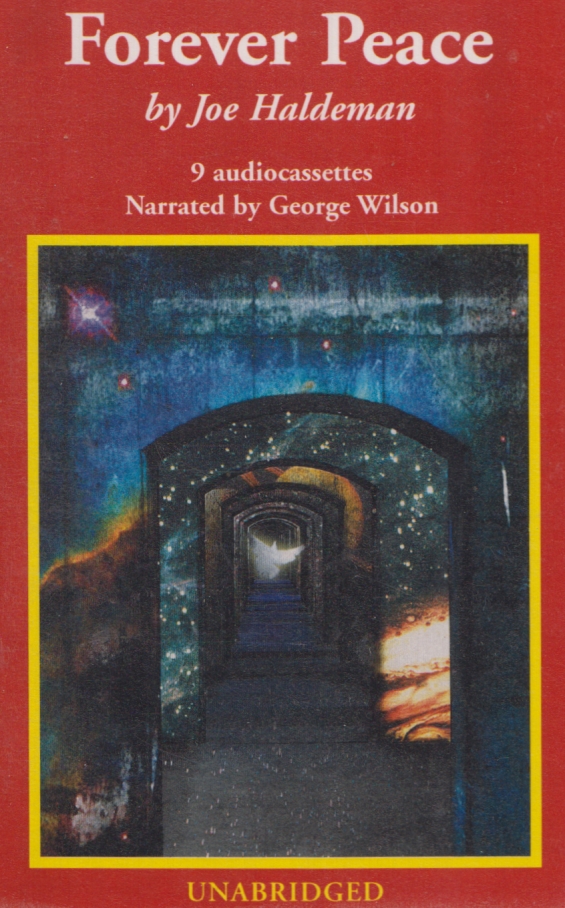
RECORDED BOOKS - Forever Peace by Joe Haldeman

Posted by Jesse Willis

The A-Men by John Trevillian

SFFaudio Online Audio

The A-Men by John TrevillianAuthor John Trevillian writes in to point out that his novel The A-Men is available as an unabridged podcast reading. Sez Trevillian:

“This is a full and unabridged audio podcast recording of the science fiction novel The A-Men by John Trevillian. Mixing dystopian future, cyberpunk and urban noir, join The Nowhereman, Sister Midnight, Pure, D’Alessandro and the 23rdxenturyboy as they fight for their lives in a dark and dangerous metropolis on the eve of its destruction.”

The sequel, The A-Men Return, is also available as both a paperbook and an ebook.

Podcast feed:

http://trevillian.libsyn.com/

Posted by Jesse Willis