News, Reviews, and Commentary on all forms of science fiction, fantasy, and horror audio. Audiobooks, audio drama, podcasts; we discuss all of it here. Mystery, crime, and noir audio are also fair game.
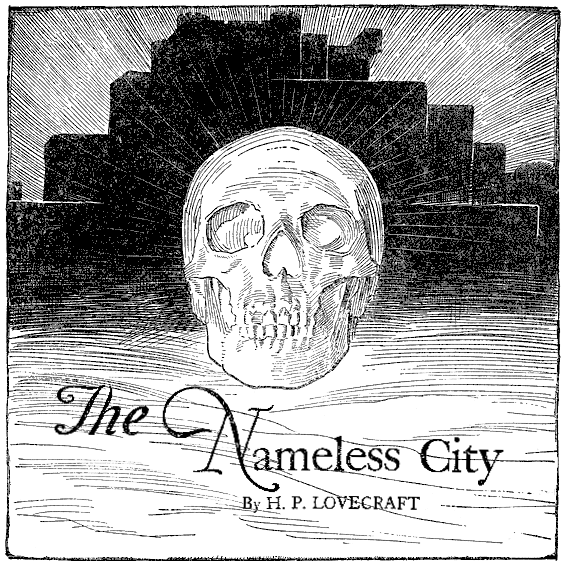
H.P. Lovecraft’s 5,000 word short story, The Nameless City, was based one of his dreams. That dream, in turn, was inspired by the last line of Lord Dunsany’s story The Probable Adventure Of The Three Literary Men, a story from 1911 (itself available as an |MP3| from LibriVox). Indeed, the line is even quoted within the tale:
“the unreverberate blackness of the abyss”
The eponymous, anonymous, city itself seems to have been inspired by “Iram, the City of Pillars” which was a mysterious lost city – a kind of “Atlantis of the Sands” – that is mentioned in the Quran.
And for all those reasons The Nameless City is certainly worth looking at, if you can find it.
To help I’ve assembled a |PDF| made from a scan of the story, as published in the November 1938 issue of Weird Tales.
And here are several freely available narrations:
The Nameless City
By H.P. Lovecraft; Read by Mark Nelson
1 |MP3| – Approx. [UNABRIDGED]
Publisher: LibriVox.org
Published: January 23, 2008 It lay silent and dead under the old cold desert moonlight, but what strange race inhabited the abyss beneath those cyclopean ruins? First published in The Wolverine, No. 11, November 1921.
The Nameless City
By H.P. Lovecraft; Read by Scott Carpenter
1 |MP3| – Approx. 28 Minutes [UNABRIDGED]
Publisher: LibriVox.org
Published: October 19, 2008 It lay silent and dead under the old cold desert moonlight, but what strange race inhabited the abyss beneath those cyclopean ruins? First published in The Wolverine, No. 11, November 1921.
The Nameless City
By H.P. Lovecraft; Read by Rebecca M.L.
1 |MP3| – Approx. 31 Minutes [UNABRIDGED]
Publisher: LibriVox.org
Published: April 14, 2011 It lay silent and dead under the old cold desert moonlight, but what strange race inhabited the abyss beneath those cyclopean ruins? First published in The Wolverine, No. 11, November 1921.
The Nameless City
By H.P. Lovecraft; Read by Michael Scott
1 |MP3| – 28 Minutes [UNABRIDGED]
Podcaster: Yog Radio
Podcast: May 7, 2006 It lay silent and dead under the old cold desert moonlight, but what strange race inhabited the abyss beneath those cyclopean ruins? First published in The Wolverine, No. 11, November 1921.
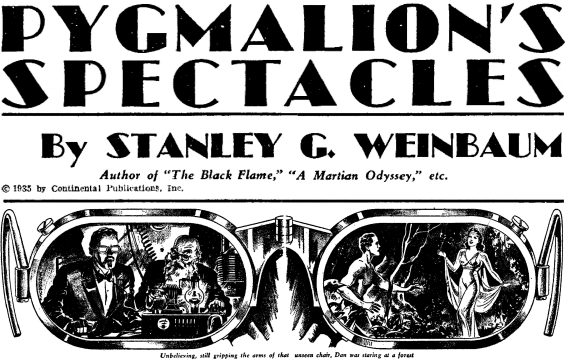
Pygmalion’s Spectacles was first published in 1935 in the aptly named Wonder Stories magazine. Four years after it’s first publication it was reprinted in Startling Stories as a “classic” and it was placed in their “Scientifiction Hall Of Fame.” It was reprinted again in Fantastic Story magazine in the Spring 1955 issue. Three magazine publications is a rare occurrence for any SF story. So, what makes this story special?
Well, this tale of utopia, immortality, and romance, is also, most probably, the very first story to feature the concept of virtual reality.
A comprehensive and specific fictional model for virtual reality was published in 1935 in the short story Pygmalion’s Spectacles by Stanley G. Weinbaum. In the story, the main character, Dan Burke, meets an elfin professor, Albert Ludwig, who has invented a pair of goggles which enable “a movie that gives one sight and sound […] taste, smell, and touch. […] You are in the story, you speak to the shadows (characters) and they reply, and instead of being on a screen, the story is all about you, and you are in it.”
And though the ideas may be pioneering, the plot of Pygmalion’s Spectacles is very similar to Fitz-James O’Brien’s The Diamond Lens, itself an excellent SF tale. The tone of their respective endings differs, but their plot, in which a man falls in love with an intangible woman, is straight out of the Greek mythology that Weinbaum alludes to. And they both use science, rather than magic to get to their respective endings.
There is, I should also point out, a LibriVox |MP3| recording of the Metamorphoses by Ovid, a 2,000 year old poem featuring the myth of Pygmalion.
Here is a |PDF| made from the Pygmalion’s Spectacles publication in Fantastic Story. And here are two LibriVox versions (my advice, go for the first one):
Pygmalion’s Spectacles
By Stanley G. Weinbaum; Read by Gregg Margarite
1 |MP3| – Approx. 43 Minutes [UNABRIDGED]
Publisher: LibriVox.org
Published: January 13,2009 He put on the glasses and fell in love with a dream… First published in Wonder Stories, June 1935.
Pygmalion’s Spectacles
By Stanley G. Weinbaum; Read by Chrystal Layton
1 |MP3| – Approx. 45 Minutes [UNABRIDGED]
Publisher: LibriVox.org
Published: November 17, 2007 He put on the glasses and fell in love with a dream… First published in Wonder Stories, June 1935.
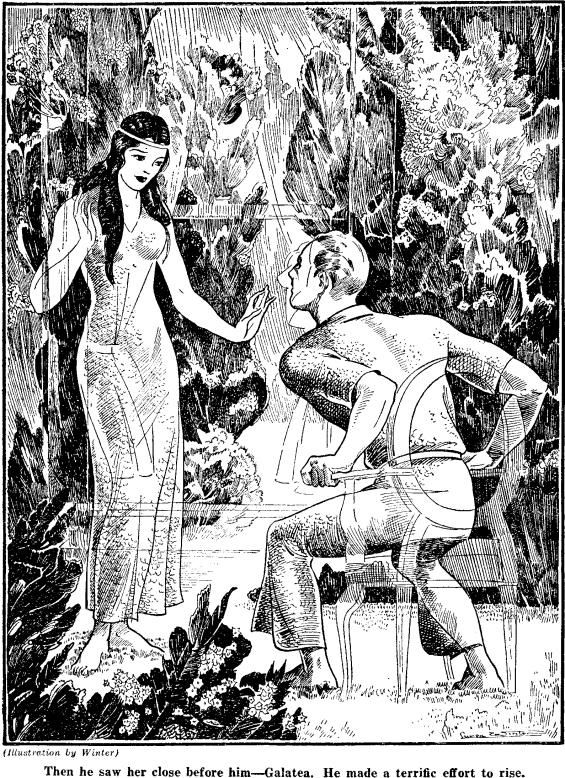
Pygmalion’s Spectacles illustration by Lumen Winter (from Wonder Stories, June 1935):
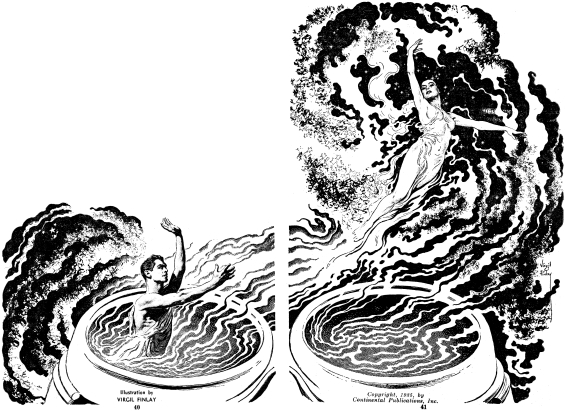
Pygmalion’s Spectacles illustration by Virgil Finlay (from Fantastic Story Magazine, Spring 1955):
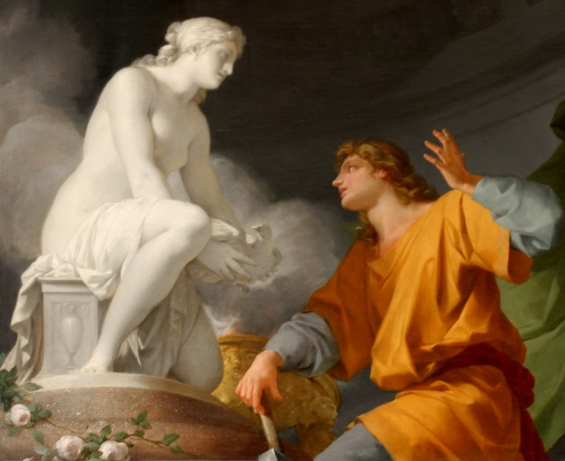
Painting of Pygmalion and the statue by Jean-Baptiste Regnault:
I have read The Diary Of A Madman and yet you, who so monomaniacally have not, have not!
Barely a short story, more a fragment, The Diary Of A Madman by Guy de Maupassant is a tale arguably more influential, and insightful, than any written since the start of the twenty-first century.
So how come I’m betting you still haven’t not read it?
Maybe it’s because you, living in the world that you do, value the new more than the old.
“The bestseller” is a social phenomenon, not a gauge of quality.
And that’s why you haven’t read it, and why you think me mad.
But I ask you, with all this laid before you …. which of us is truly the madman?
The Diary Of A Madman
By Guy de Maupassant; Read by Tom Hackett
1 |MP3| – Approx. 10 Minutes [UNABRIDGED]
Publisher: LibriVox.org
Published: July 11, 2009
First published in 1885.
The Diary Of A Madman
By Guy de Maupassant; Read by Alan Davis Drake
1 |MP3| – Approx. 13 Minutes [UNABRIDGED]
Publisher: LibriVox.org
Published: May 31, 2008
First published in 1885.
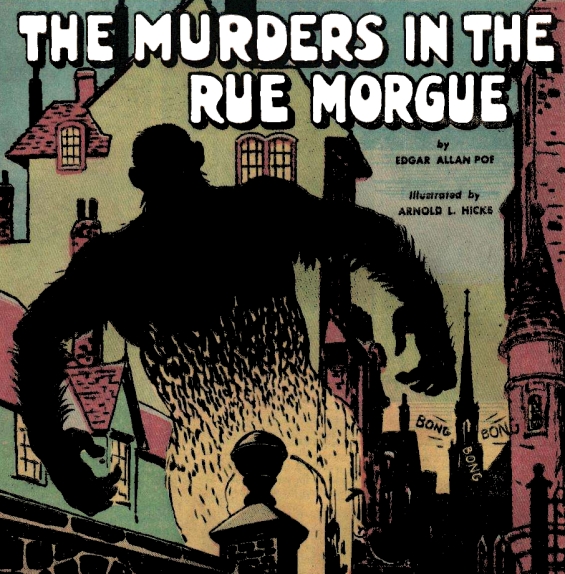
Here’s a public domain version of The Murders In The Rue Morgue.
The Murders In The Rue Morgue
By Edgar Allan Poe; Read by Reynard T. Fox
1 |M4B|, 3 Zipped MP3s or Podcast – Approx. 1 Hour 34 Minutes [UNABRIDGED]
Publisher: LibriVox.org
Published: October 30, 2007
“The Murders in the Rue Morgue is a short story written by Edgar Allan Poe in 1841. Poe referred to it as a “tale of ratiocination” featuring the brilliant deductions of C. Auguste Dupin; it is today regarded as one of the first detective stories and is almost certainly the first locked room mystery.”
|ETEXT|
Wow! I’m loving this story, as narrated by John Feaster. Sez Feaster of his narration “it’s more a performance than a reading” and that’s absolutely true – Feaster seems to be taking the events of the plot very personally, and that lends power to what is the sort of twistily fantastic tale you’d see on something like Alfred Hitchcock Presents. And yet, Achmed Abdullah’s pulpy writing seems damned good too!
And, if even half the stories about the author, as detailed over on the Wikipedia entry for him, are true, he may be one of the most fascinating writers I’d never heard of.
Alexander Nicholayevitch Romanoff (aka Achmed Abdullah) was, apparently, a Russian born relative of the last Czar, the son of an Afghan princess, an Academy Award nominated scriptwriter, an officer in the British, Indian, and Turkish armies (serving in India, Afghanistan, Tibet, Africa, China, and Turkey), as well as being a Muslim, a Catholic, and a spy!
Fear
By Achmed Abdullah; Read by John Feaster
1 |MP3| – Approx. 22 Minutes [UNABRIDGED]
Publisher: LibriVox.org
Published: June 19, 2010
First published in Detective Story Magazine, 1919.
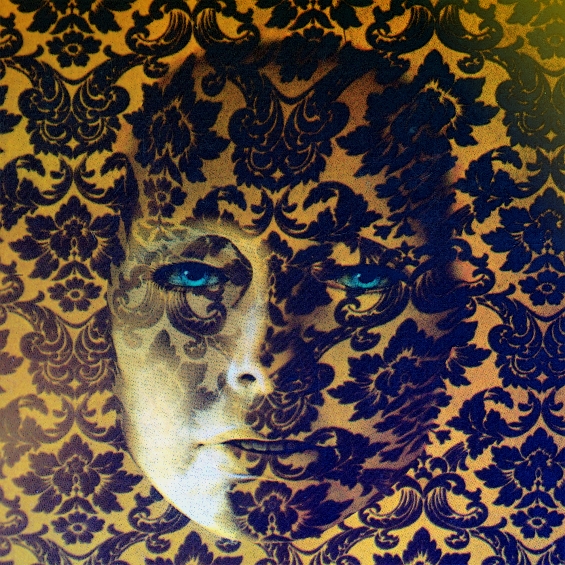
The SFFaudio Podcast #178 – An unabridged reading of The Yellow Wallpaper by Charlotte Perkins Gilman (32 minutes, read for LibriVox by Michelle Sullivan) followed by a discussion of it. Participants in the discussion include Jesse, Tamahome, Jenny Colvin, and Julie Hoverson.
Talked about on today’s show:
Charlotte Perkins Gilman vs. Charlotte Perkins Stetson, wall-paper vs. wallpaper, a seminal work of feminist fiction, a ghost story, a psychological horror story, the Wikipedia entry for The Yellow Wallpaper, Alan Ryan, “quite apart from its origins [it] is one of the finest, and strongest, tales of horror ever written. It may be a ghost story. Worse yet, it may not.” postpartum depression, “the rest cure”, phosphates vs. phosphites, condescending husbands, infantilization of women, superstitions, is she dangerous?, is she only pretending to go insane or is she actually mad?, will reading The Yellow Wallpaper drive you to insanity?, an androcentric society, Titus Andronicus by William Shakespeare, Life by Emily Dickinson
MUCH madness is divinest sense
To a discerning eye;
Much sense the starkest madness.
’T is the majority
In this, as all, prevails.
Assent, and you are sane;
Demur,—you ’re straightway dangerous,
And handled with a chain.
Jenny is the husband’s sister (or mistress?), “gymnasium or prison, she doesn’t know she’s living in a short story”, does the family think she’s crazy a the story’s start?, biting the bed is a bit suspicious, barred windows, suicide, has she forgotten that she’s the wrecked the wallpaper to begin with, a haunted house vs. a haunted woman, is the supernatural only within minds?, Julie goes crazy without something to read, first time motherhood can be a struggle, duplicity, crazy people are known to make unreasonable requests, “why is the cork on the fork?”, Dirty Rotten Scoundrels, what’s the rope for?, “all persons need work”, counting the holes, are women moral by default?, Herland by Charlotte Perkins Gilman, utopia, “everything is both beautiful and practical”, the eighteenth amendment to the U.S. Constitution (prohibition), the husband faints (and so she wins?), creeping vs. crawling, the creepiest ending, smooch vs. smudge, neurasthenia, William James (brother of Henry James), “Americanitis”, the fashion of being sick, hypochondria as a fad, the “fresh air” movement, Kellogg’s cereal 9and other patented medicines), a yogurt colonic, mental illness is shameful in Asia, mental illness vs. oppression, an absolutely unreliable narrator, Stockholm syndrome style thinking, “You think you have mastered it, but just as you get well under way in following, it turns a back-somersault and there you are. It slaps you in the face, knocks you down, and tramples upon you.” worrying a tooth, tooth loss as an adult is horrific, as a kid it’s fun, why are we rewarded by the tooth-fairy?, is the tooth-fairy universal?, was chronic fatigue syndrome a fad?, fame is popular, Münchausen’s syndrome (the disease of faking a disease), take up a hobby!, distinguishing genuine from real, syndrome (symptoms that occur together) vs. disease (dis-ease), “which is worse…”, how to look at doctors, Tam’s doctor is nicer than House, M.D., witch doctors, non-invasive cures, gallium, Vitamin C, The Disappearing Spoon: And Other True Tales of Madness, Love, and the History of the World from the Periodic Table of the Elements by Sam Kean, Julie Hoverson’s reading of The Yellow Wallpaper, the unnamed narrator (let’s call her Julie), “what’s with the plantain leaf?”, a modern version of The Yellow Wallpaper would be set at fat camp (is that The Biggest Loser), starts off, Flowers In The Attic by V.C. Andrews, arsenic doughnuts (are not Münchausen syndrome by proxy), The Awakening by Kate Chopin, civilizing influence, bathing!, “men know what side their sex is buttered on”, In The Next Room (or The Vibrator Play) by Sarah Ruhl, Changeling (screenplay by J. Michael Straczynski), what is your Yellow Wallpaper?, fiction is Jesse’s wallpaper, ‘tv, videogames, comics … none of these make you crazy’, heroin chic, Julie has many yellow papers, Tam’s yellow wallpaper is the bookstore, Sebastian Junger vs. J.G. Ballard, 1920s, The Great Gatsby by F. Scott Fitzgerald, posing gowns, identical wigs, Jenny’s yellow wallpaper is dreams, The Evil Clergyman (aka The Wicked Clergyman) by H.P. Lovecraft, nice wallpaper, authorial self-interpretations, Eric S. Rabkin, re-reading as an adult something you read as a kid, The Prince Of Morning Bells by Nancy Kress, The Portrait Of A Lady by Henry James, The Lord Of The Rings by J.R.R. Tolkien, old time radio comedies, should you read fiction from the beginning? Start with Canterbury Tales by Geoffrey Chaucer?, Hyperion by Dan Simmons, Jonathan Swift, Peter F. Hamilton, E.E. ‘doc’ Smith, Mastermind Of Mars by Edgar Rice Burroughs.


 The Nameless City
 The Nameless City