Review of The Magician King by Lev Grossman

SFFaudio Review

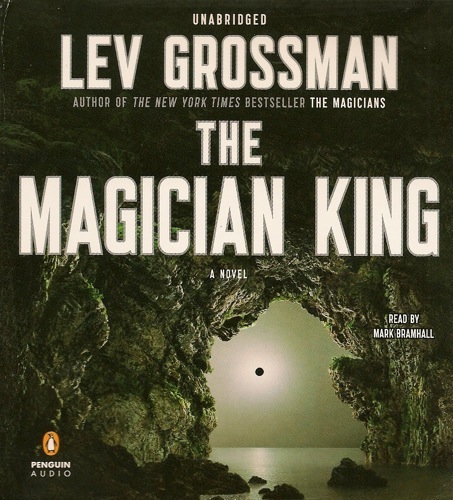
Fantasy Audiobook - The Magician King by Lev GrossmanThe Magician King
By Lev Grossman; Read by Mark Bramhall
13 CDs – Approx. 16 Hours [UNABRIDGED]
Publisher: Penguin Audio
Published: 2011
ISBN: 1611760259
Themes: / Fantasy / Magic / Wizard School / Alternate Worlds / Gods /

What does it mean to be the Hero on a Quest? What does it cost? Perhaps this is something you might want to find out before you go looking everywhere for one.

It is two years since the final scene in The Magicians (Read the Review). Quentin Coldwater is now one of the Kings of Fillory, that Narnia-esque fantasy land from the series of books he read as a child. Fellow King and Queens are fellow Brakebills Academy graduates Elliot, the self-obsessed fop, and Janet with whom Quentin had a very brief dalliance, with tragic consequences. There are to be two Kings and two Queens of Fillory with Quentin’s pre-Brakebills friend Julia taking the fourth crown.

Quentin is still emotionally scarred from the tragedies of the first book and is struggling to find a reason in his life. Again this leads him towards a search for a Quest. Despite being a King in a magical realm where you would have to go far out of your way to prevent the land from producing a bountiful harvest. It still isn’t enough, Quentin feels the need to be doing something important. One thing the Fillory was good for in the books about it that he read while growing up, was that the Chatwin children always had a quest to complete when they visited.

After a false start on a quest involving a madly thrashing over-sized clock-tree, Quentin embarks on a trip to the most remote island of the realm of Fillory. To collect on unpaid taxes. He was getting desperate to find his quest and this come up at the wrong time. Never mind that the cost of outfitting the ship and getting there would out strip the value of the unpaid taxed several times over.

Accompanying Quentin on his fools quest is Queen Julia. In The Magicians Julia was the school friend that also sat the Brakebills entrance exam, but didn’t make the cut. Half of The Magician King is told from Julia’s perspective, as we follow what brought her from failing that exam to where we found her floating in the air beside Elliot and Janet at the end of The Magicians. This half of the book is the more compelling of the two as we learn about the world of Magic that isn’t controlled by the establishment as exemplified by the Brakebills Academy.

The main quest that Quentin and Julia follow, The Search for the Seven Golden Keys of Fillory, inadvertantly takes them out beyond the furthest isle of Fillory and lands them in the one place neither of them ever wanted to be. Back home of Earth. Although Earth isn’t as magical as Fillory, there are still wonders here to be found, such as Dragons.

Julia is the real treasure in this novel. A minor character in the first book, she rivals and surpasses Quentin for the position of protaginist. Although half the book is written from Quentin’s perspective, you should pay close attention to Julia. The two halfs tell of the terrible path that this poor tortured woman drove herself along after glimpsing the secret world of Brakebills. She is a broken and empty shell as Queen Julia, slowly finding parts of herself as she and Quentin struggle to find the Keys that will prevent Magic from dissappearing from all of the different realities. Especially important to Fillory as it can’t even exist without Magic. For the Old Gods have returned. No, not Cthulu. The Gods who created the Neitherlands, and accidentily left open the loophole that allows humans to do magic at all.  Something got there attention and now they know that there is a loophole, and they are working to close it.

Quentin and Julia are both compelling characters. Quentin is still a bit of the Emo kid he was in the first book and his desire to be the Hero teaches him the cost real Heros must be prepared to pay. Julia through the two storylines has a woderful depth to her. She isn’t necessarily likeable, she is even more obsessive then Quentin in the flashback story. An obsession that costs her dearly.

Grossman’s world of Magic, although having some of the trappings of a Narial-like fairytale, it has much more in common with the original dark fairytales before they were sweetened for Victorian children. Magic is powerfull and the consequences, when they come, are swift, severe and utterly pittyless. We do get to see the awesome potential of the Magic that Quentin wields as he finds in himself the real Magician King. What he and his friends had been doing before was just playing with kid-gloves.

Mark Branhall again narrates, bringing out each character well and maintains consistent voices for characters from The Magicians.

This is a more developed narrative than the first book, which stood well on it’s own and didn’t leave you feeling there was a need for a sequel. The Magician King‘s story is also self-contained, but you should have read book one to appreciate it properly.

Posted by Paul [W] Campbell

Review of The Red Panda Adventures – Season 7

SFFaudio Review

If you haven’t already started listening to The Red Panda Adventures you’re doing yourself a grave disservice. Go back to the beginning and start with Season 1 (that’s HERE).

Superhero Audio Drama - The Red Panda Adventures - Season SevenThe Red Panda Adventures – Season 7
By Gregg Taylor; Performed by a full cast
12 MP3 Files via podcast – Approx. 6 Hours [AUDIO DRAMA]
Podcaster: Decoder Ring Theatre
Podcast: August 2011 – July 2012
Themes: / Fantasy / Superheroes / Mystery / Crime / Nazis / War / WWII / Adventure / Toronto / Androids / Espionage / Zombies / Magic / Aliens / Poetry / Astral Projection / Hypnosis / France / Germany / Berlin / Dinosaurs / Identity / Forgery / Romance /

The Red Panda Adventures is a comic book superhero series with a world, now in it’s seventh season, that is only comparable in scale to the entire Marvel or DC universes. But unlike either DC and Marvel, the Red Panda universe has all been written by one man, Greg Taylor. Because of that it has a consistency like the best seasons of Babylon 5.

The first episode of Season 7 follows right on the heels of last season’s final episode. In the season opener, From the Ashes, Kit Baxter gets a visit from the highest power in the land. And what with the Red Panda being presumed dead there’s only one thing to do – find a replacement for Canada’s greatest superhero. The government suggests that an unkillable machine, bent on vengeance, become the new Red Panda. And Kit, is fairly forced to accept the government’s choice. Now I won’t summarize any more of the plot. But, I will say this – Season 7 is a very different season than the previous six seasons.

What isn’t different is Taylor’s scripting. It’s still great, in fact its almost unbelievably great. Taylor has one of those highly distinctive writing styles, one that’s instantly recognizable – he’s like an Aaron Sorkin, a David Mamet, or an Ian Mackintosh. And with Taylor’s style comes a whole lot of substance too. He does incredible things with each half-hour script. Each standalone tale features a carefully measured combination of snappy repartee, genuine mystery, thrilling suspense, and clever action. And he does it all within a expanded universe so consistent so as to have become a kind of complete alternate history. His seven year series, and running, has created an image so vivid as to be completely realized. Taylor’s 1930s-1940s Toronto is far realer to me than any Gotham or Metropolis offered up in comics or movies. In fact to find anything comparable you’d have to go to the Springfield of The Simpsons!

Indeed, for the last seven years I’ve followed The Red Panda Adventures rather avidly and with each season I’ve become more engrossed in the show. The release of a new episode has become so inextricably linked to my listening habits so as to become like a good a visit from an old friend. It’s truly wonderful.

In my re-listening to the first eleven episodes of this Season 7 I picked up dozens and dozens of minor details in dialogue and plot that I’d missed the first time around. Take one point, early in the season, as an example – a character quotes the tagline of the CBS Radio series Suspense as a part of her dialogue.

How wonderful to find that!

And of course there are all the usual line echoes that we know from all past seasons (if you’re curious there’s a whole thread of Taylorisms over on AudioDramaTalk).

As for Season 7 as a whole, it has a sense of deep loss, very much in keeping with the times in which the story is set and the fallout from Season 6. Earlier I mentioned that Season 7 was unlike previous seasons, that’s because it features two overarching, and eventually intersecting, plots. The first, set in Toronto, deals with Kit Baxter, her new sidekick, her new job as associate editor of the Chronicle, and her developing pregnancy. The other plotline, set in Europe introduces us to a new character, a Lieutenant Flynn, a man in a deep denial, and his attempts to fight the Nazis behind their lines. It’s a radical change, and unforeseen change of pace, but not an unpleasant one.

The smaller scale stories from this season, like The Milk Run, work terrifically well too. As even the characters themselves will admit a plot about the forgery of rationing books doesn’t sound very dramatic next to the events unfolding in war torn France. But it’s a job that has to be done, and should be done, and done well it is. And that’s because the relatively harmless domestic crime of forgery is an important part of the story of WWII Toronto. The The Milk Run script tackles it in a way that makes it seem as if such a story could not not be told. In fact, this whole home-front end of the season’s story holds up very well next to the very dramatic later episodes.

One other such, The Case Of The Missing Muse, works very similairly. It’s a story in which we meet a super-villain, with a super-vocabulary, in a mystery that could have been set in any of the previous episodes. But what with the war time setting it of Season 7, and a new Red Panda running the show, it has a resolution that has its own unique wartime fit.

That replacement Red Panda, who in fact is a character from a previous season is still voiced by the wonderful Christopher Mott. The new Panda has a very different personality and temperament than our good friend August Fenwick. His goals as Red Panda are different, his methods are different, and it’s basically everything you like about when a hero regular superhero, from the comics gets, a replacement. It’s a new origins story – a fresh start – with all the promise that brings.

Some have argued that The Red Panda Adventures is really Kit Baxter’s story – and that certainly could be argued especially within the first arc of Season 7. Indeed, Kit Baxter, aka Flying Squirrel, does not get short shrift there. Besides her regular superhero duties, Kit’s also required to train the new Panda, fill in for the shattered Home Team (from last season) and somehow deal with the fact that her butler now knows she’s the Flying Squirrel! But that’s not all over at The Chronicle, the fictional Toronto newspaper that Kit works for, she, and we, get to visit with one of the best editor voices I’ve ever heard. Editor Pearly is your typical fatherly J. Jonah Jameson type caricature of an editor, but with a voice so crazily stressed out, a voice with lines so quickly delivered, you’ll barely understand a word he’s saying. It’s both fun and funny.

Then, just short of the midway point, a kind of focal transition takes place in between episodes 78 and 79, The Darkness Beyond and Flying Blind. The second arc begins slowly but soon ramps up. The aforementioned “Lieutenant Flynn”, and a team of commandos lead by one Captain Parker must escape from a Nazi stalag prison. Once achieved they spend much of the rest of the season either on the run or doing Special Operations Executive style missions in Nazi occupied France or in Berlin itself! And long time fans of the series will recognize the return of a certain Australian accented commando in one episode.

This new military aspect of the show is actually rather remarkable, being like a kind of Canadian version of WWII Captain America. It features a large male cast, allied soldiers, that act like something like a hybrid of the comics like Sgt. Rock, Sgt. Fury And His Howling Commandos, and The Unknown Soldier. Indeed, in the final episode of Season 7, The Black Heart, the show even gives a nice tip of the hat towards the later Nick Fury (the one who’s an agent for S.H.I.E.L.D.). That final season episode, incidentally, is set to be podcast later this month and features several other reveals, and dare I say reunions, which fans will be sure to love – I know I sure did. Suffice it to say, the Season 7 season-ender is definitely not a cliffhanger.

Here’s the podcast feed:

http://decoderring.libsyn.com/rss

Happy Canada Day everybody, go celebrate with some RED PANDA!

Posted by Jesse Willis

LibriVox: The Cats Of Ulthar by H.P. Lovecraft

SFFaudio Online Audio

The Cats Of Ulthar by H.P. Lovecraft

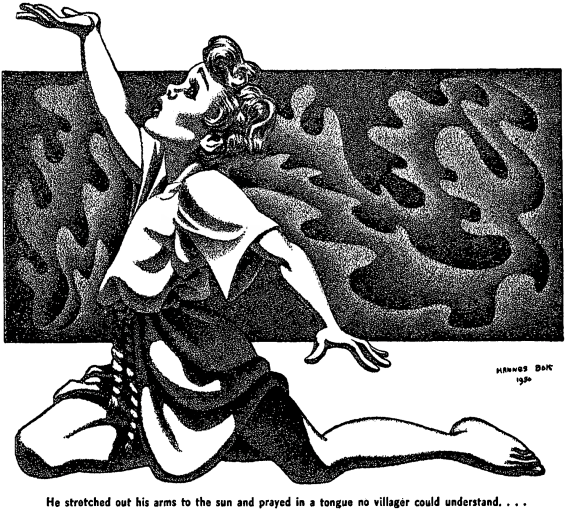
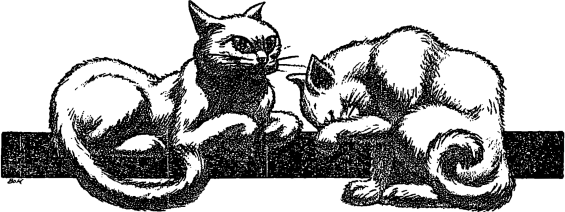
Hannes Bok illustration for The Cats Of Ulthar by H.P. Lovecraft

Hannes Bok illustration for The Cats Of Ulthar by H.P. Lovecraft

First published in Tryout, November 1920, The Cats Of Ulthar is an unusual tale by H.P. Lovecraft. It reads more like an old fashioned fairy tale than any other I’ve read. The story features a young boy named Menes who loves cats. Lovecraft probably took that name from the writings of a Greek historian named Diodorus Siculus who related a tale of a legendary Egyptian pharaoh named Menes that he heard from some crocodile-god priests. Menes it was said fled from his own dogs, who attacked him, while hinting. His escape was assisted by a crocodile. But no dogs or crocodiles are mentioned in The Cats Of Ulthar.

LibriVoxThe Cats Of Ulthar
By H.P. Lovecraft; Read by James Pontolillo
1 |MP3| – Approx. 9 Minutes [UNABRIDGED]
Publisher: LibriVox.org
Published: October 19, 2008
|ETEXT|
First published in Tryout, November 1920.

And here’s a |PDF| made from the publication in Fantastic Novels, January 1951.

Posted by Jesse Willis

The SFFaudio Podcast #157 – AUDIOBOOK: The Syndic by C.M. Kornbluth

Podcast

The SFFaudio PodcastThe SFFaudio Podcast #157 – The Syndic by C.M. Kornbluth, read by Mark Nelson.

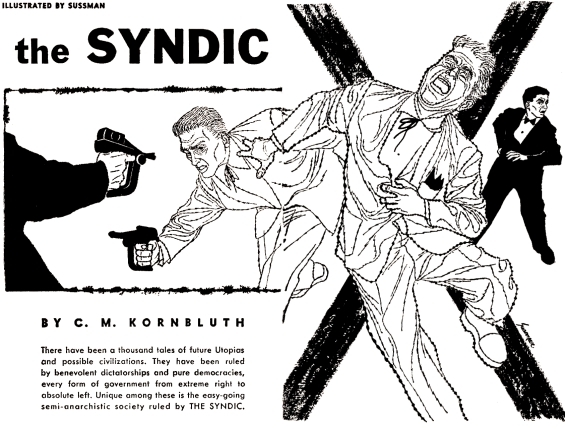
This UNABRIDGED AUDIOBOOK (6 Hours 20 Minutes) comes to us courtesy of SciPodBooks.com and WonderEbooks. The Syndic was first published in Science Fiction Adventures, December 1953 and March 1954.

Come back for our next episode (SFFaudio Podcast #158) to hear our discussion of it.

Here’s the etext |RTF| (Rich Text format).

The Syndic by C.M. Kornbluth - illustrated by Sussman

Posted by Jesse Willis

The SFFaudio Podcast #156 – READALONG: The Odyssey by Homer (Books IX – XII)

Podcast

The SFFaudio PodcastThe SFFaudio Podcast #156 – Scott and Jesse talk, in the third of a six part series, about the books IX, X, XI, and XII of The Odyssey.

Talked about on today’s show:
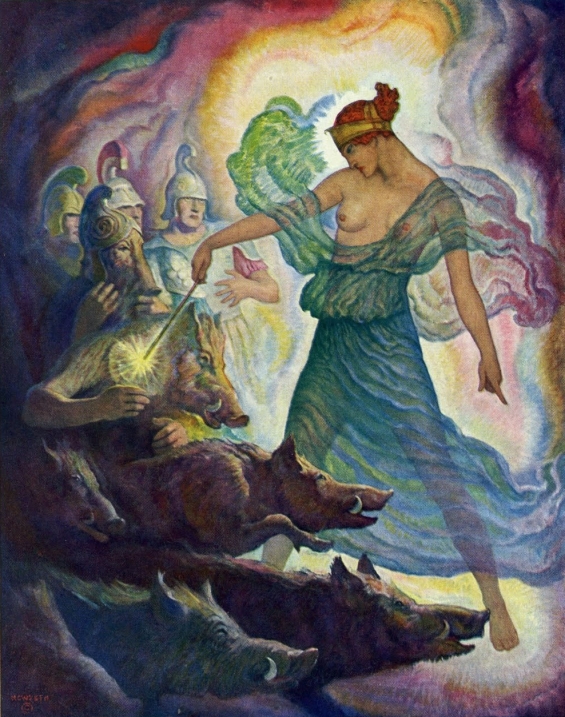
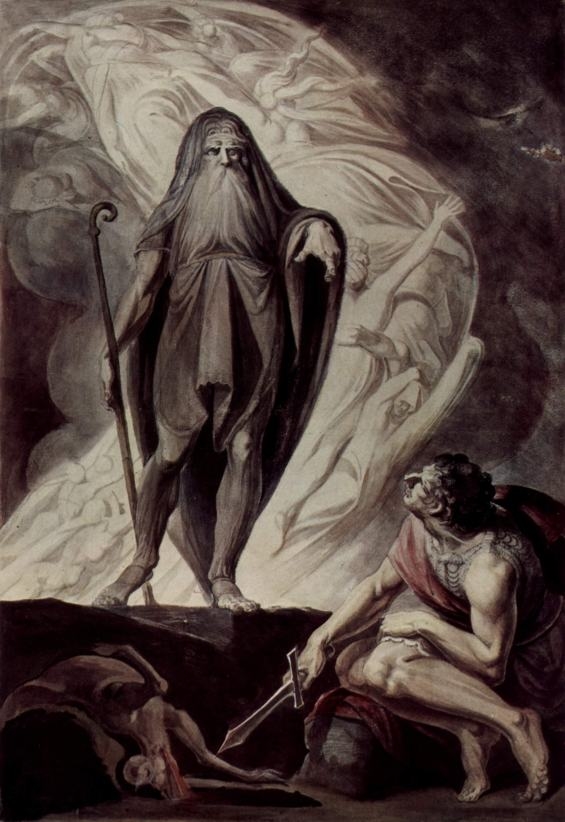
What’s the plural of cyclops?, cyclopskin?, cyclopean, Charybdis and Scylla, from this book many books have come, Philip K. Dick’s early fantasies are peppered with Odysseian goodness, Upon The Dull Earth, On Stranger Tides by Tim Powers, Odysseus is a smart liar, “my fame has reached the skies”, Telemachus runs the first four books, Odysseus in third person runs in the second four books, Odysseus in the first person runs the third four books, Calypso vs. Circe, “deep in her arching caverns”, the land of the lotus eaters, lotus addiction, Piper In The Woods by Philip K. Dick, “I’m a plant, doctor”, the 1968 Italian miniseries adaptation of The Odyssey (L’Odissea), why does Odysseus listen to the Sirens?, Circe’s wand, Hermes’ wand, the origin of wizards and sorceresses, Polyphemus, cheeses!, Beowulf, Grendel’s attack in the hall, Gilgamesh and Enkidu, a bachelor’s home vs. a maiden’s home, the cyclops island is a libertarian utopia!, Zeus vs. Poseidon, twenty-power wine!, manifest destiny, the guest gift, “I’ll eat nobody”, “I have a cunning plan my lord”, Odysseus is always messing with the gods, “you shameless cannibal”, the prophecy that Odysseus would blind Polyphemus, raider of cities, swag, Odysseus is not a righting-wrongs kind of hero, Polyphemus’ prayer to his father, Poseidon doesn’t make an on-screen appearance in The Odyssey, what is Aquaman’s hair colour?, Circe (the bewitching queen), Ian McKellan‘s narration of the audiobook, “and so he mounted her bed”, “breeding” great trust, tame lions and wolves, Eurylochus goes on the “away mission”, Eurylochus was “unmanned”, Hermes and the moly, the Wikipedia entry for moly, potions and poison, “The Book Of The Dead”, Cimmeria, Robert E. Howard, “the original Fantasy”, Odysseus becomes the bard, “one death is enough for both men, but you shall now have two”, Hercules, Achilles, Agamemnon is bitter about Clytemnestra murdering him, Charybdis and Scylla is like an old fashioned version of The Cold Equations, O’ Brother Where Art Thou, Dante’s Inferno, Paradise Lost, Riverworld by Philip Jose Farmer, The Aeneid, Strange Eden by Philip K. Dick, Star Trek (Who Mourns for Adonais?), Beyond Lies The Wub by Philip K. Dick, “oh boy”, Hyperion, Odysseus never takes the blame for anything, immortal zombie cows, how does Odysseus end up in that tree?, Ithaca at last!

N.C. Wyeth - Circe

Odysseus Performing The Nekyia

Posted by Jesse Willis

Review of The Name of the Wind by Patrick Rothfuss

SFFaudio Review

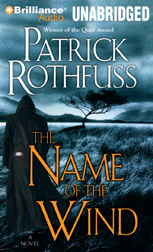
Fantasy Audiobook - The Name of the Wind by Patrick RothfussThe Name of the Wind
By Patrick Rothfuss; Read by Nick Podehl
28 hours – [UNABRIDGED]
Publisher: Brilliance Audio
Published: 2011
Themes: / Fantasy / Magic / Magicians / University /

The emperor may have clothes, but they didn’t fit me
A review by Brian Murphy

What do you want out of your fantasy? Exotic places? People different than the ones you know? High language? The clangor of battle? Wonders cold and distant and magnificent? The calling of silver trumpets? You don’t get any of this in Patrick Rothfuss’ The Name of the Wind. It feels very … pedestrian, and common. Rothfuss’ created world is very much like our own, and is altogether too much with us. Worst of all, its protagonist is annoying as hell. In my opinion.

I was fully prepared to love The Name of the Wind. I knew about the overwhelmingly positive reviews on Amazon, and the rave reviews from bloggers whose tastes and opinions frequently mirror my own. I was excited to see fantasy/SF luminaries like Robin Hobb, Ursula LeGuin, and Orson Scott Card (“He’s the great new fantasy writer we’ve been waiting for,” the latter wrote) singing its praises, and was fully prepared to do the same.

But the long and short of it is this: I didn’t love this book, and for long stretches, I didn’t even like it. Which makes me a bit sad, as I too was anticipating the arrival of a new great hope to emerge (or rescue, depending on your point of view) from the current crop of fantasy writers. As it turns out, I’m still waiting.

All that said, I recognize The Name of the Wind as a pretty solid artistic endeavor. In no way would I describe it as objectively bad, and the more I thought about it, I realized that it’s just not to my tastes. So I thought I would detail in this review why I didn’t like it, and then speculate on a few of the reasons why so many others have found it appealing. Of course, since I didn’t like The Name of the Wind very much, this review will spend much more time on the former, so be prepared.

The Name of the Wind is the first in a planned trilogy called The Kingkiller Chronicles. It details the life and times of a young man named Kvothe, a brilliant and talented magician doing his best to stay out of the limelight by posing as a simple innkeeper. When we meet Kvothe he’s in his early to mid 20s and is already a legend, though the events of his life have been exaggerated and mythologized. The Name of the Wind is essentially about a single day in which Kvothe sets the record straight for the loremaster Chronicler by giving the latter the full and true account of his youth and his subsequent rise to fame. We learn about Kvothe’s upbringing with a traveling group of minstrels and performers, to his days as a homeless street urchin, up through his first year at a University for wizards.

The Name of the Wind is epic fantasy length-wise (approximately 700 pages, and 23 discs in the audio version), but has nothing to do with J.R.R. Tolkien. It has everything to do with Harry Potter—Potter with a harder edge, yes, but Potter, unmistakably. When I read the description of the book and some of the reviews on Amazon I was expecting something closer to Ursula LeGuin’s Earthsea series—mythic, serious, a book with lessons to teach us about human nature and our place in the world. Instead I got a harmless, overlong soap opera.

I think we need a new name for this type of fantasy. This “positive” review (“Lovely and Undemanding” by Jo Walton or Tor.com) expresses one of my problems with the novel: its lightweight nature. Writes Walton, “It’s not very demanding—and I wonder if that’s precisely part of its wide appeal and success… I wonder if “undemanding” is something we actually seek in fantasy, if it’s part of the star quality that DAW instantly recognised in Rothfuss? … The Name of the Wind is a lovely read, but at the end there isn’t much to say about it.”

There is something to say about The Name of the Wind, of course, but the word that comes to mind is ordinary. I don’t mind applicability to the real world in my fantasy fiction, but what I don’t want is 1:1 equivalency. Aside from some sprinkled anachronisms (calling a week “a span,” or invoking the name of “Tehlu” instead of God) Rothfuss’ world is too much like our own. Half or more of the book is about Kvothe’s struggles with … student loans. Most of the problems Kvothe encounters are pedestrian: Young love, separation from his parents, completion of school projects on time, teachers who just don’t understand him. His college days also suffer from what I would call 90210 syndrome—despite the heavy workload we’re assured he’s suffering under, Kvothe seems to have endless time for hanging out with friends and sipping wine at the bar, or saving the town from marauding dragons. Which is much cooler than schoolwork, of course, but not entirely realistic. This is a problem, given that one of the conceits Rothfuss employs in The Name of The Wind is that he’s telling us a “real” story as opposed to a cliché fantasy. He uses the construction, “Now if this were a book, then X would have happened, but this is not a fantasy, and so here’s the real truth,” time and time again. But the problem is we never once feel like we’re in something other than a well planned, well coordinated, safe fantasy. Rothfuss does not have the maturity as a writer to pull off this conceit, in my opinion. Despite its claims to the contrary The Name of the Wind is a genre novel in every sense of the word. Again, that’s not a bad thing, and many readers have enjoyed it and will continue to do so. But let’s not pretend it’s anything more than another Belgariad.

This brings me to my first major problem with The Name of The Wind: I don’t like Kvothe. I don’t need to identify with the main character to enjoy a story, but I have to at least enjoy residing in their head space. I come up just short of actively despising the dude (Rothfuss does deserve praise for evoking that reaction in me, but I would bet it wasn’t his intent). The only way to explain Kvothe is that he is some avatar of the Gods. It’s utterly impossible for a boy his age to know what he knows. A precocious human child does not even come close to explaining his impossible adroitness and encyclopedic knowledge. Even after spending three years as a homeless street urchin, during which he did little but beg for coins and bread, Kvothe can rattle off every historical and anatomic question thrown at him by a brilliant panel of instructors to gain admission to the university. At one point he finds a dead man with a crossbow and knows how long the man has been dead, the type of crossbow he’s using, its cost, its usage, the fact that it’s illegal, etc. This is supposedly a medieval setting and yet what we have in Kvothe is a medieval McGyver, a walking Wikipedia page, applying scientific rigor and clear-headed rationality to every situation he encounters (another thing that irks me: The medieval tech level of Rothfuss’ world makes no sense. We have a college of brilliant teachers who have mastered anatomy and physics and every natural science known to man, yet are stuck reading rare books over candlelight and riding on horses).

One Amazon reviewer said that “Kvothe’s cockiness, arrogance, and impatience are constantly and quite believably landing him in trouble.” Except that they really don’t. Kvothe is not cocky and arrogant, save on a very superficial level. Impatient, yes. But his impatience lands him in minor scrapes from which he emerges undamaged or perhaps lightly scathed. He is, basically, perfect in every way, able to overcome every challenge with ease. For example, Kvothe takes the stage at a prestigious tavern to “earn his pipes,” a challenge which requires him to play before a tough, knowledgeable crowd to earn the distinction of master musician (yes, he’s an incredibly gifted lute player too. I didn’t mention that yet?). A jealous student sabotages Kvothe’s lute string so that it breaks at the height of his performance. But Kvothe is unflappable. It’s not even a real crisis, just a chance for Kvothe to again prove that he is that much better than we could have even thought. He finishes the most difficult song in the land with five strings and doesn’t miss a beat. Afterwards the audience weeps uncontrollably. There always seems to be a crowd around to applaud his every word. Hordes of faceless onlookers cheer his every act, applaud his every song, laugh at his every joke.

Kvothe’s only reported “fault” is his awkwardness with women and his inability to understand them, yet during one scene he compares his love Denna to a half dozen flowers with practiced, poetic ease, wooing her as no suitor before ever could. Denna returns the favor, spending paragraphs describing how Kvothe’s eyes change color when his emotions are aroused and how beautiful his red hair is. Kvothe flatters her back, telling her that only one other person has ever noticed that his eyes change color… this is bad romance novel stuff.

As for its originality? Sorry, I’m not seeing that either. The magic system seems very much cribbed from Ursula LeGuin, the conceit that knowing the true name of something grants you power over it.

So after all that grousing what is there to recommend about The Name of the Wind? At the sentence level Rothfuss is a pretty good writer. I think he’s better than Terry Brooks, and better than Stephen Donaldson. The Name of the Wind is compulsively readable, which is no mean feat. Stephen King has been labeled by a number of critics as pedestrian or lightweight, yet most of these guys can cite chapter and verse of his books and have apparently read all of them straight through. That’s because he’s so darned readable. So is Rothfuss. The story is easy to follow and carries you along to the end.

Second: Rothfuss gives you a lot of cool stuff to gawk at. Teachers engaged in a decades long war over the proper way to shelve books. A room where papers are cast to the wind and land on tiles labeled with “yes,” “no” and “maybe,” answering your questions unerringly like a medieval magic eight ball. And so on. Again, very Harry Potter-esque with its fine imaginative touches. Rothfuss also embeds lots of “Easter Eggs” and bits that prove significant later on, or lead the reader to speculate about their importance in the story. There’s lots of chatter by fans about why the evil Chandrian are so secretive, what the Underthing (mysterious passages and rooms beneath the school) are all about, and so on.

Yet a third reason: The Name of the Wind is a nice change of pace from the “GrimDark” fantasies of Joe Abercrombie, George R.R. Martin, and Richard Morgan, where everyone is a bastard and ends up raped, or dead, or both. We can cheer for Kvothe, and enjoy his scrapes, and perhaps remember what it was like to love our first girl with an unrequited love, or when we could barely scrape together six bucks on a Thursday night for a pizza.

In summary, The Name of the Wind is the product of a good writer with a lot of potential but did not deliver what I was looking for. Your mileage will vary, of course.

Posted by Brian Murphy