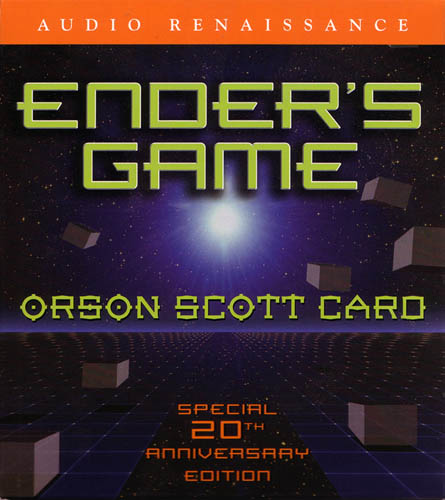
Review of Ender’s Game: Special 20th Anniversary Edition by Orson Scott Card
Science Fiction Audiobooks - Ender's Game by Orson Scott CardEnder’s Game: Special 20th Anniversary Edition
By Orson Scott Card; Read by Stefan Rudnicki, Harlan Ellison, Gabrielle de Cuir, David Birney and a FULL CAST
9 CDs – 10.5 hours [UNABRIDGED]
Publisher: Audio Renaissance
Published: 2004
ISBN: 1593974744
Themes: / Science Fiction / War / Children / Military / Politics / Spaceships / Space Station / Aliens /

Andrew ‘Ender’ Wiggin isn’t just playing games at Battle School; he and the other children are being tested and trained in Earth’s attempt to find the military genius that the planet needs in its all-out war with an alien enemy. Ender Wiggin is six years old when his training begins. He will grow up fast. Ender’s two older siblings, Peter and Valentine, are every bit as unusual as he is, but in very different ways. Between the three of them lie the abilities to remake a world–if the world survives.

Many male children covet uniforms and the manly art of war – and on the surface that is what Ender’s Game appears to be about, a wish-fulfillment novel for the pre-teen set. But it isn’t only that. Science Fiction is an accumulative literature, perhaps more so than any other kind. Good creations stick in SF and accumulate and grow. Robots once invented, need not be reinvented. Faster than light travel, time travel or Asimov’s “three laws” are tools which once created need not be ignored as outside the scope of another SF novel, quite the contrary in fact. Simply ask yourself; in what other literature could a constructed story device like an “ansible” (invented by Ursula K. Le Guin in 1966 but used in Ender’s Game) be mentioned without renaming it? But it is not just the story props that SF shares, the concepts and themes of science fiction can never be fully appreciated in isolation. Every science fiction story is in dialogue with another.

Ender’s Game is especially engaged with two other superlative science fiction novels that preceded it, namely Robert A. Heinlein’s Starship Troopers and Joe Haldeman’s The Forever War, and like those two masterpieces of science fiction Ender’s Game has something new and unique to say. Whereas Starship Troopers can be viewed as the relationship between a teenager’s individualism and his relationship to society (a neo-Hobbesian social contract concept typical of mid-career Heinlien), and The Forever War as a discussion of that same relationship but with a college aged young man and his more skeptical worldview (the post Vietnam influence) Ender’s Game engages neither an adult’s nor a teen’s relationship to his society its war. Instead Ender’s Game is that relationship from a child’s perspective. It is also, paradoxically, not a grunt’s view of a war, as was the case with both Heinlein’s and Haldeman’s novels, but rather is about how the supreme commander of an interstellar war is created.

Orson Scott Card has not ignored the disconnect between a child’s desire to play at war and the brutal cost of killing, and the burden of ultimate responsibility. We primarily follow Ender and his classmates as they train to command Earth’s military in a genocidal war against a hostile alien threat, but the parallel story of his two siblings back on Earth compels equally. Each character in this novel is in a chess match of emotional and philosophical conflict with one another and their society. There are a few better hard science fiction stories, and a few better soft science fiction stories, but there are fewer science fiction stories as well constructed and emotionally satisfying as this one.

The 20th anniversary of the novel’s re-publication brought about this audiobook. It is regrettable that the cover art of this edition is as generic as it is because the folks at Audio Renaissance have quite literally have brought greatness to the text. They’ve included an introduction and a postscript read by Card himself, both of which place the novel and the audiobook in its context as well as enlightening us to the author’s method of its construction. Multiple readers lead by Stefan Rudnicki work perfectly to vocally illustrate each chapter, character and scene. Stefan Rudnicki, Harlan Ellison, Gabrielle De Cuir, David Birney and the rest of the readers have given us an audiobook perfectly rendered. In what is the pattern for the Enderverse novels adapted for Audio Renaissance readers trade off at the ends of chapters, and when two unplaced voices are unattributed – except by what they actually say – two actors engage in conversation. Multi voiced readings have never been better.

And so it is with great pleasure that we enter this Special 20th Anniversary edition of Ender’s Game as the first into the ranks of the SFFaudio Essential audiobooks.

Posted by Jesse Willis

Review of Shadow of the Giant by Orson Scott Card

Science Fiction Audiobooks - Shadow of the Giant by Orson Scott CardShadow of the Giant
By Orson Scott Card; Read by David Birney, Scott Brick and cast
10 CD’s – 12 hours [UNABRIDGED]
Publisher: Audio Renaissance
Published: 2005
ISBN: 1593974965
Themes: / Science Fiction / World Politics / War / Leadership /

I’ve been a fan of Orson Scott Card’s Ender series for a long time. I’ve read them all in print, some more than once. When Card started to be published in unabridged audio (a medium that Card really likes) I listened to them all, too. And I loved them again.

As I did this one. Shadow of the Giant is the fourth book in the Shadow series, which started with Ender’s Shadow, then continued with Shadow of the Hegemon and Shadow Puppets. The novels follow Ender’s jeesh – the fellow students who helped him defeat the Buggers in Ender’s Game. Ender himself is off-planet, on his way to help colonize a planet. The Battle School students that were left behind are desired by the world’s governments, since they are jockeying for position after the defeat of the common enemy.

There’s a ton of things going on before this novel even starts. It works stand-alone, though, because Card takes time to let the reader know what needs to be known before moving on.

The book basically has two fronts. First, the real-life game of Risk© that is going on between nations of the world – nations ruled by past Battle School students – and Peter Wiggin’s efforts to unify everyone under a single government.

Second is the story of Bean, Petra, and their children. In a previous book, Bean and Petra have several embryos created with hopes of being able to have a normal child. Several of them were stolen and implanted in other women with hopes of creating another brilliant person that could be under the control of others. Bean and Petra search for these women while having the child they had planned on.

The audiobook is just excellent. David Birney, Scott Brick, and others perform the book. It flows so well, and there are moments to listen to again and again, like the deeply affecting conversation between Ender and his brother Peter in the last part of the book. For a person who has followed the story from the beginning, those moments are gold – filled with both the weight of the moment and the weight of all that came before. The audio performances enhance those moments, adding another layer of depth as the actors interpret the text. This book was in the right hands.

Card says that we are not quite at the end here. According to notes on his website, the writing of this book created another story to be told. So we’ve all got that to look forward to.

Posted by Scott D. Danielson

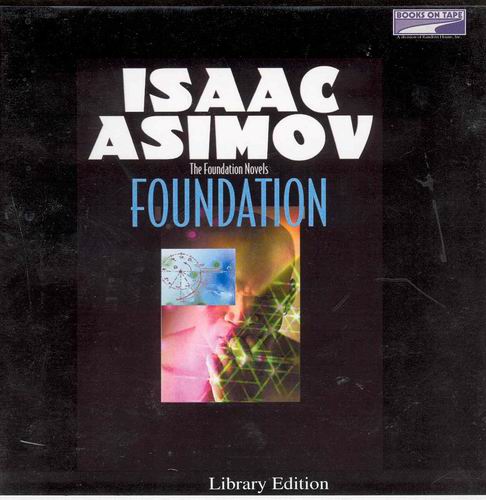
Review of Foundation by Isaac Asimov

Science Fiction Audiobooks - Foundation by Isaac AsimovFoundation
By Isaac Asimov; Read by Scott Brick
7 CD’s, 9 hours [UNABRIDGED]
Publisher: Books on Tape
Published: 2005 (Re-issued with new narrator)
ISBN: 1415917760
Themes: / Science Fiction / Psychohistory / Galactic Empire / Energy / Science /

I could write this review in one sentence: A first-rate science fiction classic performed by a top-notch narrator. Whew! I’m exhausted. I better relax with another audiobook…

But first, a few more comments. Foundation is one of Isaac Asimov’s earliest works. One of the joys of reading this novel is recognizing it as an influence on so many other works in science fiction. Since Foundation was published, countless empires have risen and fallen in the pages of science fiction novels and on flickering movie screens. Most obviously, the latest Star Wars movie includes a visit to Coruscant, a planet that is one huge city, just like Asimov’s Trantor.

Like I, Robot, another of Asimov’s best known books, this is not a novel, but a collection of stories. The first (Book 1) is called “The Psychohistorians”, which follows Gaal Dornick as he visits the planet Trantor for the first time. Trantor is a planet completely covered in city – it serves as the capital of the Galactic Empire. Dornick visits Hari Seldon, who is under persecution for predicting the fall of the empire using psychohistory, a mathematical method for predicting probable futures for large numbers of people. The story concludes with the establishment of the Foundation, where a group of scientists will be charged with collecting all human knowledge into a great Encyclopedia.

Book Two is “The Encyclopedists”. It is 30 years after the first story, and it is here that the reader first encounters Salvor Hardin, a political rival of the mayor of Terminus, the name of the planet where the Foundation resides. The story is of a political struggle between two factions, with Hardin winning the day in grand fashion as a holographic Hari Seldon makes his first appearance to tell folks what’s really going on here.

Book Three, “The Mayors”, again stars Salvor Hardin, much later in his career. He is now being challenged as he challenged others in the previous story. Hardin has discovered that the only thing he’s got that surrounding systems don’t have is knowledge of atomics (a knowledge that has been lost at the edge of the empire). So, to keep from being attacked, he creates a sort of religion out of atomic science, trains “priests” to deal with it, and sends these priests out to threatening worlds to keep them at bay. Works great, but now there’s a challenge.

“The Traders” is Book 4, again taking place years after the previous story. Hardin is long gone, and the Foundation now is home to a sub-class called Traders, who are largely independent, but still loyal to the Foundation…

…who evolve into “The Merchant Princes”, the subject of Book 5, the longest installment. The traders have grown rich, and there’s a serious threat to the Foundation. Questions about the further validity of the “religion” are questioned, toss in some espionage, and the struggle is on.

Scott Brick does an amazing job with Asimov’s work. This first book was published in 1951, so Brick has to say things like “Great leaping galaxies!” while keeping a straight face. Apart from these occasional exclamations, the book works extremely well here in 2005. Asimov deserves his place amongst the Grand Masters of the genre, and Scott Brick’s performance adds a worthy dimension to the classic. I’m very much looking forward to hearing the rest of the trilogy.

Posted by Scott D. Danielson

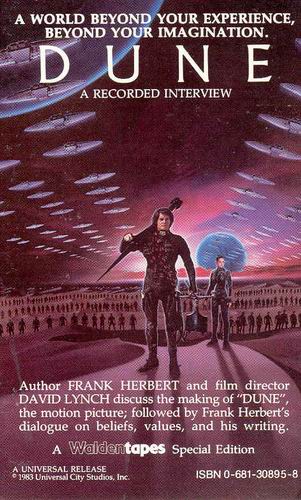
Review of Dune: An Interview with Frank Herbert and David Lynch

Dune: An Interview with Frank Herbert and David LynchDune: An Interview with Frank Herbert and David Lynch
1 Cassette – Approx. 1 Hour [INTERVIEW]
Publisher: Waldentapes
Published: 1983
ISBN: 0681308958
Themes: / Interview / Science Fiction / Moviemaking / Politics / Messiah / Power structures /

After reviewing Recorded Books unabridged Dune by Frank Herbert, Jesse suggested that I listen to this cassette which contains 2 interviews. One with Frank Herbert and David Lynch, the director of the first Dune movie, and an interview with Frank Herbert alone.

The interview with Lynch and Herbert shows how pleased Herbert was with Lynch’s film. The interview was recorded before the film’s release, and Lynch expressed nervousness while Herbert expressed satisfaction, along with some discussion of the difference between film and print, and the process of getting one to the other.

To me, the interview with Herbert alone (the bulk of the cassette) was the most interesting. Of Dune he said that what he wanted was “something that showed the impact of a messiah on history as the creator of a power structure.” His theory was that a messiah creates a power structure that attracts corruptible people, no matter how well-meaning the messiah might be. This led into a discussion of how a messiah is accepted by a culture in the first place, then into the nature of the power structure a messiah leaves behind, and into how this applies to contemporary power structures in government.

Another tidbit I picked up that I didn’t know is that Herbert considered Dune, Dune, Messiah, and Children of Dune one book, with Dune, Messiah being the pivotal book. I have not read past the first novel, so now I’ve got a couple more books on my TBR pile.

The entire program was interesting enough to listen to twice. If you are a fan of Dune, find yourself a copy of this! I think you’ll enjoy it.

Posted by Scott D. Danielson

Review of The Curse Of Chalion By Lois McMaster Bujold

Fantasy Audiobooks - The Curse of Chalion by Lois McMaster BujoldThe Curse Of Chalion
By Lois McMaster Bujold; Read by Lloyd James
15 CDs – Approx 19.5 Hours [UNABRIDGED]
Publisher: Blackstone Audio
Published: 2004
ISBN: 0786185988
Themes: / Fantasy / High Fantasy / Court Intrigue / Politics / Religion / Magic / Romance /

Lord Cazaril has been, in turn, courtier, castle-warder, and captain; now he is but a crippled ex-galley slave seeking nothing more than a menial job in the kitchens of the Dowager Provincara, the noble patroness of his youth. But Cazaril finds himself promoted to the exalted and dangerous position of tutor to Iselle, the beautiful, fiery sister of the heir to Chalion’s throne.

Cazaril was a lord and a soldier of Chalion, but that was before he was sold into slavery. Years later, having been freed by chance of war, it is a broken Cazaril, a traumatized shell of his former proud self, who walks away. He’s learned the lessons of a slave, to expect nothing and hope for little. So when this cowed former lord
begs for a place in minor noble’s household he is surprised to be appointed not to simple kitchen duties but instead as tutor to a young princess of the realm. From the start of The Curse Of Chalion our sympathies are with Lord Cazaril. Not only is he a figure of tremendous suffering, but his situation is made still worse by the fact that he has smarts enough to know just how far he’s fallen. But the rub comes more from the fact that his sudden appointment will doubtless draw the attention of those who betrayed him to the life of a slave and who may seek to more permanently dispose of him. Not only must Cazaril educate the young princess, he must also somehow stave off the powerful forces in league against him while breaking an ancient curse placed upon his charge, the heir to Chalion’s throne. His new responsibilities requires nothing less.

Lois McMaster Bujold is best known for her Miles Vorkosigan science fiction novels, which if you haven’t read them are space opera at their most operatic. What Bujold did there for space opera then, she now does here for fantasy with The Curse Of Chalion, the start of a whole new fantasy series. And what a challenge it is! She’s built an entirely new world with the very best kind of magic – magic with rules and consequences. And this thing has backstory too. Chalion is not just some neo-Tolkien rip off, that uses the tropes you’ve come to expect in order to tell some slight variation on an old and tired tale. Quite the contrary, it is a fully fleshed out fantasy setting with a fascinating and well thought out religion that plays a central role in the unfolding of the story. Also of note is an unexpected mention of one character’s homosexuality – while it plays little role in the plot proper it is a refreshing touch that symbolizes the modern and realistic approach Bujold taken in constructing her world. Chalion is chock full of motivated and interesting characters, classic political machinations, two genuine romances, surprising plot twists and everyone’s favorite theme, betrayal. This is the equivalent of a seven-course meal for any audiobook listener – and it isn’t even too long compared to most fantasy novels published these days.

I truly enjoyed this tale. It is really good stuff and that is mostly due, I think, to Bujold working with some really fascinating ideas, not the least of which is one scene which postulates a way to reconcile the idea of both human free will and the will of the gods – determinacy – that pesky problem of fate. Even better is that it isn’t one that I’d heard of before – heady cool stuff! The few sins Bujold commits are minor and might be virtues in many listener’s ears – there are a just a few places where the pace flagged and the action sequences were few and brief – though they really are more realistic than we have come to expect with fantasy. The Curse Of Chalion is likely to become one of the most beloved of medieval fantasy novels of the early 21st century. This story has genuine surprises, its own internal logic, and intelligent, thoughtful characters who are genuinely fun to hang out with. I really liked it!

Blackstone Audiobooks has made The Curse Of Chalion available in several formats: A 13 cassette, (retail or library packaged) audiobook, a 15 CD (retail or library packaged) audiobook and 2-disc CD-MP3 set. We review here the CD version and this is the first Blackstone Audio CD set I’ve ever tired. I’d always preferred the cassette format in the past but I’m really pleased with the simplicity of Blackstone’s design and track spacing. The library set, pictured above comes in the attractive and durable plastic case, with a full color paper insert cover. The cover art here is inspired by the hardcover’s original art, and though they are similar I think the Blackstone’s version is even more attractive! Reader Lloyd James does a marvelous job with the exposition; he gives many regional accents to the numerous characters and plays the three main female characters with three slightly variant falsettos – no small feat. I can honestly say, fans of both Bujold and original fantasy tales can rejoice, The Curse Of Chalion and this Blackstone Audiobook are everything you’ve been looking for!

Posted by Jesse Willis

Review of Dune By Frank Herbert

Science Fiction Audiobooks - Dune by Frank HerbertDune
By Frank Herbert; Read by George Guidall
16 Cassettes – 24 hours [UNABRIDGED]
Publisher: Recorded Books
ISBN: 0788763334
Date Published: 1998
Themes: / Science Fiction / Politics / Space travel / Culture / Ecology /

George Guidall is a tremendous narrator. His nuanced performances continually make his audiobooks easy on the ear yet insistent – his performances demand attention. Matched with the Frank Herbert’s Dune… well, this is as good as it gets, folks. A detailed, meaningful, and entertaining piece of science fiction performed by a narrator with fine voice, excellent timing, and utmost attention to those very details… magnificent.

Dune is a masterpiece of world-building. In the novel, Frank
Herbert creates Arrakis, the desert planet that is also called Dune.
The natives of this planet are people called Fremen, a mysterious desert-dwelling people that the characters in this novel don’t fully understand, at least at the beginning. They are proud people, and though a family from the galactic empire rules them, they project an aura of power and resiliency. Arrakis is important to the galactic empire because it is the world where Spice is mined. Spice is of supreme importance in Herbert’s universe for a host of reasons I won’t list here.

The fully realized culture of Arrakis is merely backdrop at the beginning of the novel, which immediately takes up the story of Paul Atreides, son of Duke Atreides. The Atreides family takes over as the ruling family of Arrakis from a rival family called the Harkonnens. From the moment they arrive on Arrakis, the Fremen treat Paul in a special way, since Paul fits the description of someone for which the Fremen have been waiting a long time. The story follows Paul from his departure from his home planet to his arrival on Arrakis and his eventual survival in the desert, during which much about the fascinating culture of the Fremen is revealed.

Frank Herbert wrote a novel here that works on so many levels that it can be read several times. From one angle, you’ve got a novel about the effects of a Messiah on a culture. From another, you’ve got an ecological novel about survival in a desert and the ethical questions about whether to disturb that harsh but natural environment to make it more habitable for humans. Still another gives you a novel of brutal political intrigue as Harkonnen plots against Atreides (and vice versa) in the pursuit of the power that is ownership of the Spice. Each of these subplots is fully developed an intertwined with the others in this novel, which succeeds in every way in print and now succeeds again as an audiobook thanks to the wonderful performance of George Guidall.

Posted by Scott D. Danielson