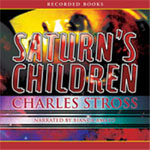
Review of Saturn’s Children by Charles Stross

SFFaudio Review

RECORDED BOOKS - Saturn's Children by Charles StrossSaturn’s Children
By Charles Stross; Read by Bianca Amato
11 CDs – Approx. 13 Hours 45 Minutes [UNABRIDGED]
Publisher: Recorded Books
Published: 2009
ISBN: 9781440750113, 9781440750106
Themes: / Science Fiction / Androids / Robots / Sex / Slavery / Identity / Venus / Mars / Mercury / Eris /

The Hugo Award-winning author of numerous best-sellers, Charles Stross crafts tales that push the limits of the genre. In Saturn’s Children, Freya is an obsolete android concubine in a society where humans haven’t existed for hundreds of years. A rigid caste system keeps the Aristos, a vindictive group of humanoids, well in control of the lower, slave-chipped classes. So when Freya offends one particularly nasty Aristo, she’s forced to take a dangerous courier job off-planet.

This novel’s title comes from the myth that Saturn (the Roman god of agriculture and harvest), ate his children at birth for fear of them usurping him. Its an apt starting point for a tale about robots More interesting is that Saturn’s Children opens with a reading of Asimov’s three laws of robotics

1. A robot may not injure a human being or, through inaction, allow a human being to come to harm.
2. A robot must obey any orders given to it by human beings, except where such orders would conflict with the First Law.
3. A robot must protect its own existence as long as such protection does not conflict with the First or Second Law.

…and then informs us that there are no humans left alive. There is, however, a whole solar system full of robots, all willing and able to obey all three laws. So what happened to all those humans? The novel is the answer to that question.

Saturn’s Children is told from the point of view of Freya Nakamichi-47 a gynoid (that’s a female android). She was activated (born) long after the last human had died. Freya, despite never having met one, still longs for her lost love (any human). Indeed, even the mere thought a human being makes her sexually excited. This is because, as a self described grande horizontale, Freya’s destiny was to be a sexual companion to any human that owned her. Now, without a master, she finds work where and when she can. But after a nasty run-in with an Aristo, a wealthy robot that owns other robots (called Arbiters), Freya will take any work that gets her off planet. Soon she’s employed by Jeeves, a masculine android who is more like her in shape and purpose than most robots. Freya’s first assignment is to transport a bio-engineered package across the solar system. But the pink police (a kind of anti biological proliferation organization), and another, more shadowy, organization are determined to stop her. Along the way Freya visits Cinnabar (a city on rails) that’s perpetually in Mercury’s shadow, drawing power from the temperature difference between Mercury’s light and dark sides), has sex with a rocket ship and grows some new hair.

Freya does a whole lot more than that too. She has a lot more sex for one. But beyond the sex there is some more fully cerebral stimulation going on in Saturn’s Children. The idea of a post-human solar system is an interesting one, and Stross plays with it quite effectively. This is a theme that I think hasn’t been done often enough in SF. The closest novel, in scope, if not in tone, is perhaps Clifford D. Simak’s City (in which intelligent dogs and robots have inherited a humanless Earth). This humanless solar system is, as I mentioned, quite vividly explored, with floating cities (like Bespin’s Cloud City) on Venus, waste heated bio-labs on the frozen dwarf planet of Eris, and a truly frightening description of what’s happened to poor old Earth. Stross has quite a lot of fun playing with the world he’s created here, naming a city Heinleingrad, naming a robot butler character after P.G. Wodehouse’s famous “gentleman’s personal gentleman.” It all mostly works with Saturn’s Children seeming to take most of its inspiration though from Heinlein’s novel Friday. Both novels feature artificial female persons as secret couriers, both tell their own stories, both secrete their smuggled cargos in their abdomens. Later on in Saturn’s Children there is some playing with the ideas promulgated in Heinlein’s 1970 novel I Will Fear No Evil. And, identity, in a world where brain data, and brain states, are easily and quickly copyable, isn’t as simple as it is with us meatbags. On the whole I enjoyed Saturn’s Children and found it full of interestingness. It was as most novels are these days, too long, and in need of a critical editor. The worst sin here is that the ending is rather weak, and features an afterword that leaves open the possibility of a sequel or seven.

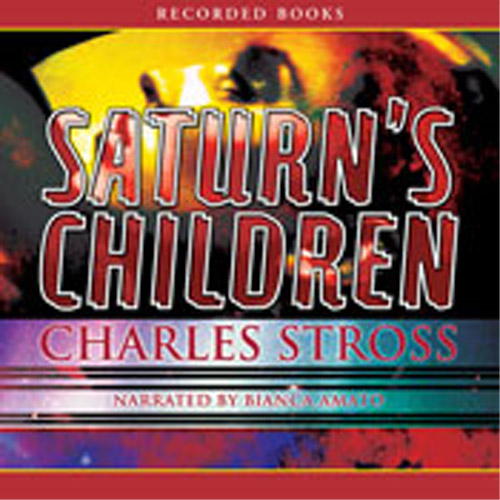
Narrator Bianca Amato, a South African accented “ALIEN OF EXTRAORDINARY ABILITY” (according to her resume), mispronounces a couple of the more obscure words but the general gist of her reading is highly competent. It helps a whole lot that Freya’s story is told in first person. I’m not sure what the present tense adds to the narrative other than being a little noticeable and not particularly harmful. Also, as I mentioned in a recent podcast, the Recorded Books cover art is boring, whereas the Ace Books paperbook edition is fabulous!

Check out the dust jacket from the paperbook edition:
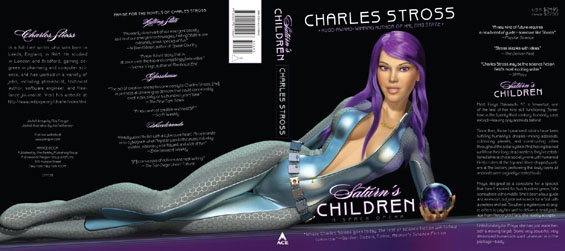
Saturn's Children by Charles Stross - The PAPERBOOK's Dustjacket

Posted by Jesse Willis

The SFFaudio Podcast #054

Podcast

The SFFaudio PodcastThe SFFaudio Podcast #054 – Jesse and Scott talk about audiobooks, the recent arrivals, the new releases and the current listens.

Talked about on today’s show:
Full Cast Audio, Kenneth Oppel, Starclimber, alternate, Lionsgate City (aka Vancouver), Space Station Rat by Michael J. Daley, Red Planet by Robert A. Heinlein |READ OUR REVIEW|, Little Brother by Cory Doctorow |READ OUR REVIEW|, 1984 by George Orwell, Brilliance Audio, A Local Habitation by Seanan McGuire, Mary Robinette Kowal, Where Angels Fear To Tread by Thomas E. Sniegoski, angels, Roger Zelazny, Blackstone Audio, Frostbite by David Wellington, werewolves, 13 Bullets by David Wellington, vampires, Let The Right One In, Dead Snow, David Wellington’s “Monster Trilogy”, zombie apocalypse, Survivors (2008), Terry Nation, Survivors (1975 – 1977), 30 Days Of Night, dreamy vampires, Blackstone Audio, Vampire$ by John Steakley, John Carpenter’s Vampire$, bounty hunting, Dark Is the Sun by Philip Jose Farmer, Recorded Books, Saturn’s Children by Charles Stross, LibriVox.org, Rastignac The Devil by Philip Jose Farmer, Gregg Margarite, The Three Musketeers by Alexandre Dumas, Dune Messiah by Frank Herbert, Love Bites by Lyndsay Sands, the paranormal romance problem, Blue Moon by Laurell K. Hamilton, Obsidian Butterfly by Laurell K. Hamilton, Single White Vampire by Lyndsay Sands, Penguin Audio, The Silent Sea by Clive Cussler and Jack DeBrule, Dirk Pitt, “Jacque Cousteau as James Bond”, Cujo by Stephen King, Firestarter by Stephen King, The Monster Of Florence by Douglas Preston and Mario Spezi |READ OUR REVIEW|, The Running Man by Stephen King = reality television, Robocop, Thinner by Stephen King, The Long Walk by Stephen King, The Long Walk by Sławomir Rawicz, Siberia, walking from Siberia to India, The Hunger Games by Suzanne Collins |READ OUR REVIEW|, Catching Fire by Suzanne Collins |READ OUR REVIEW|, The Maze Runner by James Dashner, Cube, dragons, How To Train Your Dragon, Anne McCaffrey, Eragon, Around The World In Eighty Days by Jules Verne, Komodo dragons, Dragonslayer, Dragonheart, Smaug, The Geek’s Guide To The Galaxy podcast, DragonLance, Dragon Slippers by Jessica Day George, Roadwork by Stephen King, The Hitchhiker’s Guide To The Galaxy meets The Omega Man, where the pseudonym “Richard Bachman” came from, “everything comes back to Donald E. Westlake”, Blackstone Audio, Empire Builders by Ben Bova, Nova Audiobooks, NASA, cutting the Constellation program, CBS coverage of Apollo 11, Robert A. Heinlein was a commentator for Apollo 11, why do we have so little Heinlein audio and video?, Sheepfarmer’s Daughter by Elizabeth Moon, Oath Of Fealty by Elizabeth Moon, Graphic Audio, The Serrano Legacy, Galaxy Press, A Matter Of Matter by L. Ron Hubbard, The Crossroads by L. Ron Hubbard, time travel, Captive Market by Philip K. Dick, economics, Brilliance Audio, Saucer by Stephen Coonts Saucer: The Conquest by Stephen Coonts, Peter Watts, The Eyes Of The Overworld by Jack Vance, Breaking Point by James Gunn |READ OUR REVIEW|, Tales Of Dying Earth by Jack Vance, “Vance has ideas and style”, The Last Castle by Jack Vance, The Moon Moth by Jack Vance |READ OUR REVIEW|, The Geek’s Guide To The Galaxy interviews The Tolkien Professor.

Posted by Jesse Willis

Review of Red Planet by Robert A. Heinlein

SFFaudio Review

Science Fiction Audiobook - Red Planet by Robert A. HeinleinSFFaudio EssentialRed Planet
By Robert A. Heinlein; Read by a full cast
6 CDs – 7 Hours [UNABRIDGED]
Publisher: Full Cast Audio
Published: 2009
ISBN: 9781934180518
Themes: / Science Fiction / Mars / Politics / Gender /
Sample |MP3|
Jim Marlowe’s Martian pet, Willis, seems like nothing more than an adorable ball of fur with an astonishing ability to mimic the human voice. But when Jim takes the creature to academy and runs afoul of a militantly rigid headmaster, his devotion to his pet launches the young man on a death-defying trek across Mars. Accompanied by his buddy, Frank, Jim must battle the dangers of a hostile planet. But it is not only the boys’ lives that are at stake: They have discovered explosive information about a threat to the survival of the entire colony—information that may mean life or death for their families.

Listening to Heinlein’s stories brought to life is a wonderful experience. One of the things I enjoy most about Heinlein’s quirky novels is that the politics are never fully aligned with any conventional ideology. There are repeated themes, to be sure, but they play out fairly differently in each story. I had read Red Planet at least once before and upon listening to this terrific audiobook version I was actually quite surprised by the relevance to modern politics and social phenomena. First published in 1949, and set on a Mars that is surprisingly believable, it has some very modern protagonists teenagers. Jim Marlowe and Frank Sutton get into some rather exciting adventures. They spend chilly days outside on Mars suited up in mechanical counter-pressure suits, with supercharging helmets that provide a suitable pressurized oxygen from the wispy (but oxygenated) atmosphere of Heinlein’s Mars. These suits, are much lighter than conventional air pressure suits and allow the extreme mobility needed for their skating down the frozen canals of Mars. When not outside fighting off water seekers Jim, Frank, and almost every other colonist on Mars dresses like they live on a tropical beach (they live, go to school, and work in pressurized domes). Virtually no one goes outdoors during the Martian nights (or winters) as they are cold enough to freeze even a stolid martian kid solid. Indeed, part of the excitement of the novel comes when Jim, and Frank find themselves trapped in the Martian desert far from any habitable shelter just as sunset is approaching. Heinlein’s solution is both ingenious and original.

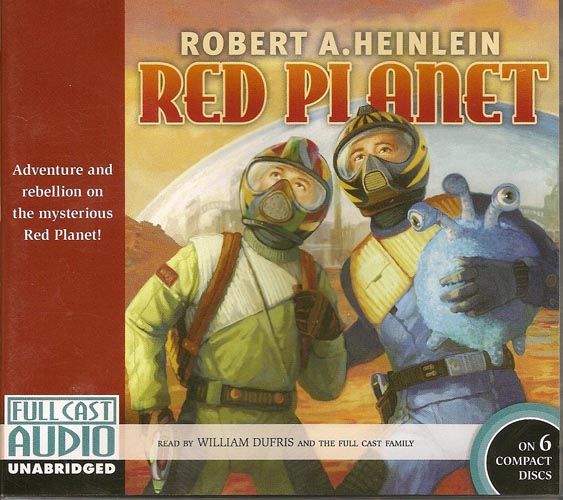
Unlike some previous Heinlein novels produced by Full Cast Audio, Red Planet is not told in first person by the main character. Instead the voice talent of William Dufris is employed to narrate. I’m a big fan of Dufris’ narrative abilities, and he does a terrific job with Red Planet. Jacob Coppola as Jim Marlowe, and Christopher Reiling as Frank Frank Sutton are both vigorous and youthful but also distinct enough to tell apart. The rest of the cast supports the story with an assortment of villainous, larcenous good humor, and stubborn contrariness – in other words nearly the full Heinleinian character spectrum. One other note, the voice of Willis is often performed by whichever actor Willis is imitating and this works just fine! Finally, check out the gorgeous cover art by Jerry Russell, it’s absolutely fantastic!

Posted by Jesse Willis

The SFFaudio Podcast #051 – TOPIC: THE YELLOW PERIL

Podcast

The SFFaudio PodcastThe SFFaudio Podcast #051 – Jesse and Scott are joined by Luke Burrage and Professor Eric S. Rabkin to discuss THE YELLOW PERIL.

Talked about on today’s show:
The Insidious Dr. Fu-Manchu by Sax Rohmer (aka The Mysterious Dr. Fu-Manchu) – available via Tantor Media, fix-up novel, hypnosis, Sherlock Holmes, the yellow peril incarnate, the yellow peril as the hordes of asia, the Chinese Exclusion Act (USA), Chinese Immigration Act, 1923 (Canada), Tamerlane (the scourge of god), The Yellow Peril by M.P. Shiel, The Purple Cloud by M.P. Shiel, racism, WWI, colonialism, Burma, Thuggees, Boxer Rebellion, genius, The Talons Of Weng Chiang, if you read it as Fu-Manchu being the hero you may like the story more, mad scientist, Faust, Paradise Lost by John Milton, Robur-Le-Conquérant by Jules Verne (aka Robur-The-Conqueror aka The Clipper of the Clouds), The Island of Doctor Moreau by H.G. Wells, The White Man’s Burden by Rudyard Kipling, colonialism, The Invisible Man, the other colored other, The League Of Extraordinary Gentleman by Alan Moore, Hawley Griffin (The Invisible Man), Allan Quatermain, Captain Nemo, Dr. Henry Jekyll/Mr. Edward Hyde, Mina Murray (from Dracula by Bram Stoker), English 418/549: GRAPHIC NARRATIVE (Winter 2010), The Invisible Man shows I and II, If I Ran The Zoo by Dr. Seuss, Jonah And The Whale, Suess’ anti-Japanese propaganda during WWII, Japanese internment during WWII in USA and Canada, Aryan, India, Nazi Germany, The Thule Society, Sri Lanka, racial stereotypes, Marco Polo, Kubla Khan by Samuel Taylor Coleridge, gender and skin color, blondness, Karamaneh (the love interest in The Insidious Dr. Fu-Manchu), femme fatale, Black Widow (1987), miscegenation, the Chinese hordes vs. the insidious Japanese, War With The Newts by Karel Čapek, Japan, LibriVox.org, Sixth Column by Robert A. Heinlein, beauty as goodness (in fairy tales), King Kong, Last And First Men by Olaf Stapledon, Star Maker, The Iliad by Homer, The Old Testament, The Science Fiction Hall Of Fame edited by Robert Silverberg, Arena by Fredric Brown, Plato, the red scare, Jack London, The Lathe Of Heaven by Ursula K. Le Guin, Arslan by M.J. Engh, Chung Kuo by David Windgrove, selective memory, polarized memory, Middlemarch by George Eliot, Encounter With Tiber by Buzz Aldrin and John Barnes, China Mountain Zhang by Maureen F. McHugh, Superfusion: How China and America Became One Economy and Why the World’s Prosperity Depends on It by Zachary Karabell, Firefly, Limehouse, London, Detroit, The Man In The High Castle by Philip K. Dick |READ OUR REVIEW|, alternate history, SS-GB by Len Deighton, Fatherland by Robert Harris, Gorky Park, North Korea, the North Korea embassy in East Berlin.

The Yellow Peril

The Fiendish Plot Of Fu-Manchu (Thanks Gregg!):

Posted by Jesse Willis

The SFFaudio Podcast #049

Podcast

The SFFaudio PodcastThe SFFaudio Podcast #049 – Jesse and Scott talk about recent arrivals, new releases, audiobooks, podcasts and plenty more!

Talked about on today’s show:
SFFaudio.com is 7 years old, So I Married An Axe Murder, San Fransisco, California, Alcatraz, recent arrivals, Brilliance Audio, military SF, Fearless: The Lost Fleet Book 2 by Jack Campbell, space opera, Gene Roddenberry‘s Andromeda, Buck Rogers, Live Free or Die: book 1 in the Troy Rising series by John Ringo, Paperback Digital, Cally’s War by John Ringo and Julie Cochrane |READ OUR REVIEW|, John Ringo can give his books away and sell books too, Time’s Eye: A Time Odyssey Book 1 by Arthur C. Clarke and Stephen Baxter, it’s not a sequel it’s an “othrquel“, time is orthogonal to space (in relativity theory), Childhood’s End by Arthur C. Clarke, benevolent aliens, malevolent aliens, H.P. Lovecraft, The Eternal Wall by Raymond Z. Gallun, LibriVox, Gregg Margarite, time travel, Blackstone Audio, Identity Theft by Robert J. Sawyer, Mars, consciousness uploading/downloading, Treason by Orson Scott Card, A Planet Called Treason by Orson Scott Card, Stefan Rudnicki, Spider Robinson, Melancholy Elephants by Spider Robinson |READ OUR REVIEW|, copyright, copyfight, the philosophy of art, The Graveyard Book |READ OUR REVIEW|, The Jungle Book by Rudyard Kipling, Harry Potter, The Dark Is Rising, A Wizard Of Earthsea by Ursula K. Le Guin, ripping off Heinlein is legit when you are Spider Robinson, Friday by Robert A. Heinlein, new releases, Wonder Audio, The Men Return & Worlds Of Origin by Jack Vance, Brilliance Audio, The Songs Of Dying Earth: Stories In Honor Of Jack Vance, Gene Wolfe, The Book Of The New Sun by Gene Wolfe, David D. Levine, Tk’Tk’Tk’ by David D. Levine, The Moon Moth by Jack Vance |READ OUR REVIEW|, Suldrun’s Garden, The Green Pearl, Madouc by Jack Vance, Swimming Kangaroo Books, Need For Magic by Joseph Swope, BBC Audiobooks America, Great Classic Science Fiction: Eight Unabridged Stories, Forgotten Classics podcast talks James Gunn’s The Road To Science Fiction series, paperback book bags, A Game Of Thrones coming to HBO, A Game Of Thrones by George R.R. Martin |READ OUR REVIEW|, Roy Dotrice, John Lee, Shogun (the TV miniseries), FlashForward, Stephen King’s Storm Of The Century, 1408, Scott’s Pick Of The Week: Steve, The First by Matt Watts |READ OUR REVIEW|, @ the CBC store, radio drama, post apocalypse, humor, Canadia: 2056 |READ OUR REVIEW|, The Hitch-hiker’s Guide To The Galaxy, Jesse’s Pick Of The Week: The Chronicles Of Solomon Kane, Roy Thomas, Howard Chaykin, Robert E. Howard, The Iliad, Ralph Macchio, Red Shadows by Robert E. Howard, religion, Solomon Kane, The Punisher.

Posted by Jesse Willis

Review of Sunrise Alley by Catherine Asaro

SFFaudio Review

Science Fiction audiobook - Sunrise Alley by Catherine AsaroSunrise Alley
By Catherine Asaro; Read by Hillary Huber
10 CDs – Approx. 11.5 Hours [UNABRIDGED]
Publisher: Blackstone Audiobooks
Published: December 2007
ISBN: 1433213007
Themes: / Science Fiction / Romance / Androids / Artificial Intelligence / California / Cyborgs /

When a shipwrecked stranger washed up on the beach near research scientist Samantha Bryton’s home, she was unaware that he was something more than human. He said his name was Turner Pascal—but Pascal was dead, killed in a car wreck. This man only held the remainder of Pascal’s consciousness in a technologically-enhanced humanoid body. He was, in fact, an experiment by the notorious criminal Charon, a practitioner of illegal robotics and android research. Charon has been secretly copying human minds into android brains, with plans to make his own army of slaves. On the run from this most ruthless criminal, Samatha and Turner seek help from Sunrise Alley, an underground organization of AIs and androids that have gone rogue. But these cybernetic outlaws are rumored to have their own hidden agenda.

It may not be so much that women and men are from different planets as women and men care about different things. Or it may be just that Catherine Asaro and I care about different things. Very different things. I have this hypothesis: people, even when they are lying to you, or writing fiction, can tell you a lot about themselves by what they focus on over and over. The word that kept coming up over and over again in Sunrise Alley was “trust.” Catherine Asaro, or at least her viewpoint character, Samantha Bryton, cares a whole helluvalot about trust. Me, I don’t care about trust, at least not in the way Asaro seems to wants me to. Based on the scenes in Sunrise Alley Asaro seems to think that being chased is also of great interest to a reader. Maybe it is to some readers. It isn’t to me. Turner Pascal, the mobile MacGuffin, is being chased prior to the novel’s start. Then Turner, the bellboy turned android, and Samantha, the scientist turned beachcomber, are chased all over the globe. They are chased in cars, by helicopter, by jet, on foot, in cars again.

The meme of an artificial person, android or evolving intelligence as Asaro dubs it, is often an interesting idea to work with in fiction. Philip K. Dick did some amazing things with it Do Androids Dream Of Electric Sheep? as did Alfred Bester in Fondly Fahrenheit. Even later career Robert A. Heinlein managed to tell a compelling story with an artificial person in Friday. William Gibson’s Neuromancer is a globe trotting adventure with an artificial intelligence as the MacGuffin. But Catherine Asaro’s take on AI and androids leaves me empty and depressed.

When Samantha and Turner aren’t being chased by unseen foes they are usually making love in one of Samantha’s many beds (in one of her many houses), or in a tastefully decorated secure facility bedrooms (where they are being held prisoner). But those looking for scene after scene of socially redeeming hot piston on human action will also be sadly disappointed. The order of the day in Sunrise Alley is for the scientist and the bellboy to show each other their emotions, their vulnerable sides and speak essentially the same dialogue over and over.
The android, Turner, has an inferiority complex and his savior/companion/scientist girlfriend is needed to shore up his insecurities. The central problem in the novel, other than their being chased, comes when Turner starts to modify his body in order to solve their problems and escape their captors (because apparently Samantha has no skills herself). In doing this Turner is increasingly loosing the handsome human looks he was given by his evil maker (the bad guy who we don’t get to meet for more than half the novel). This makes Samantha have to deal with the increasing repulsion she feels towards Turner’s increasingly mechanical-looking body. And that is basically encapsulates my big problem with this story. Writing sentences about a character’s emotional life and his/her feelings towards another character’s body parts makes me really, really annoyed.

I like idea fiction, stories that tell me something on an intellecutal level. Asaro’s Sunrise Alley seems to be merely operating on the level of wish-fulfillment. Samantha Bryton is beautiful, wealthy, and unemployed by choice. When the novel begins a handsome, insecure man has just washed up on her beach. She rescues him and drags him to the safety of her inviting home. Did I mention that Samantha also has two homes in the woods? One is near the beach in a forest, another is in some other forest, just a convienient chapter’s distance away. Both homes are filled with top-notch security, lovely decor and garages full of vehicles to make James Bond greatly envious. The explanation of why a quietly retired scientist needs to own two woodsy homes within a few hours driving distance of each other isn’t at all satisfactory. And neither is the explanation as to why she has a spy cars with built-in cloaking devices, bulletproof glass, oil slick droppers and mortars.

The worst sin that Asaro commits, in my opinion, is the final revelation which comes in the form of a pathetic pseudoscience, namely repressed memory.Sunrise Alley is not just a bad novel, but badly conceived, badly written and generally bad. This is the worst novel I have ever read. This is the worst I have ever reviewed. This is the worst I have ever finished.

Narrator Hillary Huber is tasked with making Samantha Bryton’s neurotic thoughts come alive. She pitches her voice a little deeper when voicing Turner Pascal. Huber is a fine narrator, this material is beneath her skill.

Posted by Jesse Willis