Review of A Galaxy Trilogy Volume 2 – A Collection of Tales from the Early Days of Science Fiction

SFFaudio Review

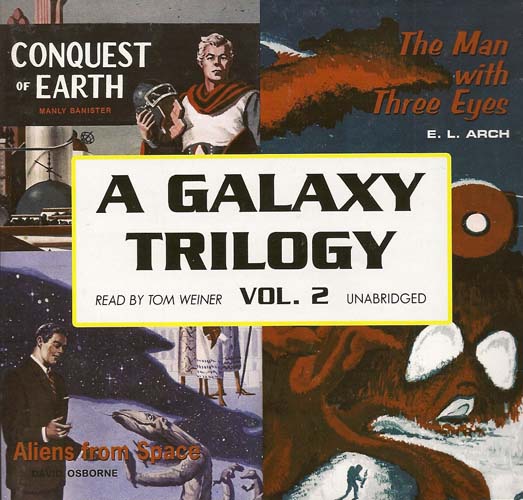
A Galaxy Trilogy, Vol. 2A Galaxy Trilogy, Vol. 2 – A Collection of Tales from the Early Days of Science Fiction
By David Osborne, E.L. Arch, and Manly Banister; Read by Tom Weiner
11 CDs – Approx. 13 hours [UNABRIDGED]
Publisher: Blackstone Audio
Published: 2009
ISBN: 9781433291081
Themes: / Science Fiction / Aliens / First Contact / Politics / Cold War / Russia / Washington, D.C. / Colorado / Amnesia / Prophecy / Sociology / Iowa / Teleportation /

Back in the 1950s at the dawn of science fiction, writers were turning out wildly imaginative stories for the pulp magazines. Robert Silverberg, writing as David Osborne, estimates he wrote over a million words in one year. Here are three more exciting stories from those heady days from the pioneers of science fiction.

Discs 1 – 3: Aliens From Space by David Osborne (Robert Silverberg)

First published in 1958, under a pseudonym, this Robert Silverberg short novel is set in a fascinatingly futuristic 1989. It is in a period of relative peace on Earth since the recent collapse of communism in Eastern Europe. With this new détente in the offing only an outside influence could disrupt the path to global harmony. And that is exactly what happens when an alien spacecraft lands in an Iowa cornfield. It seems that these aliens have been watching Earth for millennia, and now we are on the cusp of ‘regular interplanetary travel’ these alien beings wish Earth to accept their hand/tentacle in friendship. This aid would be especially needed too as it seems there is another alien species out there in the galaxy – one which would likely destroy the Earth, and all humans, given half a chance. A team of diplomats and scientists from around the world is quickly assembled to negotiate a treaty and alliance. Among them is Professor Brewster, a prominent scientist of psychosociology. He thinks the aliens are hiding something. But could it just be their very alienness? He points out the advanced technology they offer comes with its own problem; receiving technology from an technologically advanced civilization doesn’t advance the recipient’s own culture – it merely makes the culture dependent upon the giver’s civilization. But is that a small cost compared with annihilation?

A friend of mine pointed out that Greg Bear’s 1987 novel The Forge Of God has a similar premise. There are many terrific ideas in the gloriously short novel. Aliens From Space is a kind of cold war apologue, a prisoner’s dilemma situation. Wrong action invites destruction or at the very least, great loss. In a way the Brewster character reminded me of Jared Diamond (of Guns, Germs And Steel fame). Diamond and Brewster, by asking interesting questions, find interesting answers.

Discs 4 – 7: The Man With Three Eyes by E.L. Arch (Rachel Cosgrove Payes)

The Man With Three Eyes is not a terrific Science Fiction novel. But, it is a fair meta-Science Fictional story. It works well as a quasi-period piece/alien invasion story/Agatha Christie-style mystery. It’s set in 1967 New York, more specifically in Greenwich Village. It’s protagonist, I won’t call him a hero, is an Irishman, Dan Gorman. He works as a Science Fiction magazine illustrator and lives in Mrs. Mumble’s boardinghouse. That’s the central location for the plot, as it’s a virtual United Nations of ethnically diverse characters. There’s an Afghan, a German, a Mohawk, a Welshman, an Eskimo (not an Inuit), an Ethiopian, and a refugee from Hong Kong. They all seem to get along pretty well until Dan accidentally places himself in the middle of an alien espionage ring operating out of a dead drop joke shop. There, he picks up a “third eye” and takes it to a party to impress a girl. It doesn’t work like he expects (but then I can’t imagine it’d work at all), and instead acts like the titular object in H.G. Wells’ short story The Crystal Egg (giving the user a vision of aliens on another planet). Dan then leaves the party and looses the eye in his own apartment. The next two thirds of the novel feature everyone hunting for it.

Sound confusing? It is, at least a bit. I found myself wondering how fast E.L. Arch had written The Man With Three Eyes Or if he had written it on a bet. But, like I said, I think it kind of works anyway. It’s not really a good Science Fiction story, but it ain’t a bad story and can probably tell you a lot about how Science Fiction stories were written in the mid 1960s New York. It felt quite a bit like what I imagine time travel to Greenwich Village in the 1960s would feel like.

Discs 8 – 11: Conquest Of Earth by Manly Banister

The aliens came to earth more than two ice ages ago. Now, under millenia of domination by these invaders, one Man amongst a small cadre of six Men with mental powers, elite combat training and a deep education in all things human, can manoeuver to throw off the chains that have sapped Earth of most of its precious resource, water.

Like the Bene Gesserit from Frank Herbert’s Dune, Manly Banister has created a far future quasi-planetary romance with and especially compelling depiction of what it would mean to be trained to detect and interpret every nuance of human physiology. In fact this whole short novel is like a pocket version of Dune – what with all the quasi-religious/scientific ideas, the overlords, the secret societies and the deserty planet-ness. Conquest of Earth may have more ideas per hour as any other audiobook I’ve listened to in the last decade. When Kor Danay (aka the Scarlet Sage) graduates from his training he begins a quick journey across Earth that leads to scenes of assassination, disguise, mind reading and later an unusual trip off-world with a quickly romanced wife named, get this, Soma! One reviewer called the plot “aimless” and “desultory” and I can see that. The whole story feels disjointed in a way that cannot really be understated. Kor has many abilities the set him apart from other people, and even his fellow “Men.” First up, he has the ability to speed up the molecules of his body so as to, from his perspective, stop time! This trope, by the way, was probably first proposed in the The New Accelerator by H.G. Wells, and later by Star Trek in an episode called “Wink Of An Eye.” One lengthy later sequence features another quasi-Star Trek fore-echo too, namely in “The Paradise Syndrome.“ Did I mention that Kor also has a ”Divisible Mind” which may be the key to defeating the enemy Trisz? He does!

In terms of the style of writing, well, there is a nice soliloquized-style explanation of why the Trisz should not be thought of as actually evil despite being insidious energy beings or a being who rule (or rules) the Earth with an iron fist. There is a lot of other zany stuff going on in this novel: teleportation, trickery, a prophetic computer, and a dose of amnesia (for good measure). I will admit Conquest Of Earth comes off as if it was plotted by a mish-mash of meth’d up aliens in order to win a stream of consciousness contest, but somehow it really didn’t seem to bother me. And, I wouldn’t be surprised to hear it had won.

David Osborne is an acknowledged pseudonym of Robert Silverberg. E.L. Arch was a pseudonym of Rachel Cosgrove Payes (being an anagram of her first name: “Rachel”). But it is entirely unclear to me who Manly Banister is or was. There is some discussion of the improbably named Manly Banister HERE, but no Wikipedia article currently exists on this person. Even the narrator name, Tom Weiner, is an alias.

Narrator Tom Weiner’s voice lends depth and presence to the three novels – he adds an appropriate alien lisp to some of the alien speakers, plays around with accents and delivers it all a gravitas and seriousness that doesnt mock this fun material. Listening to A Galaxy Trilogy Volume 2 felt very rewarding!

A minor issue with this collection includes the distinct lack of markings on the discs. 11 CDs are in the set, with three short novels, but none of them is marked with which novels are on which discs. On the other hand, all three novels begin at the beginning of a CD.

Posted by Jesse Willis

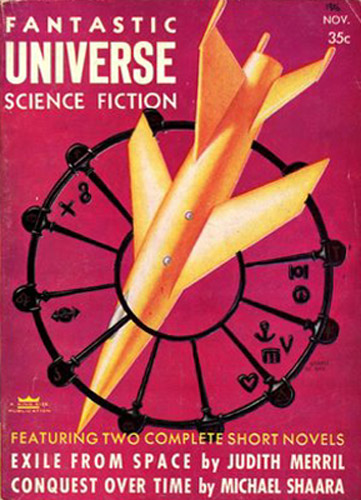
LibriVox: Conquest Over Time by Michael Shaara

SFFaudio Online Audio

Fantastic Universe November 1956Conquest Over Time
By Michael Shaara; Read by Mark F. Smith
4 Zipped MP3 Files, 1 |M4B| or Podcast – Approx. 1 Hour 20 Minutes [UNABRIDGED]
Publisher: LibriVox.org
Published: May 4, 2010
Pat Travis, a spacer renowned for his luck, is suddenly quite out of it. His job is to beat his competitors to sign newly-Contacted human races to commercial contracts… But what can he do when he finds he’s on a planet that consults astrology for literally every major decision – and he has arrived on one of the worst-aspected days in history? First published in Fantastic Universe in 1956.

Podcast feed: http://librivox.org/rss/4273

iTunes 1-Click |SUBSCRIBE|

[Thanks also to Ans Wink and Diana Majlinger]

Posted by Jesse Willis

LibriVox: The Variable Man by Philip K. Dick

SFFaudio Online Audio

LibriVoxThere’s a new FREE audiobook version of Philip K. Dick’s 1953 novella The Variable Man available from LibriVox and superstar narrator Gregg Margarite!
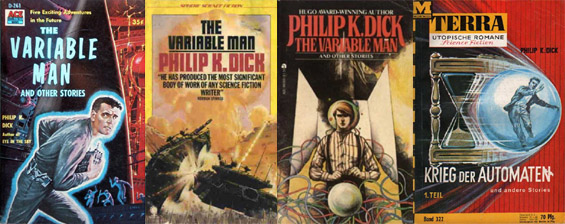
Here’s the teaser:

“He fixed things—clocks, refrigerators, vidsenders and destinies. But he had no business in the future, where the calculators could not handle him. He was Earth’s only hope—and its sure failure!”

Here are four different covers from various paperbook incarnations of this time travel tale…

The Variable Man by Philip K. Dick - Covers

And here’s the audiobook…

LIBRIVOX - The Variable Man by Philip K. DickThe Variable Man
By Philip K. Dick; Read by Gregg Margarite
3 Zipped MP3 Files or Podcast – Approx. 2 Hours 49 Minutes [UNABRIDGED]
Publisher: LibriVox.org
Published: May 3, 2010
Predictability has come a long way. The computers of the future can tell you if you’re going to win a war before you fire a shot. Unfortunately they’re predicting perpetual standoff between the Terran and Centaurian Empires. What they need is something unpredictable, what they get is Thomas Cole, a man from the past accidentally dragged forward in time. Will he fit their calculations, or is he the random variable that can break the stalemate? From Space Science Fiction September 1953.

Part 1 |MP3| Part 2 |MP3| Part 3 |MP3|

Podcast feed:
http://librivox.org/rss/4275

iTunes 1-Click |SUBSCRIBE|

[Thanks also to Betty M. and Diana Majlinger]

Posted by Jesse Willis

LibriVox: Second Variety by Philip K. Dick

SFFaudio Online Audio

LibriVoxWe talked about it on the most recent SFFaudio Podcast, I’ve listened to it, and I declare it: awesome. Here comes one of the coolest new releases from LibriVox.org this year:

Second Variety by Philip K. Dick!

And with the release there’s now a new file format that makes it easier for some users too. The M4B format is a fully bookmarkable file type that’s compatible with what I use to listen to most audiobooks, Apple iPods. Here’s the full description:

An M4B file is an audio file which can be bookmarked. This is the audio-book file type. These files can have chapter markers which can be skipped through as you would skip through files on a play list. They can have built in cover art and chapter images. They will remember where you left off each time you stop the file and come back to it . And variable speed settings on iPods and a growing number of other mp3 players can be utilized by this file type. The ability to bookmark allows for as little as one large file instead of many small ones without the burden of fast forwarding to find your spot every time you resume listening or the fear of otherwise losing your place. The reduced number of files also makes browsing through your files to find your book and your place in it much less effort.

In fact there’s a whole catalogue of M4B LibriVox audiobooks available.

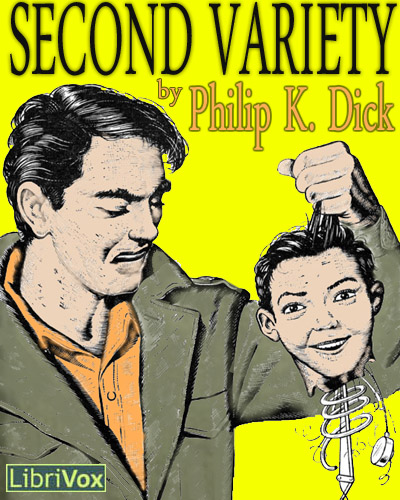
LIBRIVOX - Second Variety by Philip K. DickSecond Variety
By Philip K. Dick; Read by Gregg Margarite
1 |M4B| File or 2 Zipped MP3 Files or Podcast – Approx. 1 Hour 44 Minutes [UNABRIDGED]
Publisher: LibriVox.org
Published: April 22, 2010
Early victories by the USSR in a global nuclear war cause the United Nations government to retreat to the moon leaving behind troops and fierce autonomous robots called “Claws”, which reproduce and redesign themselves in unmanned subterranean factories. After six bloody years of conflict the Soviets call for an urgent conference and UN Major Joseph Hendricks sets out to meet them. Along the way he will discover what the Claws have been up to, and it isn’t good… First published in the May 1953 edition of Space Science Fiction Magazine.

Podcast feed: http://librivox.org/rss/4248

iTunes 1-Click |SUBSCRIBE|

[Thanks also to Betty M. and Elizabeth Klett]

Posted by Jesse Willis

Review of Saturn’s Children by Charles Stross

SFFaudio Review

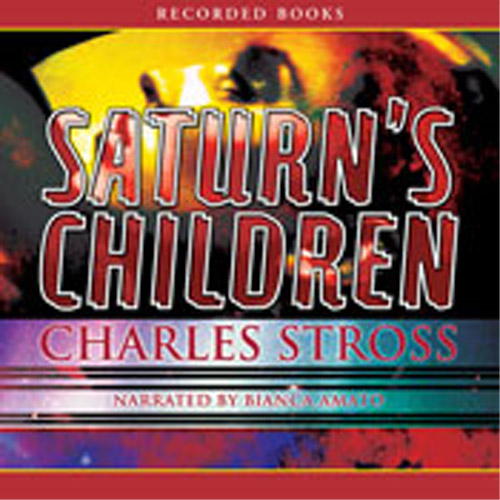
RECORDED BOOKS - Saturn's Children by Charles StrossSaturn’s Children
By Charles Stross; Read by Bianca Amato
11 CDs – Approx. 13 Hours 45 Minutes [UNABRIDGED]
Publisher: Recorded Books
Published: 2009
ISBN: 9781440750113, 9781440750106
Themes: / Science Fiction / Androids / Robots / Sex / Slavery / Identity / Venus / Mars / Mercury / Eris /

The Hugo Award-winning author of numerous best-sellers, Charles Stross crafts tales that push the limits of the genre. In Saturn’s Children, Freya is an obsolete android concubine in a society where humans haven’t existed for hundreds of years. A rigid caste system keeps the Aristos, a vindictive group of humanoids, well in control of the lower, slave-chipped classes. So when Freya offends one particularly nasty Aristo, she’s forced to take a dangerous courier job off-planet.

This novel’s title comes from the myth that Saturn (the Roman god of agriculture and harvest), ate his children at birth for fear of them usurping him. Its an apt starting point for a tale about robots More interesting is that Saturn’s Children opens with a reading of Asimov’s three laws of robotics

1. A robot may not injure a human being or, through inaction, allow a human being to come to harm.
2. A robot must obey any orders given to it by human beings, except where such orders would conflict with the First Law.
3. A robot must protect its own existence as long as such protection does not conflict with the First or Second Law.

…and then informs us that there are no humans left alive. There is, however, a whole solar system full of robots, all willing and able to obey all three laws. So what happened to all those humans? The novel is the answer to that question.

Saturn’s Children is told from the point of view of Freya Nakamichi-47 a gynoid (that’s a female android). She was activated (born) long after the last human had died. Freya, despite never having met one, still longs for her lost love (any human). Indeed, even the mere thought a human being makes her sexually excited. This is because, as a self described grande horizontale, Freya’s destiny was to be a sexual companion to any human that owned her. Now, without a master, she finds work where and when she can. But after a nasty run-in with an Aristo, a wealthy robot that owns other robots (called Arbiters), Freya will take any work that gets her off planet. Soon she’s employed by Jeeves, a masculine android who is more like her in shape and purpose than most robots. Freya’s first assignment is to transport a bio-engineered package across the solar system. But the pink police (a kind of anti biological proliferation organization), and another, more shadowy, organization are determined to stop her. Along the way Freya visits Cinnabar (a city on rails) that’s perpetually in Mercury’s shadow, drawing power from the temperature difference between Mercury’s light and dark sides), has sex with a rocket ship and grows some new hair.

Freya does a whole lot more than that too. She has a lot more sex for one. But beyond the sex there is some more fully cerebral stimulation going on in Saturn’s Children. The idea of a post-human solar system is an interesting one, and Stross plays with it quite effectively. This is a theme that I think hasn’t been done often enough in SF. The closest novel, in scope, if not in tone, is perhaps Clifford D. Simak’s City (in which intelligent dogs and robots have inherited a humanless Earth). This humanless solar system is, as I mentioned, quite vividly explored, with floating cities (like Bespin’s Cloud City) on Venus, waste heated bio-labs on the frozen dwarf planet of Eris, and a truly frightening description of what’s happened to poor old Earth. Stross has quite a lot of fun playing with the world he’s created here, naming a city Heinleingrad, naming a robot butler character after P.G. Wodehouse’s famous “gentleman’s personal gentleman.” It all mostly works with Saturn’s Children seeming to take most of its inspiration though from Heinlein’s novel Friday. Both novels feature artificial female persons as secret couriers, both tell their own stories, both secrete their smuggled cargos in their abdomens. Later on in Saturn’s Children there is some playing with the ideas promulgated in Heinlein’s 1970 novel I Will Fear No Evil. And, identity, in a world where brain data, and brain states, are easily and quickly copyable, isn’t as simple as it is with us meatbags. On the whole I enjoyed Saturn’s Children and found it full of interestingness. It was as most novels are these days, too long, and in need of a critical editor. The worst sin here is that the ending is rather weak, and features an afterword that leaves open the possibility of a sequel or seven.

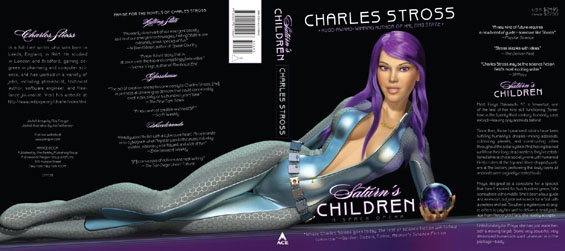
Narrator Bianca Amato, a South African accented “ALIEN OF EXTRAORDINARY ABILITY” (according to her resume), mispronounces a couple of the more obscure words but the general gist of her reading is highly competent. It helps a whole lot that Freya’s story is told in first person. I’m not sure what the present tense adds to the narrative other than being a little noticeable and not particularly harmful. Also, as I mentioned in a recent podcast, the Recorded Books cover art is boring, whereas the Ace Books paperbook edition is fabulous!

Check out the dust jacket from the paperbook edition:

Saturn's Children by Charles Stross - The PAPERBOOK's Dustjacket

Posted by Jesse Willis