
LibriVox: Security by Poul Anderson

SFFaudio Online Audio

LibriVoxNew from LibriVox.org, and featuring the voice talent of Gregg Margarite is:

Security by Poul Anderson

This isn’t the first recording of this 1953 Science Fiction novelette. Maureeen O’Brien (of the Maria Lectrix podcast) recorded a version previously. It, along with a whole bunch more Poul Anderson audio, can be found on our POUL ANDERSON page!

LibriVox - Security by Poul AndersonSecurity
By Poul Anderson; Read by Gregg Margarite
2 MP3 Files or Podcast – Approx. 1 Hour 19 Minutes [UNABRIDGED]
Publisher: LibriVox.org
Puiblished: December 4, 2009
Security, tells the story of a compartmentalized government physicist ordered by secret police to complete experiments aimed at developing a new weapon. He is brought to a hidden space station and put in charge of the project but there are many questions. In a world of spies watching spies it’s sometimes hard to know what’s patriotic. First published in Space Science Fiction February 1953.

Part 1 |MP3| Part 2 |MP3|

Podcast feed: http://librivox.org/rss/3798

iTunes 1-Click |SUBSCRIBE|

[Special thanks also to Betty M. and James Christopher @ LibriVox]

Posted by Jesse Willis

Review of Wyrms by Orson Scott Card

SFFaudio Review

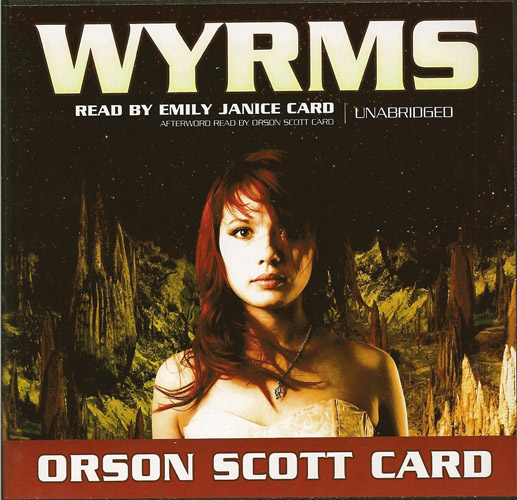
Science Fiction Audiobook - Wyrms by Orson Scott CardWyrms
By Orson Scott Card; Read by Emily Janice Card
9 CDs – 11.5 hours – [UNABRIDGED]
Publisher: Blackstone Audio
Published: 2008
ISBN: 9781433218542

Themes: / Science Fiction / Diplomacy / Slavery /

“Wyrms” by Orson Scott Card was first published in 1987. I read the book then and loved it. I loved the world, the characters and the STORY.

It got lost as it was published between two Hugo and Nebula Award winning novels, Ender’s Game and Speaker For The Dead. It didn’t deserve it.

It’s been over 20 years since I read the novel, and I have never completely forgotten the book, or its impact. When I got the audiobook, read by Card’s daughter, Emily, I was thrilled to have the chance to experience it again.

Can the book be as good as I remembered? I wondered. But not for long. Before I had finished two chapters, I was hooked. Again.

Patience is the seventh seventh seventh daughter of the space captain who first came to Imaculata. She’s the daughter of the rightful heir to the kingdom, the Heptarch. But she and her father serve the current ruler as diplomats. And slaves.

Her entire life, her father has protected her from her destiny. But, when he dies, she’s must run for her life, and face a destiny that has been prophesied for generations. A destiny that that will save the world – or destroy it.

I highly recommend this book. The story is compelling and well paced, the characters complex, and the world believable.

The audiobook is well done, except that I had a problem differentiating one or two of the lesser voices. As my only complaint, it’s pretty minor. I enjoyed Emily Card’s interpretation of Patience and the other main characters.

On a scale of 1-10, I’d give it a definite 9. Get the audiobook. Get the paperback. While you’re at it, get the 6-volume comic books by Jake Black. You’ll thank me for it later.

Posted by Charlene C. Harmon

FREE @ Audible.com: RINGWORLD by Larry Niven

SFFaudio Online Audio

Drop that tasp and grab this link! I’ve got a FREE and UNABRIDGED version of Larry Niven’s Ringworld! You’ll need an Audible.com account. Hurry now, there’s no telling when this offer will dry up so grab it while you can!

Audible.com - Ringworld by Larry Niven (Blackstone Audio)Ringworld: Free Version
By Larry Niven; Read by Tom Parker (aka Grover Gardner)
FREE Audible Download – Approx. 11 Hours 15 Minutes [UNABRIDGED]
Publisher: Blackstone Audio
Published: 1996
Provider: Audible.com
Welcome to Ringworld, an intermediate step between Dyson Spheres and planets. It is 93 million miles in radius – the equivalent of one Earth orbit or 600 miles long – 1,000 meters thick, and much sturdier than a Dyson sphere. What other advantages are there to this world? The gravitational force created by a rotation on its axis of 770 miles per second means no need for a roof. Walls 1,000 miles high at each rim will let in the sun and prevent much air from escaping.

Larry Niven’s novel Ringworld won the 1970 Hugo Award for Best Novel, the 1970 Nebula Award for Best Novel, and the 1972 Ditmars, an Australian award for Best International Science Fiction.

|READ OUR REVIEW|

[via This Week In Tech]

Posted by Jesse Willis

Fast Ships, Black Sails A PIRATE ANTHOLOGY

SFFaudio Online Audio

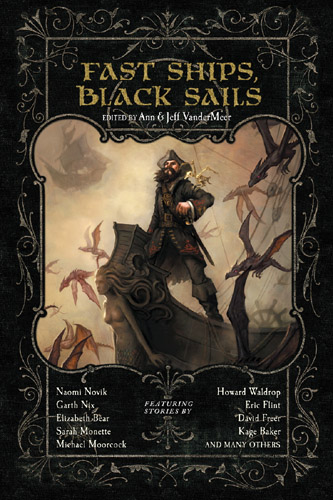
Night Shade Books - Fast Ships, Black Sails edited by Ann and Jeff VanderMeer Do you love the sound of a peg leg stomping across a quarterdeck? Or maybe you prefer a parrot on your arm, a strong wind at your back? Adventure, treasure, intrigue, humor, romance, danger–and, yes, plunder. Oh, the Devil does love a pirate–and so do readers everywhere.

Swashbuckling from the past into the future and space itself…

Night Shade Books published Fast Ships, Black Sails an anthology of fantastik pirate stories in 2008. Since then there have been two audiobook versions made of the 18 stories contained within the collection. If more get turned into audiobooks I’ll add them to this post!

PodCastlePC064: Castor On Troubled Waters
By Rhys Hughes; Read by Alasdair Stuart
1 |MP3| – Approx. 27 Minutes [UNABRIDGED]
Podcaster: PodCastle
Podcast: August 4, 2009


Escape Pod LogoEP226: Pirate Solutions
By Katherine Sparrow; Read by Sarah Tolbert, Kate Baker, Nate Periat, and Steve Eley
1 |MP3| – Approx. 42 Minutes [UNABRIDGED]
Podcaster: Escape Pod
Podcast: November 26, 2009

Contents:
Introduction: “Raising Anchor” by Ann & Jeff VanderMeer
Boojum by Elizabeth Bear and Sarah Monette
Araminta, or, The Wreck of the Amphidrake by Naomi Novik
Avast, Abaft! by Howard Waldrop
I Begyn as I Mean to Go On by Kage Baker
Castor on Troubled Waters by Rhys Hughes |MP3|
Elegy for Gabrielle, Patron Saint of Healers, Whores and Righteous Thieves by Kelly Barnhill
Skillet and Saber by Justin Howe
The Nymph’s Child by Carrie Vaughn
68˚06’N, 31˚40’W by Conrad Williams
Pirate Solutions by Katherine Sparrow |MP3|
We Sleep on a Thousand Waves by Brendan Connell
Pirates of the Suara Sea by David Freer & Eric Flint
Voyage of the Iguana by Steve Aylett
Iron Face by Michael Moorcock
A Cold Day in Hell by Paul Batteiger
Captain Blackheart Wentworth by Rachel Swirsky
The Whale Below by Jayme Lynn Blaschke
Beyond The Sea Gate Of The Scholar-Pirates of Sarskoe by Garth Nix

Posted by Jesse Willis

The SFFaudio Podcast #044 – TALK TO: Professor Eric S. Rabkin

Podcast

The SFFaudio PodcastThe SFFaudio Podcast #044 – Jesse and Scott are joined by Professor Eric S. Rabkin of the University Of Michigan to discuss fairy tales, fantastic literature and Science Fiction.

Talked about on today’s show:
Department Of English Language And Literature @ the University Of Michigan, the Winter 2010 semester: English 342 Science Fiction, English 418/549 Graphic Narrative, hey sign us up!, The Teaching Company, Science Fiction: The Literature Of The Technological Imagination |READ OUR REVIEW|, Masterpieces of the Imaginative Mind: Literature’s Most Fantastic Works, Franz Kafka, H.G. Wells, Edgar Allan Poe, Science Fiction (the most important literature for adults), I, Robot by Isaac Asimov |READ OUR REVIEW|, Brothers Grimm, fairy tales, Neuromancer by William Gibson |READ OUR REVIEW|, Asimov’s three laws of robotics, the conversation that is Science Fiction, humans are pattern seeking animals, Starship Troopers by Robert A. Heinlein |READ OUR REVIEW|, The Forever War by Joe Haldeman |READ OUR REVIEW|, Ender’s Game by Orson Scott Card |READ OUR REVIEW|, the ansible, Armor by John Steakley, Old Man’s War by John Scalzi |READ OUR REVIEW|, Gundam, The Ship Who Sang by Anne McCaffrey, Science Fiction as a form of children’s literature, Thomas Disch, Camp Concentration, 334, Kurt Vonnegut, The Plot Against America by Philip Roth, alternate history, Hugo Gernsback, pulp literature, paperback originals, adolescent power fantasies, Frank Reade and His Steam Man of the Plains by Noname, Ralph 124C 41+ by Hugo Gernsback, pushing science education through Science Fiction, The Time Machine by H.G. Wells |READ OUR REVIEW|, The Facts In The Case Of M. Valdemar by Edgar Allan Poe, From The Earth To The Moon by Jules Verne, Henry James and H.G. Wells in conversation over the future of fiction, The Portrait Of A Lady by Henry James, WWII, the societal effect of the G.I. Bill, tracking an author’s intentions, powerful fiction becomes classic?, Ted Chiang, Blankets by Craig Thompson, has Science Fiction crossed a certain cultural Rubicon?, Momento, Blindness by José Saramago, Briefing for a Descent into Hell by Doris Lessig, Galatea 2.2 by Richard Powers, has our culture become “fully Science Fictionized”?, does SF history begin with Frankenstein and end with Neuromancer?, Alan Moore, Watchmen, The League Of Extraordinary Gentlemen, pattern recognition, allusion (and literary allusion).

Posted by Jesse Willis

The Inheritors (An Extravagant Story) by Joseph Conrad and Ford Madox Ford

SFFaudio Online Audio

Mike Hagerty, in response to the Fourth Annual SFFaudio Challenge, has recorded and posted a 1901 Science Fiction(y) collaborative novel by two giants of English literature. You can currently get the entire audiobook for FREE either via LearnOutLoud.com or Archive.org. There are plans afoot to get it up on LibriVox.org as well (which will provide a very handy podcast feed). Thanks so much Mike!

The Inheritors by Joseph Conrad and Ford Madox FordThe Inheritors (An Extravagant Story)
By Joseph Conrad and Ford Madox Ford; Read by Mike Hagerty
7 MP3 Files o 7 OGG Vorbis Files – Approx. 6 Hours 28 Minutes [UNABRIDGED]
Publisher: Archive.org / LearnOutLoud.com
Published: November 2009
The Inheritors: An Extravagant Story (1901) is a quasi-science fiction novel on which Ford Madox Ford and Joseph Conrad collaborated. It looks at society’s mental evolution and what is gained and lost in the process. Written before the first World War, its themes of corruption and the effect of the 20th Century on British aristocracy appeared to predict history. In the novel, the metaphor of the “fourth dimension” is used to explain a societal shift from a generation of people who have traditional values of interdependence, being overtaken by a modern generation who believe in expediency, callously using political power to bring down the old order. Its narrator is an aspiring writer who himself makes a similar transition at a personal level only to feel he has lost everything.

Posted by Jesse Willis