Review of Peter Galaxy: Interstellar Envoy by Brian Price and Jerry Stearns

Science Fiction Audio Drama - Peter Galaxy: Interstellar EnvoyPeter Galaxy: Interstellar Envoy
By Brian Price and Jerry Stearns; Featuring David Ossman and Michael Sheard
1 CD – 45 Minutes [Audio Drama]
Publisher: Great Northern Audio
Published: 2003
Themes: / Science Fiction / Comedy / Aliens / Cars /

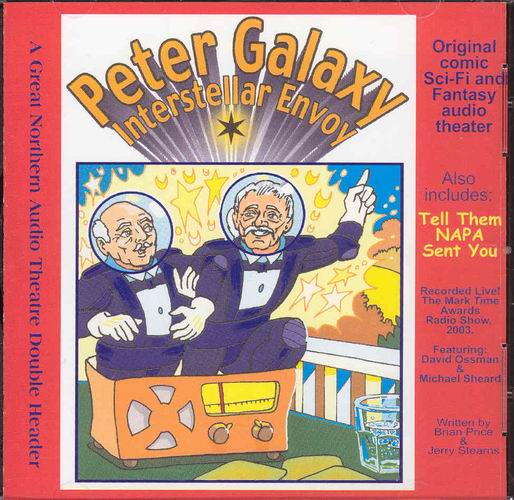
This CD contains the live performance of Peter Galaxy: Interstellar Envoy and Tell Them NAPA Sent You, which were recorded at the Mark Time Science Fiction Audio Awards at the 2003 CONvergence in Minneapolis, MN. It stars Michael Sheard (Star Wars, Dr. Who) and David Ossman of the Firesign Theater. And it is hilarious, great fun.

Peter Galaxy: Interstellar Envoy tells the story is about a radio actor who, long ago, was the star of the famous Peter Galaxy radio series. Aliens come down, thinking that Peter Galaxy is a real person whose help they need to defend themselves against an interstellar threat. The comparison to Galaxy Quest is obvious and intentional. The script is full of science fiction tropes that play well in front of a convention audience. The jokes come fast and furious, and there’s not a poor actor in the entire cast.

Tell Them NAPA Sent You is a funny shorter piece about a guy whose car won’t start. He figures out which part he needs, then goes in search of it. The story takes a distinct fantastic turn when he’s told, after a dizzying set of directions to a place where he can find this part, to knock on the “lower door – DON’T try the high one”. Definitely chuckle worthy.

Like I said, both shows were recorded live in front of a convention audience, which had a great time by the sound of them. As did I!

Posted by Scott D. Danielson

Review of Philip K. Dick Recorded Telephone Interviews

Science Fiction Audio - Philip K. Dick Telephone InterviewPhilip K. Dick Recorded Telephone Interviews
Conducted by John Boonstra
2 CDs – Approx. 111 Minutes [UNABRIDGED EXCERPTS]
Published: 1991
Themes: / Non-Fiction / Science Fiction / Interview /

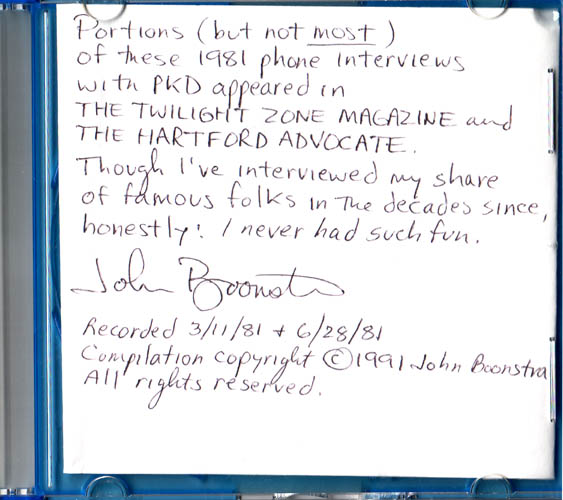
These discs combine telephone interviews conducted 3/11/81 and 6/28/81. Portions appeared in The Hartford Advocate and The Twilight Zone Magazine. I’ve interviewed dozens of interesting people in the years since, but no conversation has been quite so exhilarating. It was a privilege to have even this brief contact with PKD…”
— John Boonstra

This is a set of 2 CD-Rs with printer paper labels and a photocopy of a handwritten insert written by the interviewer John Boonstra. The packaging and media is straight out of the Staples catalogue. But the content… oh the content… It’s the ultimate! Disc 1 is one long uninterrupted audio track. It starts with a ringing telephone, answered by a “Hello?” And if you’ve heard his voice anywhere else you instantly know it is Philip K. Dick.

Boonstra conducted by telephone these two interviews. Boonstra was better prepared than we have any right to expect – he was familiar with the vast majority of his subject’s writing and anxious to engage someone who he clearly admired greatly. Dick himself is full of life, overflowing with funny anecdotes, eager to talk and expound and is a true delight to hear in such an unfiltered setting.

Admittedly the sound quality isn’t great. A constant tape hiss mars both interviews, but the voices are both loud and clear, and in stereo. Dick’s voice comes out of the left speaker and Boonstra’s out of the right. They talk for nearly two hours over the course of the two interviews and I was riveted the entire time. Unfortunately the last portion of the first interview is completely cut off and the first portion of the second interview is entirely missing. Boonstra prompts Dick now and again with well researched questions and Dick never shies away, giving us the inside dope on many aspects of his professional and private lives as well as explaining the research that went into many of his later books including, The Cosmic Puppets, The Man In the High Castle, Martian Time-Slip, Do Androids Dream of Electric Sheep?, The Galactic Pot-Healer, Confessions Of A Crap Artist, VALIS, The Divine Invasion, The Transmigration Of Timothy Archer and others.

If you like Philip K. Dick’s novels you’ll love these interviews! I just wish there were more of them. Unfortunately Dick died less than a year after the second interview was recorded. I got two CD set from Zack Wood: click here to check out his site and tell him SFFAUDIO sent you!

Posted by Jesse Willis

Review of Most of My Friends Are Two-Thirds Water by Kelly Link

Science Fiction Audiobook - Most of My Friends Are Two-Thirds Water by Kelly LinkMost of My Friends Are Two-Thirds Water
By Kelly Link; Read by Alex Wilson
FREE MP3 Download – Click here for link to file at www.spokenalex.org
– 27 minutes, 20 seconds [UNABRIDGED]
Publisher: http://www.spokenalex.org/
Published: 2005
Themes: / Science Fiction / Alien Invasion / New York / Metafiction / Writing /

Jak calls me with the first line of a story. Most of my friends are two-thirds water, he says, and I say that this doesn’t surprise me. He says, no, that this is the first line. There’s a Philip K. Dick novel, I tell him, that has a first line like that, but not exactly and I can’t remember the name of the novel. I am listening to him while I clean out my father’s refrigerator. The name of the Philip K. Dick novel is Confessions of a Crap Artist, I tell Jak. What novel, he says.

Another FREE tale from author Kelly Link’s short story collection Stranger Things Happen. Link is a Nebula, World Fantasy, and James Tiptree Jr. Award-winning author. Her urbane speculative fiction always compares well to Nalo Hopkinson and Walter Mosley – but Link takes that post-modern mentality, rotates it 90 degrees, and adds more of a sense of play. I’m ambivalent about metafiction, which this most certainly is. Sometimes it works wonderfully, but it’s harder with short stories, as they tend to be fairly crowded with concepts already. Most of My Friends Are Two-Thirds Water comes away decently. Narrator Alexander Wilson reads well, but since the narrative voice is that of a female this is not the
perfect match of voice to story. Still, how can I complain when the reading is letter perfect and the price is 100% FREE! Downloadable here.

Posted by Jesse Willis

Review of The Helmsman by Bill Baldwin

Science Fiction Audiobooks - The Helmsman by Bill BaldwinThe Helmsman
By Bill Baldwin, Narrated by Justin Brooks, C.J. Critt, Patrick Seaman, Roger Jones, & Steve Botha
MP3 Download, 576Mb – 10 hours [UNABRIDGED]
ISBN: 1587521539
Pub Date: 2005
Publisher: Timberwolf Press
Themes: / Science Fiction / Military Science Fiction / Space Travel / Aliens / Battles /

One of the few survivors of a League sneak attack on his poor and miserable homeworld of Careseria, Wilf Brim sets out to settle the score. Were it not for the attrition from the war that followed, Wilf would never have escaped his lower-class status and been accepted into the Academy. Now, freshly graduated, young Sublieutenant Wilf Ansor Brim, Imperial Fleet, begins his first assignment, Helmsman of the I.F.S. Trucluent.

I’m honestly not certain how to categorize this book audio-wise. Though it is listed as “unabridged”, the recording itself says “Based on The Helmsman by Bill Baldwin”, and is very near a 10 hour audio drama. There is a narrator (a very good one), but all of the dialogue is read by other actors, and there are sound effects throughout. The important question is “did it work”, and the answer is Yes, though the occasional unbelievable actor really pulls the listener out of the action.

The novel is pure military pulp science fiction. There is a ton of technical jargon as characters tune disruptors and such. Vehicles are often called “field pieces”, time is measured in “metacycles”, and everyone says “Aye, sir!” quite a bit. The action moves quickly as battles lead to more battles. The title is listed as “mature” for some sexual scenes.

In a nutshell, The Helmsman should please fans of military SF. The sound quality is very good, and the main narrator excellent. This is the first of several volumes – the Timberwolf Press website promises Galactic Convoy (currently available), The Trophy, The Mercenaries, The Defenders, and The Siege.

This title is available at Paperback Digital.

Posted by Scott D. Danielson

Review of The Rolling Stones by Robert A. Heinlein

Science Fiction Audiobooks - The Rolling Stones by Robert A. HeinleinThe Rolling Stones
By Robert A. Heinlein; Performed By A Full Cast
8 CDs – 7 Hours 9 Minutes [UNABRIDGED]
Publisher: Full Cast Audio
Published: 2005
ISBN: 1932076808
Themes: / Science Fiction / Young Adult / Space Travel / Newtonian Physics / The Moon / Mars / The Asteroid Belt /

When the Stone twins made up their minds to leave Luna City in a secondhand spaceship, they hadn’t planned on having their whole family accompany them. But the Stones are not your ordinary Lunar family – no way! – and their voyage through the solar system sure proves it.

Not long ago FULL CAST AUDIO contacted us, and gave us a heads-up – a new Robert A. Heinlein novel was coming. I was blown away by their first Heinlein adaptation so I tried to keep my expectations reasonable. “Lightning can’t strike twice”, I told myself. “Just be happy that it is being released. That’s what you asked for and that’s what you got. Don’t be disappointed if it doesn’t live up to your expectations.” I needn’t have worried. The Rolling Stones is as good as the superb full cast reading of Have Space Suit, Will Travel – maybe even a little better!

It is a Heinlein juvenile, written and first published in 1952, full of Heinleinian economics, politics, and family values, which all combine with a travelogue of interplanetary adventure. Dialogue moves the surprisingly light plot along, and the narrator provides the cultural and technological backdrop.

The Stone family is made up of father Roger, mother Edith, grandmother Hazel, the eldest child Meade, the youngest Buster, and the middle identical twins Castor and Pollux. The twins are natural born inventors and entrepreneurs, so when they go looking through the used spaceship yards on Luna they’ve got a scheme in mind. When Roger finds out about their plans he manages to turn the whole thing into a family venture. And off they go into the solar system.

If you like Heinlein you’ll love this novel but it’s a little different from most juvies in that it is more a series of smaller adventures. What I like best about the book is that it ably envisions a wonderful future of interplanetary travel in a completely scientifically accurate way. The economic model that would allow a family to buy a spaceship, fuel it and use it as their personal yacht may be unrealistic, but that won’t dampen your enthusiasm. It didn’t mine.

Most of the actors are new but Bill Molesky is back playing another father and Cynthia Bishop plays another mother figure. Peter Moller plays another small role, and FULL CAST AUDIO founder Bruce Coville makes another cameo too. Another plus – Daniel Bostick again directs. If I had my druthers, Daniel Bostick will direct all the future FULL CAST AUDIO Heinlein releases too (on the principle you don’t mess with success). The new actors are all perfect in their roles. There isn’t a false performance in the bunch.

A potential stumbling block was avoided. This is a third person perspective novel, as opposed to the first person of Have Space, Suit Will Travel, so they needed a narrator. Veteran voice over actor David Baker took the reins there and together with this full cast read another faithful adaptation of a Heinlein “juvenile” novel.

What’s really interesting though is that this is a straight reading with multiple readers, something I didn’t fully realize in Have Space Suit, Will Travel. There are no sound effects. There are just actors reading the text and a little accenting music at chapter openings. This was another excellent choice, a straight reading works well. You don’t need to paint in sound effects when the words evoke a mental image.

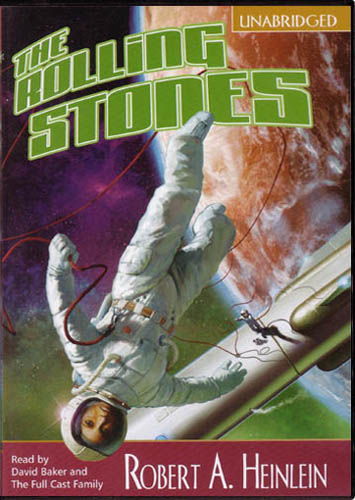
As is becoming the rule, the attention to detail found in the audio production extends to the fit and finish of the packaging. Jerry Russel’s original cover art is absolutely beautiful to behold. The CD case is the identical design to the Have Spacesuit, Will Travel case. A thick DVD style case, with the CDs stacked and secured by two plastic clamps. Perfect! Please FULL CAST AUDIO keep recording these Heinlein juvenile novels. I’d like to say I deserve it, but even if I don’t the novels sure do!

Posted by Jesse Willis

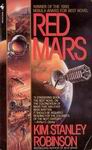
Review of Red Mars by Kim Stanley Robinson

Science Fiction Audiobooks - Red Mars by Kim Stanley RobinsonRed Mars
By Kim Stanley Robinson, read by Richard Ferrone
17 cassettes / 24 hours [UNABRIDGED]
Publisher: Recorded Books
Published: 2000
ISBN: 0788740849
Themes: / Science Fiction / Hard SF / Future history / Mars / Space exploration / Space flight / Planetary colonization / Terraforming

If I were to play you the prolog from Red Mars, neither telling you the title nor showing you the case (with Olympus Mons shown actual size), you would know immediately that it came from a very large book. The mystical meditation on the red planet that opens this tome plumbs the depths of human history and the width of human culture, conjuring a sense of vast space for the story that follows.

And what follows is a massive dose of exhilarating hard science fiction, the first volume in an epic trilogy charting the future history of the colonization of Mars. It grabs us with an opening sequence of mid-novel action, then backs up to lead us more meticulously from the selection of the first one hundred explorer/settlers to their first attempts at independence from the faltering socioeconomic powers of Earth nearly twenty Martian years later. Told through the eyes of half a dozen of these “First Hundred”, the novel details the technical, political, and to some extent personal growth of the colonists through their training on Earth’s Antarctica, the long space voyage between the planets, the rise of the first settlements and buildings, the initial attempts at terraforming, the breakaway of some of the settlers to another colony, the arrival of the next, larger and more diverse waves of colonization, and on to a cataclysmic finale. The story covers a lot of ground with striking believability.

The strongest point of the novel is its marvelous set-pieces, such as the radiation storm scene on the voyage out, a nearly deadly encounter with a Martian dust storm in a dirigible, and a perilous escape down a canyon system that is being destroyed by a torrential flood. Some of the best would be slight plot spoilers to mention, so I won’t. But suffice it to say they are all lovingly crafted, filled with mental eye-popping detail, and yet integrated well into the plot. This is science fiction with its fundamental sense of wonder not only intact, but bursting from every page like an alien from the abdomen. As you might expect, some of this detail and the buildup to monumental scenes leaves a few slow parts in the narrative, but the payoffs are almost always phenomenal.

Also strong is the fundamental clash of old and new economic systems, which contrast idealized concepts of human worth with the dehumanizing iniquities of our international market economy pushed to its all-too-readily conceivable limits. I tend to cheer at any work that is not afraid to point out how the cancerous growth of international corporations in our modern world devours the planet’s resources yet returns nothing of value to the overall system. This book gave me a lot of alternative ideas to dream about, and some Darth Vader-sized economic evil to hiss at cathartically.

One thing I didn’t like was the huge number of fundamental breakthroughs that are made by the “First Hundred” in various fields of science after they leave the messiness of life on earth. That premise borrows a little too much from Frederick Pohl’s Jem, for one thing. For another, as someone who does science and engineering for a living, I don’t believe that if you separate a bunch of scientists and engineers from the mundane glop of real life, you suddenly end up with astounding technical breakthroughs. If it were that easy, you could get any amazing breakthrough you wanted just by throwing a bunch of scientists and engineers in a nice padded cell.

Also, as with most hard science fiction, you could quibble that the characters lack the depth of believable human beings, and that the necessities of the plot move the characters more than their individual natures and decisions determine the plot. But you shouldn’t be reading this book for the same reasons you’d read The Heart is a Lonely Hunter. Come on! Red Mars may do little to illuminate the unrequited yearnings of the human soul, but that’s not the point. It boils over with effervescent ideas, dynamic images, and inspiring speculation on what human minds and hands can achieve. The characters here may feel a little hollow, and their individual voices may be pretty much interchangeable, but they do their job: they lead us into an exciting, vibrant, thrilling future world.

I will admit that the weaknesses in characterization are not greatly aided by Richard Ferrone’s narration. Don’t get me wrong, I found his cigarette-charred, “In a world where…” voice (somewhat reminiscent of my grade school secretary Mrs. Byrd) to be reliably intriguing. And he can spit out the ten-dollar words and knotty concepts in the exposition with lucid authority. However, his voice characterizations are often indistinguishable. It is possible to find yourself confused about who is speaking when the dialog comes without tag lines. This is partly Robinson’s fault for failing to provide distinctive speech patterns for all the characters, but that’s exactly where the voice of the narrator is supposed to help most. For several characters, it does. But for many, it does not.

I consider the above detractions to be minor points, however. Overall, you will find so much to gasp at, delivered with such powerful enthusiasm by both the author and the narrator, that it would be a crime to miss it. I owe a significant fine just for pushing Red Mars down my reading list for so long. If you’re looking for a hard SF novel that will make you sit up and say “Wow!” out loud, then you should get your hands on this one immediately.

Posted by Kurt Dietz