A Good Story Is Hard To Find 023: Waystation by Clifford D. Simak

SFFaudio Online Audio

A Good Story Is Hard To FindSFFaudio’s sister podcast, if there is such a thing, must be A Good Story Is Hard To Find. It’s like a slimmed down and Catholicized version of The SFFaudio Podcast. At the beginning of every show Scott and Julie describe the show as a podcast “where two Catholic friends talk about popular the books and movies they love, and the one reality we see beneath.” Now while I’m a bit suspicious of that “one reality” (especially after reading a Philip K. Dick story) I still love the show to bits. Scott and Julie, the participants, talk intelligently about great books and movies. Their latest book is a great favourite of mine:
Way Station by Clifford D. Simak |READ OUR REVIEW|.

Have a listen |MP3|.

Podcast feed: http://feeds.feedburner.com/AGoodStoryIsHardToFind

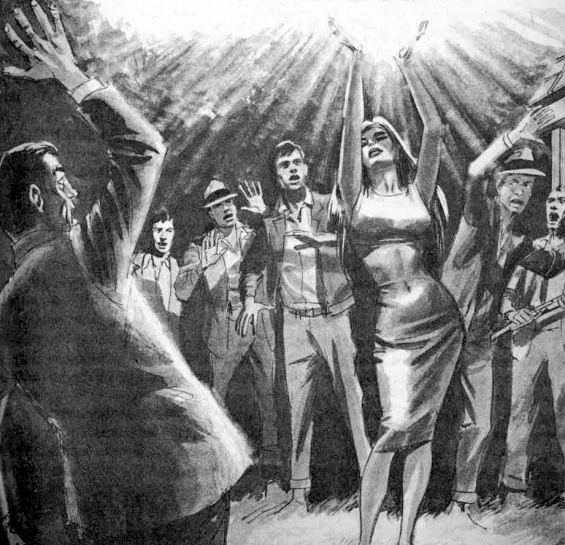
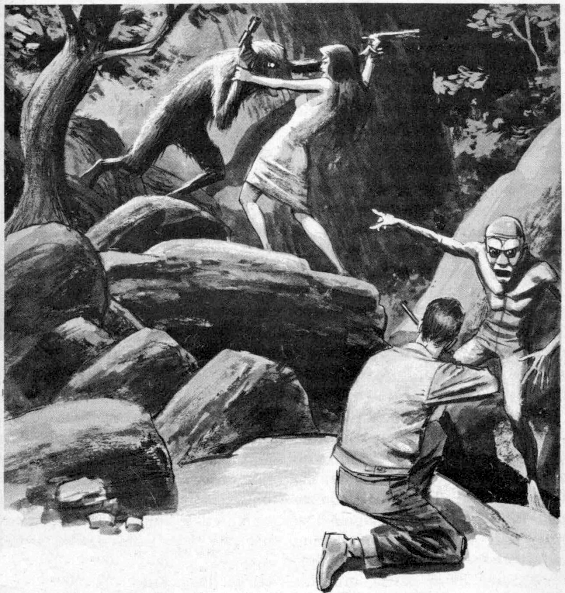
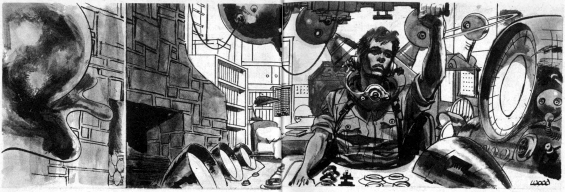
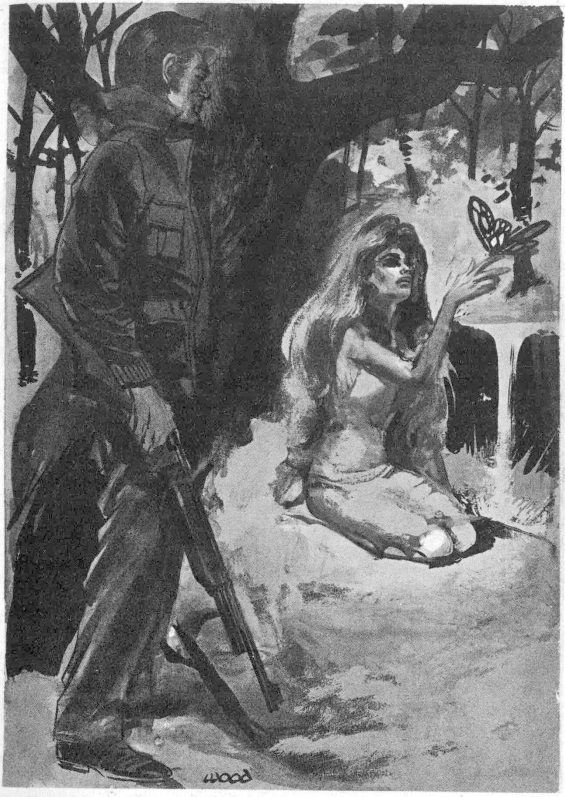
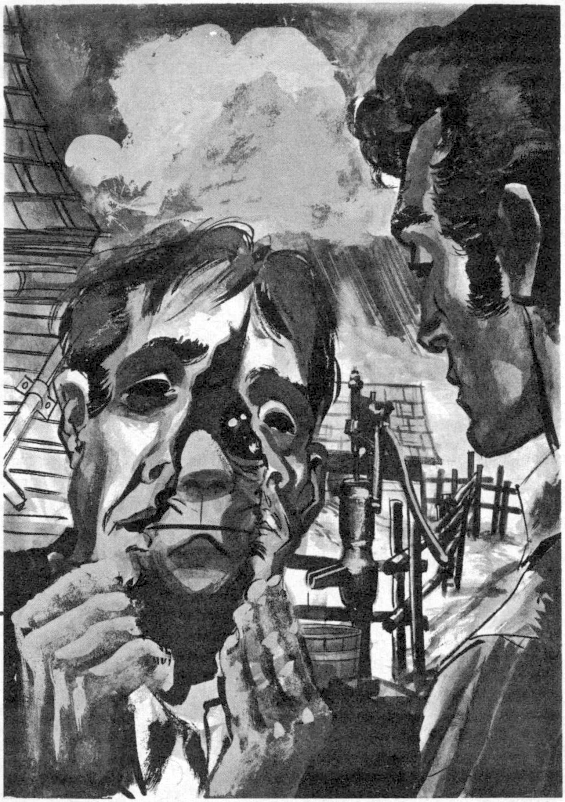
And while you’re listening check out these great Wood illustrations from the original serialization of Way Station (under the title Here Gather The Stars) in Galaxy Science Fiction June and August 1963:

Here Gather The Stars by Clifford D. Simak - Illustration by Wood

Posted by Jesse Willis

The Drama Pod: Adjustment Team by Philip K. Dick

SFFaudio Online Audio

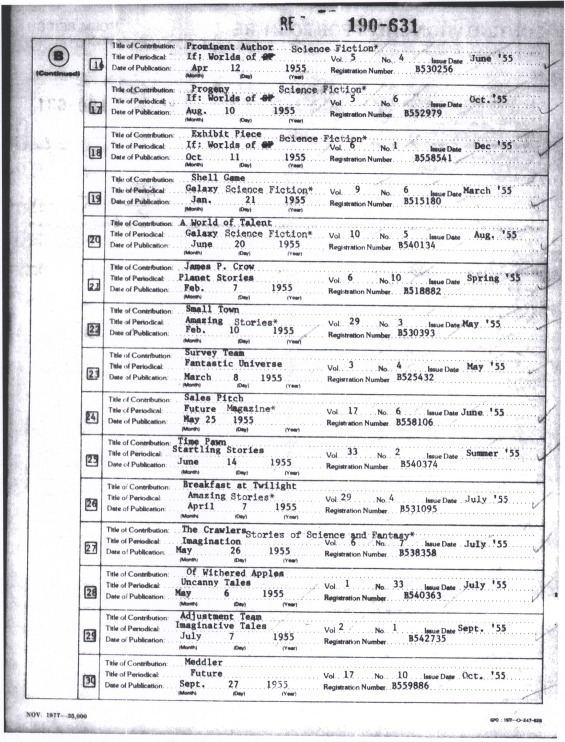
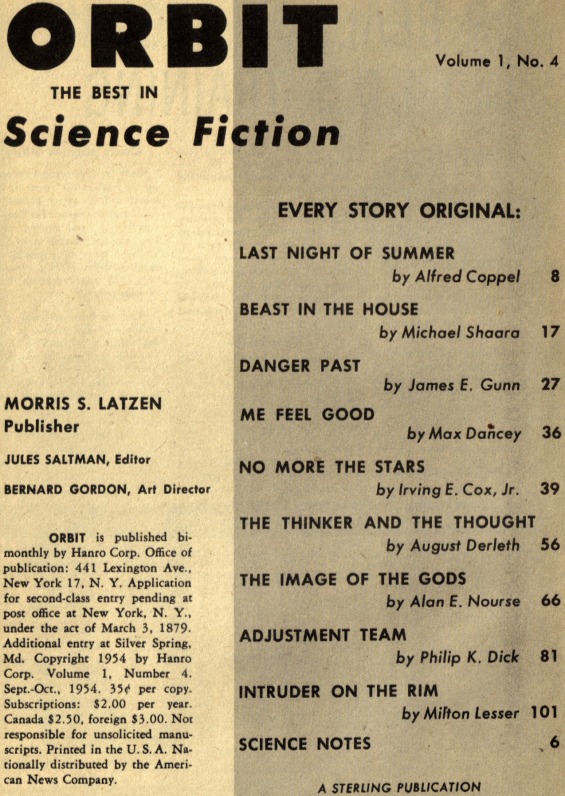
Look what the dragnet dragged in! This is a complete and unabridged recording of a story that’s been suppressed by threats of a lawsuit. Originally recorded for inclusion in a LibriVox collection of short Science Fiction stories, Adjustment Team was unjustly subject to DMCA takedown notifications |HERE| and |HERE|. The facts are these: The story wasn’t actually copyright renewed as evidenced by this falsified document RE190631 (page 2 back). We can see that the true first publication date of Adjustment Team was in Orbit Science Fiction No.4 Sept-Oct 1954 (not Imaginative Tales September 1955). Thanks Drama Pod!

The Drama PodAdjustment Team
By Philip K Dick; Read by Gregg Margarite
1 |MP3| – Approx. 59 Minutes [UNABRIDGED]
Podcaster: The Drama Pod
Podcast: November 14, 2011
“Something went wrong and Ed Fletcher got mixed up in the biggest thing in his life.” First published in Orbit Science Fiction, Sept-Oct 1954, No.4.

ETEXT Editions |SICKMYDUCK|WIKIMEDIA|WIKISOURCE|MOORINGPOST|

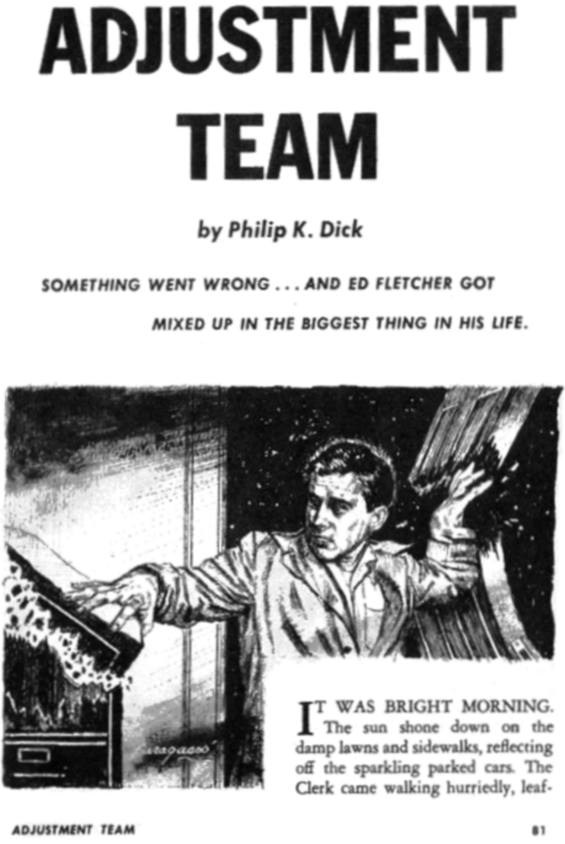
Illustrations by Faragasso:

Adjustment Team by Philip K. Dick

Adjustment Team by Philip K. Dick

[Thanks internet!]

Posted by Jesse Willis

1979 Philip K. Dick interview with Charles Platt (Santa Ana, California)

SFFaudio Online Audio

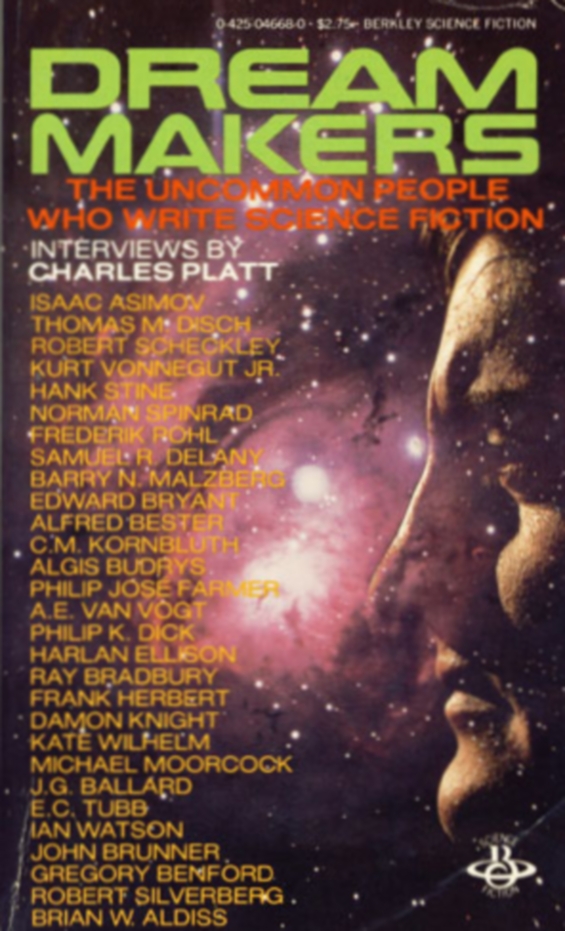
This essential interview with Philip K. Dick, conducted by Charles Platt and recorded in 1979 in Santa Ana, California, is sure to be immensely important for Dick scholars. It was recorded for Platt’s book Dream Makers: The Uncommon People Who Write Science Fiction.

Here’s the video converted back to audio, |MP3| and although it isn’t huffduffable, it is downloadable.

Notes:
-Dick was “plenty peculiar” because he read books
-he wasn’t gay despite his hanging around with gay friends
-Quakers were about the only group in the world Dick didn’t have some sort of grievance against
-Dick claims to have been kicked out of university for failing mandatory ROTC training
-Dick read The World Of Null-A by A.E. van Vogt and found in it great inspiration for his ideas about the perception of reality and reality itself
-Dick perceived his high school geometry teacher as a mechanism
Roog and other “interior projection stories”
-Dick’s fiction can be incomprehensible if you do not accept his premise (namely that “each of us lives in a unique world.”)
Martian Time Slip.
-When Dick went to a psychotherapist he was told he was an alcoholic (despite his being a teetotaler)
-“attack therapy”
-totalitarian communities
-why Dick writes about anti-heroes
-paranoia
-“I am inevitably persuaded by every argument that is brought to bare”
-private worlds
The Three Stigmata Of Palmer Eldritch
Time Out Of Joint
-artificial memories / false memories
-the influence of drugs on Dick’s writing was only in the output (using amphetamines he was completing 60 finished pages per day)
-Dick’s one real acid trip
A Scanner Darkly
-cats and cat curiosity
-Carl Jung and “the collective unconscious”
-John Belushi (on Saturday Night Live)
-WWI and the battle of The Marne
-Sergei Eisenstein’s Alexander Nevsky
-WWI and the battle of The Marne
-Dick’s father fought in WWI (in the 5th Marines) and told Philip the stories about it
All Quiet On The Western Front by Erich Maria Remarque
-“the god of this world is evil”
Maze Of Death
Ubik
Eye In The Sky
-WWII
-something is terrible is wrong (when everyone cheers a burning man)
-empathy for animals (human and rodent)
-the killing of a rat (haunted Dick)
-Buddha
Flow My Tears, the Policeman Said
-lambs and sheep
Valis (his then latest novel)
-standing on the shoulders of giants
-disorder (evil) -> order (benign)
-Dick claims to have been eccentric but not insane
-“it fired my agent, it fired my publisher” (it being the spirit that was possessing him)
-Dick’s letter to the Roman Catholic Church (about the miracle that occurred)
-conspiracies
-the Cumaean Sibyl informed Dick that the American Republic is in danger of turning into the American Empire (in 1974)
-PKD on censorship (he’s against it, unless you aren’t)
-the War Of The Spanish Lowlands
-Congressman Charles E. Wiggins got letters from Dick (written while he was possessed by the spirit of the Cumaean Sibyl)
-the Nixon tape transcripts were forgeries (according to Dick’s Cumaean Sibyl)
-the Paul Williams article in Rolling Stone on Dick
-Dick’s tutelary spirit promised to return Dick to a garden upon his deathbed
Diana
-Norman Spinrad
-“I’m in the Portuguese States Of America”
-a Chinese finger trap
We Can Build You
-Platt: “Do you recognize the possibility that you were talking to yourself?” Dick: “Yes.”
-multiple personalities
-Archimedes principle
Faith Of Our Fathers
-Ursula K. Le Guin thought Dick was crazy
-pre-socratic philosophy

Dream Makers: The Uncommon People Who Write Science Fiction

[via SFSignal.com and youtubemp3.tv]

Posted by Jesse Willis

Call Me Joe by Poul Anderson

SFFaudio Online Audio

Here is one of the greatest stories of speculative imagination, a true Science Fiction yarn in the greatest sense of that tradition. Collected previously in such anthologies as Masterpieces: The Best Science Fiction Of The Twentieth Century and The Science Fiction Hall of Fame, Volume Two A (in which it is the first story). Here is Poul Anderson’s magnificent novelette Call Me Joe.

Call Me Joe
By Poul Anderson; Read by Warren James
6 Parts – Approx. 1 Hour 22 Minutes [UNABRIDGED]
Provider: Hour 25 Online
Released: March 2001
Part 1 |MP3| Part 2 |MP3| Part 3 |MP3| Part 4 |MP3| Part 5 |MP3| Part 6 |MP3|
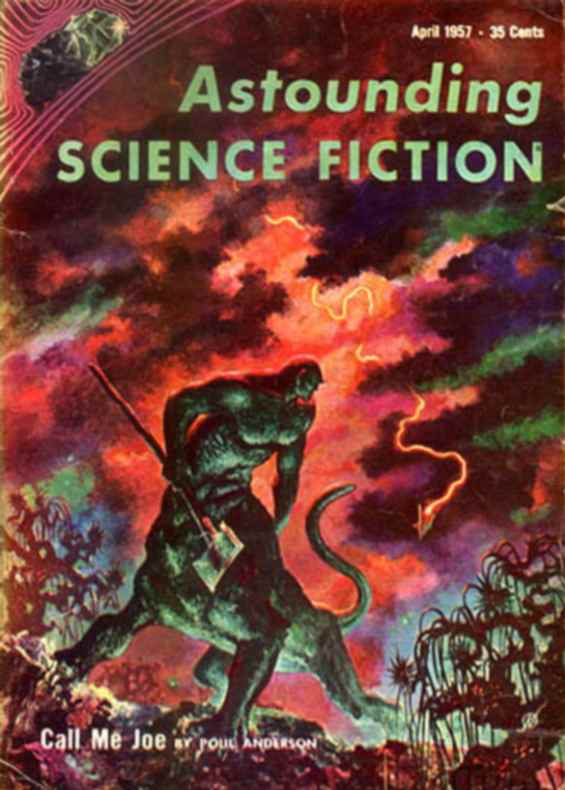
To explore Jupiter you’ll have to do more than build a pressurized suit, you’ll need a lot more. Just ask Joe. First published in the April 1957 issue of Astounding Science Fiction.

Podcast feed: http://huffduffer.com/tags/call_me_joe/rss

iTunes 1-Click |SUBSCRIBE|

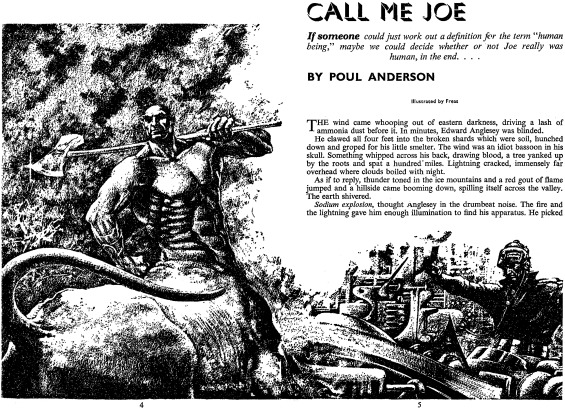
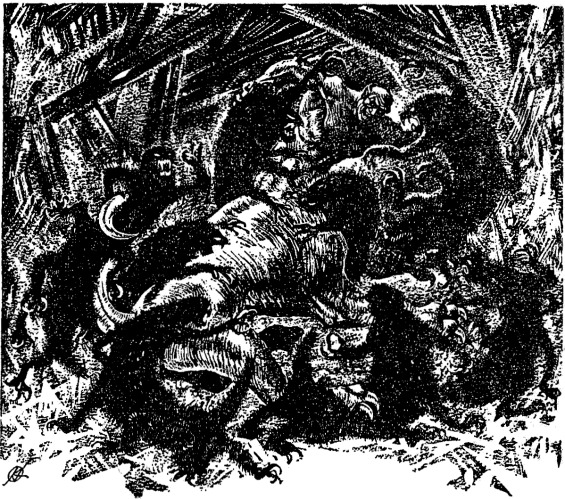
Here are the Frank Kelly Freas’ illustrations from the original 1957 publication in Astounding Science Fiction:

Astounding Science Fiction - April 1957

Astounding Science Fiction - Call Me Joe - Pages 4 and 5 Illustrations
Astounding Science Fiction - Call Me Joe - Page 12 Illustration
Astounding Science Fiction - Call Me Joe - page 18 illustration
Astounding Science Fiction - Call Me Joe - page 26 illustration

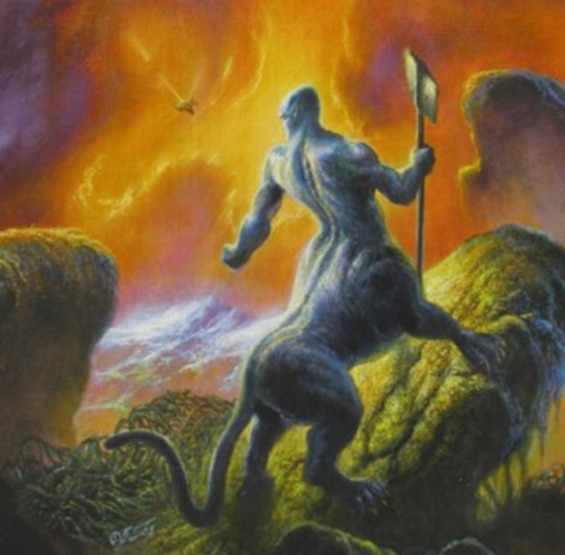
Bob Eggleton painted the cover art for Call Me Joe (The Collected Short Works of Poul Anderson) Volume 1:

Call Me Joe - Bob Eggleton Cover

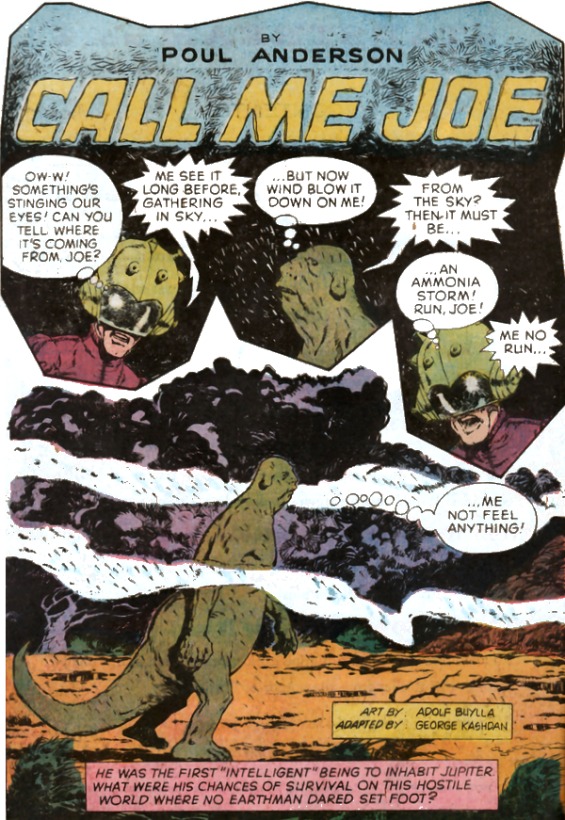
The story was also adapted to comics, in issue #4 of Starstream:
Starstream comics adaptation of Call Me Joe

Posted by Jesse Willis

SFFaudio’s Most Downloaded Podcasts (and the stats to back ’em up)

SFFaudio Online Audio

The SFFaudio PodcastI was curious about which of our podcasts was popular. Since it’s relatively easy, and I’m always interested in other podcaster’s podcasts statistics, I thought I’d reveal ours. Maybe this post will prompt some others to post theirs too.

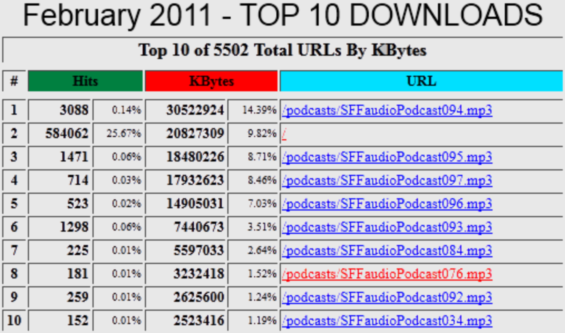
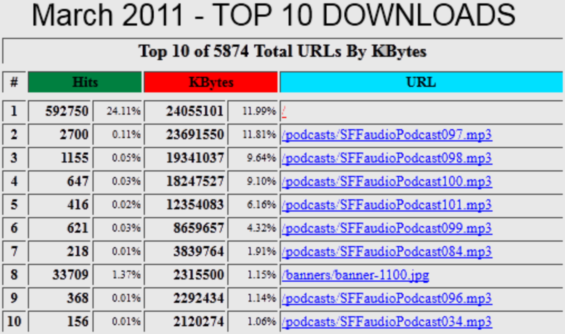
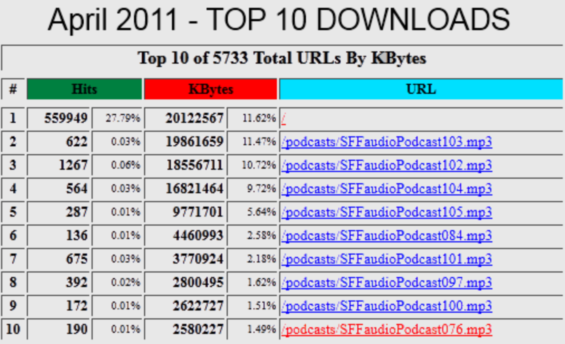
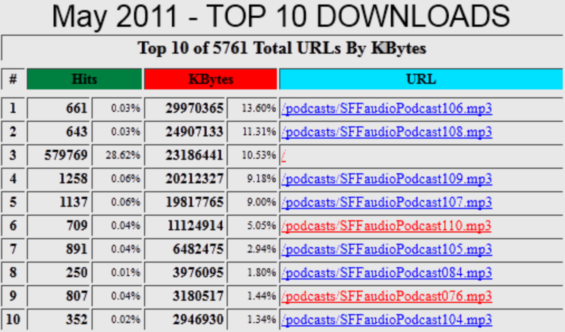
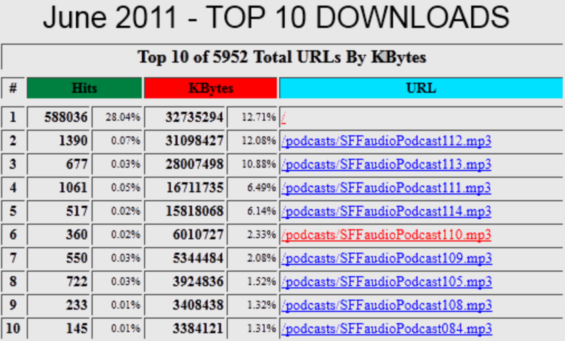
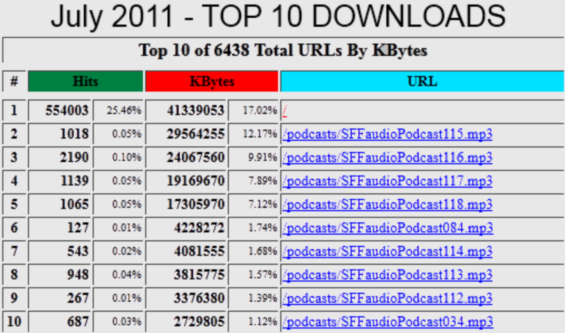
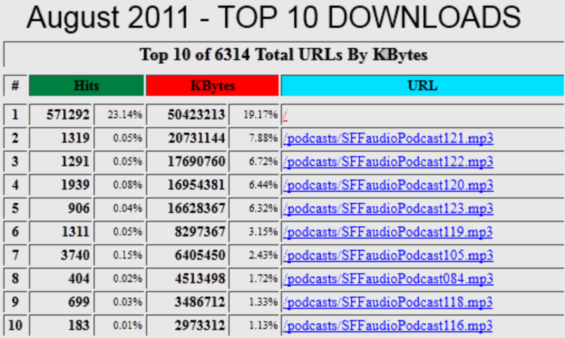
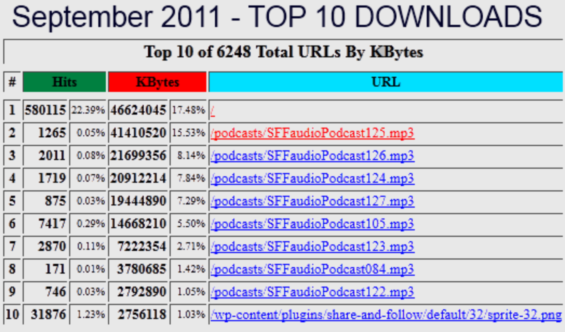
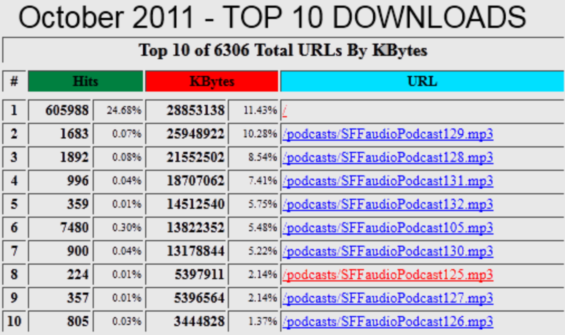
Here is a list of SFFaudio’s single most popular podcast per month (by download) from January 2011 to October 2011.

Jan. (1216 Downloads) – #089 – Jesse talks to Professor James Campanella |MP3|

Feb. (3088 Downloads) – #094 READALONG: Gulliver’s Travels by Jonathan Swift |MP3|

Mar. (2700 Downloads) – #097 READALONG: The Garden Of Forking Paths by Jorge Luis Borges and Fair Game by Philip K. Dick |MP3|

Apr. (1267 Downloads) – #102 Scott Jesse and Tamahome talk about new releases |MP3|

May (1258 Downloads) – #109 AUDIOBOOK/READALONG: The Hanging Stranger by Philip K. Dick |MP3|

Jun. (1390 Downloads) – #112 AUDIOBOOK: The Marching Morons by C.M. Kornbluth |MP3|

Jul. (2190 Downloads) – #116 READALONG: The Space Merchants by Frederik Pohl and C.M. Kornbluth |MP3|

Aug. (3740 Downloads) – #105 – AUDIOBOOK: The Most Dangerous Game by Richard Connell |MP3|

Sep. (7417 Downloads) – #105 – AUDIOBOOK: The Most Dangerous Game by Richard Connell |MP3|

Oct. (7480 Downloads) – #105 – AUDIOBOOK: The Most Dangerous Game by Richard Connell |MP3|

As you can see, for the last three months our single most popular download has been the exact same show. It is a complete and unabridged reading of Richard Connell’s The Most Dangerous Game. This show, which came out on April 25, 2011, has been downloaded about 22,000 times so far. That makes it one of our most popular (if not the most popular shows’s we’ve ever done). It is however a bit of an anomaly. This is due to the fact that The Most Dangerous Game is commonly assigned in schools. Almost all of the rest of the credit should go to the most excellent narrator, William Coon, who recorded it – go check out his site he has many other excellent audiobooks too.

If we exclude that episode from the last three months we get the following results:

Aug. (1939 Downloads) – #120 Scott, Jesse and Tamahome talk to Infinivox editor Allan Kaster |MP3|

Sep. (2006 Downloads) – #126 AUDIOBOOK/READALONG: The Statement Of Randolph Carter by H.P. Lovecraft |MP3|

Oct. (1892 Downloads) – #128 Scott, Jesse, Tamahome and Luke Burrage talk about new releases and recent arrivals |MP3|

Looking at just the most popular downloads I’m pleased to see that nearly all of our kinds of shows are represented. READALONG, AUDIOBOOK, and even regular discussion podcasts are all popular. Our listeners all have great and eclectic tastes it would seem.

For a complete listing of all our past shows go HERE.

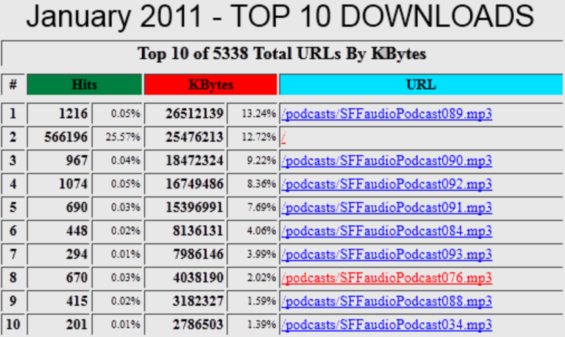
And for other podcasters (and anyone else who cares) here is the raw data on our top ten downloads for each month (January 2011 to October 2011):

SFFaudio Top 10 Downloads for January 2011

SFFaudio Top 10 Downloads for February 2011

SFFaudio Top 10 Downloads for March 2011

SFFaudio Top 10 Downloads for April 2011

SFFaudio Top 10 Downloads for May 2011

SFFaudio Top 10 Downloads for June 2011

SFFaudio Top 10 Downloads for July 2011

SFFaudio Top 10 Downloads for August 2011

SFFaudio Top 10 Downloads for September 2011

SFFaudio Top 10 Downloads for October 2011

Posted by Jesse Willis

Podcasts: Week Ending Oct 29, 2011

SFFaudio Online Audio

Mentat Jack I’m writing about what I listen to, what it makes me think about and what you might find interesting. Let me know if you think there’s something important I’m missing and if there’s a SFF related podcast you listened to during the week (no matter when it was published) that I should spotlight here.


I’m still catching up on the SF Squeecast. This week I listened to Episode Two: Dystopia A-Go-Go!. It’s a stretch to wrap the label of dystopia around the particular squeeables, much less the places the discussion wanders, however they cover some fun stuff. I like their coverage of David Louis Edleman’s Jump 255 series. I read and loved Infoquake. I really should go back and read the rest. I love how passionate and detailed reviews of music (even music I may not care for) can be. In this case, our panel of designated squeers really bring David Bowie‘s Outside to life. I’ll definitely be giving this concept album a listen. The post-apocalyptic novel The Chrysalids by John Wyndham and an episode of the cartoon Phineas and Ferb round out the discussion. |MP3|

I listened to two Beneath Ceasless Skies stories this week. Both dealt with ways in which magic users are oppressed. The magic in Gone Sleeping by Heather Clitheroe |MP3| had horrific cascading consequences. It’s interesting how we assume a naive child narrator to be unreliable, but she’s been told stories and been given warnings… The Magick by Kristina C. Mottla |MP3| involves slavery. It’s a slavery built on fear of the other, but much like in Gone Sleeping it is magic users that are feared. The magic is more controlled in this story, but obviously there are two meanings for control in this case. These are both decent fantasy stories, but they’re even stronger side by side.

I’m not sure if the Angry Robot Podcast, hosted by Mur Lafferty, is still a going concern. It’s definitely not playing nice with Google Listen and the last episode was released in July. Huffduffer may have to come to the rescue. I listened to episode #11, an interview with Lavie Tidhar. I’ve really enjoyed Lavie’s short fiction and he gives a great interview. Definitely need to read one of his novels. The interview focused on Camera Obscura, sequel to The Bookman (both from Angry Robot), but also discusses HebrewPunk, other books, and Lavie’s status as an international man of mystery. |MP3|

Two from Drabblecast:

  1. Episode 217 is Followed by Will McIntosh. It uses zombies as an allegory for externalized human cost. This is the type of story that’ll drive mad anyone too set in their mind about what zombie fiction is supposed to be, but it’s a great story. It drives home a difficult moral point. |MP3|
  2. Episode 219 is The Big Splash by George R. Galuschak. The oceans have risen and a lone alien smokes out on the beach observing humanity. Splash is as light as Followed is heavy, in spite of the shark attack and dying dog. |MP3|

SFBRP #138 is a review of Gene Wolfe’s The Sword of the Lictor, 3rd in The Book of the New Sun. This is the first episode of this podcast I’ve listened to. While I was listening, I thought possibly that the podcaster, Luke Burrage, might me insane. I hoped that he was playing around with the unreliable narrator concept that’s one of the important components of this series. It turns out the latter was the case. For the record, Gene Wolfe is a master at this technique – Luke Burrage: not so much, but it was an amusing review. |MP3|

The Coode Street Podcast always provides a spectacular reading list. Gary and Johnathan mention scores and scores of books in a podcast, most of which they make me want to read. The same thing happens when they interview someone. In the case of episode #72 that would be Ian McDonald. His latest is the first in a young adult multiverse adventure called Planesrunner. This has been mentioned before on the podcast and sounds like a ton of fun. The discussion was pure gold for those of us that are fascinated by the publishing aspects of genre fiction. McDonald’s River of Gods, which was followed by the acclaimed progressively nearer future novels: Brazyl and The Dervish House, was published in the US by Pyr and marketed 100% as science fiction. However in the UK it was marketed as mainstream fiction by Simon & Schuster. Even if the mechanics of publishing bore you, McDonald has a very cool Bibliography and you’ll come out of this podcast wanting to read all of it. |MP3|

Writing Excuses 6.21 was hilariously awesome. All 4 brainstormed the kernel of a story from the same collection of random elements. Each of their processes are different and unique voices come through. Great stuff/Small package as always. |MP3|

There’s not much story in Joe Haldeman’s Never Blood Enough (Starship Sofa 208). The world building is pretty intriguing and the main character is as well developed as space allows, however, the story is murder mystery. What could the murderer be on a planet of dangerous lifeforms? Possibly a dangerous lifeform… As a subplot in a larger work, this might have more meat. There’s more than just one story in an episode of Starship Sofa. I’m quite surprised how much I enjoy the Poetry Planet feature. It was good to hear that Tobias Buckell’s Kickstarter program worked and he’ll be writing the rest of his space opera series. I quite enjoyed all 3 of the previous novels Crystal Rain, Ragamuffin and Sly Mongoose. Be sure to check out the sneak peak of Apocalypse Ocean he gave us in Placa del Fuego. |MP3|

Sometimes, listening to two new voices on a podcast it’s difficult to tell them apart. Andy Duncan and Jeff Ford (Locus Roundtable Podcast) have VERY distinct accents so this wasn’t even vaguely a problem. I’d just read Ford’s Bright Morning that was mentioned near the end of the podcast, so it was quit interesting to hear the discussion of writers inserting themselves into their stories. The discussion was heavily weighted in the direction of “what can be done with fiction” vs “how does it happen.” I’m realizing more and more that that’s an important distinction. The more I write about discussion podcasts the more I want a better vocabulary for what TYPE of discussion podcast it is. I’ll explore this in a dedicated post. |MP3|

PodCastle Miniature 66: The Witch’s Second Daughter by Marissa K. Lingen: A vague yet elegantly described magic system explored to a logical conclusion. |MP3|

And the final podcast for the week, SFFaudio #97. I listened to this as the sun set while literally parked on the 405 (I was about 100 yards away from a motorcycle vs big-rig accident that had shut down the freeway), so I probably payed a bit more attention to it than I otherwise would have. They discussed Jose Luis Borges’ The Garden of Forking Paths and Fair Game by Philip K. Dick. I was introduced to the Borges story by my academic adviser during a quantum mechanics class he was teaching and I was not groking. Interestingly I was introduced to Borges for the first time during a mathematics seminar by a visiting professor who specialized in the math underlying String theory. Borges’ writing is fractal. The deeper you dig into it the more you find and the more it makes sense (or the more confused you get – most often both if you really understand the issues he’s wrestling with.) Grab a collection of Borges Collected Fictions. And keep it close at hand for when you need some mental exercise. Fair Game sounds neat too. |MP3|

Posted by Steven Klotz