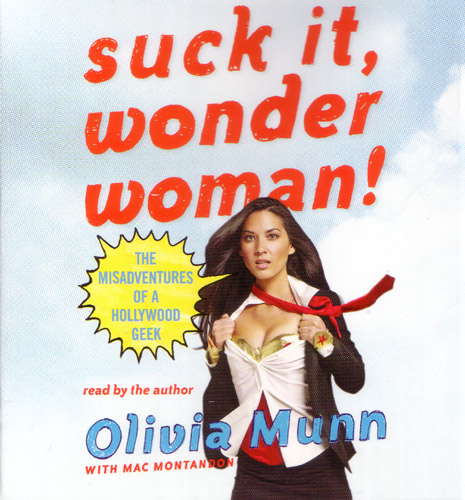
Review of Suck It Wonder Woman by Olivia Munn and Mac Montandon

SFFaudio Review

MACMILLAN AUDIO - Suck It Wonder Woman by Olivia Munn and Mac MontandonSuck It, Wonder Woman: The Misadventures Of A Hollywood Geek
By Olivia Munn and Mac Montandon; Read by Olivia Munn
4 CDs – Approx. 5 Hours [UNABRIDGED]
Puiblisher: Macmillian Audio
Published: July 2010
ISBN: 9781427209825
Themes: / Autobiography / Sexuality / Oklahoma / California / Japan / Robots / Zombies / Pie /

Sample |MP3|

Today’s hottest geek and host of G4’s Attack Of The Show dishes her unique brand of humor of on everything from Star Wars, gadgets, and her love of banana cream pie. Olivia Munn is an actress, comedian and television host, best known for being the face of the G4 network. She also occasionally likes to get dressed up as Wonder Woman. SUCK IT WONDER WOMAN is her paean to Geeks everywhere. Using her trademark humor in essays like THOUGHTS ABOUT MY FIRST AGENT’S GIRLFRIEND’S VAGINA she skewers what it’s like to live in Hollywood. In “SEX: WHAT YOU CAN DO TO HELP YOURSELF HAVE MORE OF IT” she frankly gets down to the business of getting it on. In “WHAT TO DO WHEN THE ROBOTS INVADE (YES, WHEN!),” Olivia offers valuable information on… what to do when the robots invade! And just when you thought she couldn’t get any more Geeky, she can. This book also includes an Olivia Munn timeline of great moments in Geek history and her answers to the Unofficial Geek FAQ. Is it any wonder that Olivia Munn is quickly becoming the most powerful Geek on the planet? SUCK IT WONDER WOMAN is a humorous look at geeks, gadgets, Hollywood, and huge heapings of banana cream pie.

When this audiobook arrived I didn’t recognize the author or what exactly it was. I’d seen Attack Of The Show, and at least one of the episodes of The Daily Show in which she appeared, but something dimly pinged and I decided to give it a listen. Maybe part of it is that I’ve been a sucker for biographical audiobooks since I first stumbled across Michael Caine’s amazing reading of his autobiography What’s It All About?. Since then I’d read maybe a half dozen more. I’m sad to say most were only marginally interesting, but they never sucked, and I’ve found you can learn a hell of a lot about history by hearing about individual lives. The only biography that’s come as close to recreating that first experience was perhaps, rather strangely, a Blackstone Audio version of The Most Dangerous Man In America: Scenes From The Life Of Benjamin Franklin by Catherine Drinker Bowen. Weird huh? Yeah, Michael Caine and Benjamin Franklin have very little in common, other than being male and speakers of English. What they do share, however, is a kind of an ineffable interestingness. Caine’s story was full of a bewildering matter-of-factness, performed by the actor himself, and offered dozens of surprises and a whole lifetime’s worth of experience in the movies in less than three hours. Franklin, that auto-didactic man of letters, inventor, humorist and well … you’ll just have to go listen to the audiobook yourself … was completely and utterly amazing. Olivia Munn, and her book Suck It Wonder Woman are, on the other hand, entirely and completely effable. And by that I don’t only mean that there’s a lot of potty mouth in this audiobook.

Suck It Wonder Woman is potty mouthed and full of dirty stories about crazy people in Hollywood. There are also brief chapters on seemingly random, hip-sounding dos and don’ts. I’m not sure why these bits were added in. The audiobook works best when operating in the more serious storytelling sections. Munn’s description of herself as a child are fun and retrospectively insightful. One chapter, relating her relationship with her grandparents, is highly poigniant. That isn’t fluff. But not all of these stories are all that serious either. Her relating meetings with celebrities (named and unnamed) are surprising and frightening. And while the generalities of Munn’s life story, so far, aren’t particularly unique, she has some fun tales to tell. Munn makes for quite a sympathetic figure in all of the specifics of her life. And, her almost puppy-like eagerness to tell you about it, with her narration, is very endearing. When she relates her sadnesses, you are truly disheartened. But, as Munn reminds us, we can’t be too downcast, there’s always pie.

Posted by Jesse Willis

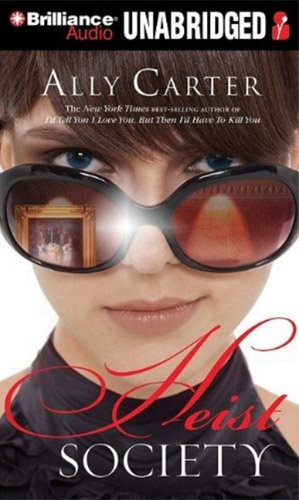
Review of Heist Society by Ally Carter

Aural Noir: Review

BRILLIANCE AUDIO - Heist Society by Ally CarterHeist Society
By Ally Carter; Read by Angela Dawe
5 CDs, 1 MP3-CD or Audible Download – Approx. 6 Hours 7 Minutes [UNABRIDGED]
Publisher: Brilliance Audio
Published: February 9, 2010
ISBN: 1441826734 (cd), 9781441826756 (mp3-cd)
Themes: / Crime / Caper / Heist / Grifting / Art / Europe / Romance /
SAMPLE |MP3|

Since she can remember, Katarina’s relatives have been grooming her for the family business – thieving. But when Kat tries to go straight and leave the “Life” for a normal life, she’s promptly kicked out of her new school for stealing the headmaster’s car and mounting it on the school fountain. Although she could have done it without breaking a sweat, ironically, this time, she’s innocent. In fact, she was framed – by another highly skilled thief. Her friend and brother-in-trade Hale, with his mischievous smile and limitless bank account, has appeared out of nowhere to bring her back to the Life, back to the family Kat tried so hard to escape. Hale has a good reason: A powerful mobster has just been robbed of his priceless art collection, and he wants to retrieve it. Only a master thief could have cracked this vault, and Kat’s father isn’t just on the suspect list, he IS the list. Now, caught between Interpol and a far more deadly predator, Kat’s dad needs her help. For Kat, a consummate thief in her own right, the solution is simple: track down the paintings and steal them back. So what if it’s a spectacularly impossible job? She’s got two weeks, a teenage crew, and maybe just enough misguided pride to pull off the biggest heist in history – or at least in her family’s (very crooked) history.

I can’t say there’s much more to this novel than the very detailed premise outlined above. It’s theme is as old as YA. A smart kid must save his or her parent from something. Mayhaps it’s not the most exicting theme ever, but it’s far more interesting than:

“Love conquers all, or love is the strongest force or something. Something about love being so strong to overcome anything.”

And as I value my time, and try to be pragmatic about these things, I find it hard not to recommend Heist Society as a breezy listen! It’s easily picked up, and just as easily dropped. I listened to it over the course of about four months – between more serious audiobooks and a forced reading of part of Twilight. Now, being a fan of practically every grifter/heist movie ever made, I can’t say I learned a single new trick or wrinkle while listening to Heist Society. But then again I didn’t really expect to. That isn’t to say, though, that I wouldn’t have liked to. And while all this probably doesn’t sound like a particularly ringing endorsement I’d much rather hand a copy of Heist Society to practically any kid than something far more popular with far more vapidity (like say something with a sparkly vampire and the teen who pines after him). See, the negatives with Heist Society aren’t particularly egregious. Sure Katarina’s and Hale are a pair of kids who act variously cynical and cool, innocent and dastardly, all while lusting (ever so gently) towards each other – but they do so in a slightly more realistic world, talking about slightly more realistic subjects, with slightly more interest in history, art and a lot more of the taking-charge-of-shit and a lot less of the lying-around-and-wishing-that a handsome-prince-whose-been-in-high-school-for-ninety-years would stare at her while she sleeps.

Bitter? Noooo, I’m not bitter.

Anyway, Ally Carter’s writing style is brisk, unobtrusive, and not wholly unsophisticated. It delivers a soft boiled tale that seems far more inspired by the Oceans 11, 12, 13, Entrapment, The Maiden Heist end of the spectrum than the The Silent Partner, The Great Train Robbery, Thief end. And if you’re an adult, in the mood for a YA novel that doesn’t have a single brooding vampire anywhere in sight (not even in the castles), this might just fill a few empty hours.

Narrator Angela Dawe performs Kat well enough, perhaps sounding a bit too adult. Dawe is not, however, quite able to fully sell me on the male characters. Her voice range isn’t particularly vast. Thankfully, as most scenes aren’t full of multiple characters, there isn’t much of a chance of confusing any of them. She’s certainly good enough for this novel.

Posted by Jesse Willis

Review of Rocannon’s World by Ursula K. Le Guin

SFFaudio Review

Science Fiction Audiobook - Rocannon's World by Ursula K. Le GuinRocannon’s World
By Ursula K. Le Guin; Read by Stefan Rudnicki
5 CDs, 5 hrs – [UNABRIDGED]
Publisher: Blackstone Audio
Published: 2007
ISBN: 9781433210822
Themes: / Science Fiction / Anthropology / Interstellar travel / Aliens / Telepathy /
Listen to sample

Against a cold war subtext of a well-meaning interstellar civilization trampling other cultures in its blind panic to defend itself against a nebulous enemy from beyond the galaxy, Ursula Le Guin kicks off her vaunted Hainish novels with a tale that blends elements of high fantasy, space opera, anthropology, and political commentary. It’s got a little bit of everything: a quest for revenge across two continents and an ocean by boat, by foot, and flying cat-horse back; a main character immersed in adventure, yet torn by guilt for his own decisions and those of his government; a classic “god gambit” featuring an invincible, invisible suit of armor, a sword, and a trial by fire; and not one, not two, not three, but five species of intelligent hominids on the same planet.

Okay, so not all of it flies as plausible science fiction. But it is compelling, as a ripping good adventure yarn, as an examination of how legends are created, and as a thought-provoking examination of our own cultural chauvinism. The complexity of emotions that roil in Rocannon’s soul as he moves into and through this world are so believable, the implausibility of some of the story elements evaporates from our notice. And even the multiplicity of intelligences works on a symbolic level. The subterranean clay-folk, the laughing Fiann, and the lords and mid-men of the North all function like the multiple poles of human nature, offering a mirror of our own nobility and baseness.
Is it LeGuin’s best? Not by a longshot. She’s still developing her craft here, still conforming to a male-dominated genre, and still working on making characters that live and breathe. But the focus on anthropology, the nobility of the small being ground beneath the powerful, and the truth that lies beneath layers of language made for falsity that will permeate so much of her later work are all there.

This is a work of solid storytelling that carefully juxtaposes just the right elements at just the right angles to produce not cold logic but warm emotion. As such, Stefan Rudnicki’s muscular, antiseptic voice is the perfect vehicle to deliver this tale. His tone is impeccable, his pronunciation exact, yet within moments all you hear is rushing wind, blaring static, crackling flames, and shocking silence, the sounds of exhilaration, heartbreak, fear, and guilt. It’s well worth your time.

Posted by Kurt Dietz

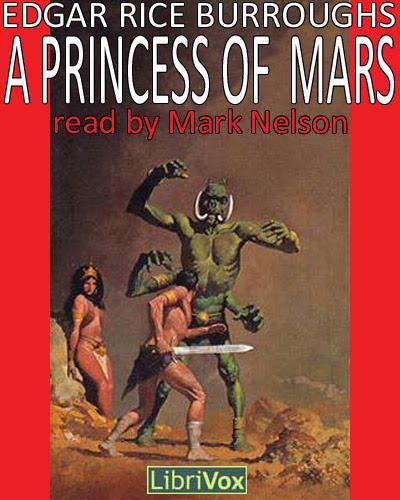
FREE LISTENS review: A Princess of Mars

Review

Source: Librivox | (14 zipped mp3s)
Length: 7 hr, 26 min
Reader: Mark Nelson
The book: While prospecting for gold in the Wild West, John Carter, formerly of the Confederate Army, is attacked by a band of hostile Apaches. He escapes into a cave, but finds himself mysteriously transported to Mars. On Mars, or as the natives call it, “Barsoom”, he finds several races of intelligent Martians, including the giant six-limbed Tharks and beautiful Dejah Thoris, a princess of the human-like red-skinned Martians.

John Carter’s Barsoom adventures are frankly preposterous, even for Burroughs’ day when people thought there might really be canals on Mars. However, the story has a momentum that propels it too fast to allow the reader to reflect on the inconsistencies of the plot or of the world Burroughs created. The constant cliffhangers and mild titillation gave the book great popularity among several generations of readers, including a number of science fiction writers who cited it as an important early influence. This book is a old-fashioned treat.

Rating: 8/10

The reader: Mark Nelson has a deep, strong voice that sounds like an old school news announcer. His cadence is slow and repetitive, but he changes his inflection enough to keep the reading interesting. He does some light voices, not straying too far from his natural voice into campiness. The recording setup he uses has very little background noise and is clear. Nelson is a reader worth seeking out in other books.

Posted by Seth

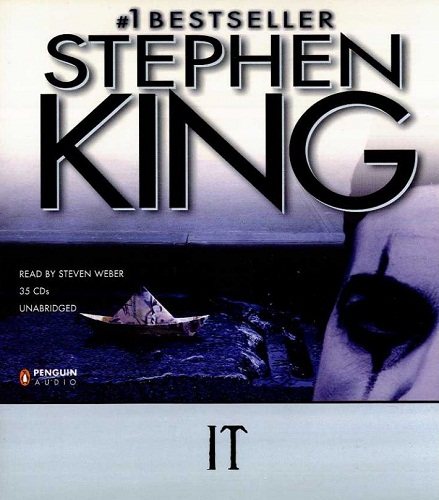
Review of IT by Stephen King

SFFaudio Review

Horror Audiobook - IT by Stephen KingIT
By Stephen King; Read by Steven Weber
45 hours – [UNABRIDGED]
Publisher: Penguin Audio
Published: 2010
Themes: / Horror / Childhood / Adulthood / Monsters /

You don’t have to look back to see those children; part of your mind will see them forever, live with them forever, love with them forever. They are not necessarily the best part of you, but they were once the repository of all you could become.
—Stephen King, IT

What quality separates an adult from a child? Is it responsibility in the former and unbridled freedom in the latter? Do adults possess a higher order of thinking? Or, to take a cynical view, are adults merely physically larger (perhaps they/we never really do grow up)?

I happen to think there is a difference, though it’s hard to say precisely what. You could describe adulthood as a phase through which we all must pass, else we remain stunted and undeveloped, looking backward instead of forward, unable to transform into the mature beings that the hard world requires. Indefinable and amorphous, you may as well call this period of transition it. Stephen King did, and in 1985 he wrote a massive book by the same name about this very subject.

As is King’s forte, IT is also a horror story, and a terrifying one at that. The villain of IT is a creature that lurks in the sewers of Derry, Maine, one that takes the shape of our worst fears. IT’s favorite shape is a painted clown known as Pennywise, friendly at first glance but whose greasepaint smile reveals a double-row of Gillette razor teeth. Pennywise can also take the form of a werewolf, the Creature from the Black Lagoon, Frankenstein, and more. Whatever a particular child finds most terrifying, Pennywise can take its shape.

Pennywise has been preyed on the children of Derry for untold generations, emerging from a deep slumber in the sewers every 27 years to feed. After a year of gruesome killings (written up in the press as mysterious child disappearances, or frequently blamed on other sources), the cycles end with a culminating event, typically an awful orgy of destruction, after which the creature resumes its hibernation.

But Pennywise—aka., IT—always comes back. Derry is perennially under its pall and seems to accept the darkness as “just the way things are” and the horrors continue in cyclical fashion. But then comes the summer of 1958. A group of 10 and 11-year-old children called the Loser’s Club, led by a stuttering, charismatic child known as Bill Denbrough, unite to battle Pennywise. All have had close brushes with the monster. Scarred by their experiences but united in purpose (Bill’s six year old brother Georgie is dragged into the sewer and killed in a gruesome scene at the beginning of the novel, and Bill vows revenge), they travel into Derry’s byzantine sewer systems to put an end to the monster. Following an epic confrontation in the creature’s den the children vow to return to Derry should Pennywise/IT ever return.

One of the club, Mike Hanlon, remains behind in the ensuring decades to watch and wait. When Pennywise does re-emerge 27 years later the children of the Loser’s Club are now adults in their late 30s. Some higher power has mercifully allowed them to forget the terrible events of their childhood and move on with their lives. But now they have to fight the terrible evil once more and growing up has diminished them in some way. This time around they find themselves less equipped to fight.

IT is a great story full of memorable events, places, and characters. King imbues Derry with its own personality, and the town feels like a member of the cast. King skillfully weaves in events from Derry’s awful past, including past murder sprees and the culminating bloodbaths that sent IT back into the sewers, including a horrific nightclub fire (The Black Spot) and the explosion of the Kitchener Ironworks.

But in the end, what I like most about IT, and what separates the book from much of the rest of King’s oeuvre, is its thoughtful exploration of that amorphous crossing of the bar from youth to maturity. To get where you want to go in life you have to grow up, King says, but it’s not a simple process. The transition from childhood to adulthood is a complex and bittersweet, its benefits equivocal. Adulthood brings with it at least some measure of financial, parental, and geographic freedom. We can leave those hometowns that are so frequently a source of shame and failure and hidden darkness. But in so doing we lose a lot, too—our dreams, our innocence, our closest friends, and sometimes even our faith in a higher power. And the only way to defeat Pennywise—that monstrous, childhood IT—is through faith.

King has been accused by his critics of being shallow, all style and no substance (he did himself no favors by once calling himself “the literary equivalent of a Big Mac and Fries”). But I’ve found that his best material has more depth than meets than eye. IT is not just about battling monsters. Or rather it is about that, but the monsters are also the real, adult fears of loneliness, guilt, and dependency, of growing up, of confronting the monsters of one’s past and trying to move on. We are all incomplete until we face our past and determine who we are, what we stand for, and how we want to live our lives. This personal struggle, as much as visceral, horrific battles with Pennywise, is what brings me back to IT again and again.

I will say that IT is not without its problems, including a sequence that remains controversial among King’s readers. Without spoiling the story, it involves a coming of age ritual in the sewers that is a bit off-putting and jarring, even though I do understand its purposes. Some of the characters feel a bit one-trick and allegorical (representative of concepts rather than three-dimensional human beings). Other readers have complained that IT’s big secret—Pennywise’s final reveal—a bit of a let-down after 1,000 pages of build up. King is unfortunately often guilty of unsatisfying endings to otherwise great novels, and IT arguably suffers from the same problem. I don’t necessarily agree, as I find the epilogue incredibly satisfying, but others have made this criticism.

But despite its flaws, IT is one of my favorite books by King. With a memorable monster, a nice cast of characters, and a compelling, decades-spanning storyline with an epic final showdown, IT is a horrific page turner with deeper literary ambitions that it mostly fulfills.

Posted by Brian Murphy

FREE LISTENS Review: The Lost World

Review

The Lost World
by Arthur Conan Doyle
Source: LibriVox (zipped mp3s)
Length: 8 hr, 22 min
Reader: Mark F. Smith

The book: Not to be confused with the Michael Crichton novel of the same name, Conan Doyle’s The Lost World is an unbelievable adventure, in both senses of “unbelievable”. Like Watson in Conan Doyle’s more famous Sherlock Holmes series, the narrator, Edward Malone, is a tag-along to the real main character of the book, the conceited and quarrelsome Professor Challenger. Malone, a newspaper reporter, accompanies Challenger on  an expedition to a plateau in the jungles of South America, where dinosaurs and other prehistoric beasts are rumored to live.

Although the premise for the book can now be seen as impossible, Challenger’s assertion of living dinosaurs is met with extreme skepticism by his colleagues in the novel, effectively removing the reader’s ability to criticize it. The story proceeds at a gallop, with new adventures happening every chapter. This book is fast and fun, making it a great light read for the summertime.

Rating: 8/10

The reader: You probably know by now that Mark F. Smith is one of LibriVox’s best readers. He’s done a wide range of books, and I can’t think of any of them that is bad. Smith’s dialog puts the listener into the story and his narration carries a bit of sarcasm at the right places, to help the listener see the wittiness in Conan Doyle’s writing. The recording, as always with Smith, is beautifully done.

Posted by Seth