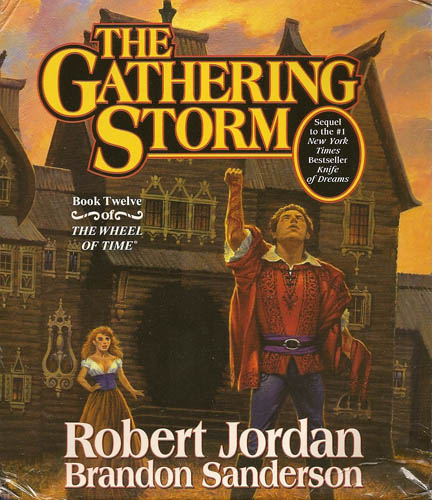
Review of The Gathering Storm by Robert Jordan and Brandon Sanderson

SFFaudio Review

Fantasy Audiobook - The Gathering Storm by Robert Jordan and Brandon SandersonThe Gathering Storm – Book Twelve of The Wheel of Time
By Robert Jordan and Brandon Sanderson
Read by Kate Reading and Michael Kramer
26 CDs – 34.5 Hours – [UNABRIDGED]
Publisher: Macmillan Audio
Published: 2009
ISBN: 9781593977672
Themes: / Fantasy / Epic fantasy / Good and Evil / Power / Politics / Religion / Magic /

The Gathering Storm is the first of the final trilogy of The Wheel of Time series. It was a long time coming, and I am pleased to report that Brandon Sanderson did an outstanding job. I actually spent part of my listening time looking for stylistic differences from the other books, but hats off to Sanderson for pulling this off. He nailed the tone of the other books, and tells a good story.

There are so many characters in these books, with different styles of speaking, that Michael Kramer and Kate Reading would be forgiven for inconsistencies in their narration, as they’ve done all 11 volumes that come before this one. That’s over 230 hours of audio! But they were right on, too. Their professional, enjoyable narration gave the book an additional source of continuity. These two are the voices of the Wheel of Time series.

So much has happened in this series that to say much about the plot here will spoil previous volumes. It should suffice for me to say that I enjoyed this book enough that I’ve started the series over from the beginning, in anticipation of the upcoming pair of concluding novels.

Posted by Tricia

Review of Sunrise Alley by Catherine Asaro

SFFaudio Review

Science Fiction audiobook - Sunrise Alley by Catherine AsaroSunrise Alley
By Catherine Asaro; Read by Hillary Huber
10 CDs – Approx. 11.5 Hours [UNABRIDGED]
Publisher: Blackstone Audiobooks
Published: December 2007
ISBN: 1433213007
Themes: / Science Fiction / Romance / Androids / Artificial Intelligence / California / Cyborgs /

When a shipwrecked stranger washed up on the beach near research scientist Samantha Bryton’s home, she was unaware that he was something more than human. He said his name was Turner Pascal—but Pascal was dead, killed in a car wreck. This man only held the remainder of Pascal’s consciousness in a technologically-enhanced humanoid body. He was, in fact, an experiment by the notorious criminal Charon, a practitioner of illegal robotics and android research. Charon has been secretly copying human minds into android brains, with plans to make his own army of slaves. On the run from this most ruthless criminal, Samatha and Turner seek help from Sunrise Alley, an underground organization of AIs and androids that have gone rogue. But these cybernetic outlaws are rumored to have their own hidden agenda.

It may not be so much that women and men are from different planets as women and men care about different things. Or it may be just that Catherine Asaro and I care about different things. Very different things. I have this hypothesis: people, even when they are lying to you, or writing fiction, can tell you a lot about themselves by what they focus on over and over. The word that kept coming up over and over again in Sunrise Alley was “trust.” Catherine Asaro, or at least her viewpoint character, Samantha Bryton, cares a whole helluvalot about trust. Me, I don’t care about trust, at least not in the way Asaro seems to wants me to. Based on the scenes in Sunrise Alley Asaro seems to think that being chased is also of great interest to a reader. Maybe it is to some readers. It isn’t to me. Turner Pascal, the mobile MacGuffin, is being chased prior to the novel’s start. Then Turner, the bellboy turned android, and Samantha, the scientist turned beachcomber, are chased all over the globe. They are chased in cars, by helicopter, by jet, on foot, in cars again.

The meme of an artificial person, android or evolving intelligence as Asaro dubs it, is often an interesting idea to work with in fiction. Philip K. Dick did some amazing things with it Do Androids Dream Of Electric Sheep? as did Alfred Bester in Fondly Fahrenheit. Even later career Robert A. Heinlein managed to tell a compelling story with an artificial person in Friday. William Gibson’s Neuromancer is a globe trotting adventure with an artificial intelligence as the MacGuffin. But Catherine Asaro’s take on AI and androids leaves me empty and depressed.

When Samantha and Turner aren’t being chased by unseen foes they are usually making love in one of Samantha’s many beds (in one of her many houses), or in a tastefully decorated secure facility bedrooms (where they are being held prisoner). But those looking for scene after scene of socially redeeming hot piston on human action will also be sadly disappointed. The order of the day in Sunrise Alley is for the scientist and the bellboy to show each other their emotions, their vulnerable sides and speak essentially the same dialogue over and over.
The android, Turner, has an inferiority complex and his savior/companion/scientist girlfriend is needed to shore up his insecurities. The central problem in the novel, other than their being chased, comes when Turner starts to modify his body in order to solve their problems and escape their captors (because apparently Samantha has no skills herself). In doing this Turner is increasingly loosing the handsome human looks he was given by his evil maker (the bad guy who we don’t get to meet for more than half the novel). This makes Samantha have to deal with the increasing repulsion she feels towards Turner’s increasingly mechanical-looking body. And that is basically encapsulates my big problem with this story. Writing sentences about a character’s emotional life and his/her feelings towards another character’s body parts makes me really, really annoyed.

I like idea fiction, stories that tell me something on an intellecutal level. Asaro’s Sunrise Alley seems to be merely operating on the level of wish-fulfillment. Samantha Bryton is beautiful, wealthy, and unemployed by choice. When the novel begins a handsome, insecure man has just washed up on her beach. She rescues him and drags him to the safety of her inviting home. Did I mention that Samantha also has two homes in the woods? One is near the beach in a forest, another is in some other forest, just a convienient chapter’s distance away. Both homes are filled with top-notch security, lovely decor and garages full of vehicles to make James Bond greatly envious. The explanation of why a quietly retired scientist needs to own two woodsy homes within a few hours driving distance of each other isn’t at all satisfactory. And neither is the explanation as to why she has a spy cars with built-in cloaking devices, bulletproof glass, oil slick droppers and mortars.

The worst sin that Asaro commits, in my opinion, is the final revelation which comes in the form of a pathetic pseudoscience, namely repressed memory.Sunrise Alley is not just a bad novel, but badly conceived, badly written and generally bad. This is the worst novel I have ever read. This is the worst I have ever reviewed. This is the worst I have ever finished.

Narrator Hillary Huber is tasked with making Samantha Bryton’s neurotic thoughts come alive. She pitches her voice a little deeper when voicing Turner Pascal. Huber is a fine narrator, this material is beneath her skill.

Posted by Jesse Willis

Aural Noir review of Killing Floor by Lee Child

Aural Noir: Review

BRILLIANCE AUDIO - Killing Floor by Lee ChildKilling Floor
By Lee Child; Read by Dick Hill
12 CDs – Approx. 14 Hours 48 Minutes [UNABRIDGED]
Publisher: Brilliance Audio
Published: 2004
ISBN: 9781423339854 (cd)
Themes: / Thriller / Murder / Mystery / Detective / Georgia / Conspiracy / Counterfeiting / Music /

All is not well in Margrave, Georgia. The sleepy, forgotten town hasn’t seen a crime in decades, but within the span of three days it witnesses events that leave everyone stunned. An unidentified man is found beaten and shot to death on a lonely country road. The police chief and his wife are butchered on a quiet Sunday morning. Then a bank executive disappears from his home, leaving his keys on the table and his wife frozen with fear. The easiest suspect is Jack Reacher – an outsider, a man just passing through. But Reacher is not just any drifter. He is a tough ex-military policeman, trained to think fast and act faster. He has lived with and hunted the worst: the hard men of the American military gone bad.

I’d heard about Lee Child for a while before I started reading his books. For a time there there was some confusion in my mind about who he was and what he wrote. I heard vague talk down the isles of bookstores. “Got any Child?” They’d say. “Lincoln?” They’d whisper. Or was it “Lee?” Then I’d hear about some character called “Repairman Jack” – or was it “Jack Reacher?” So with the confusion in the hearing it took a while longer than usual for the facts about who wrote what to float up from my unconscious to the part of my brain that thinks: “interesting.” The last time I heard about Lee Child was in Jolly Olde Books in Port Moody. That’s a used bookstore I frequent. The guy who runs the place reads Lee Child, and a couple of other booksellers I see in their from time to time were reading him too. They got to talking about how addictive the series was and that was the final clincher. When you run a used bookstore you really have your pick of books. They were reading Lee Child, so I thought I’d better get on the case too. Luckily Brilliance Audio has released most of this series, with at least one other done by Random House Audio.

But, even having the audiobook in hand, I had a hard time getting interested in listening to it. It sure doesn’t help to have such a generic title. And just look at it, the cover art is boooring. Apparently this is a very popular series, a bestselling series. That explains both the generic cover and the generic title. Killing Floor, the name sounds like just about every other techno-thriller/courtroom thriller/forensics thriller you’ll find in the supermarket paperback book rack; and that cover art only tells you vaguely about the genre – nothing about the story. The story starts out promisingly enough though. The story is told in first person, past tense (my preferred person and tense) by the protagonist, Jack Reacher. He tells us what is happening without much embroidery. When Reacher is arrested for murder, within the first few seconds of the novel, I was intrigued. It seemed like some sort of variation on David Morrell‘s First Blood: A stranger walks into small town USA and is arrested by corrupt cops. Fun. When the facts of Reacher’s backstory eventually drip out I still found myself fairly interested. Child’s explanation as to why Reacher is such a bad-ass actually makes pretty good sense too. What kind of police deal with the world’s most dangerous criminals? Child’s answer is: Military Police. The criminals the US Army deals with have been trained with every conceivable deadly art: firearms, hand to hand combat, artillery, grenades, demolitions – the many different ways of killing. A military policeman (MP) has to be trained better with these weapons than the criminals he confronts. And so an MP has to deal with the army’s best trained criminals: Green Berets, Rangers, Delta Force. Jack Reacher, we eventually find out retired from the army as a Major, having run his own criminal investigation unit (homicide investigation). A bit convienient but not too implausible. The mystery itself seems fairly interesting and Child wants to play fair. But there is one giant co-incidence that badly mars the narrative. It’s fairly well lampshaded by Reacher, but even in doing that I wasn’t wholly willing to forgive Child.

This novel has plenty of good characters and characterization. I can also see the seeds of themes that will probably reappearing in later books in the series. Like many novels of the last 25 years that I complain about Killing Floor is overly-long for the material it contains. The action sequences in the later chapters of the book are solid, but there were too many for the machinations of the plot. After listening all the way through I’d say this a solid novel with fairly good storytelling. I can see exactly what Lee Child is doing and am not particularly impressed. He’s gonna make a lot of money, but I can’t imagine anyone would ever bother to re-read one of these books. More likely they’ll just pick up another in the series and get more of the same kind of thing, just a bit different. It’s a slightly less obvious Mack Bolan story, a romance novel for men. So this is several steps removed from anything like spectacular.

Narrator Dick Hill has been a major audiobook narrator for longer than I’ve been an audiobook listener (that’s a long time). In Killing Floor he personifies Jack Reacher with a conspiratorial first person voice. When playing the other major players, criminals, love interests and fellow investigators he switches tone just enough to make it clear who’s speaking. I hope he reads more books in this series as if he does, and I get up enough interested to read another, I’d like him to narrate it.

Posted by Jesse Willis

Review of The Unincorporated Man by Dani Kollin and Eytan Kollin

SFFaudio Review

TANTOR MEDIA - The Unincorporated Man by Dani Kollin and Eytan KollinThe Unincorporated Man
By Dani Kollin and Eytan Kollin; Read by Todd McLaren
2 MP3-CDs – Approx. 24 Hours 30 Minutes [UNABRIDGED]
Publisher: Tantor Media
Published: May 2009
ISBN: 9781400161720
Themes: / Science Fiction / Utopia / Dystopia / Time Travel / Slavery / Economics / Business / Cryonics / Immortality / Virtual Reality / Philosophy / Law / Alaska / Colorado / Los Angeles / Switzerland / Nanotechnology / Space Elevator /

The Unincorporated Man is a provocative social/political/economic novel that takes place in the future, after civilization has fallen into complete economic collapse. This reborn civilization is one in which every individual is incorporated at birth and spends many years trying to attain control over his or her own life by getting a majority of his or her own shares. Life extension has made life very long indeed. Now the incredible has happened: a billionaire businessman from our time, frozen in secret in the early twenty-first century, is discovered and resurrected, given health and a vigorous younger body. Justin Cord is the only unincorporated man in the world, a true stranger in this strange land. Justin survived because he is tough and smart. He cannot accept only part ownership of himself, even if that places him in conflict with a civilization that extends outside the solar system to the Oort Cloud. People will be arguing about this novel and this world for decades.

Even though I had never heard of the authors I like this book right from the start. The title reminded me of a Philip K. Dick novel called The Unteleported Man. There are probably a whole bunch of SF books following the formula “The (negative attribution) Man”, with The Invisible Man perhaps being the first of them. But there’s a lot more to like about this novel than the title alone. Among the pleasures it brings is good, old-fashioned idea based SF. It has been quite a while since I was so intellectually engaged by a novel’s central premise. And The Unincorporated Man has one. Set on a future Earth The Unincorporated Man is fundamentally different in both tone and scope than most SF novels I’ve read recently. Authors Dani and Eytan Kollin have envisioned a future in which the institution known as “the corporation” has replaced the convention of “person.” When born each child has stock of 1000 shares issued in his or her name. 10 percent of these stocks are held by each parent, the government gets another 5 percent and the rest is held in trust until the age of majority after which the balance of the stock is given to the child-cum-adult. He or she can then sell, or keep his or her stocks as they so desire. Holding a majority of your own stock insures relative autonomy (based on the amount above 50% you hold). The primary difficulty comes when you realize that you’ll need to invest in yourself. If you want an education you’ll need to pay for it. But without an education the pay won’t be much. So, you can either get education money by working at a low-wage job, and deriving whatever profit percentage your current stock level allows, or by selling your stock off for cash. This typically manifests itself in the majority of humanity not owning majority in themselves. With the possibility of living for centuries, thanks to the ubiquitous nanotechnology, you’d be wise to invest in an education. But in so doing you’ll loose control of your majority, and thus perhaps have to work at jobs that your shareholders choose, take vacations when your shareholders agree and generally have your life dictated to you by those that hold your stock. Why not just take the money and loaf? Who cares what the shareholders say? They can’t make you work can they? Well, yes they can. The corporate system is enforced by a forced mental audit that is applicable whenever shareholders think a corporation, who they hold stock in, is committing malfeasance (shirking their job, deliberately getting fired, etc.). Every corporation is trackable, thanks to GPS-like implants, and is thus ultimately accountable to his or her shareholders. It is the ultimate invasive tyranny, a slavery to the bottom line, a profit motive enforced by an invisible hand that you shook a deal with.

But things aren’t all doom and gloom. Those who are lucky enough to have been born with enough money, drive, intelligence, talent or beauty are able to do pretty much whatever they like with their time – that is assuming they don’t loose too much of their stock in luxuries or in judgments rendered against them in civil lawsuits. You can live like a king, wear any kind of clothing you like, read the newsies and travel the world in an endless party. But, as the centuries have rolled past it seems that fewer and fewer people have found it fashionable (or is the correct word possible?) to retain or even re-seek their majority stock. After all, in their nanotechnological society material abundance sees that no-one starves, no-one remains un-housed. Freedom, it seems, is just out of fashion. Enter Justin Cord and his unincorporated status.

I really liked this novel, but it isn’t without a few caveats. I found the fascinating society portrayed to be the most interesting thing about The Unincorporated Man. The characters are all pretty stiff and the problems facing Jason Cord, our hero, were far less interesting than they were useful in exploring this strange new society. Like many novels I review this one suffers most greatly from excessive page count. At 480 pages the novel takes 24.5 hours to listen to. I’d have preferred the novel with a steadier editorial hand. The editor could have done two relatively easy things. First he or she could have cut out a lot of the filler. I’m not just talking about empty sentences, there are many scenes that could have been eliminated or described in just a sentence or two. There are, for instance, two big court cases in this nove. Would it have been impossible to tell this story in one? Second, there was a useless detour along the way. I enjoyed it, but don’t see any reason it was needed in this novel. It could have been easily explored separately, in another novel. Dani Kollin and Eytan Kollin wanted to talk about the relatively unexplored idea, a social scourge in the form of really vivid virtual reality. Larry Niven did something similar with his idea of the “tasp,” but that wasn’t exactly VR. If you could live your whole life in an artificial reality that was extremely cheap why wouldn’t you? The answer, cooked up by Kollins, is less persuasive than I’d have hoped. And again it doesn’t really need to be in this particular novel. They foresee a coming global catastrophe created not by ecological destruction, but rather by an addictive technological neuropathology. That’s great, but like I said it doesn’t need to be in this novel. When a false reality is far more enjoyable than a real one why should we care about the real one? Good question. Just don’t ask it here.

Narrator Todd McLaren, who I first encountered in Richard K. Morgan’s Altered Carbon |READ OUR REVIEW|, is very talented. He mispronounce one or two words. “Concomitant.” being one of them. McLaren isn’t called to do many accents here, but he gives voice to a fairly large cast of characters. There are also several scenes in which he is required to portray a man giving impassioned speeches to crowds. These don’t sound like shouts, thankfully, but instead give the impression of a strained voice, speaking so as to be heard.

Posted by Jesse Willis

Review of Skybreaker by Kenneth Oppel

SFFaudio Review

Book of a Thousand Days by Shannon HaleSkybreakerSFFaudio Essential
By Kenneth Oppel; Read by a full cast
10 CDs – 11.5 Hours [UNABRIDGED]
Publisher: Full Cast Audio
Published: 2008
ISBN: 9781934180150
Themes: / Fantasy / Airships / Adventure / Parallel World / Romance / Alternate History / Zoology / Paris / Pirates / Parkour /

High in the sky, far above the normal lanes of travel, drifts a ghost ship carrying unbelievable treasure. Matt Cruise, hero of the wildly popular Airborn, is on the trail of that treasure, with the help of his charming society friend Kate de Vries and a mysterious gypsy girl named Nadira. With them flies Hal Slater, roguish captain of a boldly designed Skybreaker aircraft that can reach heights previously undreamed of. But between Matt and his destination stand ruthless pirates, and an even more ruthless businessman. And what Matt’s crew will find when they finally do reach the Hyperion is far more valuable, far more exciting, and far more dangerous than they ever imagined.

Do you love airships? I know I do. If I had my way I’d double the number of all science fiction and fantasy novels being written with airships. This one, set shortly after the events of Airborn |READ OUR REVIEW|, stars our returning hero Matt Cruse. At the opening of Skybreaker Matt has been attending the world’s premier airship academy in Paris. This last semester his practicum began as assistant navigator on an old cargo airship called the Flotsam. And it’s there, whilst high over the Indian Ocean, that Matt, and the crew of the Flotsam, spot a famous ghost airship called the Hyperion. Supposedly the Hyperion is loaded with the treasures of it’s notorious billionaire inventor (kind of a cross between Howard Hughes and Thomas Edison). Upon his return to Paris, Matt discovers there are several interested parties desirous of the Hyperion’s last known coordinates. Fatefully, this is information that now only Matt knows! Determined to cash in on the knowledge and hunt down the Hyperion’s treasure Matt teams up with a rougish sky-captain named Hal Slater. Slater is the owner of a recently commissioned “skybreaker” called the Sagarmāthā. (which is the nepalese name for Mount Everest). Skybreakers are high performance, high altitude airships. Matt will need one just like it to reach the high drifting Hyperion. But Matt won’t be alone as Paris is full of both dangers and would-be competitors in the hunt for Hyperion. And what kind of a novel set in Paris would be complete without some Parkour? Kenneth Oppel doesn’t disappoint there. When Matt meets Nadira, a girl wjho quite literally holds the key to the Hyperion’s treasure, the first thing do together is jump around, off buildings, running away from some bad dudes.

One thing to bear in mind while reading this fast paced adventure, Kenneth Oppel is far less interested in the rigors of telling a scientifically plausible story than in getting on with the storytelling itself. Despite this Skybreaker does have some rudimentary science in it, notably in the areas of fluid physics (displacement), biology (human adaptability to high altitude) and even some of the zoological sciences. And though the story contains no magic it is probably still best classified as a Fantasy novel due to some very unscientific realities. The lifting gas employed in the Skybreaker universe, for example, is non-flammable (like helium gas), naturally scented of mango (like no high lifting gas on our periodic table), naturally occurring (from deep within the earth and in some animals biologically) and absolutely non-existent in our universe. Some inventions that are featured in the story are not only implausible, but also long discredited in our reality (notably Phrenology). On the plus side it contains a fun Parkour sequence fairly early in the novel. Parkouring-up a scene like that is really cool. Thanks Mr. Oppel!

As with every Full Cast Audio production that I’ve hear I come away from the novel forgetting that it is an audiobook. Skybreaker feels like a full blown audio drama. This is a rather odd realization. There are no sound effects that would normally be created for an audio drama production – they are merely described by the narrator using the actual words written by Kenneth Oppel. One technical difference in the production, as compared with Airborn is what sounds like a bit more bed music. The actors who performed in the first book in this series all return, reprising their roles as appropriate but there are some new actors too. The addition of Hal Slater, for example, is a fine one, voiced by Mark Holt, he comes off very Han Solo-ish. The actress playing Nadira, Ailsa McCaughrean, would be a fine additon to future FCA productions, she portrays a young, brash and impulsive young woman. The actors playing the Sherpas, the crew of the Sagarmatha, present what sounds to my ears as a distinct and possibly even authentic accent. Malcolm Ingram, who plays a villonous sky-pirate turned sky-mercenary sounds a bit like Sean Connery. David Kelly (Matt) and Mark Holt (Hal) even have a chance to sing a sea-shanty turned sky-shanty. This is an aurally rich production that’s a must listen for any fan of airshippery and piratical daring do.

Posted by Jesse Willis

Review of The Invisible Man by H.G. Wells

SFFaudio Review

Science Fiction Audiobook - The Invisible Man by H.G. WellsThe Invisible Man
By H.G. Wells; Read by James Adams
5 CDs – Approx. 5.5 Hours [UNABRIDGED]
Publisher: Blackstone Audio
Published: 2009
ISBN: 9781433277528
Themes: / Science Fiction / Invisibility / Chemistry / Biology / Crime / 19th Century / Sussex / Morality / Personal Responsibility /

On a freezing February day, a stranger emerges from out of the gray to request a room at a local provincial inn. Who is this out-of-season traveler? More confounding is the thick mask of bandages obscuring his face. Why does he disguise himself in this manner and keep himself hidden away in his room? Aroused by trepidation and curiosity, the local villagers bring it upon themselves to find the answers. What they discover is a man trapped in a terror of his own creation, and a chilling reflection of the unsolvable mysteries of their own souls.

While nobody could really deny H.G. Wells was an amazing and talented Science Fiction author I think we can all agree that some of his fictions are superior to others. Among those that are not superior is The Invisible Man. This is not from any serious defect in the novel’s writing. Indeed, I cannot see anything that H.G. Wells has really done badly or that he could have done better. So, if it couldn’t have been done better then why isn’t it better? I think the problem stems from two interrelated factors: One is a serious technical gripe, something in the book and unavoidable, and the other being the smallness of that idea. Taken together they make it difficult to fully engage with. What holds back The Invisible Man from an utter perfection is at the weak premise at the very core of the novel, invisibility. Invisibility is both impossible and small. I’ve expanded on its impossibility in another essay. Its smallness is a problem I will tackle here.

Invisibility is a long standing meme in human culture: Plato describes invisibility in the legend of The Ring Of Gyges, Tolkien used a similarly endowed ring in The Lord Of The Rings, and even modern scientific versions of invisibility (the invisible-like camouflage in Predator) are still with us. The problem is invisibility isn’t a story, its barely a half of an idea in terms of ideas – its a place to take a story, but it isn’t a very fruitful one. I felt the same way when I read Richard Matheson’s The Incredible Shrinking Man |READ OUR REVIEW|READ OUR REVIEW|. I though: “A man shrinking, that’s new!” It was new and completely unfruitful. See the fallout from the idea of a man shirking inexorably towards nothingness is a feeling of emptiness. The man shrinks, the world gets bigger. A man shrinks, everyday objects become like mountains and house pets like dragons. Its interesting, to be sure, but it isn’t a story. Like invisibility, no amount of hand-waving can make the explanation scientifically plausible. Unlike, the The Incredible Shrinking Man however I can still recommend The Invisible Man – Wells is the master of Science Fiction. In The Invisible Man he takes a fatally flawed concept, invisibility, and writes the shit out of it. When Griffin, the scientist and anti-hero of the title goes about explaining his methodological reasoning in a Socratic dialogue, he is fully persuasive. Check this passage out:

“Phew!” said Kemp. “That’s odd! But still I don’t see quite … I can understand that thereby you could spoil a valuable stone, but personal invisibility is a far cry.”

“Precisely,” said Griffin. “But consider, visibility depends on the action of the visible bodies on light. Either a body absorbs light, or it reflects or refracts it, or does all these things. If it neither reflects nor refracts nor absorbs light, it cannot of itself be visible. You see an opaque red box, for instance, because the colour absorbs some of the light and reflects the rest, all the red part of the light, to you. If it did not absorb any particular part of the light, but reflected it all, then it would be a shining white box. Silver! A diamond box would neither absorb much of the light nor reflect much from the general surface, but just here and there where the surfaces were favourable the light would be reflected and refracted, so that you would get a brilliant appearance of flashing reflections and translucencies—a sort of skeleton of light. A glass box would not be so brilliant, not so clearly visible, as a diamond box, because there would be less refraction and reflection. See that? From certain points of view you would see quite clearly through it. Some kinds of glass would be more visible than others, a box of flint glass would be brighter than a box of ordinary window glass. A box of very thin common glass would be hard to see in a bad light, because it would absorb hardly any light and refract and reflect very little. And if you put a sheet of common white glass in water, still more if you put it in some denser liquid than water, it would vanish almost altogether, because light passing from water to glass is only slightly refracted or reflected or indeed affected in any way. It is almost as invisible as a jet of coal gas or hydrogen is in air. And for precisely the same reason!”

“Yes,” said Kemp, “that is pretty plain sailing.”

So, I’m of two minds on The Invisible Man. It derives its heart from a weak concept – and like the phlogiston theory of combustion it is discredited, and undeserving of serious consideration. Despite all this I still find myself willing to recommend you read the novella. The psychological rigor that Wells brings to the novel makes The Invisible Man quite possibly the first and last straight Science Fiction story worthy of our attentions.

Narrator James Adams is a capable reader, he reads the third person perspective text with what sounds like an authentic English accent. The clam-shell style case, for the library CD edition that I received, features a bit of fading text on the cover, a design inspired by the invisibility of the title. Unfortunately this makes the details hard to make out in anything other than a bright light environment. Blackstone Audio has four other formats available too: Cassette, MP3-CD, digital download (via Audible.com) and playaway (a kind of disposable MP3 player that can only play one book). Given the widespread availability of The Invisible Man by other audiobook publishers I’d like to have seen some value added materials, perhaps a specially commisioned introduction by Professor Eric Rabkin and or an afterward by Professor Michael D.C. Drout.

One thing I like about paperbooks that rarely (if ever) gets included in an audiobook is a map. Maps are fun and informative. One of the funnest paperback series ever was the old Dell Mapbacks. Here’s the Map from the back of Dell’s edition of The Invisible Man:

The Invisible Man by H.G. Wells - A Dell Book (MAPBACK)

Posted by Jesse Willis