
It looks like the entire Blueberry Girl by Neil Gaiman, a poem picture book, get’s an unabridged reading in this video trailer…
Posted by Jesse Willis
News, Reviews, and Commentary on all forms of science fiction, fantasy, and horror audio. Audiobooks, audio drama, podcasts; we discuss all of it here. Mystery, crime, and noir audio are also fair game.

It looks like the entire Blueberry Girl by Neil Gaiman, a poem picture book, get’s an unabridged reading in this video trailer…
Posted by Jesse Willis

 Posted on March 1 at The Fix: Short Fiction Review is the latest Rocket Science column, which covers 1960 – 1961.
Audio versions of Hugo winners from those years:
 1960:
1960:
Short Fiction: “Flowers for Algernon” by Daniel Keyes
I couldn’t find an audio version of the novelette version, but the novel version (which later won a Nebula Award) is available from Recorded Books.
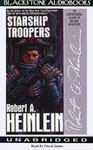
Novel: Starship Troopers by Robert A. Heinlein
There are two versions of this – one from Blackstone Audio and one from Recorded Books. See Jesse’s review of both of them for the full scoop.
 1961:
1961:
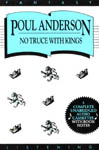
Short Fiction: “The Longest Voyage” by Poul Anderson
This one was included in a Dercum Press collection called No Truce with Kings. |SFFaudio Review|.
Novel: A Canticle for Leibowitz by Walter M. Miller, Jr.
Amazon lists an out-of-print version from Books on Tape, and Wisconsin Public Radio produced a 13 part audio drama for NPR, which you may be able to find.
1962:
Short Fiction: The “Hothouse” series by Brian W. Aldiss
I couldn’t find this one on audio.
Novel: Stranger in a Strange Land by Robert A. Heinlein
Blackstone Audio has an unabridged production, read by Christopher Hurt.
Posted by Scott D. Danielson

 Starman Jones
By Robert A. Heinlein; Read by Paul Michael Garcia
7 CDs – 8.5 Hours [UNABRIDGED]
Publisher: Blackstone Audio
Published: 2008
ISBN: 9781433230387
Themes: / Science Fiction / Space Travel / Aliens / Dystopia /
It was a desperate time, when one’s next meal and the comforts of home couldn’t be taken for granted. Max Jones, a practical, hard-working young man, found his escape in his beloved astronomy books. When reality comes crashing in and his troubled home life forces him out on the road, Max finds himself adrift in a downtrodden land. Until an unexpected, ultimate adventure carries him away as a stowaway aboard an intergalactic spaceship—but to where? And when? And how could he ever get back? With the ship’s pilot dead and his charts and tables all destroyed, Max must call upon all of his untested knowledge and skills in order to survive.
There’s nothing like going back to that old-time Science Fiction. Heinlein’s novels are steeped in the inspissate brew of American idealism. Puritanical hard work, honesty and humility are mixed with the libertarian and the liberal, the conservative and the anarchistic. These aren’t just the bywords of Heinleinian characters, they’re the fundamentals of their character – all that, and tempered too with happy portions of both skepticism and hucksterism. A Heinlein character is just as likely to be a gruff middle aged con-man (honest in his own fashion) as a naive wundderkind. The naive wundderkind is often found with a variously doting, tolerant, and even brighter sweetheart. We find all three, the canny conman, the boy genius and his devoted young woman, along with a whole lot more in Starman Jones.
There are three main sections of Starman Jones. Most of the folks who talk about the novel talk about the middle section – where Max works his way up the chain of command in a luxury spaceliner. Indeed, this is what gives the novel its title. The third section, set on board a primitive alien planet has some nicely interesting aliens (a whole novel could have been done there). Personally I liked the first third, set on a vaguely dystopic planet Earth. This is a land of no-opportunity, in order to get a decent job you have to inherit it. Vested interests, taking the form of professional guilds, seem to have staked out every possible avenue for advancement. Sure, there are people there willing to bend the rules to kind-hearted kids like Jones, but the general rule is a complacency towards pervasive corruption. At one point during this first third a kindly truck driver, hopped up on amphetamines, gets Max to help him break the rules of the road (that you have to pull over and sleep once in a while). That scene and another, gives an odd kind of atmosphere of low-level-corruption that Heinlein seems fairly comfortable with. Later still, with the only ticket off the sewed-up planet Earth is via false documents and bribery – Max goes for it, to the detriment of his conscience only after the fact.
In other juvenile novels, like Citizen Of The Galaxy, a Heinleinian protagonist will stay “dirtside” where he’ll grift and finagle his way through life – justifying each action step by step – here and frankly in every single Heinlein story that I’ve ever read, the bad guys are never bad because of the greed or corruption per se, but rather because they are dumb, ignorant and vain.This is a Heinlein failing I think. His cardboard cut-out villians are too dim, too dull-humored and too officious to be any real threat. There are at least two of these lame-brains in this novel. That got me to thinking. If one were to rewrite a Heinlein novel from the strawman’s point of view – it’d be extremely obvious who Heinlein had meant the hero to be [namely Heinlein’s own ideas and values – however ambivalent they are]. But, don’t let this criticism let you think I don’t like Starman Jones because, warts and all, I really did enjoy it.
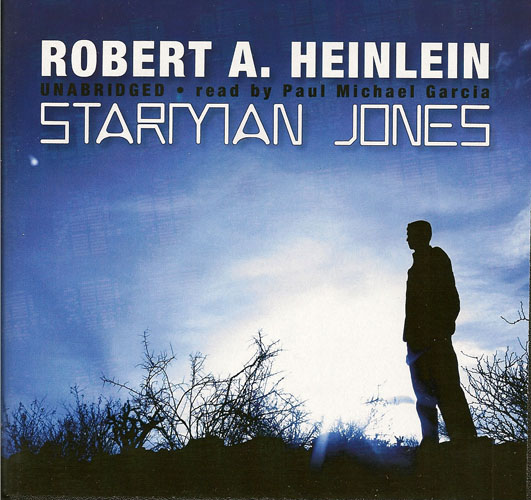
Paul Michael Garcia is ably suited to reading Heinlein’s well chosen words – giving the dialogue-heavy prose a banter-like give and take. Garcia’s range too is very impressive, voicing Max Jones as youthful and energetic, his older pal Sam as languid and confident, the girl, the mom, the step-dad, the alien spacepet, and everyone else – all in unique voice. It really is the ideal reading. I’ve been a fan of Garcia’s narration since Blackstone picked him for Kirinyaga. Despite a lot of technical jargon, especially while talking astrogation, I only heard one tiny mispronunciation in the whole novel. Concomitant meaning “occurring or existing concurrently.” Garcia read it as “konk-mittant.” The original art that Blackstone has given Starman Jones looks good, if a bit generic, but a closer inspection – past the silhouetted landscape and into the roiling clouds will admit a bit more detail in the night’s overcast sky.
Posted by Jesse Willis
 Eugie Foster has a new collection out called Returning My Sister’s Face and Other Far Eastern Tales of Whimsy and Malice. It’s available from Barnes and Noble and Amazon, but if only I had read further before ordering my copy!
If you order directly from her, not only will she autograph your copy, but she’ll also throw in an MP3-CD containing five stories from the collection, and a bonus:
• “The Tiger Fortune Princess” read by Norm Sherman, produced and podcast by Drabblecast (Mar. 2008).
• “The Snow Woman’s Daughter” read by cunning minx, produced and podcast by Escape Pod (Aug. 2007).
• “The Tanuki-Kettle” read by Tina Connolly with an introduction by M. K. Hobson, produced and podcast by Podcastle (Oct. 2008).
• “The Archer of the Sun and the Lady of the Moon” read by Eugie Foster, an original audio production.
• “Returning My Sister’s Face” read by Stephen Eley, produced and podcast by Pseudopod (Sept. 2006).
• Bonus Story: “Souls of Living Wood” read by Eugie Foster, an original audio production.
Posted by Scott D. Danielson
 A letter from the editor has been posted along with the latest issue of Orson Scott Card’s Intergalactic Medicine Show. Editor Edmund R. Schubert says that IGMS will be released bi-monthly (used to be quarterly), the number of stories in each issue will be reduced to five (used to be seven), and that, instead of writing a new story for each issue (which he was having trouble keeping up with), Orson Scott Card will record a story for each issue.
The audio story he records might be one of his own previously published stories; it might be a story by another author published in IGMS; or it might be something from a novel-in-progress.
The latest issue, which went live just yesterday, contains text and audio versions of “The Man in the Tree” by Orson Scott Card, a story from the upcoming novel The Lost Gate.
Posted by Scott D. Danielson
 The January Dancer
By Michael Flynn; Read by Stefan Rudnicki
1 MP3-CD or 9 CDs – Approx. 10.5 Hours [UNABRIDGED]
Publisher: Blackstone Audio
Published: 2008
ISBN: 9781433250996 (MP3-CD), 9781433250972 (CD)
Themes: / Science Fiction / Space Opera / Aliens / Space Flight /
Captain Amos January, and crew, are forced to look for ship repair materials on an unknown planet. There they discover an alien ship filled with fascinating artifacts, among them a shape-changing sculpture that becomes known as “The Dancer.” We learn of some of The Dancer’s attributes as known in ancient legends and confirmation is received as we watch the story unfold. It is sought by cabals, pirates, governments, and other powers who unleash different characters to acquire The Dancer. Not unexpectedly these characters are scoundrels, idealists, and romantics whose tracks intersect and form their own sort of dance as they maneuver to best one another. This tale is told to us as a story within a story as a Harper hears the tale, a bit at a time, from the Scarred Man. This is an interesting device as not only are we told the story but Flynn uses the framing story to give us his ideas about storytelling as an art.
It is a trend these days, or so it seems to me, for modern science fiction authors to attempt to write “space opera.” As an aficionado of that subgenre who has recently been browsing among the past masters of the art (in large part thanks to Librivox), my view is that the modern take tends to be drawn-out, unfocused, and sprawling by comparison. Sadly, although I also am an aficionado of Michael Flynn’s work, I believe he has fallen prey to the desire to expand the story past the demands of the genre. The original writers wrote snappy, bold, romantic adventures that did not worry overmuch about expostulation and got to the point. Flynn, on the other hand, gives a bewildering combination of too much philosophical conversation and not enough details about the characters’ lives. There is a plethora of characters as well, almost too many to track, and this often leaves the listener bewildered as to just who has suddenly popped up unexpectedly in a scene. As well, in the last couple of chapters the tone shifts unexpectedly, as if Flynn suddenly was told he had to finish up, and thus the novel swung into abrupt action and snapped out a strangely sparse finale. The revelations were not illogical or even unsatisfying. However, after dragging on and on in the middle of the book it was quite disconcerting to suddenly be flung headlong into the finish in the style of “a shot rang out and everyone fell dead.”
Stefan Rudnicki narrates with his usual expertise, adroitly affecting slight voice changes that communicate character when voicing dialogue. One wishes that the editors had added a slight aural indicator when there were scene changes. In a book of many characters who are flung from one exotic location to another at a second’s notice, it is very difficult to tell when there is a scene change immediately with nothing other than a slight pause between sections. I must also note, that my above complains about Flynn’s book overall may have been due to the fact that a complex book is necessarily more difficult to grasp when listening rather than reading as it was written. In this instance, the editors would have done well to help the listener all they could.
If you are a Michael Flynn fan, this book will not be a complete waste. I did enjoy it initially, but I simply wished it had been truly the space opera that it purported to be.
Note: should readers think that there are no modern writers capable of space opera that is worthy of comparison with those of older times, I refer you to the “Agent of Change” series by Sharon Lee and Steve Miller (Agent of Change, Conflict of Honors, Carpe Diem, Plan B, and I Dare) and Space Vulture by Gary K. Wolf and John J. Myers. None of these are in audiobook format that I know of but are well worth seeking out.
Posted by Julie D.