Review of The Long Walk by Stephen King

SFFaudio Review

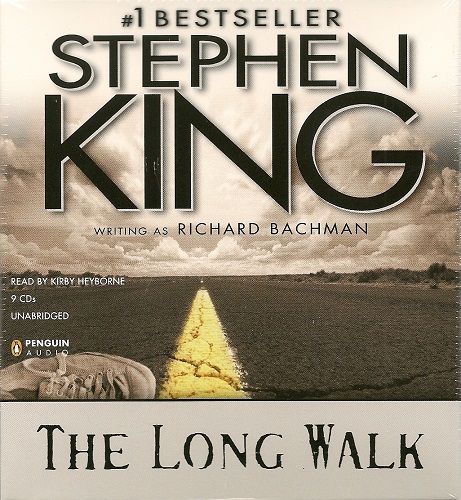
Horror Audiobook - The Long Walk by Stephen KingThe Long Walk
By Stephen King; Read by Kirby Heyborne
9 CDs – Approx. 11 Hours [UNABRIDGED]
Publisher: Penguin Audio
Published: 2010
ISBN: 9780142427835
Themes: / Horror / Walking / Alternate History / Maine /

Every year, on the first day of May, one hundred teenage boys meet for an event known throughout the country as the “Long Walk.” Among this year’s chosen crop is sixteen-year-old Ray Garraty. He knows the rules: Warning are issued if you fall under speed, stumble, sit down. After three warnings, you get your ticket. And what happens then serves as a chilling reminder that there can be only one winner in the Walk: the one who survives.

One of the things that generally makes me not connect with fiction is what’s missing. That is to say, if the story isn’t talking about some idea (the human condition, society, or how the world works) I probably won’t connect with it. I therefore always assume that a novel has some message. A lesson it is trying to impart to me. Perhaps this is a mistake as The Long Walk, by Stephen King, lives on the surface of what it is. It’s 100 boys walking across the United States in a kind of slow motion deathrace. Unlike the the traditional death march, these walkers are all volunteers, and are supplied with food and water. “That’s the premise.” I told myself. But what message had King planted underneath it? What idea was he trying to convey in novel form?

At first I was wondering if King was addressing the Vietnam War. But that didn’t pan out, not exactly. The way the book is structured, the premise is never flatly stated, we only learn how the boys ended up where they are (walking across Maine) when they discuss it amongst themselves. So, we’re learning the premise as we go. I figured that if there was a message in The Long Walk it needed to be decoded. My first suspect for the key to the message was the soldiers who passively enforce the Long Walk’s rules. Their faces were strangely blank, providing no bounce or reaction to their work or the insults the walkers hurl at them. I thought their blankness might be a hint, a symbol, or something. But if so, it didn’t work out for me. In fact, by the end, never having learned the names of any of the nearly faceless soldiers, it was quite the opposite. The only idea I could come up with to explain this was that they were designed to represent the unfeeling laws of nature. Kind of an embodiment physics, unfeeling and inalterable. That got me thinking that perhaps the whole of the The Long Walk was kind of a metaphor for mortality – you know, the idea that no matter your station, no matter your talent, none of us can escape our coming demise. But, the more I read, the less that seemed likely. In fact, no matter which intellectual straw I grasped at I kept coming away with a figurative handful of nothing.

Another angle of attack I took was to look at the world. What kind of a world would allow this horror race? What was the meaning of “the prize” for the winner? The world, what little we get to hear of it, was pretty interesting. We learn that there are 51 states in the Union, that before then end WWII some kind of air raid from Nazi Germany hit the American East Coast, and that the government may be entirely in the hands of a military dictatorship. Nice! These and other small details slip out in the many varied conversations between the boys in the Walk, amongst trash talk, sex talk and the discussion of literature. With nothing much left to go on I tried to think about the literary references, tried to see if there was some key there, to unlocking the meaning of this novel. At one point one of the walkers says that ‘the Walk is like living in a Shirley Jackson story.’ He was right! And later on, when ruminating on the effect of being watched by the public, another of the boys says he’s ‘reminded of a Ray Bradbury story.’ And he was right! In fact, there are maybe a half dozen literary references alluded to in this novel. But none of them, not any one of them, was the key to decoding the meaning for me. So, in the end, I didn’t come away with was any sense of what this novel was about, other than what it would be like to be force marched across the United States.

Apparently The Long Walk was originally written in 1966 and 1967 while King was in his first two semesters of university. I’m assuming it was somewhat updated or re-written before it’s 1979 debut in paperback under King’s Richard Bachman pseudonym. I first heard Kirby Heyborne’s narrative abilities with Little Brother |READ OUR REVIEW|. That novel was told in the first person, and Heyborne’s youthful voice was up for the job there. Here, voicing more than a dozen young men and boys, all in the third person, he renders an acceptable, if not stellar, performance. He adds the occasional regional American accent to each kid and it always sounds appropriate for what we know about his background. Also of note: There is an interesting introductory essay on Disc 1 entitled The Importance Of Being Bachman. It does not, however, provide any particular details about The Long Walk.

Posted by Jesse Willis

Review of Escape From New York AUDIO DRAMA

SFFaudio Review

WARNING: This review is a bit of an aberration, it’s a bit more gonzo. It was written this way out of necessity and it is thus perhaps only suitable for those who… ‘heard he was dead.’

BrokenSea Audio Productions - Escape From New York - FAN AUDIO DRAMAEscape From New York
Based on the screenplay by John Carpenter and Nick Castle; Adapted by Bill Hollweg; Performed by a full cast
5 MP3 Files or Podcast – Approx. 2 Hours 15 Minutes [AUDIO DRAMA]
Podcaster: BrokenSea Audio Productions
Podcast: April 2009 – March 2010
Themes: / Crime / Dystopia / Science Fiction / Alternate History / WWIII / Prison / Horror / New York /

Part 1 |MP3| Part 2 |MP3| Part 3 |MP3| Part 4 |MP3| Part 5 |MP3|

In the year 1988 the crime rate in the United States rises 400%. The once great city of New York becomes the one maximum security prison for the entire country. A fifty foot containment wall is erected along the New Jersey shoreline, across the Harlem river, and down along the Brooklyn shoreline. It completely surrounds Manhattan Island. All bridges and waterways are mined. The United States Police Force, like an army, is encamped around the island. The prison’s name: New York Maximum Security Penitentiary, Manhattan Island. There are no guards inside the prison, only prisoners, and the worlds they have made. The year now… 1997.

In the opening crawl (detailed above) we are given a world rife with Science Fiction glory. Escape From New York has a premise full of promise. It is a story pregnant with possibilities – nearly all of which are fulfilled. Escape From New York, my friends, is both a powerful satire of our times and a powerful cinematic experience movie. Now, thanks to the creative love and attention by fans at BrokenSea Audio Productions it is a wondrous audio drama made by fans for fans.

Now hang with me on this. I hope I don’t end up seeming like a crazed french film critic, arguing for the superiority of the second Star Wars trilogy (The Phantom Menace et. al) over the original Star Wars and Empire. Take that first statistic: “the crime rate in the United States rises 400%” – how would that be possible? It certainly wouldn’t match any conventional trend or shift in population growth. Might it then be categorized under some sort of Freakonomics-style explanation? Maybe. But, I think we could argue, quite convincingly, that the only way to increase the crime rate 400% overnight would be to make a whole lot more human behaviors crimes. Disrespecting authority, sharing files with friends, or as the trailer for Escape From L.A. puts it “No talking, no smoking, no littering, no red meat, no freedom of religion. And remember all marriages must be approved by the Department of Health.” So, the world of Escape From New York is really fun. But a world is not enough. You need a plot and a set of characters. As to the latter…

The anti-hero takes many forms but I have a special fondness for Snake Plisken. As in an IMDB grendelkhan says:

“Snake Plissken is the classic anti-hero, ala Clint Eastwood’s Man-with-no-name. Plissken is an ex-soldier turned criminal, recruited/blackmailed into rescuing a hostage president from the prison of New York City. Plissken is a walking ball of anger and a survival machine.”

Indeed, a survival machine who’s been betrayed, lied to shat on by his own government – and he’s got a cool eye-patch, a reverse tramp stamp of a cobra, and a gravelly voice. He is a great character.

“But what of his motivation?” You ask.

Read on…

Plisken, call him Snake, lives in a parallel universe – a USA run like a fun-house-lensed double craptoberfest of moral hypocrisy. If you’ve seen the movie Escape From New York, you’re seeing the 1980 zeitgeist of Manhattan as the epitome of ghettoic urban decay. This fear, that your neighbors are out to get you, the horror that politicians so often rely upon, works great in movies (and in the opening credits to The Equalizer). But this isn’t only a horror story. The prison genre is one of my favorites (check out Animal Factory). Like westerns, these genre stories have a certain set of conventions or constraints that make a story told within those constraints far more satisfying. But neither is Escape From New York just a prison story. For it
is also a quest story, a revenge story, an all out action adventure. There are MacGuffins galore for Plisken to chase after: First up is a world peace conference that is about to end in disaster lest a certain audio cassette is retrieved, then there’s a kidnapped President Of The United States to be rescued, and of course there’s a jet glider (don’t think too hard about that one) as their only escape, but to top it all off there’s a pair of ticking time-bombs in Snake’s body! That’s not just motivation, that’s entertainment folks!

Snake, now motivated, has enough-knock-down-drag-out adventures in the course of just less than 24 hours, so as to numb any thoughy you had about suspending any disbelief. Or as Samuel Taylor Coleridge argued: “[if a writer could infuse a] human interest and a semblance of truth [into a fantastic tale, the reader would suspend judgment concerning the implausibility of the narrative].” If you look at it another way this is the original 24, but with a hard-assed biker veteran saving the USA instead of a Kiefer Sutherland. In the course of just over 2 hours Bill Hollweg and the folks at BSAP have created a faithful and loving tribute to one of 1981’s best movies.

Speaking of 1981, I look forward to hearing BSAP adapt Clash Of The Titans (1981), Excalibur (1981) and Body Heat (1981). They’re already working on a Mad Max II (1981)-inspired series.

Posted by Jesse Willis

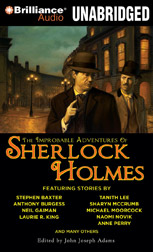
Aural Noir Review of the Improbable Adventures of Sherlock Holmes

Aural Noir: Review

The Improbable Adventures of Sherlock HolmesThe Improbable Adventures of Sherlock Holmes
Edited by John Joseph Adams; Read by Simon Vance and Anne Flosnik, John Joseph Adams (uncredited)
18 CDs – 22 hours [UNABRIDGED]
Publisher: Brilliance Audio
Published: 2010
ISBN: 1441839070
Themes: / Mystery / Crime / Alternate History / Science Fiction / Horror / 19th Century / London /

“When you have eliminated the impossible, whatever remains, however improbable, must be the truth.” This famous Sherlock Holmes quote is the impetus which drives this intelligent, inventive, and at times irreverent compilation of Sherlock Holmes stories written in the last few decades. As John Joseph Adams explains in his introduction, his aim in compiling these stories is to explore the uneasy peace between the cold clear logic of the deerstalker-wearing, pipe-smoking detective and the unanswered, perhaps unanswerable mysteries which continue to thwart human investigation to this very day. While many of the stories miss the mark of this goal entirely, the collection as a whole succeeds in pushing Holmes in new directions while staying true to the spirit of Sir Arthur Conan Doyles’s original work.

The stories in this collection fall into one of three categories. First, there are the traditional mysteries. These are stories that, with but slight alteration, might easily have found a home among Conan Doyle’s own work. The best of these tales expand upon characters or cases mentioned in the original œuvre only in passing. Mrs. Hudson’s Case by Laurie R. King, for instance, features Holmes’s protégé Mary Russell as its protagonist and reveals the character of Holmes’s long-suffering landlady. Edward D. Hoch’s A Scandal In Montreal, meanwhile, reunites Sherlock Holmes with his sometime nemesis Irene Adler. As a whole, however, this category fits rather uneasily into the collection because, by and large, there is little in the way of “the improbable” in any of these stories. All are well-written and most are engaging; they simply miss the point.

The second category I would call historical, or pseudo-historical. In most respect these stories are similar to those of the first category, with one redeeming addition: Sherlock Holmes crosses paths with historical figures from the Victorian era. Stephen Baxter’s The Adventure of the Inertial Adventure sees our detective join forces with author of scientific romances H.G. Wells, while Tony Pi’s Dynamics Of A Hanging brings mathematician Charles Dodgson (better known as Lewis Carroll) into the Holmesian world. The highlight of this grouping, though, is The Adventure Of The Field Theorem by Vonda N. McIntyre, in which Sherlock Holmes investigates crop circles at the behest of none other than Arthur Conan Doyle.

The last category throws Sherlock Holmes–and let’s not forget Doctor Watson, through whose eyes we see most of these tales unfold–into genres as wide-ranging as alternate history, horror, and science fiction. Subjectively, I liked these stories best because they fall into genres which I most commonly read. Objectively, these stories succeed because they deliver on the promise of “improbable adventures.” The collection opens with a chilling tale by horror master Tim Lebbon, which unlike most Holmes stories is never intellectually resolved. The Singular Habits Of Wasps by Geoffrey A. Landis, perhaps my favorite story in the collection, puts a fascinating otherworldly spin on the mysterious murders of Jack the Ripper. Robert J. Sawyer’s closing story, You See But You Do Not Observe, pits Holmes’s intellect against the fermi paradox concerning extraterrestrial life. The collection is worth the price of admission for these entries alone.

Simon Vance carries the bulk of the narration, with Anne Flosnik reading only a few stories featuring female protagonists. Flosnik performs solidly in her few appearances. Simon Vance’s portrayal of Holmes and Watson is spot-on; the former speaks with a whip-sharp voice, while the latter lumbers along in a more lugubrious manner. He falls short only when narrating the few “New World” characters who figure in the stories, but these cases are uncommon and Vance’s accent isn’t off by much. John Joseph Adams himself narrates the collection’s introduction, as well as introductory passages to each story.

Whether you’re a fan of mystery, history, or something further afield, chances are high you’ll find something to sate your appetite in The Improbable Adventures of Sherlock Holmes. I’ll venture out on a limb and say that visitors to this site will likely be most interested in the tales of speculative fiction. I assure you, in particular, that you’ll not be disappointed.

Posted by Seth Wilson

Review of Skybreaker by Kenneth Oppel

SFFaudio Review

Book of a Thousand Days by Shannon HaleSkybreakerSFFaudio Essential
By Kenneth Oppel; Read by a full cast
10 CDs – 11.5 Hours [UNABRIDGED]
Publisher: Full Cast Audio
Published: 2008
ISBN: 9781934180150
Themes: / Fantasy / Airships / Adventure / Parallel World / Romance / Alternate History / Zoology / Paris / Pirates / Parkour /

High in the sky, far above the normal lanes of travel, drifts a ghost ship carrying unbelievable treasure. Matt Cruise, hero of the wildly popular Airborn, is on the trail of that treasure, with the help of his charming society friend Kate de Vries and a mysterious gypsy girl named Nadira. With them flies Hal Slater, roguish captain of a boldly designed Skybreaker aircraft that can reach heights previously undreamed of. But between Matt and his destination stand ruthless pirates, and an even more ruthless businessman. And what Matt’s crew will find when they finally do reach the Hyperion is far more valuable, far more exciting, and far more dangerous than they ever imagined.

Do you love airships? I know I do. If I had my way I’d double the number of all science fiction and fantasy novels being written with airships. This one, set shortly after the events of Airborn |READ OUR REVIEW|, stars our returning hero Matt Cruse. At the opening of Skybreaker Matt has been attending the world’s premier airship academy in Paris. This last semester his practicum began as assistant navigator on an old cargo airship called the Flotsam. And it’s there, whilst high over the Indian Ocean, that Matt, and the crew of the Flotsam, spot a famous ghost airship called the Hyperion. Supposedly the Hyperion is loaded with the treasures of it’s notorious billionaire inventor (kind of a cross between Howard Hughes and Thomas Edison). Upon his return to Paris, Matt discovers there are several interested parties desirous of the Hyperion’s last known coordinates. Fatefully, this is information that now only Matt knows! Determined to cash in on the knowledge and hunt down the Hyperion’s treasure Matt teams up with a rougish sky-captain named Hal Slater. Slater is the owner of a recently commissioned “skybreaker” called the Sagarmāthā. (which is the nepalese name for Mount Everest). Skybreakers are high performance, high altitude airships. Matt will need one just like it to reach the high drifting Hyperion. But Matt won’t be alone as Paris is full of both dangers and would-be competitors in the hunt for Hyperion. And what kind of a novel set in Paris would be complete without some Parkour? Kenneth Oppel doesn’t disappoint there. When Matt meets Nadira, a girl wjho quite literally holds the key to the Hyperion’s treasure, the first thing do together is jump around, off buildings, running away from some bad dudes.

One thing to bear in mind while reading this fast paced adventure, Kenneth Oppel is far less interested in the rigors of telling a scientifically plausible story than in getting on with the storytelling itself. Despite this Skybreaker does have some rudimentary science in it, notably in the areas of fluid physics (displacement), biology (human adaptability to high altitude) and even some of the zoological sciences. And though the story contains no magic it is probably still best classified as a Fantasy novel due to some very unscientific realities. The lifting gas employed in the Skybreaker universe, for example, is non-flammable (like helium gas), naturally scented of mango (like no high lifting gas on our periodic table), naturally occurring (from deep within the earth and in some animals biologically) and absolutely non-existent in our universe. Some inventions that are featured in the story are not only implausible, but also long discredited in our reality (notably Phrenology). On the plus side it contains a fun Parkour sequence fairly early in the novel. Parkouring-up a scene like that is really cool. Thanks Mr. Oppel!

As with every Full Cast Audio production that I’ve hear I come away from the novel forgetting that it is an audiobook. Skybreaker feels like a full blown audio drama. This is a rather odd realization. There are no sound effects that would normally be created for an audio drama production – they are merely described by the narrator using the actual words written by Kenneth Oppel. One technical difference in the production, as compared with Airborn is what sounds like a bit more bed music. The actors who performed in the first book in this series all return, reprising their roles as appropriate but there are some new actors too. The addition of Hal Slater, for example, is a fine one, voiced by Mark Holt, he comes off very Han Solo-ish. The actress playing Nadira, Ailsa McCaughrean, would be a fine additon to future FCA productions, she portrays a young, brash and impulsive young woman. The actors playing the Sherpas, the crew of the Sagarmatha, present what sounds to my ears as a distinct and possibly even authentic accent. Malcolm Ingram, who plays a villonous sky-pirate turned sky-mercenary sounds a bit like Sean Connery. David Kelly (Matt) and Mark Holt (Hal) even have a chance to sing a sea-shanty turned sky-shanty. This is an aurally rich production that’s a must listen for any fan of airshippery and piratical daring do.

Posted by Jesse Willis

The SFFaudio Podcast #046

Podcast

The SFFaudio PodcastThe SFFaudio Podcast #046 – Jesse and Scott talk audiobooks, hard SF, current theatrical movies, Kenneth Oppel‘s Skybreaker and the new Gene Wolfe audiobooks at Audible.com! We also debut a new feature (boldly stolen from the late lamented Sofanauts Podcast). RIP.

Talked about on today’s show:
bananas, Smoke by Donald E. Westlake, invisibility, humor, the Richard Stark novels are only funny to psychopaths, crime, Don’t Call Us, We’ll Call You by Donald Westlake (Westlake’s open letter to Science Fiction on why he’s not writing SF anymore), Philip K. Dick’s interview on Hour 25, Those Sexy Vintage Sleaze Books: A Blog About Vintage Soft Core Paperbacks, Robert Silverberg, Lawrence Block, paperbackswap.com, The Ax and The Hook by Donald E. Westlake, The Engines Of God by Jack McDevitt, Rendezvous With Rama by Arthur C. Clarke, aliens, xenoarcheology, terraforming, Tom Weiner, hard SF, 2010: Odyssey Two by Arthur C. Clarke, exoplanets, social science fiction, soft SF, The Windup Girl by Paulo Bacigalupi, androids, first contact, Calculating God by Robert J. Sawyer |READ OUR REVIEW|, how to win any argument about modern SF: bring up Ted Chiang, The Story Of Your Life by Ted Chiang, The Invisible Man by H.G. Wells, Starship: Flagship by Mike Resnick, hero characters doing villainous things, Island Of The Blue Dolphins by Scott O’Dell, Summer Of The Monkeys by Wilson Rawls, Dolphin Island by Arthur C. Clarke, hovercraft, Australia, 2010: The Year We Make Contact, marine biology, District 9, the MacGuffin in District 9 is stupid, Avatar, Sharlto Copley, Star Trek, Skybreaker by Kenneth Oppel, Full Cast Audio, audio drama, Science Fiction, alternate history, Fantasy, airships, pirates, lifting gasses, phrenology, Howard Hughes, Thomas Edison, Graphic Audio, Brandon Sanderson‘s Warbreaker, Elizabeth Moon‘s Serrano Legacy series, audio drama is for truckers!, Jesse’s pick of the week: William Friedkin‘s Sorcerer (1977), laserdiscs, the great thing about laserdiscs!, VHSrips!, The Wages Of Fear (1953), Scott’s Pick of the week: Gene Wolfe’s The Book Of The New Sun (a novel in four parts), narrated by Jonathan Davis, the SFFaudio Yahoo! Group, Audible.com, Blake’s 7 The Early Years – Jenna: The Trial / The Dust Run (Vol. 1.5), Carrie Dobro, Babylon 5: Crusade, the Blake’s 7 television series, Blake’s 7 is the best audio drama space opera series ever!, Brian AldissHelleconia series, Non-Stop by Brian Aldiss, Best SF Stories of Brian W. Aldiss, the fix-up novel, Dreamsongs by George R.R. Martin |READ OUR REVIEW|, Maps In A Mirror by Orson Scott Card, short stories turned into novels, Karen Makes Out (a short story), Out Of Sight (a novel) by Elmore Leonard, Out Of Sight (the film), Karen Sisco, Meatball Fulton‘s Ruby The Galactic Gumshoe, NPR, Recorded Books, The Atrocity Archives by Charles Stross, what Jesse wants for his birthday: the complete fiction of Ted Chiang in audio, The Bishop’s Heir by Katherine Kurtz, the Deryni series, David Weber, series should end!

Posted by Jesse Willis

The SFFaudio Podcast #044 – TALK TO: Professor Eric S. Rabkin

Podcast

The SFFaudio PodcastThe SFFaudio Podcast #044 – Jesse and Scott are joined by Professor Eric S. Rabkin of the University Of Michigan to discuss fairy tales, fantastic literature and Science Fiction.

Talked about on today’s show:
Department Of English Language And Literature @ the University Of Michigan, the Winter 2010 semester: English 342 Science Fiction, English 418/549 Graphic Narrative, hey sign us up!, The Teaching Company, Science Fiction: The Literature Of The Technological Imagination |READ OUR REVIEW|, Masterpieces of the Imaginative Mind: Literature’s Most Fantastic Works, Franz Kafka, H.G. Wells, Edgar Allan Poe, Science Fiction (the most important literature for adults), I, Robot by Isaac Asimov |READ OUR REVIEW|, Brothers Grimm, fairy tales, Neuromancer by William Gibson |READ OUR REVIEW|, Asimov’s three laws of robotics, the conversation that is Science Fiction, humans are pattern seeking animals, Starship Troopers by Robert A. Heinlein |READ OUR REVIEW|, The Forever War by Joe Haldeman |READ OUR REVIEW|, Ender’s Game by Orson Scott Card |READ OUR REVIEW|, the ansible, Armor by John Steakley, Old Man’s War by John Scalzi |READ OUR REVIEW|, Gundam, The Ship Who Sang by Anne McCaffrey, Science Fiction as a form of children’s literature, Thomas Disch, Camp Concentration, 334, Kurt Vonnegut, The Plot Against America by Philip Roth, alternate history, Hugo Gernsback, pulp literature, paperback originals, adolescent power fantasies, Frank Reade and His Steam Man of the Plains by Noname, Ralph 124C 41+ by Hugo Gernsback, pushing science education through Science Fiction, The Time Machine by H.G. Wells |READ OUR REVIEW|, The Facts In The Case Of M. Valdemar by Edgar Allan Poe, From The Earth To The Moon by Jules Verne, Henry James and H.G. Wells in conversation over the future of fiction, The Portrait Of A Lady by Henry James, WWII, the societal effect of the G.I. Bill, tracking an author’s intentions, powerful fiction becomes classic?, Ted Chiang, Blankets by Craig Thompson, has Science Fiction crossed a certain cultural Rubicon?, Momento, Blindness by José Saramago, Briefing for a Descent into Hell by Doris Lessig, Galatea 2.2 by Richard Powers, has our culture become “fully Science Fictionized”?, does SF history begin with Frankenstein and end with Neuromancer?, Alan Moore, Watchmen, The League Of Extraordinary Gentlemen, pattern recognition, allusion (and literary allusion).

Posted by Jesse Willis