
Colin‘s reading of The Nine Billion Names Of God by Arthur C. Clarke is not nearly popular enough.
As of this post it’s only received a mere 17 viewings (or hearings).
Posted by Jesse Willis
News, Reviews, and Commentary on all forms of science fiction, fantasy, and horror audio. Audiobooks, audio drama, podcasts; we discuss all of it here. Mystery, crime, and noir audio are also fair game.

Colin‘s reading of The Nine Billion Names Of God by Arthur C. Clarke is not nearly popular enough.
As of this post it’s only received a mere 17 viewings (or hearings).
Posted by Jesse Willis
This recording of Arthur C. Clarke’s The Nine Billion Names Of God was produced by Dercum Audio – it’s that signature opening, that terrific, haunting music that begins at the ten second mark – that’s the giveaway. Produced in 1991, it is long out of print and a real treasure.
Part 1 of 2:
Part 2 of 2:
Posted by Jesse Willis

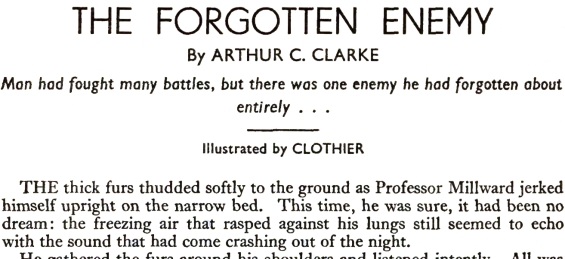
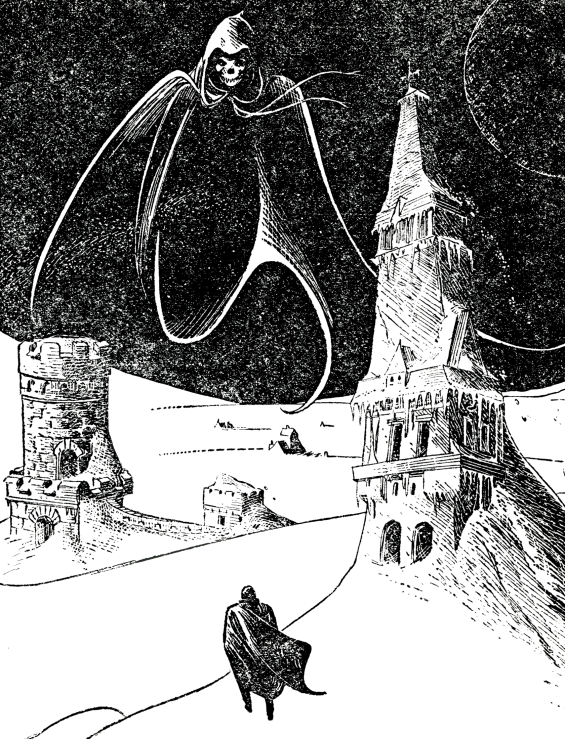
This is the third time I’ve posted about this wonderful podcast episode. The last time was just last year. But I’ve just come across another wonderful illustration, this time from a reprinting in an issue of Avon Science Fiction And Fantasy Reader, so I’ve just had top post about it again. It’s highly recommended listening.
 A Bite of Stars, a Slug of Time, and Thou – The Forgotten Enemy
By Arthur C. Clarke; Read by Elisha Sessions
1 |MP3| – Approx. 1 Hour [UNABRIDGED]
Podcaster: A Bite Of Stars A slug Of Time And Thou
Podcast: 2008
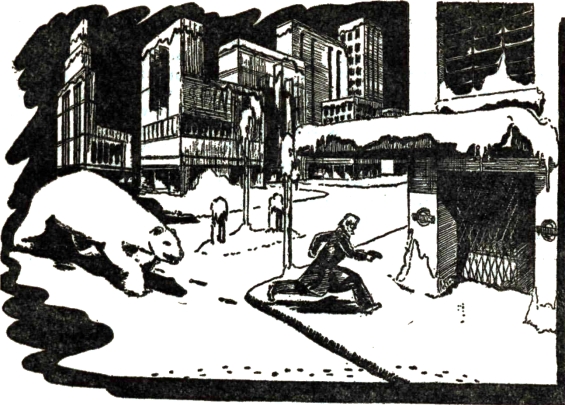
In a bleak snow and ice covered London, a lone survivor faces isolation, polar bears and loneliness. But even his one hope, the idea that a rescue team is crossing the Atlantic ice sheet isn’t enough to stave off The Forgotten Enemy. First published in December 1948, in an issue of King’s College Review.
First broadcast in 2008 on Resonance FM 104.4 FM in London, U.K, The Forgotten Enemy is an excellent Arthur C. Clarke tale. Set in London, it tells of solitary man waiting for rescue. He can almost hear the helicopters. Yes, the helicopters. The slow, loud, helicopters coming inevitably from the north. But what of the terrible white menace that threatens his lonely existence? Can he survive?
One aspect of the tale may remind you of 28 Weeks Later, another may remind you of The Day After Tomorrow. But fear not, this story pays far greater dividends than either of those.
In the discussion that follows the story is described as a “cozy calamity” and it’s compared to Who Goes There? and A Pail Of Air. It is a wonderful podcast – all around!
Here’s the accompanying art, by Clothier, from the New Worlds printing:
Posted by Jesse Willis

 Last year somebody* pointed out that a list of “The Top 100 Sci-Fi Books” (as organized by the Sci-Fi Lists website) was almost entirely available in audiobook form!
At the time of his or her compiling 95 of the 100 books were available as audiobooks.
Today, it appears, that list is approaching 99% complete!
I’ve read a good number of the books and audiobooks listed, and while some of them are indeed excellent, I’d have to argue that some are merely ok, and that others are utterly atrocious.
That said, I do think it is interesting that almost all of them are available as audiobooks!
Here’s the list as it stood last year, plus my added notations on the status of the missing five:
01- Ender’s Game – Orson Scott Card – 1985
02- Dune – Frank Herbert – 1965
03- Foundation – Isaac Asimov – 1951
04- Hitchhiker’s Guide To The Galaxy – Douglas Adams – 1979
05- 1984 – George Orwell – 1949
06- Stranger In A Strange Land – Robert A Heinlein – 1961
07- Fahrenheit 451 – Ray Bradbury – 1954
08- 2001: A Space Odyssey – Arthur C Clarke – 1968
09- Starship Troopers – Robert A Heinlein – 1959
10- I, Robot – Isaac Asimov – 1950
11- Neuromancer – William Gibson – 1984
12- Do Androids Dream of Electric Sheep? – Philip K. Dick – 1968
13- Ringworld – Larry Niven – 1970
14- Rendezvous With Rama – Arthur C. Clarke – 1973
15- Hyperion – Dan Simmons – 1989
16- Brave New World – Aldous Huxley – 1932
17- The Time Machine – H.G. Wells – 1895
18- Childhood’s End – Arthur C. Clarke – 1954
19- The Moon Is A Harsh Mistress – Robert A. Heinlein – 1966
20- The War Of The Worlds – H.G. Wells – 1898
21- The Forever War – Joe Haldeman – 1974
22- The Martian Chronicles – Ray Bradbury – 1950
23- Slaughterhouse Five – Kurt Vonnegut – 1969
24- Snow Crash – Neal Stephenson – 1992
25- The Mote In God’s Eye – Larry Niven and Jerry Pournelle – 1975
26- The Left Hand Of Darkness – Ursula K. Le Guin – 1969
27- Speaker For The Dead – Orson Scott Card – 1986
28- Jurassic Park – Michael Crichton – 1990
29- The Man in the High Castle – Philip K. Dick – 1962
30- The Caves Of Steel – Isaac Asimov – 1954
31- The Stars My Destination – Alfred Bester – 1956
32- Gateway – Frederik Pohl – 1977
33- Lord Of Light – Roger Zelazny – 1967
34- Solaris – Stanisław Lem – 1961
35- 20,000 Leagues Under The Sea – Jules Verne – 1870
36- A Wrinkle In Time – Madeleine L’Engle – 1962
37- Cat’s Cradle – Kurt Vonnegut – 1963
38- Contact – Carl Sagan – 1985
39- The Andromeda Strain – Michael Crichton – 1969
40- The Gods Themselves – Isaac Asimov – 1972
41- A Fire Upon The Deep – Vernor Vinge – 1991
42- Cryptonomicon – Neal Stephenson – 1999
43- The Day of the Triffids – John Wyndham – 1951
44- UBIK – Philip K. Dick – 1969
45- Time Enough For Love – Robert A. Heinlein – 1973
46- A Clockwork Orange – Anthony Burgess – 1962
47- Red Mars – Kim Stanley Robinson – 1992
48- Flowers For Algernon – Daniel Keyes
49- A Canticle For Leibowitz – Walter M. Miller – 1959
50- The End of Eternity – Isaac Asimov – 1955
51- Battlefield Earth – L. Ron Hubbard – 1982
52- Frankenstein – Mary Shelley – 1818
53- Journey To The Center Of The Earth – Jules Verne – 1864
54- The Dispossessed – Ursula K. Le Guin – 1974
55- The Diamond Age – Neal Stephenson – 1995
56- The Player Of Games – Iain M. Banks – 1988
57- The Reality Dysfunction – Peter F. Hamilton – 1996
58- Startide Rising – David Brin – 1983
59- The Sirens Of Titan – Kurt Vonnegut – 1959
60- Eon – Greg Bear – 1985
61- Ender’s Shadow – Orson Scott Card – 1999
62- To Your Scattered Bodies Go – Philip Jose Farmer – 1971
63- A Scanner Darkly – Philip K. Dick – 1977
64- Lucifer’s Hammer – Larry Niven and Jerry Pournelle – 1977
65- The Handmaid’s Tale – Margaret Atwood – 1985
66- The City And The Stars – Arthur C Clark – 1956
67- The Stainless Steel Rat – Harry Harrison – 1961
68- The Demolished Man – Alfred Bester – 1953
69- The Shadow of the Torturer – Gene Wolfe – 1980
70- Sphere – Michael Crichton – 1987
71- The Door Into Summer – Robert .A Heinlein – 1957
72- The Three Stigmata Of Palmer Eldritch – Philip K. Dick – 1964
73- Revelation Space – Alastair Reynolds – 2000
74- Citizen Of The Galaxy – Robert A. Heinlein – 1957
75- Doomsday Book – Connie Willis – 1992
76- Ilium – Dan Simmons – 2003
77- The Invisible Man – H.G. Wells – 1897
78- Have Space-Suit Will Travel – Robert A. Heinlein – 1958
79- The Puppet Masters – Robert A. Heinlein – 1951
80- Out Of The Silent Planet – C.S. Lewis – 1938
81- A Princess of Mars – Edgar Rice Burroughs – 1912
82- The Lathe of Heaven – Ursula K. Le Guin – 1971
83- Use Of Weapons – Iain M. Banks – 1990
84- The Chrysalids – John Wyndham – 1955
85- Way Station – Clifford Simak – 1963
86- Flatland – Edwin A. Abbott – 1884
87- Altered Carbon – Richard Morgan – 2002
88- Old Man’s War – John Scalzi – 2005
89- COMING SOON (October 15, 2012) – Roadside Picnic – Arkady and Boris Strugatsky – 1972
90- The Road – Cormac McCarthy – 2006
91- The Postman – David Brin – 1985
92- NEWLY AVAILABLE – Stand On Zanzibar – John Brunner – 1969
93- VALIS – Philip K. Dick – 1981
94- NEWLY AVAILABLE The Cyberiad: Fables for the Cybernetic Age – Stanisław Lem – 1974
95- NOT AVAILABLE AS AN AUDIOBOOK – Cities In Flight – James Blish – 1955
96- The Lost World – Sir Arthur Conan Doyle – 1912
97- The Many-Colored Land – Julian May – 1981
98- Gray Lensman – E.E. ‘Doc’ Smith – 1940
99- The Uplift War – David Brin – 1987
100- NEWLY AVAILABLE – The Forge Of God – Greg Bear – 1987
In case you were wondering, the list was compiled using the following criteria:
“A statistical survey of sci-fi literary awards, noted critics and popular polls. To qualify a book has to be generally regarded as science fiction by credible sources and/or recognised as having historical significance to the development of the genre. For books that are part of a series (with some notable exceptions) only the first book in the series is listed.”
The “Next 100”, as listed over on Sci-Fi Lists, has a lot of excellent novels and collections in it too, check that out HERE.
[*Thanks to “neil1966hardy” from ThePirateBay]
Posted by Jesse Willis

 The SFFaudio Podcast #170 – Jesse, Tamahome, and Jenny discuss the Brilliance Audio audiobook of The Fountains Of Paradise by Arthur C. Clarke.
Talked about on today’s show:
Skyhooks and space elevators, Sri Lanka, “my first space elevator book”, Robert A. Heinlein, Friday, “it feels like a novel”, “the fictional accounting of a real construction project”, history, Colombo, afterwords, sources and acknowledgements, “what a rip-off”, Sigiriya’s Lion Paws Gate, King Kashyapa I, “past, present, and future”, engineering fiction vs. science fiction, Taprobane, Paradise Regained by John Milton, Jo Walton’s review of The Fountains Of Paradise, religion, “Heinlein in a dress”, an idea book, to think interesting Science Fictional thoughts, hard SF, Clarke’s Laws, space probe, a game changer, Gregg Margarite, Shri Jawaharlal Nehru, The Nine Billion Names Of God, Sigmund Freud, growing out of religion?, Thomas Aquinas, symbolic logic, Bertrand Russell, satellites and their uses, unseen benefits to giant engineering projects and science, Sydney Opera House, the Eiffel Tower, Burj Khalifa, Mission: Impossible – Ghost Protocol, “this is what we’re meant to do”, the space age, the 1970s, Jenny gets depressed, Terpkristin‘s visit to French Guiana (PICS!), will we have a Chinese moonbase by 2022?, innovation vs. exploration, Jerry O’Neil, good reasons to go to space, we ought to do things that we can do, Leviathan Wakes by James S.A. Corey, the daily life challenges of a space born population, The Island Worlds by Eric Kotani and John Maddox Roberts, the probe is a person, The Geek’s Guide To The Galaxy #64: John Scalzi, (Star Trek holds us back), “the God Particle”, “you’re going to die soon”, can we empathize with a character that isn’t a human being?, a complimentary cosmonaut, 2001: A Space Odyssey, one day in Jerusalem, the transhuman future in the end of The Fountains Of Paradise, Starglider/Starholme, a well developed solar society, the Wikipedia entry for The Fountains Of Paradise, The Last Theorem, The City And The Stars, a non-off putting post-human story, Childhood’s End by Arthur C. Clarke, Fahrenheit 451 by Ray Bradbury, Ted Chiang, Charles Stross, sequels and science, Star Trek: The Next Generation, Alastair Reynolds, Kim Stanley Robinson, in SF ideas build can on one another whereas others books are more parasitizing upon those ideas, why does it have to be a new book?, ‘these were the stepping stones to today’, a balance of both a good story and good ideas, William Gibson, Embassytown by China Miéville, The City And The City, “garbage, garbage, garbage”, 2312, Playboy’s serialization of The Fountains Of Paradise, Buckminster Fuller, why did Sir Arthur C. Clarke live in Sri Lanka?, Milton is literature, Dante’s Inferno, Lucifer’s fall from heaven, Brilliance Audio, A Fall Of Moondust by Arthur C. Clarke, BBC Radio dramatization of A Fall Of Moondust, Crisis On Conshelf Ten by Monica Hughes, “best book ever”, The Abyss, Tom Swift, Aquaman vs. The Sub-Mariner, Blue Remembered Earth by Alastair Reynolds, The Prefect, Ray Of Light by Brad Torgeson, “Alien sun mirror block deepwater living daughter Glimmer Club surface discovery.”, the Mars tangent, Phobos and Deimos, John Scalzi, “I liked that he didn’t explain it.”, “we don’t build em that way”, “I want it to be hard”, Phobos interference would be a feature not a bug, “wiggle the thread”, atmospheric density and windspeed, carbon nano-tubes vs. buckminsterfullerene, Roald Dahl, Charlie And The Great Glass Elevator, horror, The BFG, Jack McDevitt, a waking dream, in the shadow of Vesuvius, the Prime Directive, Doctor Who, Fantasy vs. Science Fiction, Inferno (Doctor Who episode), Sliders, Doorways by George R.R. Martin, Tom Baker.


Posted by Jesse Willis
The SFFaudio Podcast #166 – Jesse, Luke Burrage, and Eric S. Rabkin discuss, at length, the SFF FORMS (Short Story, Novella, Novellete, Novel, Fix-up, Trilogy, World). Here’s the premise:
Science Fiction Forms: Short Story, Novella, Fix-Up, Novel, Trilogy, and World. Respectively, they might be exemplified thus: Short Story (“Mars Is Heaven!“), Novella (“Flowers for Algernon“), Fix-Up (The Martian Chronicles, which contains a revised version of “Mars Is Heaven!” or The Seedling Stars, Accelerando, and Beggars In Spain, all of which began as novellas), Novel (originals, like 1984, and derivatives like Flowers for Algernon or Varley’s novel Millennium coming from his short story “Air Raid“), Trilogy (original Foundation series), World (the ultimate Foundation world or Heinlein’s Future History [shared with others] or Banks’s Culture or LeGuin’s Hainish series [created just for the authors, but let’s not forget about fan fiction]). What are the special challenges and rewards in reading and writing in these diverse forms? What special challenges or rewards attend on reusing material in another form? Is the formal plasticity of SF unique among literary genres?
Talked about on today’s show:
Eric’s suggestion, literature with a capital “L”, The Dead by James Joyce, The Portrait Of The Artist As A Young Man, Doomsday Book by Connie Willis, Luke’s Science Fiction Book Review Podcast, the format, the themes, the variability of short story form, the feghoot, Day Million by Frederik Pohl, Accelerando, Stories Of Your Life And Others by Ted Chiang, The Tower Of Babel, stripped away vs. embellished to the nth degree, Flowers For Algernon by Daniel Keyes, Understand by Ted Chiang, The Bells by Edgar Allan Poe, The Black Cat, fantasy, the unexplicit story, valid reactions, the etymology of “text”, Earth Abides by George R. Stewart, a persuasive existential journey, The Scarlet Plague by Jack London, San Fransisco, short stories as objects of frivolity or training, the brilliance of an idea is not always enough, a novel can act as a community to an individual, Fahrenheit 451 by Ray Bradbury vs. The Fireman by Ray Bradbury, is the novel inherently more participatory than a short story?, the failure of technology vs. the power of nature, The Masque Of The Red Death, teaching Science Fiction with short stories and novels, The Science Fiction Hall Of Fame (Volume 1), the composite novel, Winesburg, Ohio by Sherwood Anderson, A.E. van Vogt, the fix-up, The Martian Chronicles by Ray Bradbury, Accelerando by Charles Stross, Lobsters by Charles Stross, the cat changes function, “an intellectual framework”, Robert A. Heinlein’s future history, the composite novel, Isaac Asimov, future history vs. psychohistory, Michael Moorcock, I, Robot, Robbie, the three laws, Stephen Byerly and Susan Calvin, unAsimovian assumptions, the full dose of SF, Reason, The Evitable Conflict, is Stephen Byerly a robot or a man?, the Mérode Altarpiece (a medieval iconographic trope), art history, Luke doesn’t think Asimov is that clever, R. Daneel Olivaw, the three laws are fairytale laws, positronic brains are positive, the three laws are for people (not just robots), The Bicentennial Man, Asimov’s powers, Asimov’s business acumen, Brandon Sanderson, shared worlds, gods, Mormonism, Daniel Clowes, The Death Ray, Elantris, “The Alexandria Quartet” by Lawrence Durrell, reading The Martian Chronicles backwards, Luke’s fiction, Alastair Reynolds, Sherlock Holmes, Baker Street Irregulars, whodunit ain’t the attraction, The Adventure Of The Speckled Band, a matter of cutting, A Clockwork Orange, it’s better without the extra chapter, the commercial effect (or the effect of commercialism), popular literature, the flabby novel, Robert J. Sawyer, Hominids, Calculating God, William Shakespeare, The Royal Ontario Museum, horse evolution, God needs a starship!?, where to find a paleontologist, “a hundred pages of nothing happening”, a circular argument, writing to the story’s demands, Kevin J. Anderson, commercial constraints shouldn’t be points of pride, the thickness of books, The Lord Of The Rings, does more succinct = more better?, novellas are novels with threads missing?, The Hobbit, the ambition of the author, Luke is rejecting the basic premise, The Stand by Stephen King, is it a better story short or long?, changes and updates and additional material, don’t let Asimov near a typewriter unless you want something written, Against The Fall Of Night by Arthur C. Clarke, The City And The Stars, expanding everything, Monster Story, “it came to me in a dream”, Minding Tomorrow, Nightfall (the short story) vs. Nightfall (the novel), “it’s a lot like a perfectly nice novel that eventually becomes a masterpiece”, The Lion of Comarre, it’s not a commercial podcast, a civil rowdiness, Eric’s Coursera course: Fantasy and Science Fiction: The Human Mind, Our Modern World, rechunking, forums, essays, 18,000 registered students, University of Michigan, only the competitors are qualified to judge the competitors, a history of the U.S. Civil War, Luke’s kitchen, grades, “there is no absolute abstract grade for anything”, Science Fiction and Politics (Courtney Brown), the governor of a steam engine, Luke confuses two professors, “yes, by golly, that was a very good thing of it’s kind”, The Odyssey by Homer, a foundational classic, The Bible, the Benjamin Franklin bible, there should be an SFBRP review of The Odyssey, Luke’s Matthew Mark Luke Skywalker, Star Wars, Joseph Campbell, time for coffee!


Posted by Jesse Willis