Happy Mother’s Day Fantasy Fiction

SFFaudio Online Audio

Marsha Loftis' Family Of 7 BlogMarsha Loftis’ Family of 7 blog features one of the shortest, and perhaps cutest of podcasts of anthropomorphic fiction ever. It is the story of a kitten named “Sniffles” who needs both an owner and a new name. In Kitten Story our hero Sniffles visits a pet zoo, leaves the city, and goes to the top of a mountain. You’ll dig the surprise ending too!

Morgan's Kitten StoryKitten Story
By Morgan; Read by Morgan
1 MP3 File – 1 Minute 37 Seconds [UNABRIDGED]
Podcaster: Morgan’s Kitten Story Podcast
Podcast: May 2007

Subscribe to the feed:

http://familyof7.wordpress.com/feed/

Also available, but no longer in the podcast feed is Cinderella Story , also by Morgan, which is a Battlestar Galactica -style re-imagining of the Greco-EgyptianCinderella fairy tale |MP3|.

LibriVox has classic Fantasy: The Princess And The Goblin by George MacDonald

SFFaudio Online Audio

Standing tall and proud in the history Fantasy fiction is George MacDonald’s much loved The Princess And The Goblin. First published in 1872, the story of Princess Irene, her myserious grandmother, her unbelieving nurse, and her loyal friend Curdie weaves magic and monsters together into a delightfull Victorian children’s novel. The influence of The Princess And The Goblin upon subsequent fantasy fiction can be felt in the writings of J. R. R. Tolkien and C. S. Lewis. All thanks for this, the first known unabridged FREE reading of this classic, go to narrator Lizzie Driver. Thanks Lizzie!

The Princess And The Goblin by George MacDonald;The Princess And The Goblin
By George MacDonald; Read by Lizzie Driver
18 Zipped MP3 Files – Approx. 5 Hours 32 Minutes [UNABRIDGED]
Publisher: LibriVox.org
Published: April 2007
The Princess and the Goblin is an enthralling fantasy tale written by George MacDonald. Her nurse Lootie raises the princess Irene in a house on a mountain, it is here that she meets her mysterious great-great-grandmother, and her friend the minor boy Curdie. Things are peaceful for Irene until the hideous race of goblins that live beneath the mountain start planning something big.

FREE Robert E. Howard Novellete Red Shadows

SFFaudio Online Audio

The latest FREE Fantasy audiobook on LibriVox.org is “Red Shadows” a fantasy novelette first published in Weird Tales’ August 1928 issue. This story, also known as “Solomon Kane,” was the first Solomon Kane story ever published. I’m a big fan of Solomon Kane and was pleased to hear that the narrator, Paul Siegel, is going to continue voicing more Kane stories.

Solomon Kane AKA Red Shadows by Robert E. HowardRed Shadows (AKA “Solomon Kane”)
By Robert E. Howard; Read by Paul Siegel
5 Zipped MP3s – Approx. 63 Minutes [UNABRIDGED]
Publisher: LibriVox
Published: April 2007
Red Shadows is the first of a series of stories featuring Howard’s puritan avenger, Solomon Kane. Kane tracks his prey over land and sea, enters the jungles of Africa, and even faces dark Gods and evil magic — all to avenge a woman he’d never met before.

Review of Storm Front by Jim Butcher

SFFaudio Audiobook Review

Editor’s Note: Let’s give a big hand to our newest reviewer, Michael Bekemeyer. When Michael isn’t writing screenplays and shooting pictures, he writes and reads his own stories on his podcast, Scatterpod.
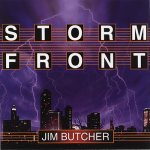
Science Fiction Audiobook - Storm Front by Jim ButcherStorm Front: Book 1 of the Dresden Files
By Jim Butcher; Read by James Marsters
1 MP3 Disc or 8 CDs – Approx. 10.5 hrs [UNABRIDGED]
Publisher: Buzzy Multimedia
Published: 2004
ISBN: 0965725561(MP3 disc); 0965725502(CDs)
Themes: / Fantasy / Mystery / Magic / Private Detective / Wizard / Noir /

Fans of the Dresden series of books will probably recognize this title as the first in the widely successful series authored by Jim Butcher. Those of you who have been living under a rock somewhere, like I have, might only have known this as a TV series on the Sci-Fi Channel. Either way, once introduced to the world of Harry Blackstone Copperfield Dresden, you are most likely to find yourself under his spell and wanting more.

If first impressions count the most, you might not think much of Harry Dresden. He is the classic underdog; a private investigator complete with a sagaciously dry sense of humor, a cat called Mr., a car that breaks down more than it runs and oh, yes, magical powers. That’s right, he’s a wizard and a P.I. and therein lies the charm of this series.

The story starts like a lot of detective stories. The unlikely hero is hired by a seemingly normal client, who is trying to find her missing husband and the mystery that is woven is tight and spellbinding, as well as thoughtful and told in first person. So we, the reader (or listener) find things out as Dresden does and are never allowed the luxury of knowing what’s going on before he does.

Sounds pretty cut and dry, I know, but as the mystery unfolds we are introduced to a holistically inventive cast of characters that includes vampires, demons, giant scorpions, a dark wizard, prostitutes, fairies, drug dealers, gangsters, a nymphomaniac and even a peeping-pizza-delivery-guy-Tom. Each of these characters adds to the story and texture of the Dresden universe with richly orchestrated layers of darkness, humor and a never-ending sense of impending doom. And, since being underestimated is part of Dresden’s charm, we find that he has more than just a few card tricks up his sleeve.

The story is narrated by James Marsters, who you will most certainly know as Spike from Buffy the Vampire Slayer television series. His dry reading of the text does an excellent job of expressing the internal monologue of Harry Dresden. Since the story in first person, from the perspective of the main character, Marsters does not do a lot of voices, or interpretation of the characters. I think, as an actor, he may have been more inclined to capture the dramatic truth of the moment as opposed to using animated voices to tell the tale. So, it feels like we are gathered around a campfire while Dresden is personally recounting the details of the story for us.

The production value of this audio book is high, with rich sound that is full and easy to listen to. However, there were a few minor things that stood out to me. At times the reading sounded rushed. For instance, there are several times when the narrator almost flubs a line and doesn’t stop to correct himself. Also, there were several times when the background noise and page turns really jumped out at me. I know it may sound a bit picky to mention such things, but the beauty of listening to a story in audio form, is that the listener can enter the audible world of the story. Even the slightest glitch can instantly kill the mood.

All in all, I highly recommend this audiobook. I am happy to say that the hiccups in the production do not deteriorate the stellar performance and storytelling that you will find in Storm Front, Dresden Book 1. So, if you haven’t already found yourself under Dresden’s spell, this audio presentation by Buzzy Multimedia is a fine place to start.

Review of Rings, Swords, And Monsters: Exploring Fantasy Literature by Michael D.C. Drout

SFFaudio Review

Modern Scholar - Rings, Sword, Monsters Rings, Swords, And Monsters: Exploring Fantasy Literature
Lectures by Professor Michael D.C. Drout
7 CDs & Book – 7 Hours 51 Minutes [LECTURES]
Publisher: Recorded Books LLC / The Modern Scholar
Published: 2006
ISBN: 1419386956
Themes: / Non-Fiction / Lectures / Fantasy / J.R.R. Tolkien / Middle Earth / Beowulf / Children’s Fantasy / Arthurian Legend / Magic Realism / World Building /

“It used to be that fantasy was a boy’s genre and that was clear even back through the 80s and 90s, that 90% of your audience for fantasy literature, 90% of your audience for Tolkien was male. That is no longer the case. When I give lecturings [sic] at gatherings of Tolkien enthusiasts the crowd is easily 50-50 male female and often times more female than male – though I will have to say that many of the women in the crowd are wearing elf-princess costumes – I’m not really sure what that means.”
-Lecture 13: Arthurian Fantasy (on the ‘Marion Zimmer Bradley effect’)

Most of this lecture series is concerned with Tolkien. Drout explains what influenced Tolkien’s fiction, how his work impacted Fantasy and how later writers reacted to and imitated him. A full five of the 14 lectures are on Tolkien’s books proper, with another four on what influenced him, and who he influenced. The scholarship here is absolutely engrossing, hearing Drout tease out details from names, the structure and the philosophy of Tolkien’s The Lord Of The Rings, The Hobbit and The Silmarillion will delight any Tolkien fan. At one point in Lecture 4 Drout explains the sources for the names of both the 13 dwarves of The Hobbit and Gandalf too. According to Drout, Gandalf was originally named “Bladderthin.” But this isn’t just scholarship here, Drout is very much a critic, a fan of the works he studies. He gives a critical examination of plots, themes and the worlds of each of the Fantasy novels he talks about. Drout dissects Ursula K. Le Guin’s Earthsea books, calling them possibly the best Fantasy since Tolkien, on the one hand and also shows what doesn’t quite work in them. Drout, like Tolkien is an scholar of Anglo-Saxon so there is also plenty of talk about Beowulf and the impact it had on Tolkien. In fact, central to many of his arguments is the linguistic background each work of Fantasy makes use of. Tolkien works so well, argues Drout, in part, because it all hangs linguistically together. Stephen R. Donaldson’s The Chronicles Of Thomas Covenant, which Drout thinks immensely prominent in post-Tolkien Fantasy, doesn’t have a cohesive linguistic bedrock, and that hurts the series – which he thinks is otherwise one of the best realized “secondary worlds” created. Whatever it is Drout talks about, he backs up his critical opinion. Terry Brooks’ Shannara series, he’s read them, and has dissected the plots to show how as time has gone by and Brooks has written more, he’s come to have something of his own voice, and not just stayed the pale Tolkien imitator he started as.

The lectures on Tolkien inevitably lead to the Narnia books by C.S. Lewis. Drout gives them their due, and shows why some of it works and some of it doesn’t. Arthurian Fantasy, which predates Tolkien, seems to have run a parallel course to “secondary world” fantasy literature. After hearing Lecture 13 you’ll come away with a desire to find a copy of T.H. White’s The Once and Future King and Mary Stewart’s Merlin series. My own opinion is that Drout gives too much credit to J.K. Rowling and her Harry Potter novels, he talks about her writing for about 8 minutes. In fairness it would probably not be possible to talk about Children’s Fantasy literature without mentioning her popular series. But on the other hand there are many different kinds of Fantasy that Drout doesn’t talk about at all. I wonder why Neil Gaiman isn’t mentioned. What of Robert E. Howard? And why almost no talk about short stories? James Powell’s A Dirge For Clowntown needs some attention! The only solution is for Recorded Books to go back and ask for more from this professor. Call it Gods, Barbarians, and Clowns: Further Explorations Of Fantasy Literature or something. Until then I’ll be working on my Cimmerian-clown costume.

Posted by Jesse Willis

Review of Guardians Of The West by David Eddings

SFFaudio Audiobook Review

Science Fiction Audiobook - Guardians of the West by David EddingsGuardians Of The West (Book #1 of the Malloreon)
By David Eddings; Read by Cameron Beierle
14 CDs , 1 MP3 CD or Cassettes- Aprox. 15 hours [UNABRIDGED]
Publisher: Books in Motion
Published: 2006
ISBN: 1596072377 (MP3-CD), 1596072369 (CDs), 1596072350 (Cassettes)
Themes: / Fantasy / Magic / War / Magical Creatures / Wizards / Gods /

Guardians Of The West is the first book in a five book series called the The Malloreon. There’s a previous five volume series, The Belgariad, that takes place in this same fantasy setting. In fact, Guardians Of The West picks up shortly after The Belgariad’s ending. I had never read The Belgariad series, so I had to play catch-up listening to this title.

After a prologue that was obviously written as a refresher to those who had read the previous series, the story gets underway. The tale unfolds slowly enough. The large cast of characters are easy to get to know and are varied and interesting in themselves. There is Errand, a naive child with special gifts. Polgara, who is a motherly near-immortal. And her father, Belgrath, a boozing, womanizer, a real Falstaffian character until things get serious.

The novel’s central characters switches to the young king, Garion, who we find to be having trouble with his new spirited queen, Ce’Nedra. The plot really begins to move when there are hints of a new dark power known only as Zandramas. The pacing remains leisure through the first half of the novel. After the climatic ending to the first series, I suppose Eddings needed to maneuver and reintroduce the cast to his readers and create a new major conflict. This could have been frustrating if wasn’t for Eddings’ gift for dialog and characterization.

This book needed a talented voice actor to carry off the large and varied cast. Sprawling fantasy novels may be the most challenging genre for an actor to convey. Cameron Beierle does it all with unequivocal panache. His very intonations carry enough characterization that Eddings’ descriptions of characters become redundant. He uses many accents that seem entirely appropriate to the characters. Like Harry Potter’s narrator, Jim Dale, he has a seemingly endless repertoire of voices. I’d go so far as to call Cameron Beierle the American Jim Dale.

If you haven’t read or listened to Eddings’ Belgariad series, I’m sure that’s the place to start. The first book in the series is called Pawn of Prophecy and it along with all the books in the two series are available from Books In Motion. And all narrated by Cameron Beierle!