News, Reviews, and Commentary on all forms of science fiction, fantasy, and horror audio. Audiobooks, audio drama, podcasts; we discuss all of it here. Mystery, crime, and noir audio are also fair game.
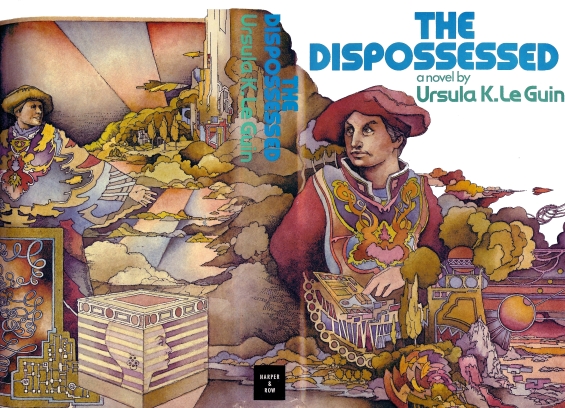
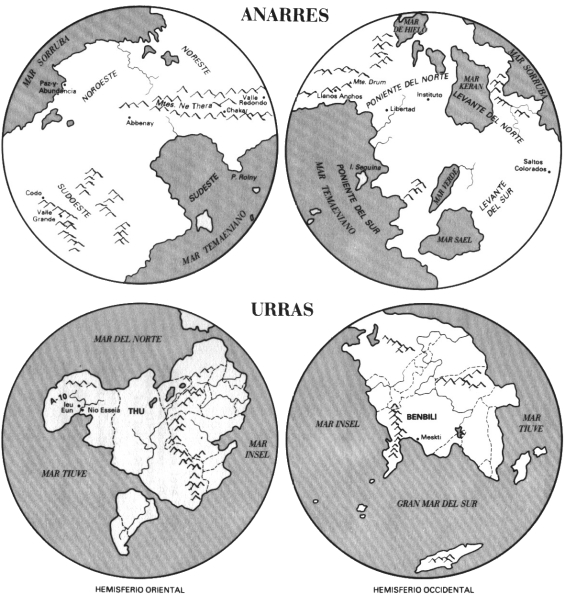
A six part radio dramatization of The Dispossessed was broadcast on CBC Radio in weekly 1/2 hour installments from June 12 to July 17, 1987 for The Vanishing Point (a long running SF radio drama series). Airing at 7:30pm on Friday nights this serial was based on the 1974 novel of the same name, by Ursula K. Le Guin. Subtitled “An Ambiguous Utopia” it tells the story of the occupants of twin planets, Urras and Annares. A sprawling epic of its era it features tree-planting, dinner parties, copulation, physics, homosexuality, anarchism, social justice, copulation, spankings, propaganda, culture, copulation, pregnancy, babies, famine, revolution, class consciousnesses, politics, and copulation.
Here’s the official plot:
“Shevek, a brilliant physicist, decides to take action. He will seek answers, question the unquestionable, and attempt to tear down the walls of hatred that have isolated his planet of anarchists from the rest of the civilized universe. To do this dangerous task will mean giving up his family and possibly his life. Shevek must make the unprecedented journey to the utopian mother planet, Urras, to challenge the complex structures of life and living, and ignite the fires of change.”
The Vanishing Point – The Dispossessed
Adapted from the novel by Ursula K. Le Guin; Dramatized by David Lewis Stein; Performed by a full cast
6 Episodes – Approx. 3 Hours [RADIO DRAMA]
Broadcaster: CBC Radio
Broadcast: 1987
Cast:
Gary Reineke as Shevek
Barbara Gordon
Gaysa Kovacs
John Swindells
Gillie Fenick
Greg Elwand
Hrant Alianak
Terry Waterhouse
Francine Volkhurt
Mary Durkin
Marsha Moreau
Michael Hogan
Phil Aiken
Beth Robinson
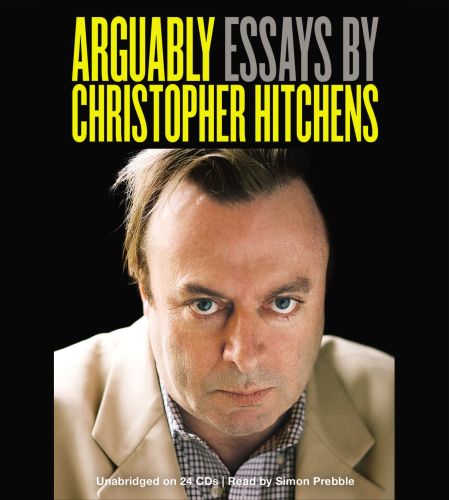
Arguably: Essays
By Christopher Hitchens; Read by Simon Prebble
24 CDs – Approx. 28.5 Hours [UNABRIDGED]
Publisher: Hachette Audio
Published: September 1, 2011
ISBN: 9781611139068
Themes: / Non-fiction / History / War / Biography / Science Fiction / Fantasy / Iran / Afghanistan / Germany / North Korea / France / Dystopia / Utopia / Religion / Tunisia / Piracy / Terrorism / Feminism / Pakistan /
The first new collection of essays by Christopher Hitchens since 2004, Arguably offers an indispensable key to understanding the passionate and skeptical spirit of one of our most dazzling writers, widely admired for the clarity of his style, a result of his disciplined and candid thinking. Topics range from ruminations on why Charles Dickens was among the best of writers and the worst of men to the haunting science fiction of J.G. Ballard; from the enduring legacies of Thomas Jefferson and George Orwell to the persistent agonies of anti-Semitism and jihad. Hitchens even looks at the recent financial crisis and argues for arthe enduring relevance of Karl Marx. The audio book forms a bridge between the two parallel enterprises of culture and politics. It reveals how politics justifies itself by culture, and how the latter prompts the former. In this fashion, Arguably burnishes Christopher Hitchens’ credentials as-to quote Christopher Buckley-our “greatest living essayist in the English language.”
Here’s a question I was thinking about while listening to Arguably.
What is fiction for?
One answer, the bad one, is that it’s for entertainment. That’s certainly where many readers are willing go, and the fiction writers who write it too. Maybe that’s precisely why so much fiction is just so very shitty.
To me, if you aren’t exploring ideas in your fiction, then you really aren’t serving a greater purpose. Idea fiction, fiction with ideas rather than just action and plot, is to my mind a kind of supplement to the wisdom found in writings on history, biography and science.
Of the many lessons learned I in listening to the 107 essays in Arguably I was particularly struck by the wisdom Christopher Hitchens gleaned from his reading of fiction. Hitchens reviews many books in this collection, nearly half of the essays are book reviews. Books like 1984, Animal Farm, Flashman, The Complete Stories Of J.G. Ballard, Our Man In Havana, and even, surprisingly, Harry Potter And The Deathly Hallows all get fascinating, critical, and reverent reviews.
Yet Hitchens also takes the lessons with him into his writing about his travels. Hitchens writes about visits to such places as North Korea, Cyprus, Afghanistan, and Kurdish Iraq. When talking about his visit to Beirut we see what comes when Hitchens, a man of ideas, acts upon them. The essay, The Swastika and the Cedar sees the convictions of the commited anti-fascist Hitchens beaten and nearly kidnapped for an act of vandalism on a prominently displayed swastika. Writes Hitchens:
“Well, call me old-fashioned if you will, but I have always taken the view that swastika symbols exist for one purpose only—to be defaced.”
In a review of two books, Lolita and The Annotated Lolita, Hitchens applies the controversial subject in a real life look at the modern, and very non-fictional oppression and objectification of women. Indeed, the ideas he appreciated in fiction helped Hitchens to come to grips with the real world.
I think the worst essay in this collection is the one on the serving of wine and restaurants, Wine Drinkers Of The World, Unite. It was simply a waste of the talent, too light, too easy a target. And yet, even that essay, the worst essay in all 107 has a memorable anecdote: “Why,” asks Hitchens’ five year old son, “are they called waiters? It’s we who are doing all the waiting.”
As to the narration of the audiobook. I’m ashamed to admit that I was initially dismayed when I saw that Christopher Hitchens had not narrated this audiobook himself. I was wrong to worry. Incredibly, Simon Prebble seems to have have become Hitchens for this narration. Prebble perfectly captures the erudite words, so eloquently performs them, and with an accent so like that of Hitchens’ own so as to make me think that it was Hitchens who had actually read it.
I think the worst essay in this collection is the one on the serving of wine and restaurants, Wine Drinkers Of The World, Unite. It was simply a waste of the talent, too light, too easy a target. And yet, even that essay, the worst essay in all 107 has a memorable anecdote: “Why,” asks Hitchens’ five year old son, “are they called waiters? It’s we who are doing all the waiting.”
Here’s a list of the book’s contents, with links to the original etexts when available, along with my own notes on each:
The Private Jefferson – a review of Jefferson’s Secrets: Death And Desire At Monticello by Andrew Burstein
Jefferson Vs. The Muslim Pirates – a review of Power, Faith, And Fantasy: America In The Middle East: 1776 To The Present by Michael B. Oren
Benjamin Franklin: Free And Easy – a review of Benjamin Franklin Unmasked: On the Unity of His Moral, Religious, And Political Thought by Jerry Weinberger
John Brown: The Man Who Ended Slavery – a review of John Brown, Abolitionist: The Man Who Killed Slavery, Sparked The Civil War, And Seeded Civil Rights by David S. Reynolds
Abraham Lincoln: Misery’s Child (aka Lincoln’s Emancipation) – a review of Abraham Lincoln: A Life by Michael Burlingame
JFK: In Sickness And By Stealth – a review of An Unfinished Life: John F. Kennedy, 1917–1963 by Robert Dallek
Saul Bellow: The Great Assimilator – review of six novels by Saul Bellow (The Dangling Man, The Victim, The Adventures Of Augie March, Seize The Day, Henderson The Rain King, and Herzog)
Vladimir Nabokov: Hurricane Lolita – reviews of Lolita by Vladimir Nabokov and The Annotated Lolita edited and annotated by Alfred Appel, Jr.
John Updike: No Way – a review of The Terrorist by John Updike (with reference to The Coup too) John Updike: Mr. Geniality – a critical review of the affable Due Considerations: Essays And Considerations by John Updike
Vidal Loco – Gore Vidal went crazier, more elitist and perhaps more racist as he got older (with attention and quips for Quentin Crisp and Oscar Wilde and Joyce Carol Oates)
America The Banana Republic – Hitchens on the “socialistic” bank bailout of 2008 (“socialism for the rich and free enterprise for the rest”)
An Anglosphere Future – a review of The History Of The English Speaking Peoples by Andrew Roberts (with reference to both Sherlock Holmes and The White Company by Sir Arthur Conan Doyle as well as to Cecil Rhodes and Rudyard Kipling)
Political Animals – a review of Dominion: The Power Of Man, The Suffering Of Animals, And The Call To Mercy by Matthew Scully
Old Enough To Die – on capital punishment as applied to children In Defense Of Foxhole Atheists – a visit to the United States Air Force Academy and the tax funded proselytizing
ECLECTIC AFFINITIES Isaac Newton: Flaws Of Gravity – a stroll through the medieval streets of Cambridge with the scientists, mathematicians, and philosophers who worked there
Gustave Flaubert: I’m With Stupide – a review of Bouvard et Pécuchet by Gustave Flaubert translated by Mark Polizzotti The Dark Side Of Dickens – a review of Charles Dickens by Michael Slater a biography (Hitchens was a not uncritical admirer of the subject)
Marx’s Journalism: The Grub Street Years – a glowing review of Dispatches for the New York Tribune: Selected Journalism Of Karl Marx edited by James Ledbetter, foreword by Francis Wheen (Marx admired the United States, and other fascinating facts about the father of communism)
Rebecca West: Things Worth Fighting For – an introduction to Black Lamb and Grey Falcon: A Journey Through Yugoslavia by Rebecca West
Ezra Pound: A Revolutionary Simpleton – a review of Ezra Pound, Poet: A Portrait Of The Man And His Work: Volume I: The Young Genius, 1885-1920 by A. David Moody (a biography of the fascist poet)
John Buchan: Spy Thriller’s Father – a review of John Buchan The Presbyterian Cavalier by David R. Godine (with discussion of The 39 Steps and a fantasy novelette The Grove Of Ashtaroth)
Fraser’s Flashman: Scoundrel Time – a look at the George MacDonald Fraser series of Flashman books and the connection with The Adventure Of The Empty House
AMUSEMENTS, ANNOYANCES, AND DISAPPOINTMENTS Why Women Aren’t Funny – a controversial essay on why more comedians are male and why women laugh at them the way they do
As American As Apple Pie – a literary and chronological history of the blowjob, with reference to Valdamir Nobokov’s Lolita
So Many Men’s Rooms, So Little Time – a fascinatingly insightful argument on what’s was going on with the Larry Craig bathroom airport scandal and related phenomena
A War Worth Fighting – a persuasively systematic review of Churchill, Hitler And The Unnecessary War: How Britain Lost Its Empire And The West Lost The World by Pat Buchanan
Just Give Peace A Chance? – a critical review of Human Smoke by Nicholson Baker
Don’t Mince Words – the disenfranchisement of south Asians in Britain isn’t the cause of bombings, hatred of women is.
History And Mystery – al-Qaeda in Iraq, jihadists, or “insurgents”? Do words matter? Of course they bloody well do.
Words Matter – political slogans make of “every adult in the country” an “illiterate jerk who would rather feel than think”
This Was Not Looting – how can a government “loot” it’s own weapons manufacturing facility? The government of Iraq managed it according to The New York Times.
The “Other” L-Word – a lighthearted piece on the prominence of the word “like” and it’s use
The You Decade – what’s wrong with you (marketing to the selfish)
Suck It Up – the Virginia Tech shootings prompted the wrong response from the world (namely that it prompted one)
A Very, Very Dirty Word – the English empire, in centuries to come, may only be remembered for soccer and the phrase “fuck off”
The Summer Isles
By Ian R. MacLeod; Read by Steve Hodson Audible Download – Approx. 13 Hours [UNABRIDGED]
Publisher: Audible Frontiers
Published: 2012
Themes: / Alternative History / Dystopia / History / Fascism / Homosexuality /
I have always been intrigued by alternative histories. Unfortunately my knowledge of history sometimes limits my enjoyment, being more of an overview of the subject. I often can’t tell if an event has been changed, and if so, whether it is significant or not. In some of the better alternate histories you can get away with not knowing too much about the period and still enjoy the story. Thankfully, in this case, I had recently been reading a history of Europe covering the same period from the early 1910’s to 1940.
MacLeod’s The Summer Isles is set primarily in a 1940 where Great Britain lost The Great War in 1918. America doesn’t enter the war and France makes an appeasement with Kaiser Wilhelm II’s Germany. The result is that Britain, not Germany, is left in a state of shock, feeling betrayed by their supposed allies. A young soldier, John Arthur, rises to power in the bleak years that follow, suggesting a parallel to Hitler, who gets only a single reference, never having the opportunities to gain power that losing the war afforded. The great Empire that was Britain is stripped away in the reparations following the war. That sense of betrayal is used to fuel Arthur’s rise to power as he brings in his political movement “Modernism”. John Arthur’s portrait hangs everywhere, even in the men’s public toilets.
Modernism is a very British take on fascism and drove several of the same horrors that Naziism did in our own history. Jews, homosexuals, intellectuals, the Irish and any and all other ‘deviants’ are persecuted and ultimately removed from the new Modernist society. The Jews in particular are sent to be “resettled” on the eponymous Summer Isles.
The story is told by Geoffrey Brook, a secretly homosexual Oxford history Don, who had some prestige for having been a favourite teacher of John Arthur as a child. Brook is in his 60’s in 1940 when he receives the news that he has at terminal lung cancer.
Brook, in trying to reconcile himself with his past, recounts in flashbacks the one true love of his life that he lost in the Great War. More flashbacks fill in the years before and after that war; several of the scenes flowing together with the present day as Brook’s mind drifts in and out of his reminiscences. Particularly when he visits some of the same locations.
MacLeod’s writing is excellent, at times didactic, as the historian narrator recounts past political and social events, yet by turns touching, confused, detailed and frightened as more personal or recent events are recounted. Slow at times, this fits will with the drifting recollections of the narrator as the hidden story is gradually revealed. The final act of the novel moves at a much faster pace, while still holding convincingly onto the character of the narrator. The Summer Isles was nominated for the John C Campbell Memorial Award, the Sidewise Award for Alternate History and the World Fantasy Award.
The audio narration by Steve Hodson fits the character perfectly. The weariness with life, the broken rapture at prized but lost moments of love and of lust are all perfectly portrayed. He even nails virtually all of the Scottish pronunciations; a pet peeve sf mind, being Scottish myself, with several other narrators.
The SFFaudio Podcast #045 – Jesse and Scott are joined by the ghost of Xmas future as they talk about audiobooks, video games, audio drama and lots more. Jesse even reveals an earth shattering bit of trivia about Vincent Price (you’ll never guess it) and what he thinks is clearly “the greatest joke ever.”
Jess Nevins, librarian and author of the forthcoming The Encyclopedia of Pulp Heroes (2010), gave a scholarly lecture on the earliest origins and strange evolution of the superhuman/superhero meme. Starting in the the early 19th century with a perceived need for better military training, and progressing into the middle of the 20th century, Nevins explains, among other things: Why Doc Savage lost his superpowers (but kept his physique), why The Shadow needed the ability to “cloud men’s minds”, the development of Muscular Christianity and the Physical Culture movements, and even the minor role Sir Arthur Conan Doyle played in all this! There’s lots more in the there too – it’s fascinating!
Those Who Cannot Remember Doc Savage Are Condemned To Repeat Him: The 20th Century Backlash Against Posthuman Bodybuilders
By Jess Nevins
1 |MP3| – Approx. 30 Minutes [LECTURE]
Podcaster: Changesurfer Radio / Institute For Ethics & Emerging Technologies
Podcast: Dec 13, 2009
Recorded: December 4, 2009
Provider: Archive.orgOne bit of local colour that I can add to this fun lecture is a kind of a capper to the story of the Physical Culture and Muscular Christianity movements. Their was a curious practice at the Vancouver YMCA, patrons were encouraged to exercise in the nude. This eventually led a young man named Victor Willis (no relation) to immortalize the results in this song:
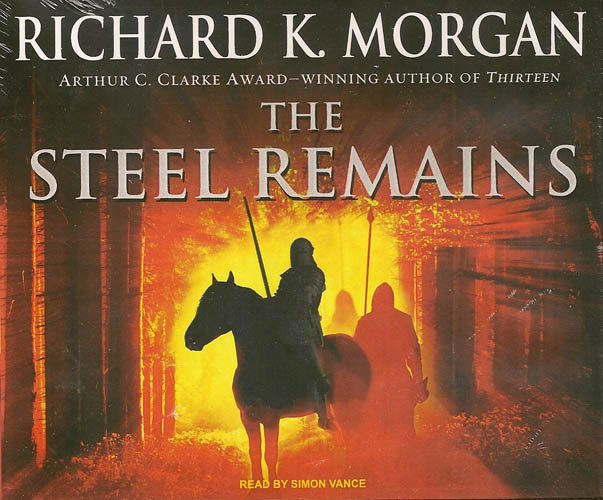
The Steel Remains
By Richard K. Morgan; Read by Simon Vance
[UNABRIDGED]
Publisher: Tantor Media
Published: 2009
ISBN: 9781400139637
Themes: / Fantasy / Noir / Hard Boiled / Magic / War / Homosexuality /
“Men were like blades, they would all break sooner or later, you included. But you looked around at the men you led, and in their eyes you saw what kind of steel you had to hand, how it had been forged and tempered, what blows, if any, it would take.”
—Richard Morgan, The Steel Remains
With his new book The Steel Remains, Richard Morgan sets out to (as main character Ringil Eskiath might say) “prick the bloated arse” of J.R.R. Tolkien and post-Tolkien fantasy. Elsewhere on the web Morgan has expressed his deep dissatisfaction with traditional high fantasy, which often pits stainless forces of good against hordes of irredeemable evil in bloodless, antiseptic sword play. He’s accused Tolkien of the same shortcomings (a flawed analysis with which I vehemently disagree). Against this backdrop, Morgan set out to write The Steel Remains as a deliberately gray, grimy, alternative viewpoint. His book succeeds in sliding cold steel into the lie of childlike fantasy, with which my favorite genre of fiction is admittedly littered.
But when the screaming of gutted men and the skirling of steel dies down, and the full extent of the destruction is laid bare for us to see, The Steel Remains does not have much to offer. The old cliché that it’s easier to tear down and destroy than to build anew applies here. In its falling over itself desire to slice and dice fantasy’s traditional conservatism, The Steel Remains indulges in plenty of its own predictable clichés: Every priest is a religious fanatic and a sex fiend, every leader a morally and ethically corrupt, egotistic blowhard, for example. The book lacks a moral compass; Morgan the author’s world view must be a bleak one, indeed.
The action of The Steel Remains focuses on the converging storylines of three uneven characters—one very well done (Ringil, a sarcastic, war-weary, homosexual master swordsman), one middling (Egar, a brawling, boisterous, randy barbarian from the steppes), and one rather forgettable (Archeth, a black, female half-breed of human and Kiriath, deadly with throwing knives and hooked on drugs). All three are veterans of a recent war against an invading race of “scaly folk,” in which humanity staved off utter destruction at a very high price. Ringil, a war hero but now combat- and world-weary, has retreated from his mercenary lifestyle and is living a slothful, under-the-radar existence, until he’s summoned by an urgent message from his mother: Ringil’s cousin, Sherin, has been sold into slavery to repay a debt, and Ringil’s mother wants her back. Ringil reluctantly agrees.
Soon Ringil finds out that the slavery web in which Sherin has been caught is very dark, wide, and sinister. At its centre are a race of alien beings called the dwenda—tall, attractive, human-like, magic-using creatures that are a combination of Michael Moorcock’s Melniboneans with their cruel and alien immorality, and Poul Anderson’s Nordic-inspired, haughty, and warlike elves (Morgan lists Anderson and Moorcock as two of his sources of inspiration; the third is, unsurprisingly, Karl Edward Wagner). The dwenda are planning to incite a second war on earth and then destroy the victor, taking back their ancestral lands (the dwenda dwelled on earth many years ago). The dwenda require the sacrifice of barren human females to fuel the dark powers that are the source of their sorcery.
There’s much to like in The Steel Remains. Morgan’s prose is sharp and highly readable, and he shows a fine eye for detail and realism in his culture and city-building. Trelayne—a nasty, sprawling, brawling city in which whoring, slavery, and public executions are practiced openly—feels real. Egar’s Majak culture is based on pre-colonized North American Indians, and is well-done with its shamans and superstitions, trade in vast herds of buffalo, and armor and weapons suited to a nomadic lifestyle on the plains.
In addition, if you like your battles bloody and realistic, Morgan is your man. His fight scenes are well-done and you get a great sense of Ringil’s skill with his deadly broadsword of Kiriath steel, and Egar’s brutal butcher’s work with his two-bladed Majak lance. Disembowelings, beheadings, and other ghastly wounds are rife.
Much of the book passed under my eyes as well-oiled but heartless machinery producing graphic combat carnage and highly explicit sex (I’ll pause here to state that the blood and semen-soaked pages of The Steel Remains would make George R.R. Martin blanch, and Eric Van Lustbader—author of The Ninja—green with envy). I found the characters rather unlikeable and unengaging, and the plot fair at best. Very little actually clicked with me until the concluding act, in which Ringil, Egar, and Archeth reunite to fight a desperate last stand against the duenda. This was one of the few moving scenes in the book in which I actually felt some measure of concern and identification with our heroes. Ringil’s rousing speech is of the stuff with which great heroic fantasy is made. I wish there was more like this.
In summary, we know that life is can be dirty and horrible. War is hell, yes, and men are weak and piggish. But Morgan drives the same points home, again and again, over 400 dark, cynical, iconoclastic pages of The Steel Remains, which by the end is too one-note and sacrifices story at the expense of the author’s agenda.
Narrator Simon Vance does a terrific job as narrator, changing his voice to suit the temperaments and personalities of the various characters in Morgan’s novel. Clarity and precision are among Vance’s strengths as a reader and he does not disappoint here. When I began listening to The Steel Remains, and before I had seen the narration credits, I recognized Vance’s distinctive voice from his wonderful depiction of Count Dracula and the rest of the characters from Bram Stoker’s Dracula (Blackstone Audiobooks). For unknown reasons Vance performed Dracula under the pseudonym, Robert Whitfield.


 The Vanishing Point – The Dispossessed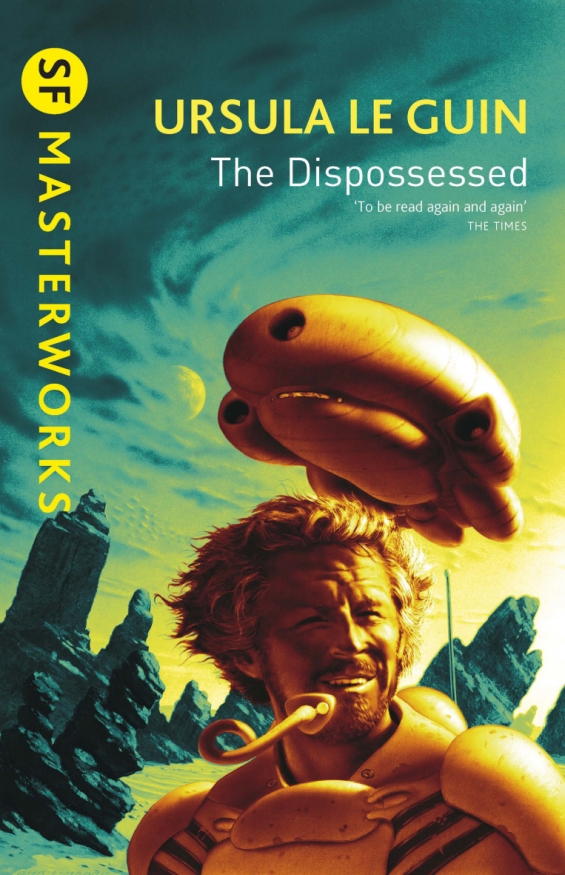

 Arguably: Essays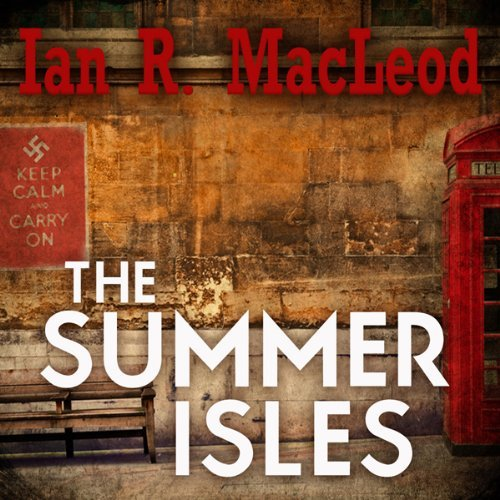



 Those Who Cannot Remember Doc Savage Are Condemned To Repeat Him: The 20th Century Backlash Against Posthuman Bodybuilders