Aural Noir review of Downtown by Ed McBain

Aural Noir: Review

Here’s the first review by a long time internet ally, fellow proponent of all things Donald E. Westlake, and soon a guest on The SFFaudio Podcast.
BOOKS ON TAPE - Downtown by Ed McBainSFFaudio EssentialDowntown
By Ed McBain; Read by Michael Prichard
8 Cassettes – Approx. 8 Hours [UNABRIDGED]
Publisher: Books On Tape
Published: 1992
ISBN: 0736621423
Themes: / Crime / New York / Humor / Murder / Mistaken Identity /

Michael Barnes is in New York on business. He has a couple of hours to kill before his plane leaves. It’s Christmas Eve. When he stops for a drink, he finds a young woman very attracted to him. He swells with masculine pride. But soon Michael’s wallet and then his rented car are stolen – only to resurface on the other side of town in unexpected company – a corpse!

There’s nothing quite like picking up a book (metaphorically) you’ve never heard of and know nothing about and discovering that you’ve stumbled across a classic. This was my experience with Ed McBain’s Downtown.

A classic? Strong words, there, Trent. But I mean it. I just recently read Donald Westlake’s The Hot Rock, which I loved and which is considered the classic comic crime novel. Downtown is nearly if not just as good (although very different).

Our protagonist is Michael Barnes, an orange-grower from Florida who is about to fly out of New York City on Christmas Eve, after a meeting with his advertising agency, when he gets hustled by a gorgeous woman and her fake police detective accomplice in an airport bar. His drivers license, credit cards, and money now gone, he goes downtown to report the crime to the police, getting his rental car stolen along the way. From there, he ends up on the lam accused of murder, running hither and thither meeting all sorts of strange people and ending up in all sorts of strange situations as he tries to figure out just what the hell is going on.

Tempering this craziness is the fact that Michael Barnes has some serious emotional baggage–he’s a cuckold and bitter about it, has issues with his mother, and was scarred by his combat experience in Vietnam (although he’s not an offensive psycho stereotype, thank God). These emotional scars are played upon masterfully by McBain, for dark humor or for grounding moments of pathos as appropriate, and they give Downtown a humanity that makes the whole farce unexpectedly powerful.

I don’t know why Downtown isn’t better known. Maybe Ed McBain just pumped out so many books that lots of his stuff falls through the cracks while readers get stuck trying to read the 87th Precinct and Matthew Hope novels in order. Maybe it’s because nobody made a movie out of it (although see below). Maybe, and this is a strong possibility, the style of humor doesn’t appeal to a broad enough audience.

Whatever the reason, Downtown deserves much better than obscurity. It’s clever, witty, touching, and terrific.

That’s the book review portion of this write-up, but I don’t want to end without bringing up something that struck me while listening to Downtown.

With a movie director figuring prominently in the plot, Downtown is loaded with film references (including to Evan Hunter/Ed McBain films The Birds and Fuzz). A movie not mentioned is one that Downtown bears a great resemblance to–Martin Scorsese’s After Hours.

If you’re not familiar with this film (too few people are), After Hours is a comedy about a fairly-average Joe who meets all sorts of strange people and ends up in all sorts of strange situations in late-night Manhattan. Oh, and he also gets accused of a crime he didn’t commit.

The setting and several story elements in After Hours are very similar to Downtown. The style of humor (dry with repetitive absurdity) also bears a marked resemblance. Both even feature prominent references to The Wizard Of Oz.

Coincidence? Homage? Rip-off (I doubt that)? Subconscious borrowing? We’ll likely never know. But if you liked After Hours, you’ll probably like Downtown, and vice versa. And if you’re not familiar with either, do yourself a favor and check them both out.

I listened to the 1992 edition of Downtown from Books on Tape, read by Michael Prichard. When I started the book, I thought his reading was stiff, but I quickly recognized that he had done a great job capturing the somewhat-uptight, neurotic lead character. Mr. Prichard is also quite skilled in creating voices to distinguish the many other characters without resorting to ridiculous exaggerations or outrageous accents (in a book with a lot of ethnic characters, no less). Downtown is written in a highly rhythmic style, with lots of short sentences and lots of repetition. Prichard grasps this and captures the novel’s rhythms superbly. It’s a really good reading.

There are two other editions of Downtown (both available at Audible.com), an abridged version from Phoenix Books read by Stephen Macht and an unabridged version from Brilliance Audio read by David Regal. For the sake of comparison, I listened to the available samples of both.

Downtown is a lousy candidate for abridgment, but even if it wasn’t I wouldn’t care for Stephen Macht’s reading, which is overdramatic.

David Regal’s reading is considerably better. His interpretation is quite different from Michael Prichard’s, making Michael Barnes sound like a traveling salesman. I would have to hear more to have a real sense of how well this works but I heard enough that I think I can judge it a solid effort. Go with the Books on Tape edition if you can find it, but if you can’t, Regal’s version will likely do as a substitute.

Posted by Trent Reynolds

Review of The Loving Dead by Amelia Beamer

SFFaudio Review

BRILLIANCE AUDIO - The Loving Dead by Amelia BeamerThe Loving Dead
By Amelia Beamer; Read by Emily Durante
7 CDs or 1 MP3-CD – Approx. 8 Hours [UNABRIDGED]
Publisher: Brilliance Audio
Published: July 2010
ISBN: 9781441868343 (cd), 9781441868367 (mp3-cd)
Themes: / Horror / Zombies / Sex / Airships / Humor / San Fransisco / California /

Kate and Michael, twenty-something housemates working at the same Trader Joe’s supermarket, are thoroughly screwed when people start turning into zombies at their house party in the Oakland hills. The zombie plague is a sexually transmitted disease, turning its victims into shambling, horny, voracious killers. Thrust into extremes by the unfolding tragedy, Kate and Michael are forced to confront the decisions they’ve made, and their fears of commitment, while trying to stay alive. Michael convinces Kate to meet him in the one place in the Bay Area that’s likely to be safe and secure from the zombie hordes: Alcatraz. But can they stay human long enough?

Beamer creates scenes, and cuts adequately between them, but when confronted by the surrealistic circumstances she provides (like being trapped in a Zeppelin bathroom with two lesbian zombies) her characters seem more like emotional marionettes, than like real people. It’s almost as if Beamer was actually role-playing a series of improvised scenarios, rather than plotting it out like a novel. When one of the characters discovers that these zombies respond to the crack of a whip, for example, Kate downloads an “Indiana Jones App” to her iPhone and subdues them with it. Clever? Sure. Novelistic? Notsomuch. Thus the tension of a zombie confrontation – will she or won’t she be able to get 3G service high above Oakland – isn’t very satisfying.

Shortly after this audiobook arrived I listened to it’s author, Amelia Beamer, being interviewed on the SFSignal Podcast #006. She talked about how she found the relentlessness of zombies almost endearing. It was a neat idea. And then she said she intended it to be a romantic comedy with zombies. And that was enough to put it in my bathroom audiobook stack. So, for the last week or so I’ve been brushing and flossing my teeth to this novel. I didn’t go in expecting much other than zombies and loving and a few laughs. It has the first two. The loving is actually sex and the zombies are less dead and rotting than they are contagious and sex crazed. If you did a count you’d probably find as many individuated zombies as there are sex scenes. Come to think of it there were probably about just as many tattoos as there were sex scenes and zombies. Where this novel really doesn’t fulfill it’s promise is in the humor department. I didn’t laugh, or smile, or even smirk. Thinking about it, it wasn’t that there were jokes and they weren’t funny, but rather I that the humor was supposed to come from the absurd situational specifics and the slacker/poser cast’s bumbling their way through it all. It has relationships, and people thinking about their relationships, and it has some zombies but I didn’t find it funny.

Getting into specifics now – there’s something odd going on with the meta-Americanness, or rather some subset of it, within the novel’s characters and setting. Even though both Kate and Michael both pretty quickly recognize the infected as zombies, Beamer’s characters seem highly reticent to kill them. Instead they far prefer restraining their wrists, sitting on them – any form of bondage – as in, tie them up or tie them down. Yeah … well … okay. So, I have to think that, in combination with the whips, and the sex and all the tattoos, that taken as a whole this is not so much a zombie novel as a kind of contemporary fiction novel, set in a slacker BDSM San Fransisco subculture, with some zombie additions. Maybe that’s what I signed up for, but I was wrong to do so.

At first I liked some of the references to local stores and products. This is something that is done far too little in most fiction, as far as I’m concerned. It’s one of the things I like most about William Gibson’s prose, he has a reverence to specifics. But as it all went on in The Loving Dead, and as the characters repeatedly reminded each other that they’d read Max Brooks (World War Z |READ OUR REVIEW|), worked at Trader Joe’s or Whole Foods, it seemed like it wasn’t so much fun – instead it became increasingly clear that it was what was on their minds all the time. It seemed like the real zombies in this audiobook were the characters, living their quiet lives of desperate consumption, performing a narrative for themselves and expressing it in text messages. If I believed in a soul I’d call it a soul-numbing audiobook.

On the final disc we get a flash cut to ten years after the zombie apocalypse first hits. It’s an interesting experiment, to take a doomsday scenario way down the road and see what life is like in the aftermath. One of the redeeming features, of David Moody’s otherwise lackluster Hater |READ OUR REVIEW|, is also in The Loving Dead too. The author takes one significant aspect of a premise to it’s logical and (hopefully inevitable) conclusion. As such, it has some novelty value if only for that. For some true vanilla zombie goodness I’ll get back to reading Robert Kirkman’s The Walking Dead.

Narrator Emily Durante, a new voice to my ears, is a good reader, I can see that, even despite my not loving The Loving Dead, she provided a steady voice to a patchy and punctuated narrative.

Posted by Jesse Willis

The SFFaudio Podcast #072 – READALONG: Assam And Darjeeling by T.M. Camp

Podcast

The SFFaudio PodcastThe SFFaudio Podcast #072 – Jesse and Scott talk with Julie Davis, of the Forgotten Classics podcast about Assam And Darjeeling by T.M. Camp |READ OUR REVIEW|.

Talked about on today’s show:
Assam & Darjeeling by T.M. Camp, Podiobooks.com, iTunes, serialized fiction, entertaining copyright notices, where do you do your podcast listening?, I’ve got my hands full of car, the volume on Assam And Darjeeling is way too low!, remastering Assam And Darjeeling for audiobook, listening to podcasts at double speed (only on iTouch and iPhone), the premise of Assam And Darjeeling, Hades, the underworld, Inferno by Larry Niven and Jerry Pournelle |READ OUR REVIEW|, Escape From Hell by Larry Niven and Jerry Pournelle , The Divine Comedy: The Inferno by Dante Alighieri, Virgil’s The Aeneid, Ovid, the Brothers Grimm, witches, Greek Mythology, Edgar, no one can be as cruel as a kid, Joss Whedon, in the hands of a skillful author, Matters Of Mortology by T.M. Camp, Kij Johnson‘s The Fox Woman, the Black Gate blog, foxes in mythology, Aesop’s Fable The Fox And The Grapes, Cernunnos, Herne the Hunter, making the switch from comedy to horror and horror to comedy, the Shaggy Man (in the Oz series), Tom Bombadil, he has psychic powers too?, page 18, masterly dialogue put into the mouths of young children, the PDF version of Assam And Darjeeling, What Dreams May Come by Richard Matheson, life after death, Inception, Edgar Alan Poe should go into the underworld to get his wife Virginia, The Memory Palace episode about Edgar Allan Poe’s death (Episode 20 strong>This Ungainly Fowl), This American Life is really bleak, WNYC’s Radiolab isn’t, general fiction is generally bleak, A Good Man Is Hard To Find by Flannery O’Connor, Science Fiction vs. general fiction, Social Science Fiction, Science Fiction has a second layer, it’s not all style, The Cold Equations by Tom Godwin, Staggerford by Jon Hassler, there are ways to tell powerful stories, A Man In Full by Tom Wolfe, Bangsian Fantasy, Fantasy, re-reading The Lord Of The Rings, the more I think about it the more I think I don’t like Fantasy, SFSite.com, derivative Fantasy, romance novels, Jane Austen, John Thorne, The Long Walk by Stephen King (Richard Bachman), The Stand, It, Salem’s Lot, The Shining, Under The Dome, Shirley Jackson, Ray Bradbury, long vs. short, The Cell by Stephen King, 28 Days Later, Desperation by Stephen King, The Rapture, if you were a character in this book who would you be?, the rule that makes any book better: talk about food, Lawrence Block, the economy of the afterworld, lampshading, I’m done with sequels, Mike Resnick’s Starship series, Jim Butcher’s Dresden series, The Fall Of Hyperion by Dan Simmons, Make Room, Make Room by Harry Harrison, Soylent Green, Adventures by Mike Resnick, mammoths vs. mastodons, Brave New World by Aldous Huxley, Nineteen Eighty-Four by George Orwell, The Star Beast by Robert A. Heinlein, The Great Gatsby by F. Scott Fitzgerald, The Scarlet Letter by Nathaniel Hawthorne.

Posted by Jesse Willis

LibriVox: The Wrong Box by Robert Louis Stevenson and Lloyd Osbourne

Aural Noir: Online Audio

LibriVoxRobert Louis Stevenson wrote The Wrong Box with his stepson, Lloyd Osbourne. This is the same kid whose drawing had inspired Treasure Island seven years earlier. Interestingly, it was published while Stephenson (age 39), and Osbourne (age 21), were traveling in Polynesia. Here is an 1888 photograph of Lloyd Osbourne and Robert Louis Stevenson in Tahiti (Osbourne is standing, Stevenson is seated):
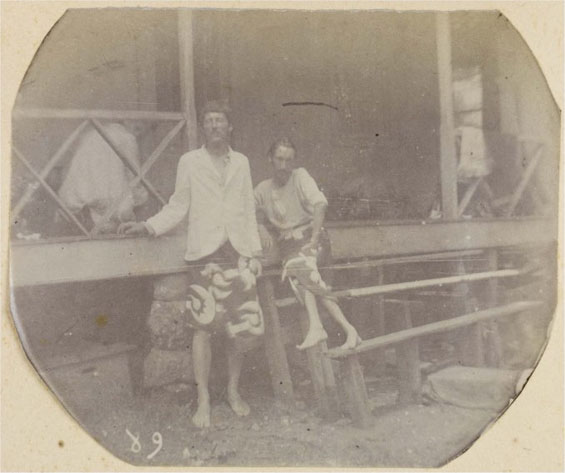
Lloyd Osbourne and Robert Louis Stevenson in Tahiti, 1888

Of The Wrong Box, Rudyard Kipling wrote:

“I have got R.L. Stevenson’s [The Wrong Box] and laughed over it dementedly when I read it. That man has only one lung but he makes you laugh with all your whole inside.”

Indeed, as the RLS website describes The Wrong Box as “a humorous tale of misunderstandings, drunkenness, attempted fraud, false identities and other mishaps.” After having watched a scratchy old VHS copy of the movie I discovered this audiobook on LibriVox! I am enjoying it immensely. This enjoyment is assisted by its wonderful narrator. Andy Minter has a very appropriate accent for both the text and the telling.

LIBRIVOX - The Wrong Box by Robert Louis Stevenson and Lloyd OsbourneThe Wrong Box
By Robert Louis Stevenson and Lloyd Osbourne; Read by Andy Minter
1 |M4B|, 16 Zipped MP3 Files or Podcast – Approx. 6 Hours 20 Minutes [UNABRIDGED]
Publisher: LibriVox.org
Published: September 14, 2008
The Wrong Box is a comedy about the ending of a tontine (a tontine is an arrangement whereby a number of young people subscribe to a fund which is then closed and invested until all but one of the subscribers have died. That last subscriber then receives the whole of the proceeds). The story involves the last two such survivors and their relations, a train crash, missing uncles, surplus dead bodies and innocent bystanders. A farce really.

Podcast feed: http://librivox.org/bookfeeds/the-wrong-box-by-robert-louis-stevenson-and-lloyd-osbourne.xml

iTunes 1-Click |SUBSCRIBE|

There is also a 1966 film adaptation starring Michael Caine, Dudley Moore, Peter Cook and Peter Sellers:

[via Robert-Louis-Stevenson.org and Edinburgh City Libraries and Information Services]

Posted by Jesse Willis

Mister Ron’s Basement: My Financial Career by Stephen Leacock

Aural Noir: Online Audio

This 100 year old story of a very Canadian bank heist, authored by Canada’s greatest literary humorist, could encapsulate a good part of that elusive Canadian culture we say were always looking for.

My Financial Career by Stephen Leacock, Art by GordRaymer (found in SENSE AND FEELING)

Mister Ron's BasementMy Financial Career
By Stephen Leacock; Read by Mister Ron
1 |MP3| – Approx. 7 Minutes [UNABRIDGED]
Podcaster: Mister Ron’s Basement
Podcast: 2005

My Financial Career by Stephen Leacock

When I go into a bank I get rattled. The clerks rattle me; the wickets rattle me; the sight of the money rattles me; everything rattles me.

The moment I cross the threshold of a bank and attempt to transact business there, I become an irresponsible idiot.

I knew this beforehand, but my salary had been raised to fifty dollars a month, and I felt that the bank was the only place for it.

So I shambled in and looked timidly round at the clerks. I had an idea that a person about to open an account must needs consult the manager.

I went up to a wicket marked “Accountant.” The accountant was a tall, cool devil. The very sight of him rattled me. My voice was sepulchral.

“Can I see the manager?” I said, and added solemnly, “alone.” I don’t know why I said “alone.”

“Certainly,” said the accountant, and fetched him.

The manager was a grave, calm man. I held my fifty-six dollars clutched in a crumpled ball in my pocket.

“Are you the manager?” I said. God knows I didn’t doubt it.

“Yes,” he said.

“Can I see you,” I asked, “alone?” I didn’t want to say “alone” again, but without it the thing seemed self-evident.

The manager looked at me in some alarm. He felt that I had an awful secret to reveal.

“Come in here,” he said, and led the way to a private room. He turned the key in the lock.

“We are safe from interruption here,” he said; “sit down.”

We both sat down and looked at each other. I found no voice to speak.

“You are one of Pinkerton’s men, I presume,” he said.

He had gathered from my mysterious manner that I was a detective. I knew what he was thinking, and it made me worse.

“No, not from Pinkerton’s,” I said, seeming to imply that I came from a rival agency.

“To tell the truth,” I went on, as if I had been prompted to lie about it, “I am not a detective at all. I have come to open an account. I intend to keep all my money in this bank.”

The manager looked relieved, but still serious; he concluded now that I was a son of Baron Rothschild or a young Gould.

“A large account, I suppose,” he said.

“Fairly large,” I whispered. “I propose to deposit fifty-six dollars now and fifty dollars a month regularly.”

The manager got up and opened the door. He called to the accountant.

“Mr. Montgomery,” he said unkindly loud, “this gentleman is opening an account. He will deposit fifty-six dollars. Good morning.”

I rose.

A big iron door stood open at the side of the room.

“Good morning,” I said, and stepped into the safe.

“Come out,” said the manager coldly, and showed me the other way.

I went up to the accountant’s wicket and poked the ball of money at him with a quick, convulsive movement, as if I were doing a conjuring trick.

My face was ghastly pale.

“Here,” I said, “deposit it.” The tone of the words seemed to mean, “Let us do this painful thing while the fit is on us.”

He took the money and gave it to another clerk.

He made me write the sum on a slip and sign my name in a book. I no longer knew what I was doing. The bank swam before my eyes.

“Is it deposited?” I asked in a hollow, vibrating voice.

“It is,” said the accountant.

“Then I want to draw a cheque.”

My idea was to draw out six dollars of it for present use. Someone gave me a cheque book through a wicket and someone else began telling me how to write it out. The people in the bank had the impression that I was an invalid millionaire. I wrote something on the cheque and thrust it in at the clerk. He looked at it.

“What! are you drawing it all out again?” he asked in surprise. Then I realized that I had written fifty-six instead of six. I was too far gone to reason now. I had a feeling that it was impossible to explain the thing. All the clerks had stopped writing to look at me. Reckless with misery, I made a plunge.

“Yes, the whole thing.”

“You withdraw your money from the bank?”

“Every cent of it.”

“Are you not going to deposit any more?” said the clerk, astonished.

“Never.”

An idiot hope struck me that they might think something had insulted me while I was writing the cheque, and that I had changed my mind. I made a wretched attempt to look like a man with a fearfully quick temper.

The clerk prepared to pay the money.

“How will you have it?” he said.

“What?”

“How will you have it?”

“Oh”—I caught his meaning and answered without even trying to think—”in fifties.”

He gave me a fifty-dollar bill.

“And the six?” he asked dryly.

“In sixes,” I said.

He gave it me and I rushed out.

As the big door swung behind me I caught the echo of a roar of laughter that went up to the ceiling of the bank. Since then I bank no more. I keep my money in cash in my trousers pocket and my savings in silver dollars in a sock.

And here is the 1962 National Film Board adaptation:

Posted by Jesse Willis

Escape Pod: Bride Of Frankenstein by Mike Resnick

SFFaudio Online Audio

Our friend, Julie Davis of Forgotten Classics podcast, is the narrator of the latest Escape Pod episode. It’s a Mike Resnick story that retells the first Science Fiction novel.

Escape PodBride Of Frankenstein
By Mike Resnick; Read by Julie Davis
1 |MP3| – Approx. 39 Minutes [UNABRIDGED]
Podcaster: Escape Pod
Podcast: June 23, 2010
Victor can be so annoying. He constantly whistles this tuneless song, and when I complain he apologizes and then starts humming it instead. He never stands up to that ill-mannered little hunchback that he’s always sending out on errands. And he’s a coward. He can never just come to me and say “I need money again.” Oh, no, not Victor. Instead he sends that ugly little toady who’s rude to me and always smells like he hasn’t washed. And when I ask what the money’s for this time, he tells me to ask Victor, and Victor just mumbles and stammers and never gets around to answering. First published in the December 2009 issue of Asimov’s Science Fiction magazine.

Podcast feed:
http://escapepod.org/podcast.xml

iTunes 1-Click |SUBSCRIBE|

Posted by Jesse Willis