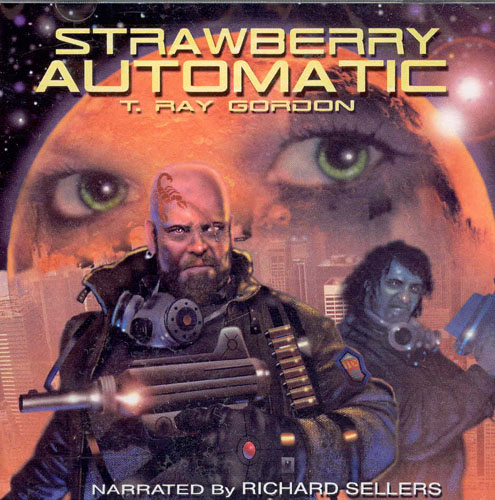
Review of Strawberry Automatic by T. Ray Gordon

Science Fiction Audiobook Review

Science Fiction Audiobook - Strawberry Automatic by T. Ray GordonStrawberry Automatic
By T. Ray Gordon, Full Cast Production by Richard Sellers
1 CD – 78 Minutes [UNABRIDGED]
Publisher: Apex Audio Theatre
Published: 2005
Themes: / Science Fiction / Androids / Terraforming Mars /

The Automatics are androids, and trained fighting machines. When they fought for their own rights, they were, of course, declared non-personal non grata and the ones that could left Earth for other parts of the Solar System colonies. Strawberry Automatic is tall with flaming red hair, beautiful and deadly as they come. On Mars there is a company running the terraforming operation. Naturally someone wants to speed up the process using illegal nukes, and someone else wants to stop them.

I say “of course” and “naturally” because as I listened to this CD I had no trouble keeping slightly ahead of the story line. I kept thinking “This is a 1950s sci-fi story.” On his CD sales website, producer and narrator Richard Sellers says that T. Ray Gordon wrote 72 original manuscripts during the 1950s, which have never been published until now. So I was right. And as seems to be the cliché with pulp and radio writers, he was alcoholic and killed himself in 1961.

As a story Strawberry Automatic is a fairly good sci-fi adventure. As a script it relies too much on narration, some of which could have been written into dialogue or eliminated to keep the story moving faster. This might have made the script longer, though, and it appears they had decided to keep it to one CD. The production values are high, as the producer works as a voiceover artist and knows his trade. He also narrates the story. The acting is quite good, and it shows that Sellers knows his community of good performers. They just need someone to help them develop the script a bit before moving on.

The production values and the fact that it was not a story that had ever been produced before garnered it an Honorable Mention for the 10th Annual Mark Time Awards for Science Fiction Audio this year. Click here for more info.

The first of Gordon’s stories made for audio by Apex Audio Theatre, Inhumanity Quest, was also produced by Richard Sellers, and it shares many of the qualities mentioned here regarding the story, the production quality, and the performances.

I liked the production a little better the second time I heard it, as I could listen a bit more critically. It is well done. But I don’t know if I could listen to 72 of this kind of tale.

UK Radio Programme Welcome To Mars available as a podcast

Online Audio

Welcome To Mars (1947-1959)Welcome To Mars (1947-1959) is a fascinating collection of non-fiction oddments about the fantastic futuristic world of the fifties. Presenter Ken Hollings in a live twelve-part series reflects on the “fantasy of science” in the early years of the American Century.

“Between 1947 and 1959, the future was written about, discussed and analysed with such confidence that it became a tangible presence. This is a story of weird science, strange events and even stranger beliefs, set in an age when the possibilities for human development seemed almost limitless.”

The show is broadcast live on Wednesdays at 3.30pm GMT on Resonance FM (104.4 FM) in the UK and podcast to the world via XML feed:

http://www.simonsound.co.uk/podcasts/marspodcast.xml

Episodes released so far:

Part 1: 1947: Rebuilding Lemuria |MP3|
Part 2: 1948-49: Flying Saucers over America |MP3|
Part 3: 1950: Cheapness and Splendour |MP3|
Part 4: 1951: Absolute Elsewhere |MP3|
Part 5: 1952: Red Planet |MP3|
Part 6: 1953: Other Tongues, Other Flesh |MP3|
Part 7: 1954: Meet The Monsters |MP3|
Part 8:
Part 9:
Part 10:
Part 11:
Part 12:

posted by Jesse Willis

Review of Caedmon’s Science Fiction Soundbook

SFFaudio Review

Science Fiction Audiobook - Caedmon Science Fiction SoundbookScience Fiction Soundbook
By Ray Bradbury, Isaac Asimov, and Robert A. Heinlein
Read By Leonard Nimoy and William Shatner
4 hours – 4 Cassettes [UNABRIDGED]
Publisher: Caedmon
Published: 1977
Themes: / Science Fiction / Mars / Edgar Allan Poe / Computers / Mathematics / Sociology / Space Travel /

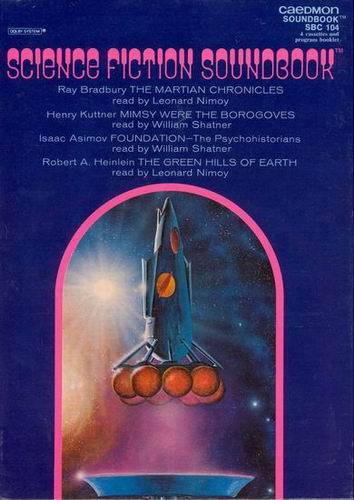
This out-of-print Caedmon set was a wonderful find (thanks, Esther!) because it contains two cassettes (four stories) that are amongst the earliest science fiction audio I ever heard. The stories are “The Green Hills of Earth” and “Gentlemen, Be Seated” by Robert A. Heinlein, and “There Come Soft Rains” and “Usher II” by Ray Bradbury, all read by Leonard Nimoy. Also included here is “The Psychohistorians” by Isaac Asimov and “Mimsy Are the Borogroves” by Henry Kuttner, both read by William Shatner. The audio was originally published in 1977.

I found Leonard Nimoy’s readings to be excellent. In Bradbury’s “Usher II”, he delivers a passionate speech about the evils of book burning with perfection. In “Gentlemen, Be Seated” and “The Green Hills of Earth” he portrays working class spacemen with complete success.

William Shatner, though, was disappointing. I’ve heard him read some Star Trek titles, and felt his delivery was pretty good, but here, on both cassettes, he reads as if he needs to be across town in fifteen minutes. He zips through the text, sometimes fast enough to affect my comprehension.

The stories are all bona-fide 5-star classics:

“There Will Come Soft Rains” by Ray Bradbury, read by Leonard Nimoy
This famous story is about a house. That’s it, just a house. An automatic, programmed house that keeps running and running… but where are its inhabitants? Bradbury manages to tell a very human tale without any actual people.

“Usher II” by Ray Bradbury, read by Leonard Nimoy
A fantastic story, passionately read, about a man who builds Poe’s House of Usher on Mars. Because of the social climate on Earth, it would be illegal to build such a fantastic structure, because stories of fantasy are simply no longer allowed. If you agree with that policy, this fellow would be happy to show you around, and he does get that opportunity. As I mentioned earlier, a highlight is a speech on censorship that was an obvious precursor to Bradbury’s Fahrenheit 451.

“The Psychohistorians” by Isaac Asimov, read by William Shatner
This is the first novelette in the first book of Asimov’s Foundation trilogy. In it, you meet Hari Seldon and Gaal Dornick in an introduction to some of the key elements of the Foundation story, including the Empire in decline and the mathematics of psychohistory. However, I did have difficulty get into Shatner’s narration.

“The Green Hills of Earth” by Robert A. Heinlein, read by Leonard Nimoy
Rhysling is a Spacer who lost his eyesight in a reactor pile accident. Now, he’s a famous bard, and this is his story. The story is an excellent portrayal of what spaceflight might be like from the working stiff’s point of view, once flight becomes common. At least from the perspective of a science fiction writer in 1948. No NASA engineers here.

“Gentlemen, Be Seated” by Robert A. Heinlein, read by Leonard Nimoy
This story is similar to “Green Hills” in that the characters are working class spacemen. One agrees to take a reporter through some new buildings on the moon (yes, he does get overtime pay for it), but an accident occurs during the tour. Another story from the late 1940’s, which is the part of Heinlein’s long career that I enjoy most.

“Mimsy Were the Borogroves” by Henry Kuttner, read by William Shatner
This story fared better under Shatner’s cadence than did “The Psychohistorians”. I was captured by it within 5 minutes or so of concentrated listening, and Kuttner’s story held my attention even when Shatner didn’t. The story involves some toys that were sent back in time by a far-future scientist with too much time on his hands. The toys are found by some kids, who play with them, and are changed by them. The story plays with the ideas of how people think – how kids think, how adults think, and how it could possibly be different. I found it a well-written and entertaining exploration of these ideas. Great science fiction.

Posted by Scott D. Danielson

Review of A Princess of Mars by Edgar Rice Burroughs

SFFaudio Review

Science Fiction Audiobook - A Princess of Mars by Edgar Rice BurroughsA Princess of Mars
By Edgar Rice Burroughs; Read by John Bolen
6 CD’s – 6 hours – [UNABRIDGED]
Publisher: Tantor Media
Published: 2001
ISBN: 1400100186
Themes: / Science Fiction / Mars / Aliens / Swordplay / Classic /

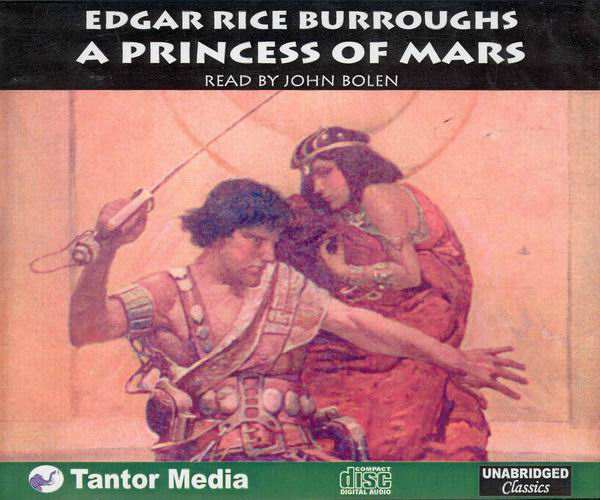
There are few classic novels with as much influence as Edgar Rice Burroughs’ A Princess of Mars. First published in 1912 (serialized in All-Story magazine with the title Under the Moons of Mars), Burroughs sparked the imagination of many of science fiction’s golden age writers, including Ray Bradbury and his Martian Chronicles. The audiobook cover is a detail from the 1919 Grosset & Dunlap cover.

A Princess of Mars is an imaginative adventure novel in which John Carter, a Virginian military man who starts the story running from Indians in the Arizona desert, is magically transported to Mars. Burroughs does not go into detail on the mechanics of the transportation, but does go into great detail about the inhabitants of Mars, called “Barsoom” by its natives.

There are two races on Mars – a four-armed green warrior race, and a red human-like race. The princess of the title is Dejah Thoris of Helium, whose beauty captures John Carter when he sees her taken by him in chains by some four-armed Barsoomians.

The novel is filled with damsel-in-distress/derring-do-male-hero sensibility that is laughable at times, but still the story holds up as a classic of the genre. Burroughs’ description of an alien culture is a forerunner of an entire category of science fiction, and I found it entertaining on that level. I also felt a great deal of nostalgia, because I read this book a few times as a early teen, along with the other ten Mars volumes, and a Tarzan or three.

John Bolen performs the whole book as John Carter, with a southern gentlemanly manner that the character demands. This means not only Carter’s attitude, but his southern accent, which took me a few minutes to settle into.

Check out Tantor’s science fiction and fantasy section for more Edgar Rice Burroughs titles.

Posted by Scott D. Danielson

***NOTE*** Because of the CBC strike, these links …

SFFaudio Online Audio

***NOTE***
Because of the CBC strike, these links aren’t working. Sorry! I’ll post an update when things are cleared up. –sd

Quirks And Quarks, CBC Radio’s excellent and long running Saturday afternoon science program is not only a great source of science news – it’s also a great Science Fiction resource! The show’s host, Bob McDonald, has even narrated an SF novel and is obviously a fan of both science and Science Fiction.

Every week, the program presents the people behind the latest discoveries in the physical and natural sciences, from the smallest sub-atomic particle to the largest objects in the sky and everything in between. The program also examines the political, social, environmental and ethical implications of new developments in science and technology. And now Quirks And Quarks has also got into podcasting too! Show segments are available in MP3 format for FREE!

Here’s a list of links to show segments that deal with
Science Fiction concepts:

Multiple Worlds & Parallel Universes (April 16, 2005)
LINK: http://www.cbc.ca/quirks/media/2004-2005/mp3/qq-2005-04-16a.mp3

Telepathy (November 20, 2004)
LINK: http://www.cbc.ca/quirks/media/2004-2005/mp3/qq-2004-11-20a.mp3

First Contact (March 9, 2002)
With SF writer Robert J. Sawyer
LINK to Part 1:
http://www.cbc.ca/quirks/archives/01-02/mp3/qq090302a.mp3

LINK to Part 2:
http://www.cbc.ca/quirks/archives/01-02/mp3/qq090302b.mp3

Settling The Stars (February 23, 2002)
With SF writers Joe Haldeman, Charles Sheffield and
Geoffrey Landis
LINK: http://www.cbc.ca/quirks/archives/01-02/mp3/qq230202a.mp3

Terraforming Mars (May 12, 2001)
LINK: http://www.cbc.ca/quirks/archives/00-01/mp3/qq120501a.mp3

Review of The Rolling Stones by Robert A. Heinlein

Science Fiction Audiobooks - The Rolling Stones by Robert A. HeinleinThe Rolling Stones
By Robert A. Heinlein; Performed By A Full Cast
8 CDs – 7 Hours 9 Minutes [UNABRIDGED]
Publisher: Full Cast Audio
Published: 2005
ISBN: 1932076808
Themes: / Science Fiction / Young Adult / Space Travel / Newtonian Physics / The Moon / Mars / The Asteroid Belt /

When the Stone twins made up their minds to leave Luna City in a secondhand spaceship, they hadn’t planned on having their whole family accompany them. But the Stones are not your ordinary Lunar family – no way! – and their voyage through the solar system sure proves it.

Not long ago FULL CAST AUDIO contacted us, and gave us a heads-up – a new Robert A. Heinlein novel was coming. I was blown away by their first Heinlein adaptation so I tried to keep my expectations reasonable. “Lightning can’t strike twice”, I told myself. “Just be happy that it is being released. That’s what you asked for and that’s what you got. Don’t be disappointed if it doesn’t live up to your expectations.” I needn’t have worried. The Rolling Stones is as good as the superb full cast reading of Have Space Suit, Will Travel – maybe even a little better!

It is a Heinlein juvenile, written and first published in 1952, full of Heinleinian economics, politics, and family values, which all combine with a travelogue of interplanetary adventure. Dialogue moves the surprisingly light plot along, and the narrator provides the cultural and technological backdrop.

The Stone family is made up of father Roger, mother Edith, grandmother Hazel, the eldest child Meade, the youngest Buster, and the middle identical twins Castor and Pollux. The twins are natural born inventors and entrepreneurs, so when they go looking through the used spaceship yards on Luna they’ve got a scheme in mind. When Roger finds out about their plans he manages to turn the whole thing into a family venture. And off they go into the solar system.

If you like Heinlein you’ll love this novel but it’s a little different from most juvies in that it is more a series of smaller adventures. What I like best about the book is that it ably envisions a wonderful future of interplanetary travel in a completely scientifically accurate way. The economic model that would allow a family to buy a spaceship, fuel it and use it as their personal yacht may be unrealistic, but that won’t dampen your enthusiasm. It didn’t mine.

Most of the actors are new but Bill Molesky is back playing another father and Cynthia Bishop plays another mother figure. Peter Moller plays another small role, and FULL CAST AUDIO founder Bruce Coville makes another cameo too. Another plus – Daniel Bostick again directs. If I had my druthers, Daniel Bostick will direct all the future FULL CAST AUDIO Heinlein releases too (on the principle you don’t mess with success). The new actors are all perfect in their roles. There isn’t a false performance in the bunch.

A potential stumbling block was avoided. This is a third person perspective novel, as opposed to the first person of Have Space, Suit Will Travel, so they needed a narrator. Veteran voice over actor David Baker took the reins there and together with this full cast read another faithful adaptation of a Heinlein “juvenile” novel.

What’s really interesting though is that this is a straight reading with multiple readers, something I didn’t fully realize in Have Space Suit, Will Travel. There are no sound effects. There are just actors reading the text and a little accenting music at chapter openings. This was another excellent choice, a straight reading works well. You don’t need to paint in sound effects when the words evoke a mental image.

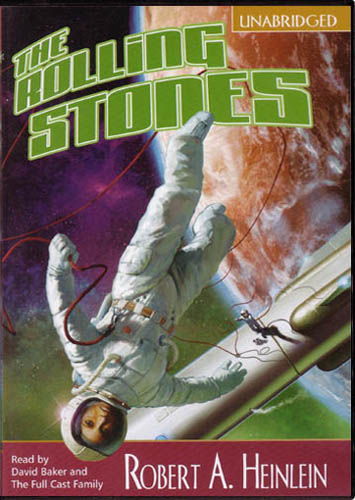
As is becoming the rule, the attention to detail found in the audio production extends to the fit and finish of the packaging. Jerry Russel’s original cover art is absolutely beautiful to behold. The CD case is the identical design to the Have Spacesuit, Will Travel case. A thick DVD style case, with the CDs stacked and secured by two plastic clamps. Perfect! Please FULL CAST AUDIO keep recording these Heinlein juvenile novels. I’d like to say I deserve it, but even if I don’t the novels sure do!

Posted by Jesse Willis