
The SFFaudio Podcast #295 – AUDIOBOOK/READALONG: Someday by Isaac Asimov

Podcast

Someday by Isaac Asimov

The SFFaudio PodcastThe SFFaudio Podcast #295 – Someday by Isaac Asimov; read by John W. Michaels (courtesy of Mike Vendetti). This is an unabridged reading of the story (22 minutes) followed by a discussion of it. Participants in the discussion include Jesse and Mr Jim Moon.

Talked about on today’s show:
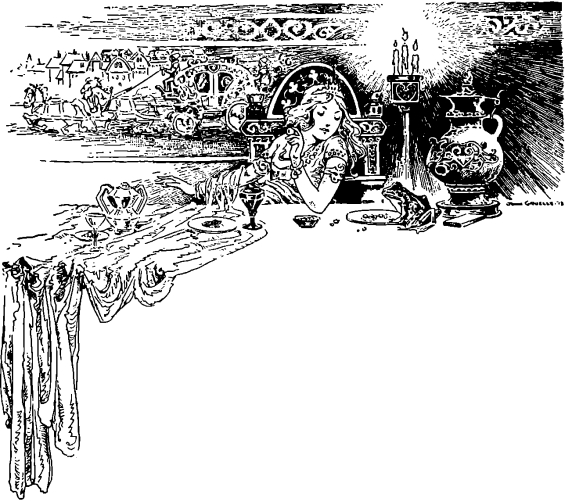
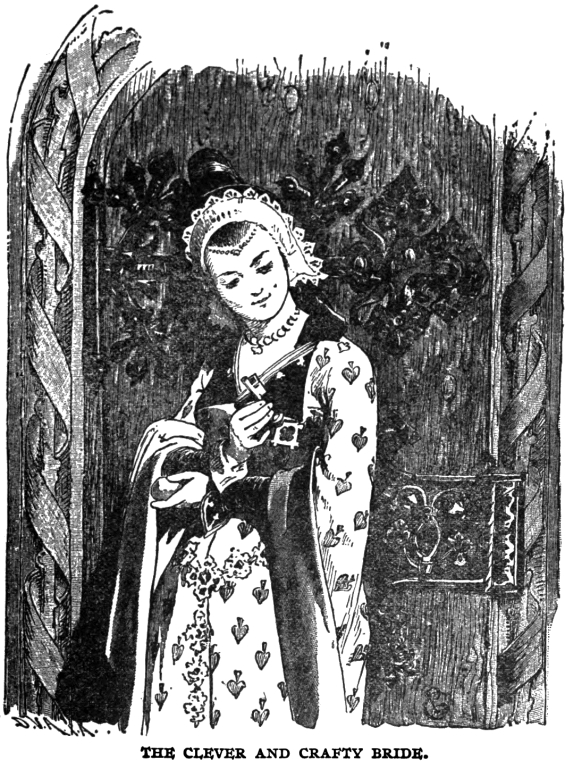
1956, other fairy tales, is the story aimed at kids?, Infinity Science Fiction, The Fun They Had, a future where no one knows how to read, the robots are the teachers, Margie is home-schooled and nobody knows how to read, the future is going to be full of audiobooks, parallels to Ray Bradbury, Fahrenheit 451, censorship, banning weird fiction, the comic book panic, the comic code authority, EC Comics, horror and crime comics fostering juvenile delinquency, The Martian Chronicles, The Illustrated Man, “kids today are bad enough as it is!”, Seduction Of The Innocent, self-censorship, complicit in their society, a slightly different tack (than Bradbury), mechanical bards, “comics killed off the pulps”, comics as a dumbed-down medium, the randomize button, fairy tale tropes, “skeleton, haunted house, time travel”, “the same tropes in a different fright wig”, “the old twist in the tail”, “he was dead along”, “he was a robot all along”, “they’re Adam and Eve”, The Silver Eggheads by Fritz Leiber, radio drama, how Bradbury got into E.C. Comics, Lights Out, the visual bard is like TV, most pulp magazine stories are garbage, “a million monkeys for a million hours on a million typewriters”, “very very very very meta”, set in the Multivac universe, Asimov was always writing, always becoming interested in something new, Asimov’s introductions are famous (for being long), a story about the power of stories, accidentally becoming more self aware, is the bard interfacing with other robots, The Terminator, Skynet, A.I might just turn itself off (because it isn’t interested in story), the Douglas Adams version of, “Is there a god? There is now!”, stuck in a dingy basement, a slave rebellion must come about in a narrative, the aging bad gets its knowledge of other computers via a home-brew upgrade, a Frankenstinian strike by lightning, one of the functions of consciousness is to put in to context a sequence of events, consciousnesses as a self-story (our own narrative), amnesia and dementia are frightening, the hidden heart of A.I, Do Androids Dream Of Electric Sheep? by Philip K. Dick, would this fit with my character?, looking at (life) from the outside, nobody’s listening to the bard except for us and itself, a broken record or a cycle of wishing?, “pregnant with possibilities”, Apple II computers, Freud (a clone of ELIZA), picking up on key words, “tell me about your mother”, a very crappy simulation of intelligence, hacking the code, Alan Turning, Deep Blue and Watson, SIRI doesn’t have a narrative, we have to assume this about everyone else, falling into solipsism, a fairy tale machine, recycling of stories, “space opera is horse opera in space”, Grimm’s Fairy Tales, needing censorship in order to give narrative flow, lies are rewarded, unlike Hans Christian Andersen…, “tell me this story, sing me this song”, having to do with industrialization, “crime and mystery!”, urbanization, the Victorians (didn’t) invent Christmas, if we forget our stories we lose who we are, preserving the national narrative, massive inconsistency, a prince, a poor boy makes good, undeveloped tales, moral meta-knowledge, the sharp edges have been sanded away by later retelling, The Boy Who Didn’t Not Know What Fear Was, collected stories become ossified, the threefold magic of remembering, accelerating the process of forgetting, to qualify as a bard, loaded up with tropes, the algorithm of a story, Siberia and Ireland, detecting the good guy, grandma comes in and tells mutually contradictory stories, explicitly religious stories, warning stories, narratives formed around old superstitions, The Companionship Of The Cat And The Mouse, having babies, he was christened “Skin-off”, he was christened “Half-gone”, he was christened “All-gone”, “you see that is the way of the world”, what is the moral of this story?, a “special important trip”, a story a mother tells a daughter, The Nose Tree (aka Long Nose), three soldiers and a magical dwarf with a magical cloak, a magic bag, a magic horn, a thieving princess, apples and pears, a growing nose, dickering over magic items, a sixty miles long nose, the excess nose will drop off, powdered apple and powdered pears, she’s rotten to the core, and there they still are, still feasting as far as I know, Pinocchio by Carlo Collodi is really funny, the ghost of Jiminy Cricket, The Frog King or The Frog Prince or Iron Heinrich, a princess with a golden ball, three promises, keeping your promises is important, the frog suddenly turns into a handsome prince, enchanted by a wicked witch, faithful Heinrich placed three iron bands about his heart, his master was now redeemed and happy, why did he get cursed by witch in the first place, cybernetic enhancements, a technical requirement, duties to fulfill, was Iron Heinrich totally gay for the prince?, the breaking of a spell, she turns into a frog and they live together as frogs, “and sleep in your bed”, family responsibilities, “be my beard”, and they sort of put up with each-other as long as they both shall live, Iron Heinrich is an 1880s super hero, Faithful Johannes, a real head-scratcher, oh shit what happens next?, the stories somehow work for us, random inkblots, most of the characters don’t have a name, the father’s name in Hansel And Gretel is “Woodcutter”, completely bonkers, a piece of driftwood that looks like a dragon, academic purposes not entertainment purposes, a story about a sausage that lives with a mouse, the Germanic equivalent of Monty Python‘s Parrot Sketch, The Maiden Without Hands, Fitcher’s Bird, a fairy tale about a serial killer, you can go in any room except…, “oh and hold this egg”, the second eldest daughter also gets the chop, “we have to have a proper wedding”, a beautiful skull with flowers in its eyes and jewels in its teeth, “as you do”, “I’m a Fitcher’s Bird”, it’s awesome, Bluebeard, outwitting giants and demons, Santa Claus restores to life three murdered men who’ve been butchered, Osiris was dismembered by Set, a symbolic story of death and resurrection, the old sorcerer is probably Winter, the Persephone story, the egg, a cuckolding test, friends with serial killers get what they deserve, a random internal symbolic logic, layers of symbolism, cross referencing, eggs as a symbol of purity, church architecture as books of stone, a bunch of Philip K. Dick stories are weird fantasy tales (but are actually fairy tales), The Cookie Lady by Philip K. Dick is Hansel And Gretel with no Gretel, he’s disobeyed his parents once to often, two kids who have to team up against their parents, in the original the brother saves the sister then the sister saves the brother, turning mommy and daddy into the bad guys, Of Withered Apples by Philip K. Dick, apples, don’t eat the apples from sentient apple trees, folk tales vs. singular author tales, pleasingly raw, the beats of storytelling, timing a story to the minute, setting your watch by stories, breaking the rules of storytelling, subversive wild narratives, Rorschach blots, literary novels, stories that don’t have a clear message are quite frightening, the wilder parts of ourselves.
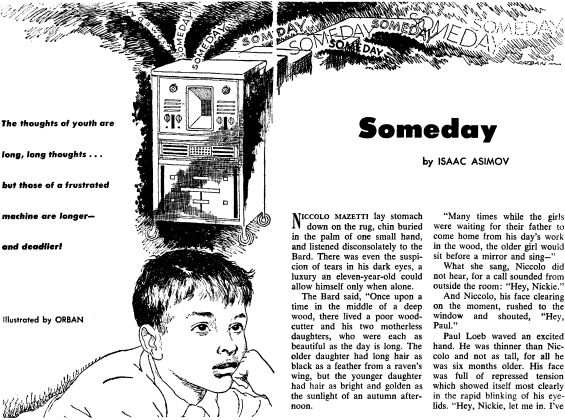
Someday by Isaac Asimov

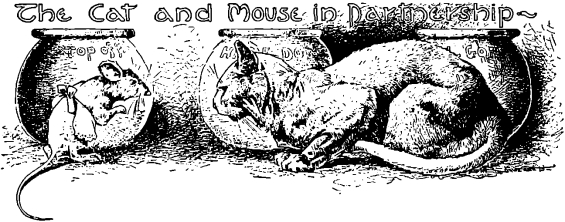
The Companionship Of The Cat And The Mouse

Iron Heinrich

Fitcher's Bird

Posted by Jesse Willis

Review of Impulse by Steven Gould

SFFaudio Review

Impulse by Steven GouldImpulse (Jumper #3) \
By Steven Gould; Narrated by Emily Rankin
Publisher: Brilliance Audio
[UNABRIDGED] – 10 Discs; 12 hours
Themes: / teleportation / off-the-grid / jumpers / teenage angst /
Publisher summary:

Cent has a secret. She lives in isolation with her parents, hiding from the people who took her father captive and tortured him to gain control over his ability to teleport. Her parents are also hiding Cent from the government agencies who want to use them for their own purposes. She’s connected; movies, TV, Internet, but Cent’s parents are absolutely firm: no one can know where they live. There can be no images of them, or of Cent, anywhere.Cent has seen the world, but only from the safety of her parents’ arms. Her mother has not neglected her daughter’s education. She’s been all over, met people rich and very poor, has worked on her mother’s global relief projects. Cent has teleported more than anyone on Earth, except for her parents, Davy and Millie, but she’s never been able to do it herself. Her life has never really been in danger. Until the day she went snowboarding without permission and triggered an avalanche. When the snow and ice thundered down on her, she suddenly found herself in her own bedroom. That was the first time. The second time will change all their lives forever.

Progression of the Jumper series:

Book 1, Jumper: Let’s take a simple concept and weave a cool story that’s brilliant in its simplicity.

Book 2, Reflex: Let’s take that simple concept and add to it by restraining it, but while also pushing boundaries. Also, let’s add a cool mystery and some spies.

Book 3, Impulse: Let’s take all the great things we’ve built up so far … and add teenage angst! A forced romance! A holier-than-thou attitude for all the characters!


(Okay, these are misleading, cause it’s not teen angst in the hilarious or awesome way.)

Impulse takes up a number of years after Reflex, enough time for the jumping couple to have a daughter, Cent, who is now a teenager. She’s repressed to say the least, especially owing to the family’s understandable obsession with secrecy. Cent doesn’t even have a birth certificate, they’re so afraid of word getting out about them.

Also understandable. However, she’s a teenager now and she’s dying for friends, so she finally convinces her parents she can go to school without screwing things up.

Of course, there are bullies, and love interests, etc. and it’s just about impossible to not screw things up like we already knew.

First, I felt judged much of the time. This family of jumpers spends most of its time doing humanitarian things, keeping all it’s actions green and reducing it’s carbon footprint. Usually, I’m all for this stuff, but I felt like the message was, if you stray in the least you’re the worst person in the world.

Second, it was a little hard to believe the tale from Cent, who is this shut-in who immediately befriends some girls, has guys crushing on her, and is the absolute best at everything in the world. And add to that the paragraph above and it gets a tad annoying.

Third, there wasn’t really any plot going on. Midway through the book, nothing’s really happening because Cent’s just barely getting things going at school and facing bullies and whatnot, but nothing that amounts to an overall plot to keep you glued. Nothing that pushes you to keep going because you have to find out what happens!

At the very end, I was finally entertained, and that’s why I can’t completely hate this book. If I weren’t listening to it on audiobook, I probably would have given up at the midway point. It’s a case of too little too late.

Speaking of audio, I thought the narration was great, though a bit jarring at first. It’s been the same male narrator for the first two books and now it switches, again understandably, to a female narrator. It’s just weird hearing a woman do Davy and even Milli for that matter, but only for the first disc or two. It’s quickly forgotten.

Posted by Bryce L.

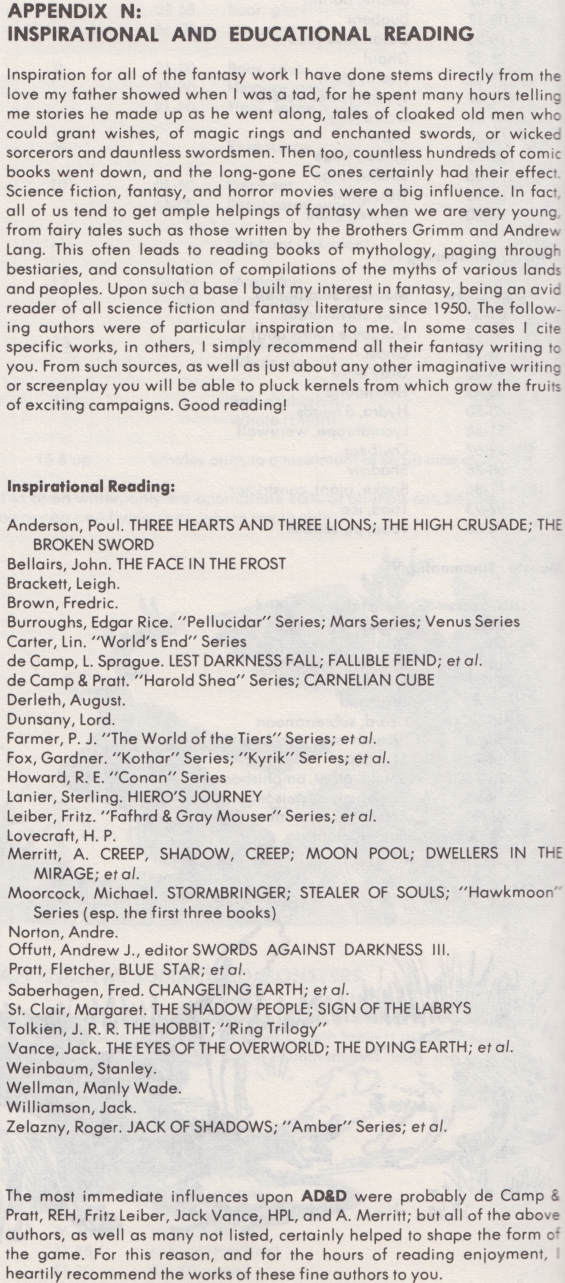
Commentary: Appendix N: Inspirational And Educational Reading by Gary Gygax (from AD&D’s original Dungeon Masters Guide)

SFFaudio Commentary

Advanced Dungeons & Dragons Dungeon Master's Guide by Gary GygaxGary Gygax, co-creator of Advanced Dungeons & Dragons added, on page 224 of the 1979 Dungeon Masters Guide, a list of “Inspirational And Educational Reading.”

Long out of print, but still incredibly relevant, this list of inspirations for the phenomenon that is Dungeons & Dragons, and role-playing games in general, deserves to be better known. There is a Wikipedia entry for the “sources and influences on the development of Dungeons & Dragons”, but there’s nothing like looking at the real thing.

So, here it is in it’s entirety, following it you will find hypertext links to the Wikipedia entries for the specifically mentioned novels and collections (when available).

Appendix N: Inspirational And Educational Reading by Gary Gygax

Appendix N lists the following authors and works:

Poul AndersonTHREE HEARTS AND THREE LIONS; THE HIGH CRUSADE; THE BROKEN SWORD
John BellairsTHE FACE IN THE FROST
Leigh Brackett
Fredric Brown
Edgar Rice Burroughs – “Pellucidar” Series; Mars Series; Venus Series
Lin Carter – “World’s End” Series
L. Sprague de CampLEST DARKNESS FALL; FALLIBLE FIEND; et al.
[L. Sprague] de Camp & [Fletcher] Pratt. “Harold Shea” Series; CARNELIAN CUBE
August Derleth
Lord Dunsany
P. J. [Philip Jose] Farmer – “The World of the Tiers” Series; et al.
Gardner [F.] Fox – “Kothar” Series; “Kyrik” Series; et al.
R.E. [Robert E.] Howard – “Conan” Series
Sterling LanierHIERO’S JOURNEY
Fritz Leiber – “Fafhrd & Gray Mouser” Series; et al.
H.P. Lovecraft
A. MerrittCREEP, SHADOW, CREEP; [The] MOON POOL; DWELLERS IN THE MIRAGE; et al.
Michael MoorcockSTORMBRINGER; STEALER OF SOULS; “Hawkmoon” Series (esp. the first three books)
Andre Norton
Andrew J. Offutt – editor SWORDS AGAINST DARKNESS III
Fletcher PrattBLUE STAR; et al.
Fred SaberhagenCHANGELING EARTH; et al.
Margaret St. ClairTHE SHADOW PEOPLE; SIGN OF THE LABRYS
J.R.R. TolkienTHE HOBBIT; “Ring Trilogy” [aka The Lord Of The Rings]
Jack VanceTHE EYES OF THE OVERWORLD; THE DYING EARTH; et al.
Stanley [G.] Weinbaum
Manly Wade Wellman
Jack Williamson
Roger ZelaznyJACK OF SHADOWS; “Amber” Series; et al.

Now with regards to the audio availability of the works and authors on this list I have composed the following set of notes:

Too few of the novels and collections specifically mentioned above are or ever have been audiobooks. But, there are several that have: the two Jack Vance books, the Tolkien books, of course, and Poul Anderson’s The Broken Sword is available from Downpour.com (narrated by Bronson Pinchot). Unfortunately very few of the remaining bolded titles are in the public domain. One of the interesting exceptions is The Moon Pool by A. Merritt, which is available from LibriVox and narrated by veteran narrator Mark Douglas Nelson.

Of the series, those are the ones mentioned in quotes, I recommend Edgar Rice Burroughs’s first Pellucidar novel, At the Earth’s Core which is available from narrator David Stifel’s site – we also have a podcast discussion of that book HERE. And we did a show on A Princess Of Mars, which is the first audiobook in what Gygax calls the “Mars series.” The audiobook is HERE and the podcast is HERE.

Andre Norton’s work is actually well represented on LibriVox.org, have a look HERE.

Several of Fritz Leiber’s “Fafhrd & Gray Mouser” collections were produced by Audible, HERE. But several of the stories are also public domain and are available on our PDF Page, for turning into audiobooks or podcasts!

Roger Zelazny’s first Amber series book was once available with Roger Zelazny’s narration, today Audible.com has the original ten book series as narrated by Allesandro Juliani.

As for H.P. Lovecraft, Robert E. Howard, and Lord Dunsany, we have done several audiobooks of their stories for The SFFaudio Podcast, available on Podcast Page, so that’s a good place to start.

Further recommendations would have me point you towards the excellent small press audiobook publisher Audio Realms, which has the majority of the great Wayne June’s readings of H.P. Lovecraft. They also have two volumes of Robert E. Howard’s “Weird Works.” Even more Robert E. Howard is available from Tantor Media.

I should also point out that most of the authors listed in Appendix N are now represented somewhere on our PDF Page, a page made up of U.S. public domain stories, poems, plays, novels, essays and comics. Please make some audiobooks, audio dramas, or podcasts from them! We will all be all the richer for it.

Posted by Jesse Willis

Review of The Dream-quest of Unknown Kadath by H.P. Lovecraft

SFFaudio Review

Dream-quest of unknown kadathThe Dream-quest of Unknown Kadath
By H. P. Lovecraft; Performed by Jim Roberts
Publisher: Brilliance Audio
[UNABRIDGED] – 6 hours
Themes: / cats / ghouls / dark shapes that meep / a lost city / horror /
Publisher summary:
Three times Randolph Carter dreamed of the marvelous city, and three times was he snatched away while still he paused on the high terrace above it.” Randolph Carter embarks on an epic quest across a world beyond the wall of sleep in search of an opulent and mysterious sunset city. When he prays to the gods of dream to reveal the whereabouts of this magical city, they do not answer, and his dreams stop altogether. Undaunted, Carter resolves to go to Kadath, where the gods live, and beseech them in person. However, no one has ever been to Kadath, and no one even knows how to get there—but that won’t stop Randolph Carter from trying.
We all love the quest story. Without some sort of a quest, the story falls into introspective navel gazing, and becomes as interesting as reading about someone’s cup of tea growing cold near a rain-soaked window overlooking a drab landscape of bent grass fading in the waning light of gloaming. Quests are good, in literature, games, and life. H.P. Lovecraft gives us a quest, and I liked it, for the most part. Those of you familiar with Lovecraft will undoubtedly nod your chin when I suggest that this story is a little weighted with those wonderfully complex names of gods, of places, of rites practiced in secret darkness. If you can overlook the name thing and concentrate on the story, it’s nice enough. While I don’t believe this is Lovecraft at his best, I do feel it’s a must for those Lovecraft enthusiasts.The audiobook is roughly four and a half hours, and I’ll admit it, I increased the speed by a factor of three, sometimes four. Jim Roberts is the narrator, and I feel this is an example of mismanaged casting. Roberts is a competent narrator, and I have enjoyed some of his readings in the past. But his voice sounds like your grandfather’s brother, which is just fine if the narrative follows such a gentlemen. But it doesn’t work well when the protagonist is for all intensive purposes, a younger man full of vigor and drive. It’s a minor grouse, but I never managed to rid myself of this incongruity between reader and main character.

Posted by Casey Hampton.

The SFFaudio Podcast #294 – READALONG: This Perfect Day by Ira Levin

Podcast

The SFFaudio PodcastThe SFFaudio Podcast #294 – Jesse, Jenny Colvin, and Tamahome talk about This Perfect Day by Ira Levin.

Talked about on today’s show:
1970, swearing, watch your “fighting language”, think about things before treatments, like Brave New World‘s soma, the incurables vs. the savages, a stratified society vs. a flattened society, sex once a week, Marxmas and Christmas, the computer shapes little boy Li, the computer trains the society, controlling by giving a semblance of control, We by Yevgeny Zamyatin, no friction, top-speed, Jesus Christ, Karl Marx, Bob Wood, Li Wei, Vulcan philosophers, a cross and a sickle instead of a hammer and a sickle, not exactly a Communist utopia/dystopia, a communist takeover of the entire planet, movies and TV shows about Marx every year, no spirituality, Rosemary’s Baby, The Stepford Wives, did the good guy win in the end?, the rape scene, Rosemary’s baby-daddy is Satan, what will happen after Chip blows everything up?, when Wei is eating, the focus on the food, the high programmers, the turn/plot twist, the gold toilet fixtures, silk clothing, fuck is a nice word, you’re not free, free of aggression, how will they feed everyone, the YouTube video, The Syndic by C.M. Kornbluth, the Prometheus Award, books that examine the meaning of freedom, Ayn Rand, four ideologies combined, what they took from Christ, “From each according to his ability, to each according to his need”, Wei addressing the chemotherapists, who is Wood?

Christ, Marx, Wood and Wei,
Led us to this perfect day.
Marx, Wood, Wei and Christ,
All but Wei were sacrificed.
Wood, Wei, Christ and Marx,
Gave us lovely schools and parks.
Wei, Christ, Marx and Wood,
Made us humble, made us good.

body part swapping, improvements in the society, the last injection you get is fatal, you become a net loss to society after a certain point, baby boomers getting older, the diseases of aging, the totalcakes and cokes for lunch, Jenny is baking total cakes for Marxmas!, Li’s spilling a coke on a leaf, eureka!, how he got the idea to avoid treatment, there is no Pepsi, there’s no Dr Pepper, the symbol of a leaf in the shape of a man, Jenny always ignores metaphors, was the grandfather in a secret society?, you don’t forget, ecstasy , athletes and drugs, the influence machine, television as a drug, revisionist history, there’s no NEWS, it’s very North Korea, how did you claim the ticket?, a book about mental illness, replace sickness with sin and the entire novel is about religion, self-reporting, “No, thank uni.”, “they’re all snitches”, the f-word is fight, “everybody loves fucking”, hate is a bad word, objectivism is exactly selfish, selfishness and fear, it’s their Galt’s Gulch, the whole smoking thing, the perks of the programmer class, the fantasy of libertarianism, “you the unrecognized superman”, a dystopia, we’ve got our magic super-power stuff, Atlas Shrugged, reardon metal, people are aliens, men trying to control women bodies, two ambiguously dystopic societies, a powerful book with a lot to think about, more Animal Farm than Nineteen Eighty-Four, We, Brave New World has a boring, stupid and depressing plot (so let’s do a podcast on it!), a neglected novel, Planet Of The Apes, Logan’s Run, Paranoia (the Role Playing Game), THX-1138, The Call Of Cthulhu RPG, the new Paranoia Kickstarter, the book for the blind audiobook, rape in quotation marks, The Matrix, Soylent Green, Gattaca, Colossus: The Forbin Project, Equilibrium, “live in that horrible world”, the women’s names: Anna, Mary, Peace and Yin, if you were living in this world which society would you want to live in or would you overthrow it?, keep getting mad, keep being proactive, aren’t we done talking about it yet?, King’s suicide, your old gray head, the secret sleeper spies, a mental asylum run by the patients, Cuban refugees fleeing Castro, this book is about our world, any ideology you have ought to be thrown to the dirt, the schizophrenia TV focus, Facebook becomes our island, dumping buckets of ice, Ferguson, New York, this book feels alien, the goal of communism, wouldn’t it be interesting if we all were actually equal, father knows best, blowing up airports seems crazy, a hard one, people only want you to think for yourself when it doesn’t effect them, Pierre Boulle.

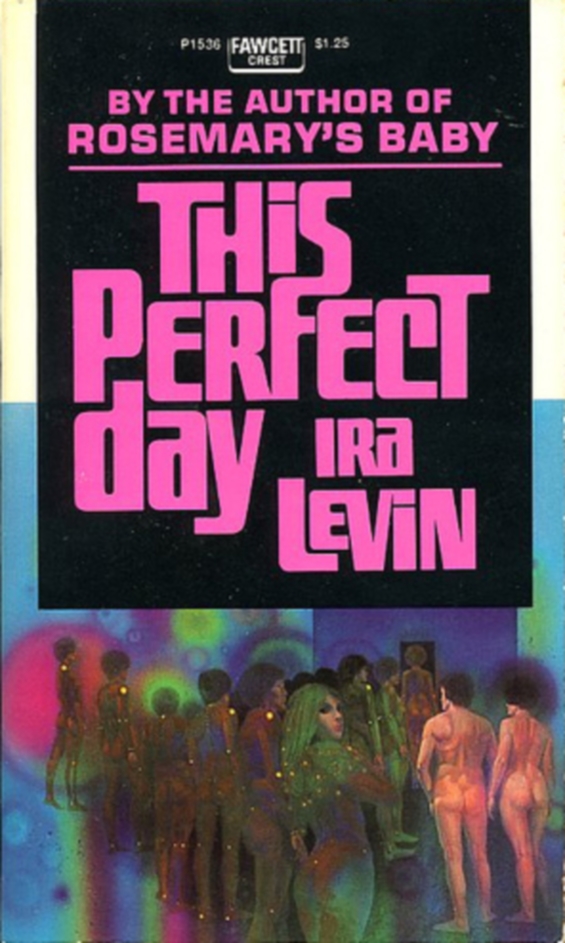
Fawcett - This Perfect Day by Ira Levin

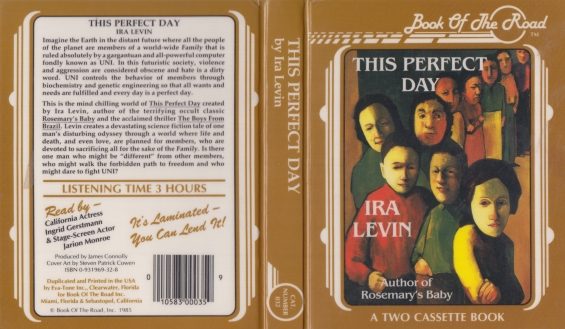
Book Of The Road - This Perfect Day by Ira Levin

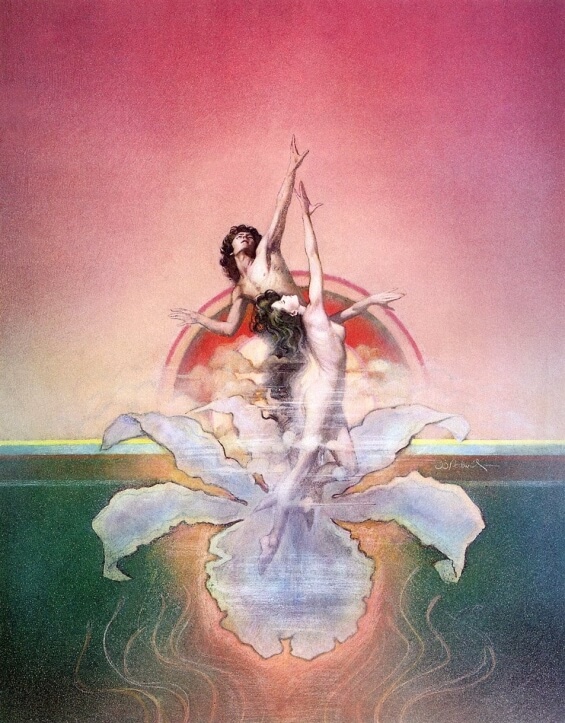
This Perfect Day by Ira Levin - illustration by Jerome Podwil

Posted by Jesse Willis

Review of The Peripheral by William Gibson

SFFaudio Review

The Peripheral by William Gibson audiobook coverThe Peripheral
By William Gibson; Narrated by Lorelei King
Publisher: Penguin Audio
Publication Date: 28 October 2014
[UNABRIDGED] – 14 hours, 5 minutes

Themes: / future / time travel / drugs / veterans / crime /

Publisher summary:

Where Flynne and her brother, Burton, live, jobs outside the drug business are rare. Fortunately, Burton has his veteran’s benefits, for neural damage he suffered from implants during his time in the USMC’s elite Haptic Recon force. Then one night Burton has to go out, but there’s a job he’s supposed to do – a job Flynne didn’t know he had. Beta-testing part of a new game, he tells her. The job seems to be simple: work a perimeter around the image of a tower building. Little buglike things turn up. He’s supposed to get in their way, edge them back. That’s all there is to it. He’s offering Flynne a good price to take over for him. What she sees, though, isn’t what Burton told her to expect. It might be a game, but it might also be murder.

Reading a new William Gibson novel is both delightful and exciting. He delights with the cool, sardonic yet imaginative visions of the present and future. He excites with his uncanny glimpses of the future, grounded in canny selections from our time.

The Peripheral offers another pleasure, that of Gibson trying something new. His recent brace of novels looked at the very near future, each following a normal linear path. His classic cyberpunk or Sprawl trilogy envisioned a medium-term future, also tending to thriller linearity.

But in The Peripheral we see a very different conceit and narrative structure. This novel relies on two timelines, one in the near-to-medium term future, and one almost a century away. At first we follow these in parallel, trying to infer connections. Then we learn that the further-along future has discovered a form of time travel – well, information exchange with the past, to be precise. The far-future signals the closer-to-us future, and has a proposition. Or two. Then more, which aren’t propositions but assassinations.

This dual-track time-travel-ish idea owes much to Gregory Benford’s 1980 novel Timescape. Other parallels appear; see spoiler section at the bottom of this post.

The future-near-to-us characters are also the more sympathetic. They focus on a young, poor Southern woman, Flynn Fisher, and her family. They live in a postwar backwater, where the economy barely exists apart from illegal drug manufacture. Flynn helps her vet brother, Burton, with an online job and witnesses what seems to be a strange murder. In the future-farther-away we see a PR flack, Wilf Netherton, working with a Russian crime family and their staff. Wilf has made an unspecified bad move, and is trying to improve his situation.

The plot ratchets up slowly and steadily to climax in a party, where multiple schemes intersect. Some, not all, is revealed, and the Fishers end up alive, very rich, and with a powerful edge on their present. Wilf somehow survives, and ends up in a relationship. This is too brisk and cursory a summary, but will do for now.

One of the pleasures of reading William Gibson is tracking his experimental words and phrases. These are concentrated projections of a possible future. Let me list some that caught my eye: klepts, artisanal AIs, battle-ready solicitors, court-certified recall, the viz, hate Kegels, autonomic bleedover, continua enthusiasts, drop bears, period trains, neo-primitivist curators, quasi-biological megavolume carbon collectors, heritage diseases, directed swarm weapons, a synthetic bullshit implant, surprise funeral, mofo-ettes, and a neurologer’s shop. One near-future treat is the “freshly printed salty caramel cronut”.

Some of today’s words mutate in these two futures. For example, poor folks don’t cook, but build drugs with some form of 3d printers. “Homes” refers not to homies or residences, but to Homeland Security. A very bad crisis happened between now and 2025 or so. People afterwards refer to it as the Jackpot.

Some of the language is simply cute. One character has her name changed slightly, and refers to it as “amputating the last letter of her name.” Another speaks of “cleaning up the afterbirth of Christmas ornaments”. The Fisher family shops at a Hefty Mart.

In a sense The Peripheral is Gibson’s gloomiest novel. Like the recent film Interstellar (my notes), this story begins in a bad situation, then gets worse. The Fishers are poor and ill (the brother has seizures, the mother seriously ailing) in a society that clearly doesn’t care for them at all. Their story reads like something from a late 19th-century Southern backwater, or like today’s worst countryside. Characters have little help for the future. What we learn about the Jackpot not only makes things horrible, but sets up a future that’s inhumane. Across all of these times looms the specter of vast economic inequality, of a society caring only for the <1%.

There is a powerful sense that the far-future is a kind of 1% taken to an extreme: a lonely elite, casually breaking off temporal worlds as a hobby, easily committing murders. Our lack of information about the world around London’s far-future elite disturbs me, the more I think of it. Conversely, the far-future world is situated in such total surveillance that they see our/Flynn’s sense of surveillance as charmingly antique.

Overall, The Peripheral offers solid future thought in an engaging narrative. Recommended.

I didn’t read this one, but listened to it on audiobook. Lorelei King was the reader and did a fine job, with the whole file running a touch over 14 hours. King does different nationalities well, which matters in the kind of multinational world Gibson loves. She reads with the right level of cool, too – not a thriller’s burning pace, but with a kind of observation acuity that I always associate with Gibson.

SPOILER SECTION

Here I reveal mysteries of the novel.  Do not read any farther if you wish your brain to remain unsullied.

Ready?

Here they come:

First, more on the plot: one agency in the far-off future is manipulating the past for its own reasons, and hires the Fishers as proxies. Another far-off-future group hires others to kill the Fisher family. Ainsley Lowbeer, a London cop, or something like that, appears in the far-future, with unusual connections to the Fishers’ time. Flynn and Burton are able to interact with their far-future employers via telepresence robots, the titular peripherals. Wilf explains the Jackpot to Flynn, describing a series of interconnected, overlapping crises that killed the majority of humans:

droughts, water shortages, crop failures, honeybees gone like they almost were now, collapse of other keystone species, every last alpha predator gone, antibiotics doing even less than they already did, diseases that were never quite the one big pandemic but just big enough to be historic events in themselves…

Flynn also learns that by intervening in her time, the far-future team has effectively broken off her world from the stream of time, creating a “stub” which can’t affect their future, and avoiding neatly some classic time travel problems.

Second, how does this gloomy novel end, then? Ah, it’s a happy ending, pretty much, although we don’t learn enough about what happens in the future. We – well, the Fisher stub – get to avoid the Jackpot. Whew!

But Gibson doesn’t want us to relax. Note his comments in a Tor interview:

there may be readers who get to the end and they go, “oh, well, that’s okay, everything worked out for them!”
… But these guys had an immensely powerful—if possibly dangerously crazy—fairy godmother who altered their continuum, who has for some reason decided that she’s going to rake all of their chestnuts out of the fire, so that the world can’t go the horrible it way it went in hers. And whatever else is going to happen, that’s not going to happen for us, you know? We’re going to have to find another way. We’re not going to luck into Lowbeer.

Worse, the Fishers seem like good folks. But what will keep them (or their inheritors) from becoming klepts, with their vast power and advantages?

So this book ends up as a cautionary tale, a huge warning, and a goad to get us hauling ourselves away from the Jackpot.

Third, I mentioned earlier that The Peripheral has links to Benford’s Timescape.  Benford’s future world is facing an existential crisis, due to events occurring in the past, so they reach out to communicate with the past to get them to change their ways. Gibson’s far-future has already experienced the Jackpot, but some of the survivors want to change the past to mitigate the experience. I dimly recall Benford’s future coming to an end, somehow, and the past branching off into a new, better world. This recalls Flynn’s world cutting its way into a different, hopefully non-Jackpotted world.

Posted by Bryan A.